






How to practise Parts 1, 2 and 3 of the oral exam in 14 days – and why, according to scientific studies, each step helps you demonstrate your actual speaking ability during the exam.
Quick Answer: How Can You Prepare for the Oral Exam in 2 Weeks?
In 14 days, you can prepare for the oral exam in exactly the same order in which it takes place: first, the introduction (Part 1), then speaking freely about a topic (Part 2), followed by a dialogue with a partner (Part 3) – and finally, a full exam rehearsal. Each stage addresses a specific problem that causes people to speak less well during the exam than they actually can. Every step is based on scientific studies investigating how exam stress can be reduced.
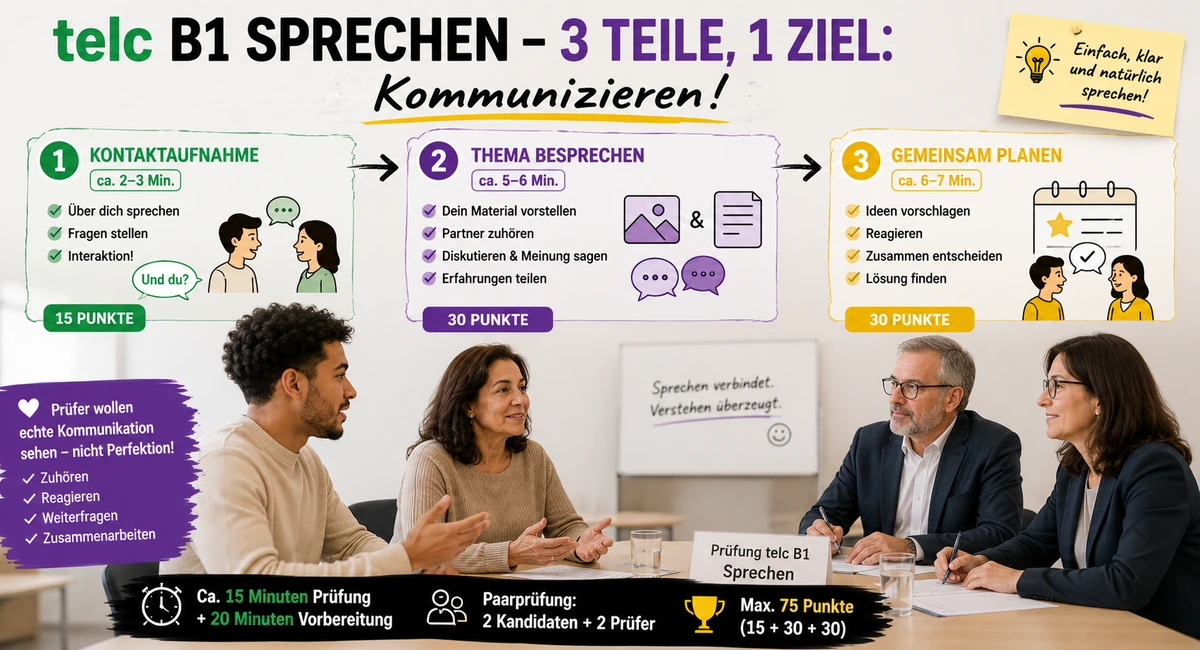
The plan is suitable for oral exams conducted in pairs at B1 and B2 levels of the Common European Framework of Reference for Languages (CEFR) – for example, DTZ B1, telc B1 or B2 Beruf. It does not replace a language course but prepares you specifically for the exam situation.
Why We Speak Less Well in the Oral Exam Than We Actually Can
When speaking, the brain performs several tasks simultaneously: it listens to the other person, searches for words, constructs sentences and thinks about what to say next. All of this relies on working memory. Worries such as “What if I cannot think of anything to say?” occupy this very same mental resource. Researchers at the University of Chicago describe it as follows: exam-related worries consume mental capacity that is actually needed to complete the task.
Two preparation principles follow from this:
- The content must already be in your mind before the exam – your introduction, ideas for different topics and useful phrases. During the exam, your brain can then focus entirely on speaking rather than searching for ideas.
- The conversation situation must become familiar. The fewer unfamiliar elements it contains, the less anxiety it causes – and the less working memory is consumed by nervousness.
Each stage of the plan supports one or both of these principles.
How the Oral Exam Is Structured – and What This Means for Your Preparation
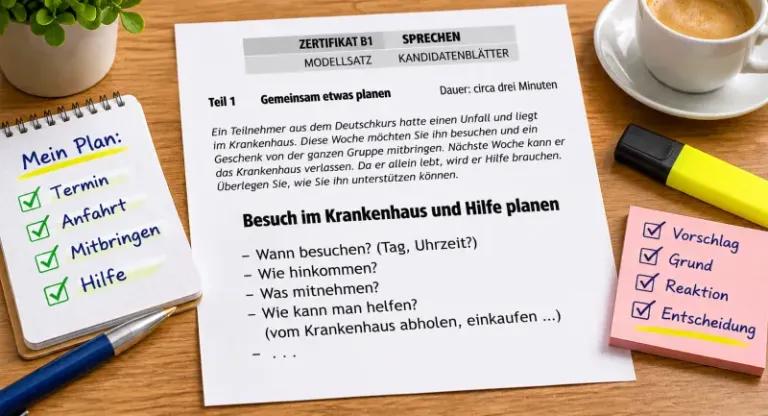
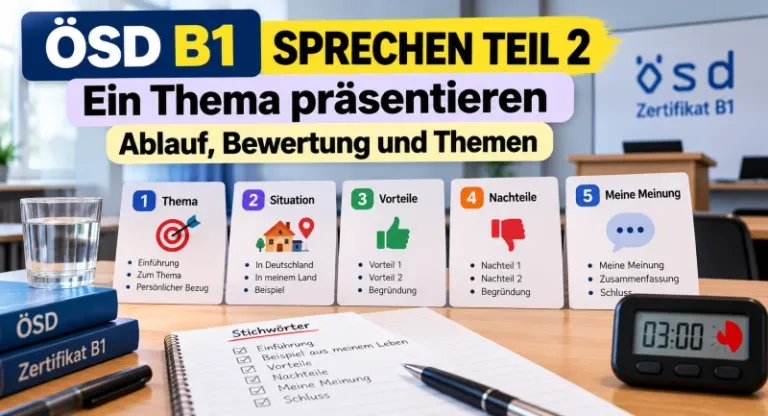
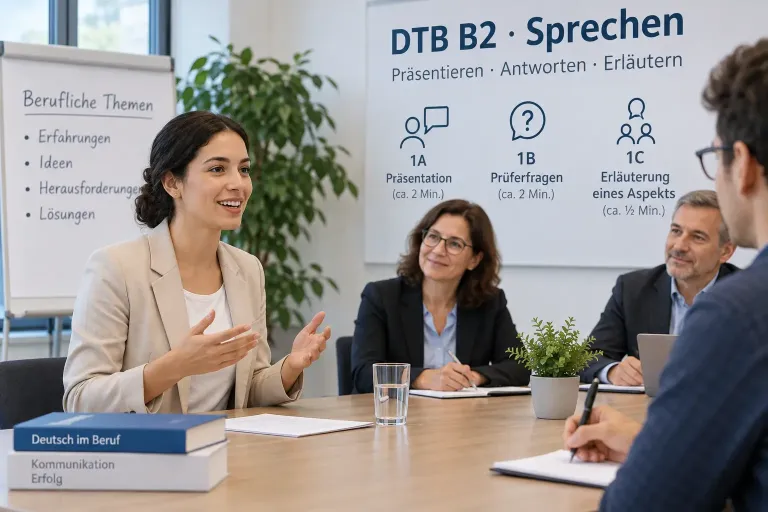
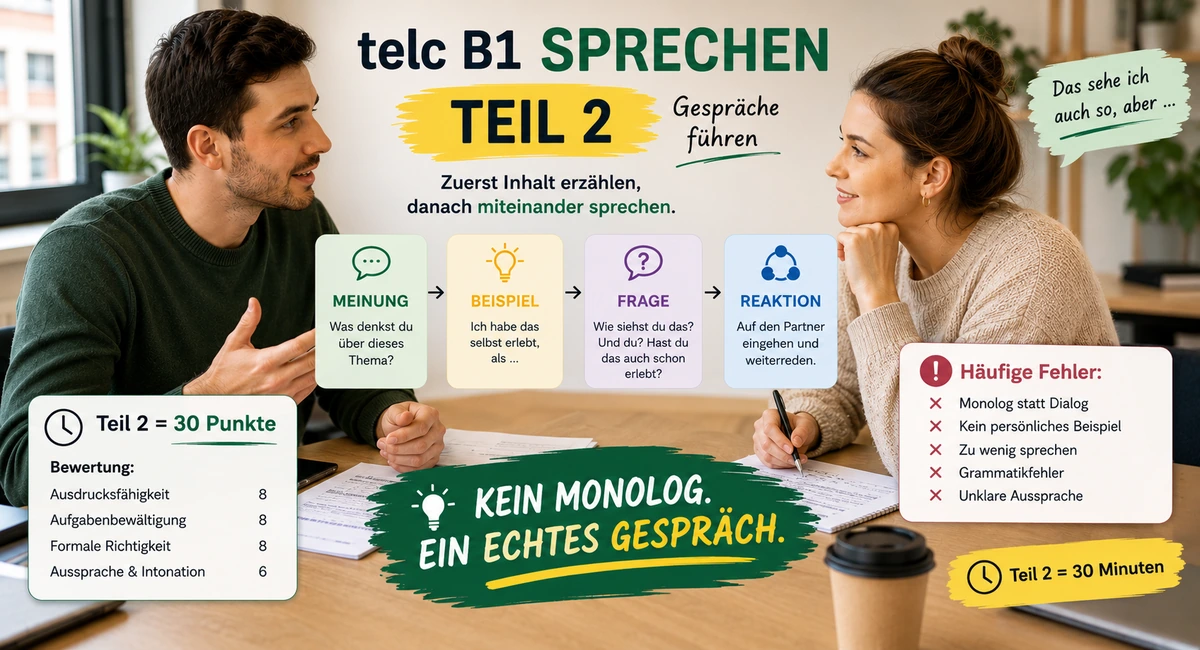
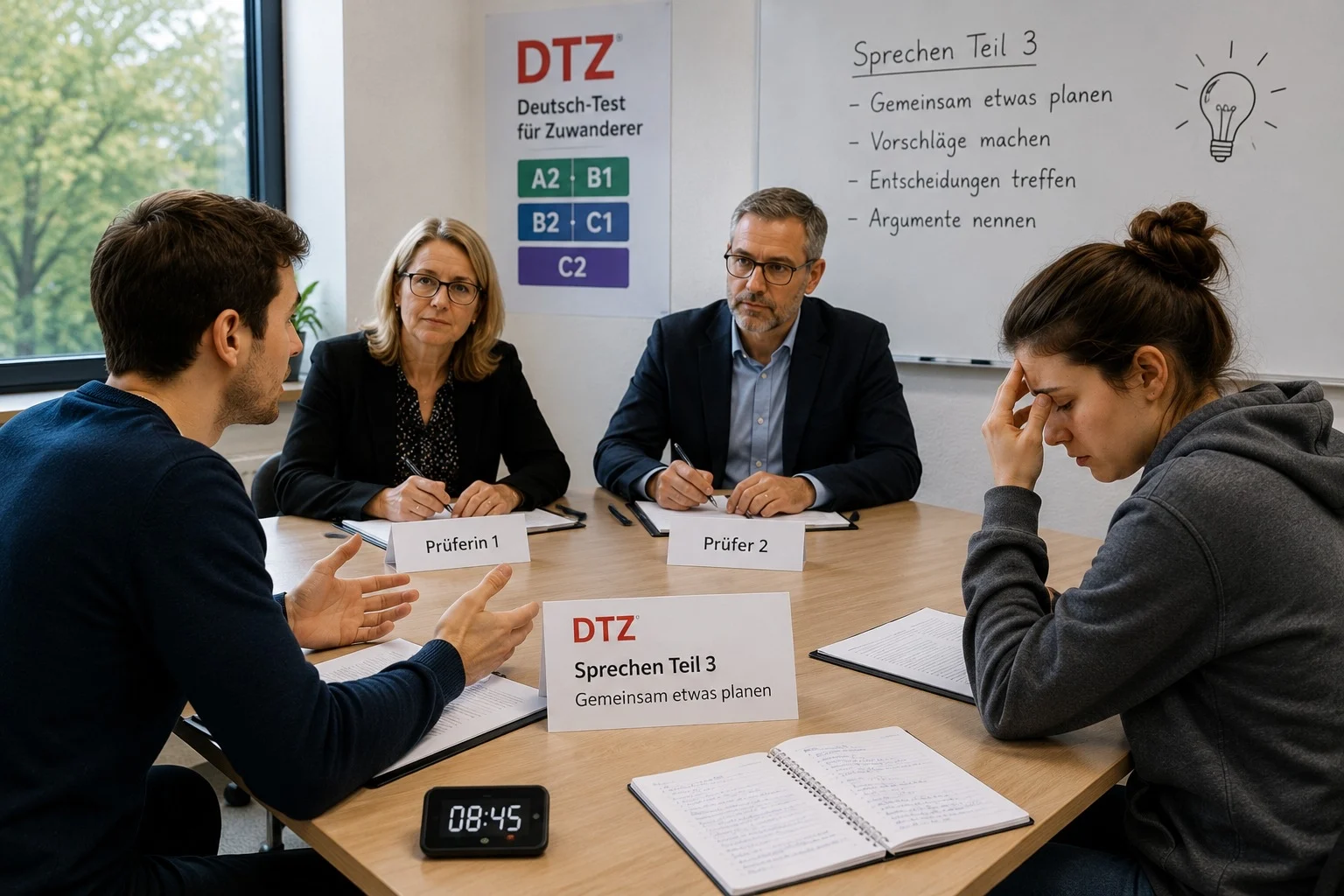
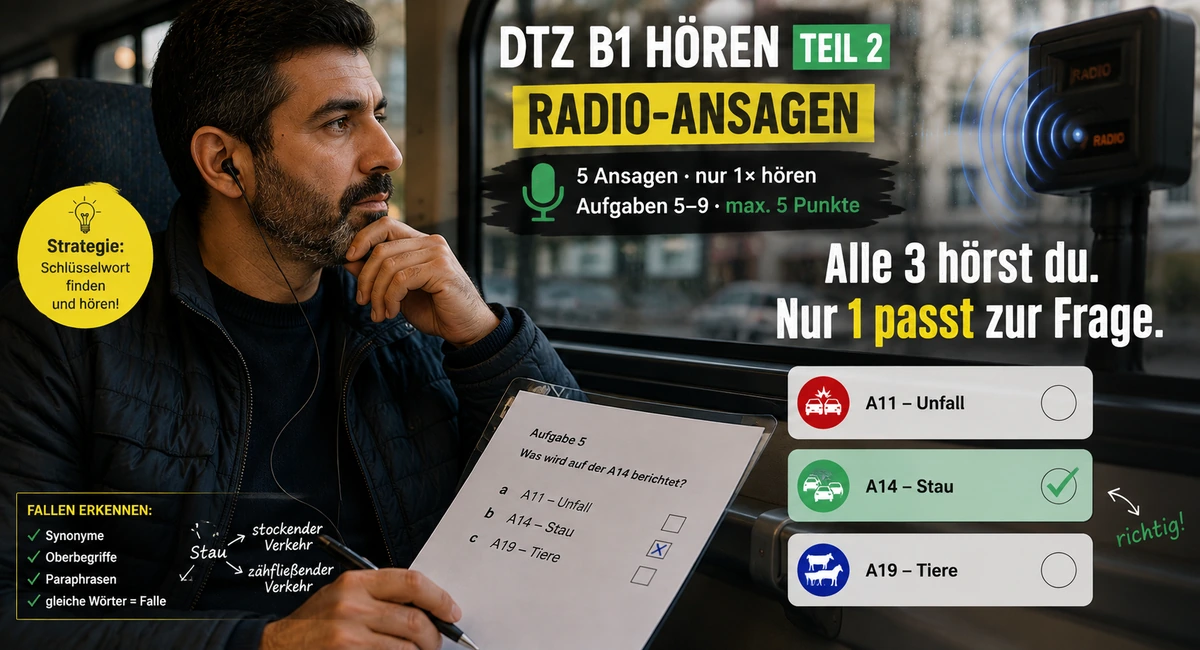
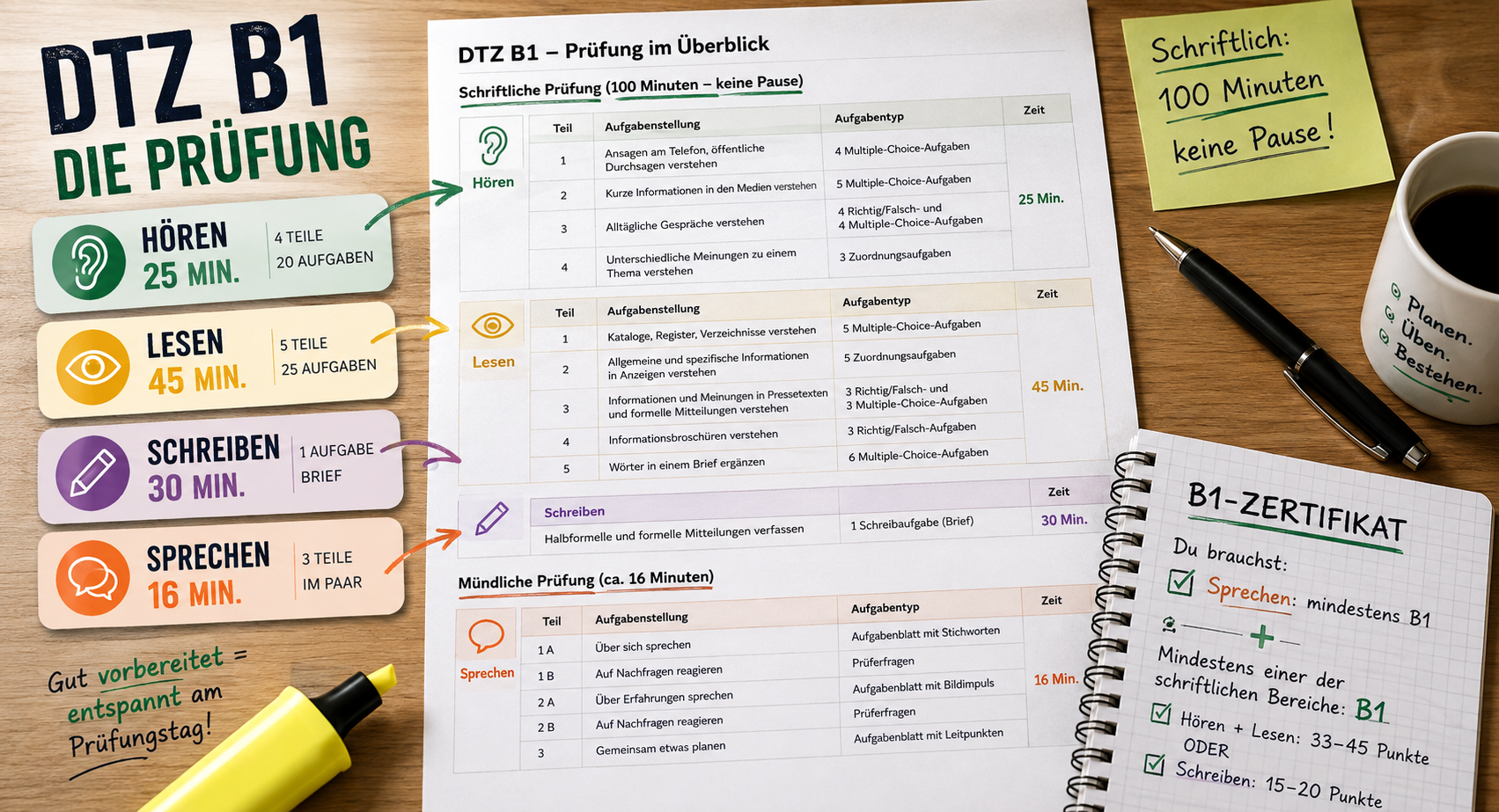
In many exams, the oral section consists of three tasks: an introduction or presentation, speaking freely about a topic and having a conversation with a partner. In the DTZ, for example, according to the official telc practice test, the parts are called: 1A “Über sich sprechen” (Talking about yourself), 1B “Auf Nachfragen reagieren” (Responding to follow-up questions), 2A “Über Erfahrungen sprechen” (Talking about experiences, using a picture as a prompt), 2B “Auf Nachfragen reagieren” (Responding to follow-up questions) and 3 “Gemeinsam etwas planen”.
This leads to an important insight: after the first and second tasks, the examiners ask follow-up questions, and your responses to these questions are assessed separately. Therefore, you need to prepare not only what you want to say but also for the questions that may arise from your answers. This is included in Stage 1 and Stage 2.
As of 21 November 2026. The structure and names of the exam sections vary depending on the exam. Always check the exact exam format in the official model test for your specific exam.
Stage 1 (Days 1–3): Make Part 1 Automatic
Step 1: Use an Example from the Platform as a Starting Point
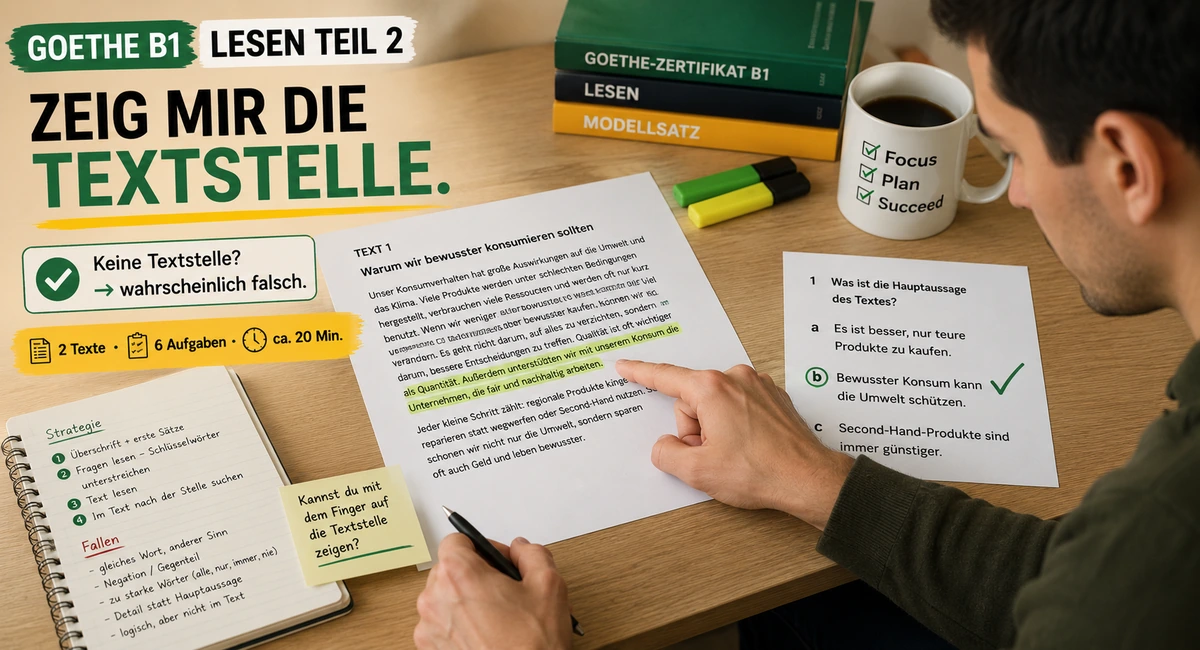
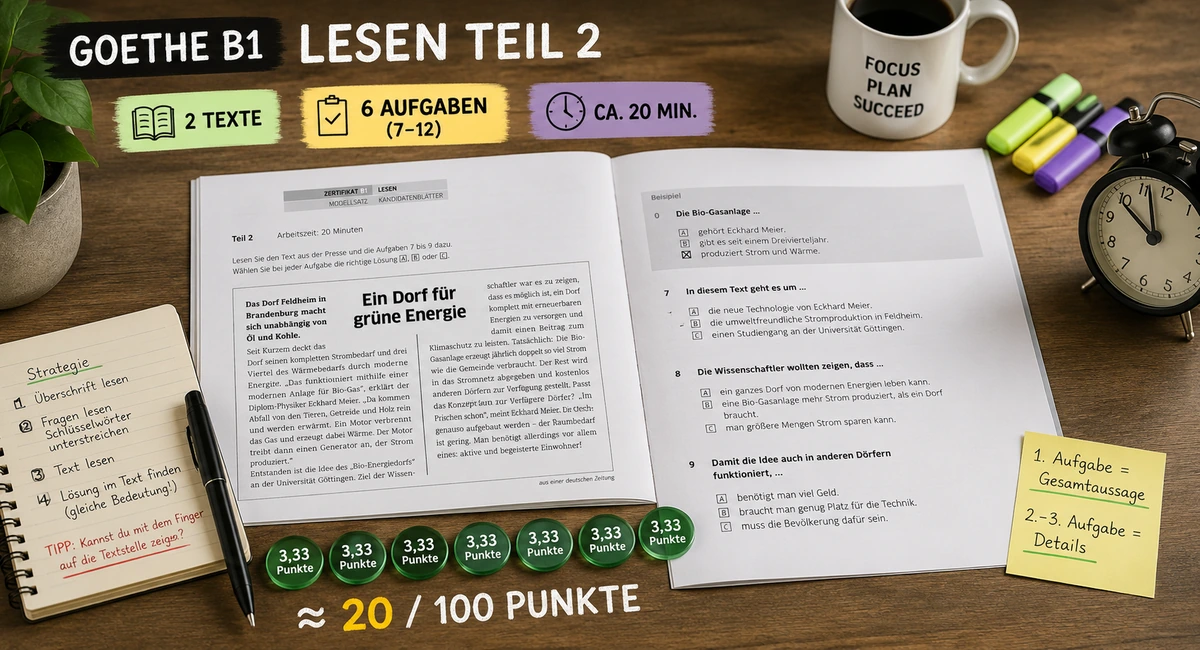
Use the appropriate sample for your exam – for example, “Über mich” for B1 DTZ, “Präsentation” for B2 Beruf or “Einander kennenlernen” for telc B1.
Step 2: Adapt the Example to Your Personal Situation
The goal is to make the examiners interested in listening to you from your very first sentence. You can therefore turn even the simplest point into a short story. In the B1 task “Über mich”, for example, one of the points is “Name”. Instead of simply saying “Mein Name ist Jamila”, you can say:
„Mein Name ist Jamila. Ich bin noch jung, um mich in Deutschland zu integrieren. Mein Vorname ist in meiner Heimat sehr verbreitet und bedeutet ‚die Schöne‘.“
Step 3: Prepare Answers to Questions That May Arise from Your Introduction
The examiners ask follow-up questions about what you have just told them. This means that you can influence the direction of the conversation yourself. Go through every point of your introduction and ask yourself: “What would someone naturally ask about this?” Are you saying that your name means “the beautiful one”? Then prepare an answer explaining who chose your name. Are you saying that you have been learning German for two years? Then prepare an answer explaining how and where you study.
Step 4: Speak Aloud and Freely Every Day
Practise your introduction aloud every day without using notes – until the first two minutes feel as though they are running on autopilot.
👉 DTZ B1 Speaking: Topics and Examples👉 telc B1 Speaking: Topics and Examples
Why This Works: Starting with Something Easy
Language anxiety researcher Fernando Rubio Alcalá investigated whether anxiety in oral foreign language exams decreases when candidates experience their own performance positively right at the beginning of the exam (Rubio Alcalá, 2002, ELIA). In his study involving school students, anxiety decreased when this technique was used.
Part 1 is the only part that you can prepare completely in advance. Once it becomes automatic, your exam begins with a successful experience. You move on to Part 2 with the feeling “I can do this” rather than increasing nervousness.
Your introduction and your answers to possible follow-up questions are ready. You have the first few minutes of the exam under control.
Stage 2 (Days 4–9): Part 2 – Ideas and Useful Phrases First, Then Speaking
You cannot memorise Part 2 because you will only discover the topic during the exam. The aim of this stage is therefore to build up as much ready-to-use material in your mind as possible, so that you do not have to come up with everything from scratch during the exam.
Step 1: Listen to Every Audio Recording for the Task
Listen to all the audio tracks for your task – for example, “Über ein Thema sprechen” for telc B1, “Bildbeschreibung” for B1 DTZ or “Small Talk” for B2 Beruf. The audio recordings cover the most common topics for this task. Once you have listened to all of them, you will have built up a collection of useful phrases and ideas for each topic in your passive memory – and there is a high probability that one of these topics will appear in the exam. Even if you encounter an unfamiliar topic, the useful phrases and response structure will still work because they are not tied to any particular topic.
Step 2: Read the Transcript While Listening for the First Time
Write unfamiliar words in a notebook and translate them. This helps you understand your passive vocabulary rather than simply recognising how the words sound.
Step 3: Practise Speaking About Every Topic with the AI Assistant
Now it is your turn to speak, using the useful phrases and ideas that are already in your mind. You can also practise describing pictures independently on the website.
Step 4: Add Your Personal Experience and Opinion to Every Topic
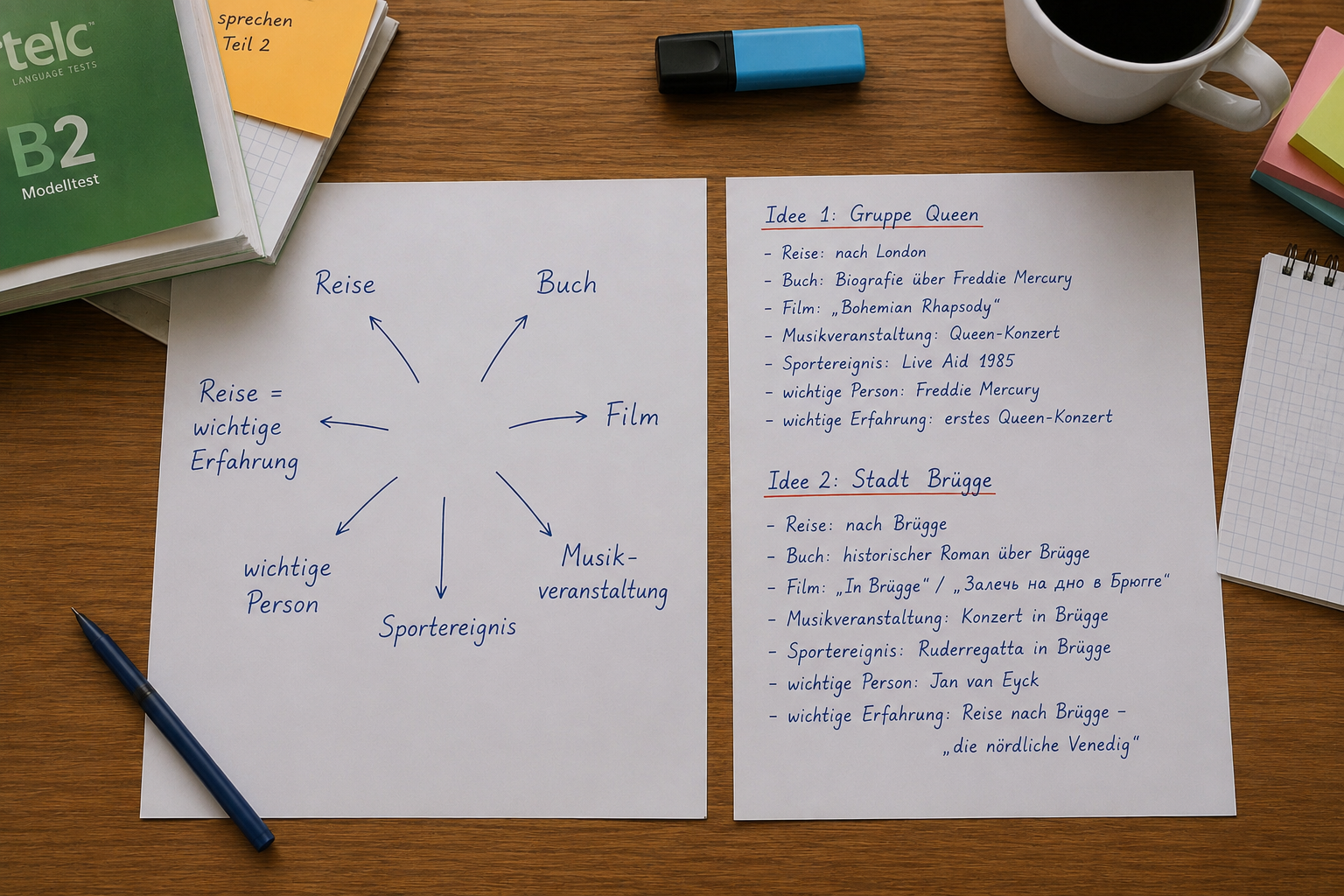
In the second task, the follow-up questions remain focused on the same topic and usually become more personal: What is your own experience? What do you think about it? Why? In the DTZ, the task is even called “Über Erfahrungen sprechen”. If you have already expressed your personal experience and opinion aloud for each topic, you will have ready-to-use material for the follow-up questions.
Why This Works
Having ideas ready reduces the demands on working memory. You do not have to think about what to say and how to say it at the same time. The content is already there – your brain only needs to focus on expressing it. This is the first preparation principle in action.
Gradually becoming familiar with the exam situation. A meta-analysis of randomised controlled trials involving university students with test anxiety (Huntley et al., 2019, Journal of Anxiety Disorders) showed that interventions targeting test anxiety were more effective than the control conditions, including at follow-up assessments. Behavioural therapy approaches received the strongest support. Their principle is to avoid avoiding the anxiety-provoking situation and instead face it repeatedly, step by step.
Speaking with the AI assistant is the first level: you are already speaking aloud about exam topics, but nobody is watching you, and nobody interrupts you with corrections. At the end of your monologue, the AI assistant provides an assessment and suggestions for improvement. This prevents anxiety from arising and allows you to see your progress from one attempt to the next.
For every common topic, you have ideas, useful phrases, personal experiences and your own opinion. You have learned to speak freely without pressure – now it is time to have a conversation with another person.
Stage 3 (Days 10–13): Part 3 – Dialogues
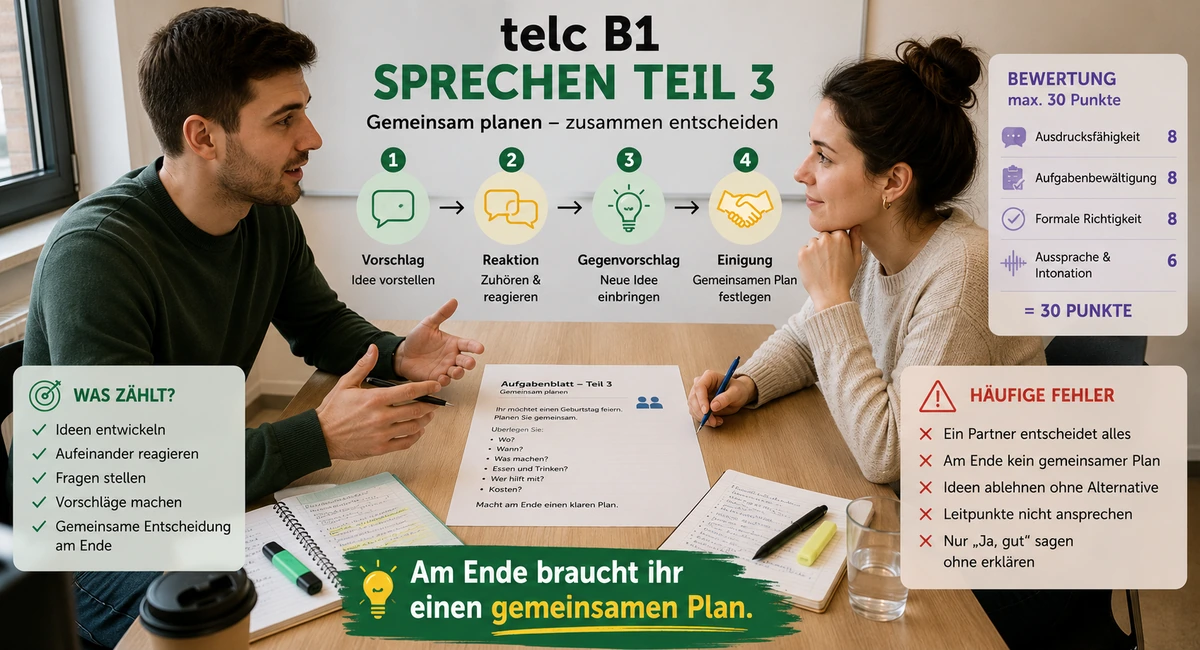
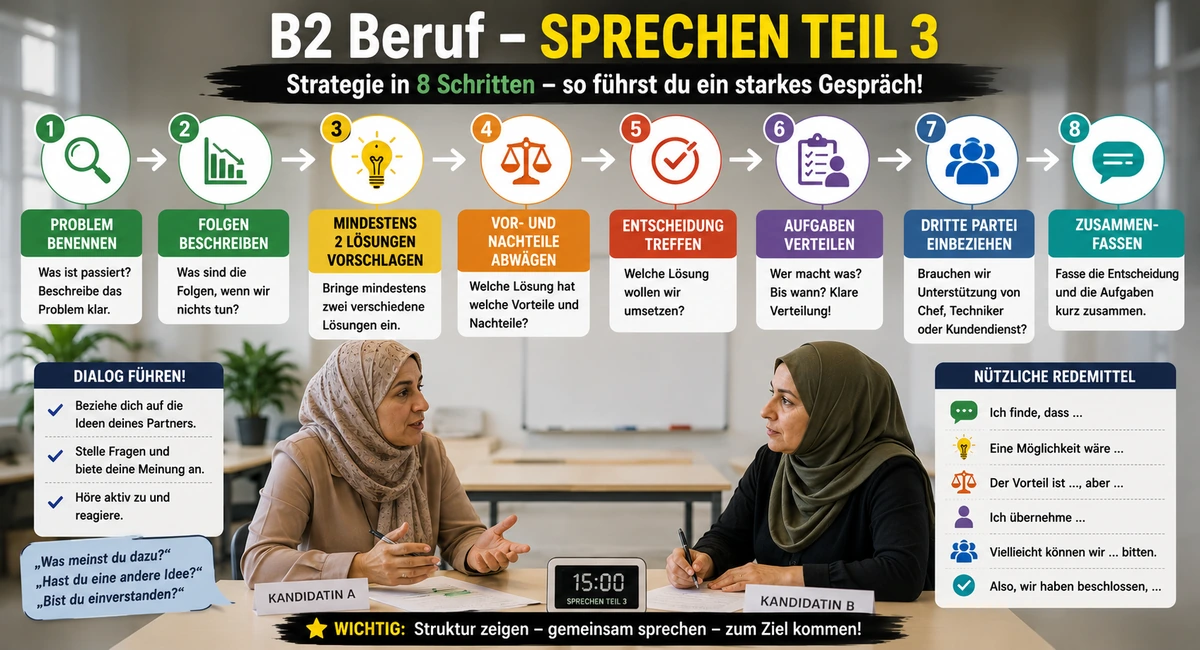
The third task differs from the first two: you speak not with the examiners but with a partner – and you do not know in advance what your partner will say. This stage is therefore structured like a staircase, progressing from listening to having a conversation with a real person.
Step 1: Listen to the Audio Dialogues
The sample dialogues are structured around fixed useful phrases. This allows you to hear how these sentences sound in a real conversation.
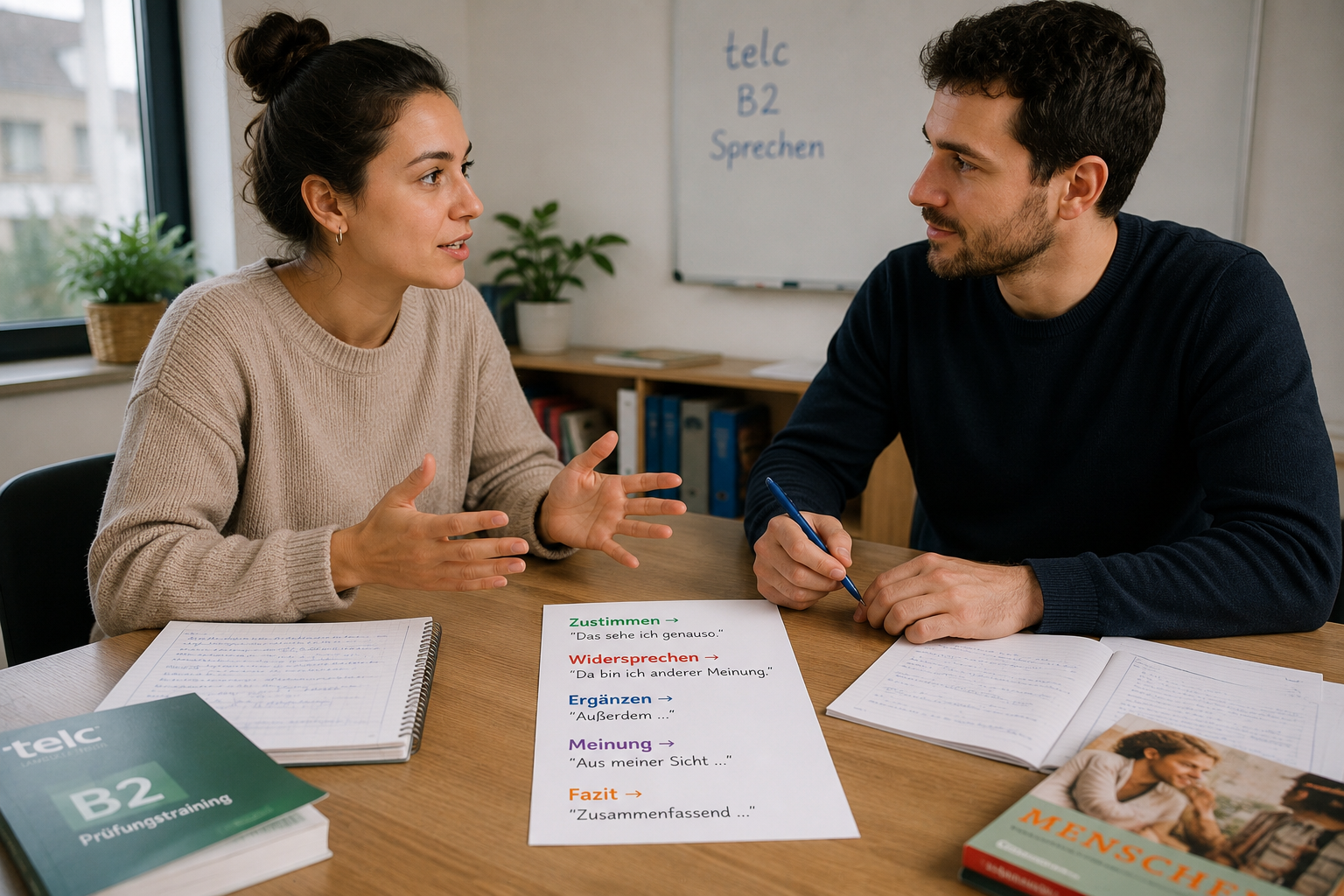
| Function in the Dialogue | Useful German Phrases |
|---|---|
| Making Suggestions | „Wie wäre es, wenn wir …?“ · „Ich schlage vor, dass …“ |
| Agreeing | „Gute Idee, das machen wir so.“ · „Da bin ich ganz deiner Meinung.“ |
| Disagreeing | „Das finde ich nicht so gut, weil …“ · „Ich habe eine andere Idee: …“ |
| Involving Your Partner | „Was meinst du dazu?“ · „Hast du eine Idee?“ |
| Summarising | „Also, wir machen es so: …“ |
Step 2: Write Down and Translate Unfamiliar Words
Learn useful phrases as complete language chunks rather than as individual words.
Step 3: Practise Dialogues with the AI Assistant
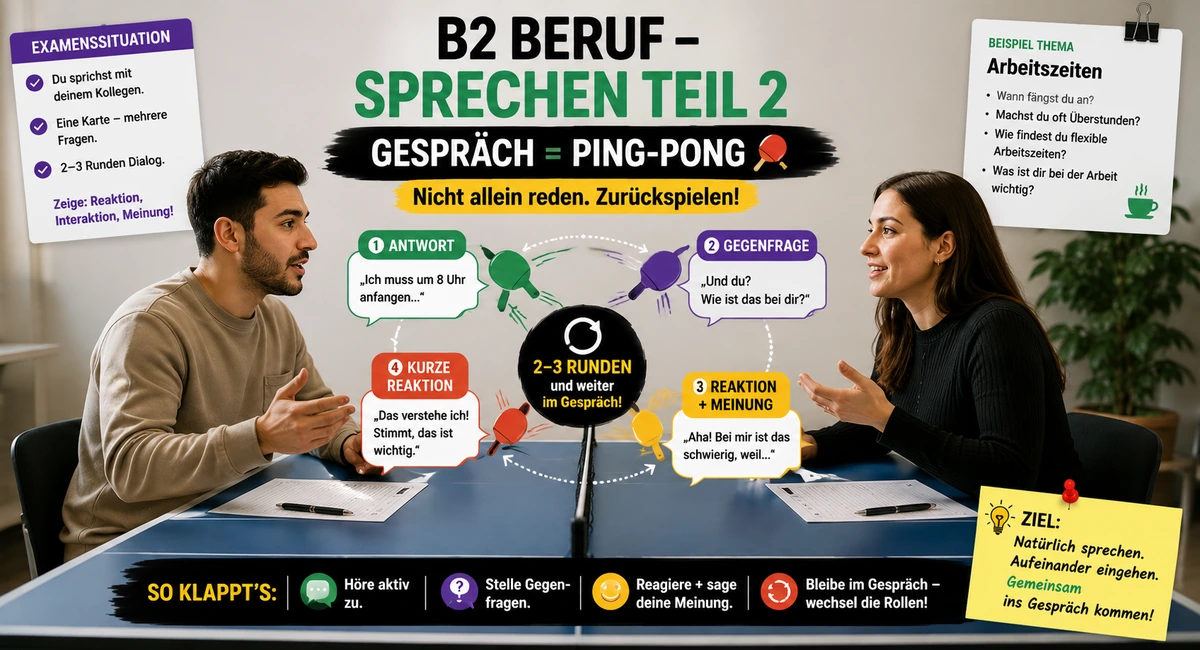
The AI assistant responds to what you say. This teaches you how to respond to another person's statements rather than simply delivering your own prepared text.
Step 4: Finish by Practising with a Real Conversation Partner
With the “Conversation Partner” feature, you can have dialogues with other learners on the platform. Your partner may have weaker or stronger language skills than you – and this is precisely what makes the practice useful, because you cannot choose your partner in the actual exam either. With a less proficient partner, you learn how to guide the conversation yourself. With a more proficient partner, you learn how to contribute your own ideas. The camera is switched off, there is no pressure, and your confidence grows with every conversation.
Why This Works: Gradual Familiarisation Once Again
Look at the sequence of stages: listening → speaking with the AI assistant → speaking with another person without a camera → speaking face to face with another person during the exam. Each stage brings you just a little closer to the real situation than the previous one. This is exactly the principle of gradual familiarisation that received the strongest support in the meta-analysis. When you arrive at the exam, having a conversation with an unfamiliar partner will not be your first experience of this kind, but one of many.
You can have a dialogue with any partner – someone less proficient, someone more proficient or someone you have never met before.
Day 14: Full Exam Rehearsal
Complete the entire oral section of a model test: all three tasks consecutively, using a timer and without taking breaks. Until now, you have practised the individual parts separately – but in the actual exam, they follow one another directly. The full exam rehearsal is the final stage of familiarisation: the exam as a whole becomes a familiar procedure.
Exam Day: Clear Your Mind of Nervousness
The content is prepared, and the conversation situation is familiar. On exam day, only one task remains: preventing nervousness from occupying your working memory. There are three techniques for doing this.
Write Down Your Worries
How to do it: Shortly before the exam – while you are still allowed to use your personal belongings – spend approximately 10 minutes writing down what worries you on a piece of paper in your native language. Be specific: instead of writing “I am afraid”, write “I am afraid that I will not understand the picture”.
Why this works: Psychologists Gerardo Ramirez and Sian Beilock from the University of Chicago conducted a randomised study and published it in the journal Science (Ramirez & Beilock, 2011). Before an important exam, the participants spent 10 minutes writing down their exam-related worries – freely, without rules and without being assessed: what worried them, what they were afraid of and what thoughts were going through their minds. The result: their exam performance improved significantly, particularly among those who were usually very nervous during exams. The underlying logic is the same as throughout the entire preparation plan: once worries are written down, they no longer keep circulating in your mind and occupying your working memory.
Reinterpret Your Nervousness
How to do it: Is your heart beating faster? Tell yourself: “This is not panic; this is energy. My brain is receiving more oxygen, and my body is getting ready.” Do not try to suppress your nervousness – use it.
Why this works: In a study conducted at Harvard University (Jamieson et al., 2010), a group of participants preparing for the GRE graduate admissions test were told that physiological arousal could improve their performance. This group achieved higher scores on the practice test than the control group. One to three months later, the participants provided their results from the actual test – and the group that had reinterpreted their nervousness performed better again. When nervousness is no longer perceived as a threat, it no longer interferes with performance.
Mindfulness: Breathing with Longer Exhalations
How to do it: Before entering the exam room, breathe in through your nose while counting to 4, then breathe out through your mouth while counting to 6 or 8. Repeat this 5 to 10 times. Practise this technique at home beforehand so that it feels familiar on exam day.
Why this works: A meta-analysis published in 2024 (Yılmazer, Hamamci & Türk, Frontiers in Psychology) analysed 18 studies involving a total of 1,275 participants. Mindfulness-based programmes reduced test anxiety with a medium to large effect.
The Exam: You Have Already Practised Every Part
It now becomes clear why you are prepared: for every part of the exam, there is a stage in which you have already practised it.
- Part 1: You talk about what you prepared at home and have practised saying many times. The follow-up questions relate to your own introduction – and you prepared answers to these questions in Stage 1, Step 3.
- Part 2: The topic is likely to be one of those you have listened to and discussed with the AI assistant. If not, you have useful phrases and a response structure that work with any topic. The follow-up questions usually concern your personal experience and opinion – and these are exactly what you practised expressing aloud for every topic in Stage 2, Step 4.
- Part 3: A conversation partner is sitting opposite you, just like on the platform – except that you are now speaking face to face. You help a less proficient partner by asking a question, and with a more proficient partner, you find the right moment to make your own contribution. You have already practised both situations in Stage 3.
You do not enter the exam hoping to get lucky with the topic. You have already worked through every part – one stage at a time.




























There are no comments for this article. Leave your comment