





Schreiben in the telc Pflege exam:
simply explained for beginners
Are you preparing for the Schreiben section of the telc Deutsch B1·B2 Pflege exam? Here you will find simply explained what you need to write, what matters most and which Redemittel always help.
What is the telc Deutsch B1·B2 Pflege exam?
The telc Deutsch B1·B2 Pflege is a professional language exam for nursing staff. It is designed for people who already hold a qualification in a nursing profession and wish to work in elderly care or hospital nursing in Germany, Austria or Switzerland.
The exam tests four skills: Hören, Lesen, Schreiben and Sprechen. All topics come from everyday professional life in nursing. This shows that you can really use the language in your job.
One special feature: it is a so-called dual-level exam. This means you sit one exam and receive at the end — depending on your performance — either the B1 certificate or the B2 certificate. You therefore do not have to choose between B1 and B2 in advance.
The exam is available in a digital, hybrid and paper-based version. Which format is possible depends on the examination centre. It is best to ask there directly.
What does the exam consist of? A brief overview
The exam has a written and an oral section. Both sections usually take place on the same day. The written section lasts approximately 115 minutes in total (one hour and 55 minutes).
The written section consists of four tasks in sequence: Hören, Lesen, Sprachbausteine and Schreiben. The oral section follows afterwards. Before Sprechen you have 20 minutes of preparation time; the examination conversation then lasts approximately 16 minutes.
| Exam section | What you do | Duration (approx.) |
|---|---|---|
| Hören | Understand announcements, conversations and a meeting | approx. 25 minutes |
| Lesen | Understand texts from everyday nursing life | Part of the written block |
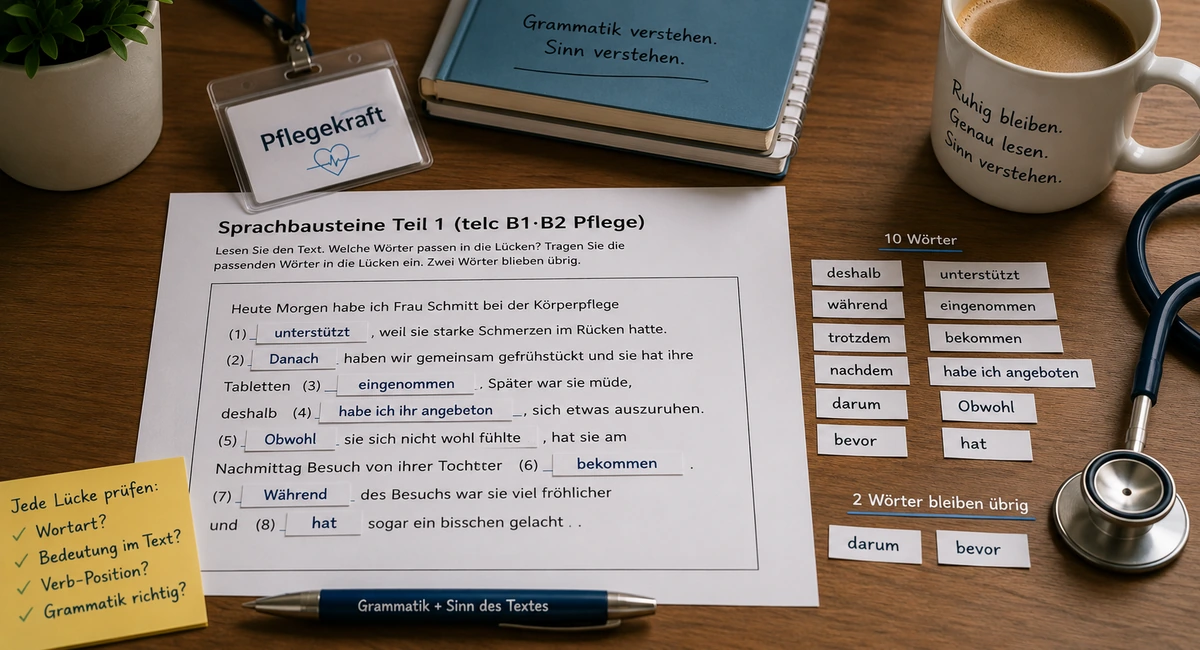
| Sprachbausteine | Complete grammar and vocabulary in a text | Part of the written block |
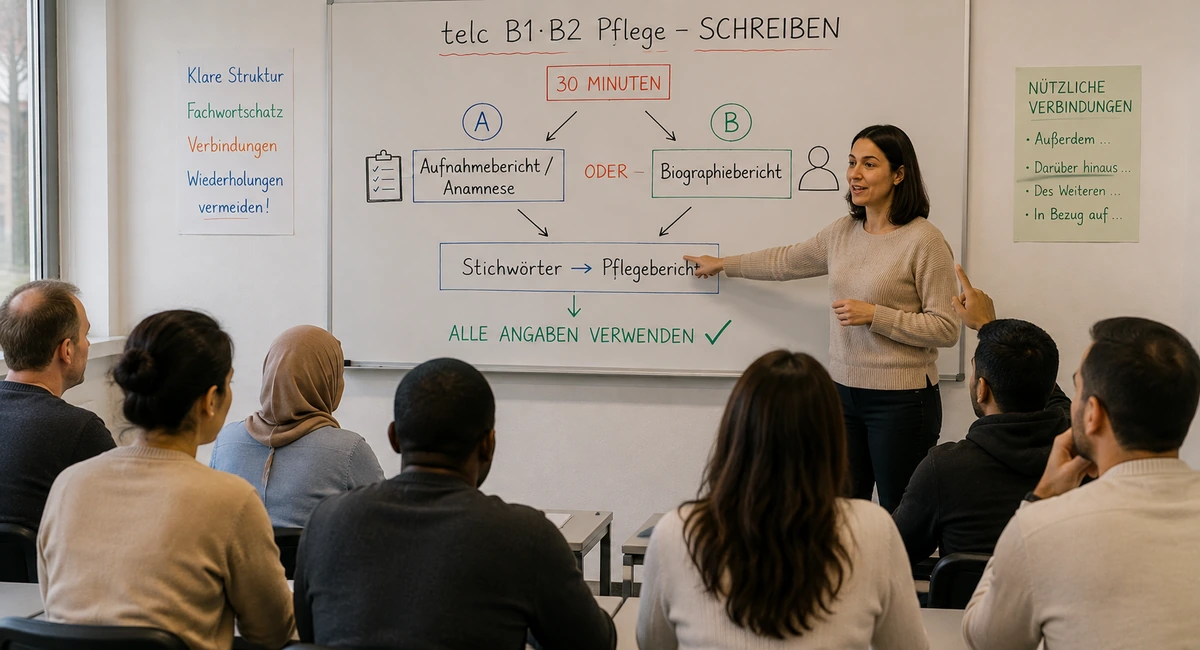
| Schreiben | Write a report (Aufnahmebericht or Biographiebericht) | 30 minutes |
| Sprechen | Talk about a photo, short presentation, discussion | approx. 16 minutes (+ 20 minutes preparation) |
This article focuses mainly on the Schreiben section. This is exactly where good preparation can secure you many points.
The „Schreiben“ section: task, time and points
In the Schreiben section you are required to write a coherent report. You have 30 minutes for this. In this section you can achieve a maximum of 20 points.
You receive two tasks to choose from and only have to complete one of them:
- Task A — Aufnahmebericht (admission report / anamnesis): You describe how a patient is at the time of admission (for example orientation, need for assistance, aids).
- Task B — Biographiebericht (biographical report): You describe the life story of a resident (for example parents, childhood, youth, profession).
Each task comes with a form (an Anamnesebogen or a Biographiebogen). Information is already given on this form — with crosses (✕) or short keywords. Your task is to turn these keywords into a fluent, easy-to-read text.
Write your report directly on the answer sheet. Anything written only in the task booklet will not be assessed. You will not receive extra time to copy the text over later.
The most important rule: use all the information from the form
This is the central requirement in this section: you must use all the given information from the form in your report. Every piece of information you forget costs points.
You may also add information of your own. But be careful: these additions must fit with the information on the form. They must never contradict the given information.
One more important point: if you invent something that has nothing to do with the form at all, you will receive no extra points for it. So stay with the given information and round it off sensibly.
If the form only shows the keyword „Hörgerät“, you may add whether it is needed on the left, right or both sides. But you must not write: „… hört noch sehr gut.“ That would be a contradiction.
If the form states that the person is fully orientated, you must not invent that they sometimes confuse people or get lost.
Start with a complete introductory sentence. Answer in it: who is admitted, when and where — and with what diagnosis? For example: „Frau Müller wurde heute in unserer Pflegeeinrichtung aufgenommen.“
What the examiners look at: the four assessment criteria
Your report is assessed according to four criteria. If you know these four points, you know exactly what to pay attention to when writing.
- Inhaltliche Angemessenheit (content adequacy): Have you used all the information from the form? This is the most important point.
- Kommunikative Gestaltung (communicative organisation): Is the text structured like a real report and well connected? Varied sentence openings are important here.
- Korrektheit (accuracy): How many errors do you make in grammar and sentence structure? Even simple sentences should be correct.
- Wortschatz (vocabulary): Do you use appropriate technical terms and synonyms instead of always repeating the same word?
Common mistake: always the same sentence openings
Many participants write sentence after sentence with the same opening: „Sie ist …“, „Sie hat …“, „Sie braucht …“, „Sie kann …“. This sounds monotonous and earns only few points in the Kommunikative Gestaltung criterion.
Vary your sentence openings. Connect your sentences with words such as „Außerdem“, „Darüber hinaus“, „Des Weiteren“ or „In Bezug auf“.
Vocabulary: show variety
Use different words for the same idea. Instead of always writing „brauchen“ you can also write „benötigen“. Instead of always „sagen“ also „mitteilen“, „äußern“ or „Bescheid geben“. Technical terms such as „Rollator“, „Blutzucker“ or „orientiert“ show that you have command of the professional language.
Universal Redemittel for your report
These building blocks almost always fit. Learn them by heart — that way you will have the right phrases ready immediately in the exam.
📋 Introduction
- Herr/Frau … wurde am … in unserer Pflegeeinrichtung aufgenommen.
- Die Angaben zur Person wurden von … gemacht (von der Bewohnerin/dem Bewohner selbst, von den Angehörigen).
- Das Aufnahmegespräch führte … (zum Beispiel die zuständige Pflegefachkraft).
🔗 Connecting information
- Außerdem … / Darüber hinaus … / Des Weiteren … / Zudem …
- In Bezug auf … / Hinsichtlich … / Was … betrifft, so …
- Aus diesem Grund … / Deshalb … / Daher …
🩺 Describing the need for assistance (Aufnahmebericht)
- … benötigt Unterstützung bei … / … braucht Hilfe beim …
- … kann … selbstständig durchführen.
- … benötigt Anleitung bei … / … benötigt Beaufsichtigung beim …
- … muss vollständig durch das Pflegepersonal übernommen werden.
🕒 Describing the life story (Biographiebericht)
- Aufgewachsen ist sie/er in … auf dem Land / in der Stadt.
- Als Kind … / In ihrer/seiner Jugend … / Später …
- Auf … ist sie/er besonders stolz.
✅ Conclusion
- Abschließend ist festzuhalten, dass … das Zimmer bereits bezogen hat und sich gut einlebt.
- Diese Angaben helfen dem Pflegepersonal, … besser zu verstehen und einfühlsam auf … einzugehen.
How to prepare correctly from the very beginning
If you are just starting your preparation, these steps will help you to practise correctly from the very beginning:
- 📝 Practise with real forms and compare your text with a model answer.
- ⏱️ Always practise with a clock: 30 minutes, exactly as in the exam.
- ✅ After writing, mark every piece of information from the form and check whether it is really in the text.
- 🎯 Deliberately vary your sentence openings and use synonyms.
- 📚 Learn the nursing vocabulary. An official word list can be found in the free exam handbook on the telc website.
It is best to practise regularly with different diagnoses and life stories. The more different forms you write, the more confident you will be in the exam.
Collect your own Redemittel in a short list. Repeat this list before every practice session. Over time the phrases will become second nature to you.


There are no comments for this article. Leave your comment