





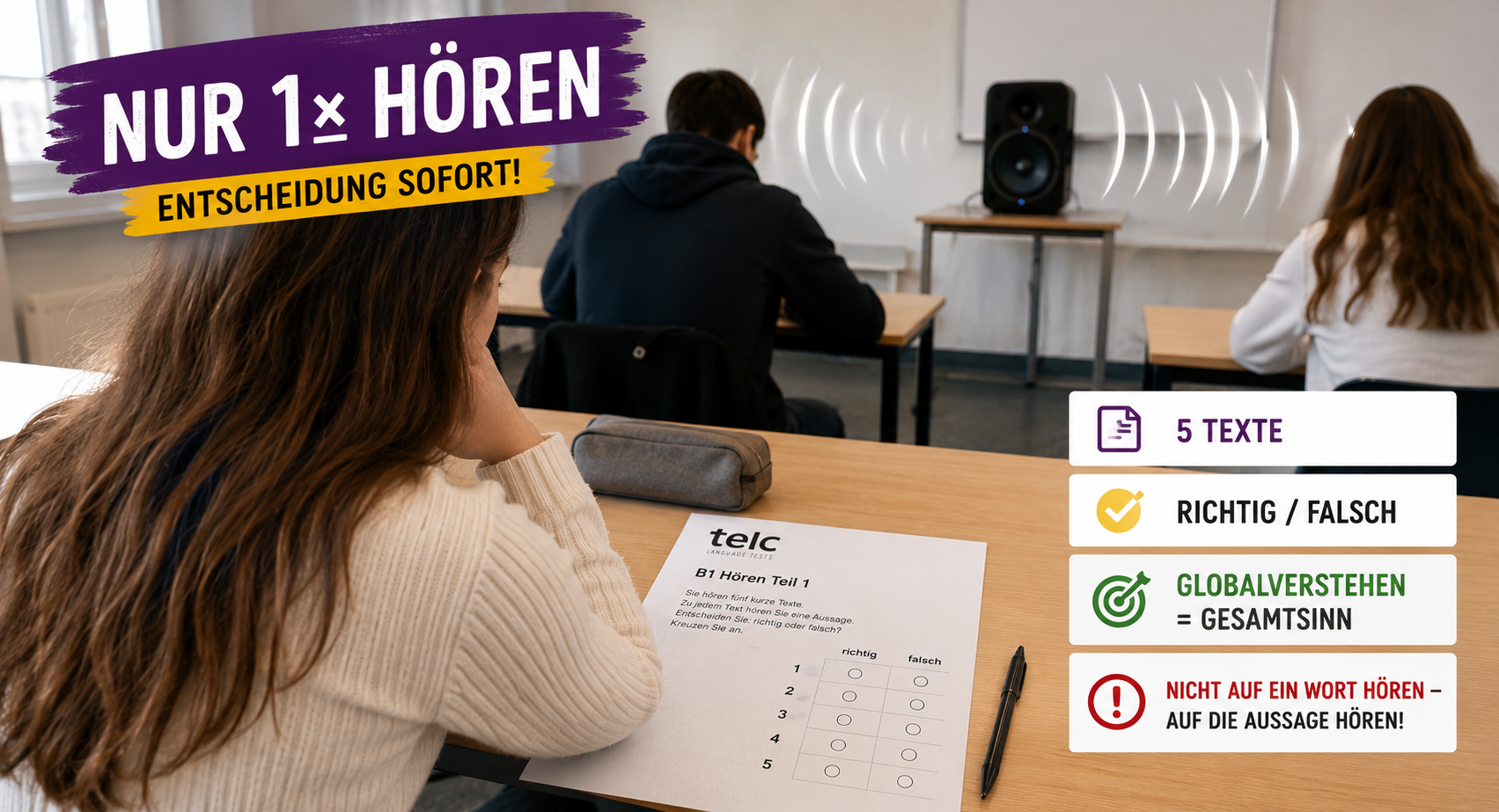
telc B1 Listening Part 1:
structure, assessment and typical mistakes
Find out exactly how Listening Part 1 in the telc Deutsch B1 exam is structured, how it is assessed and which mistakes learners make most often – before you start training.
What is Listening Part 1? The short answer first
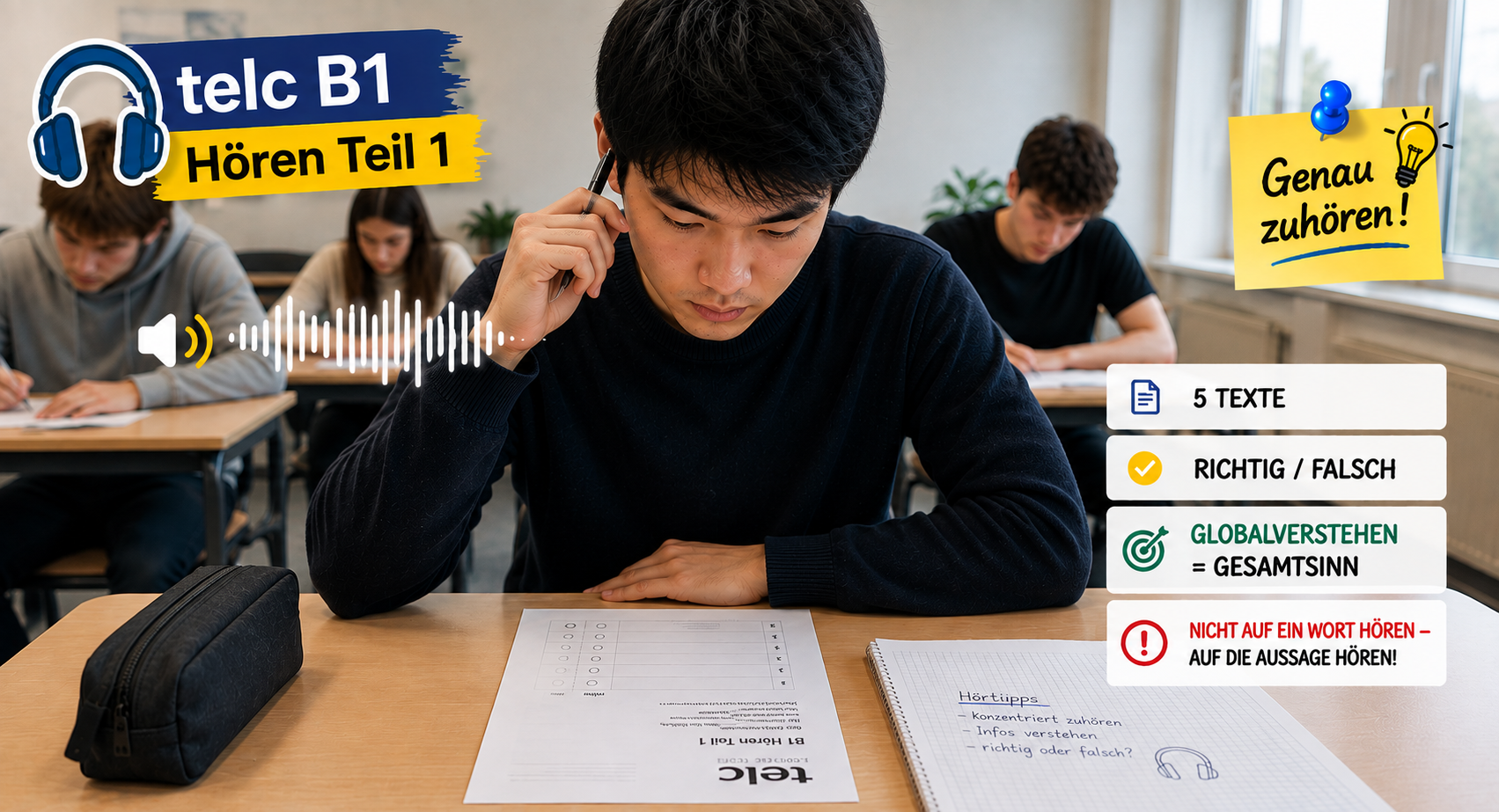
Listening Part 1 is the first of three parts in the listening section of the telc Deutsch B1 exam. You hear five short, mutually independent texts. For each text there is one statement that you have to mark as true or false. This part tests what is called global comprehension – that is, whether you understand the overall sense of a short text, not every single detail.
A typical format: a presenter asks a question about an everyday topic (for example free time, family, housing, work). After that you hear five different people answering this question – each person with their own, independent opinion. Exactly one statement on your task sheet belongs to each person.
The five speakers have nothing to do with one another. A mistake with person 2 has no influence on whether your answer for person 3 is correct. Each statement is its own small task.
The most important key facts at a glance
| Feature | Listening Part 1 |
|---|---|
| Number of texts | 5 short, independent texts |
| Number of items | 5 statements (true / false) |
| Skill being tested | Global comprehension (overall sense, not every detail) |
| How often do you hear the text? | As a rule only once |
| Reading time before listening | A short time before the recording begins |
The exact reading time, the working time and the weighting in the overall result can differ slightly depending on the exam version. Always check the current details additionally on the official telc website.
The exact procedure in the exam room
Before you hear the first recording, you have a short time to read through all five statements. This is not wasted time – on the contrary: these seconds often decide whether you can solve the task or not.
After that the recording is played. One important detail that many learners underestimate:
As a rule, you hear each text in Listening Part 1 only once. There is no second chance and you cannot stop the recording or rewind it. That is why your preparation – reading the statements – has to be finished before the listening begins.
While listening, you decide immediately: true or false. There is no pause between the five speakers in which you could think things over calmly – the next person is already starting to speak while you are still noting down your previous decision.
Practical consequences for how you act in the exam
- Read all five statements during the preparation time, not just the first one.
- Decide immediately while listening – do not wait for the perfect moment.
- If you have missed a statement: mark something anyway and concentrate on the next person straight away. An empty box guarantees zero points, whereas a guessed answer has a 50 per cent chance.
What is really assessed in Listening Part 1?
The name Globalverstehen (global comprehension) is the key to this exam part. What is tested is not whether you have understood every single word. What is tested is whether you have grasped a person’s main message: what is their opinion? What is their situation? What is their attitude to this topic?
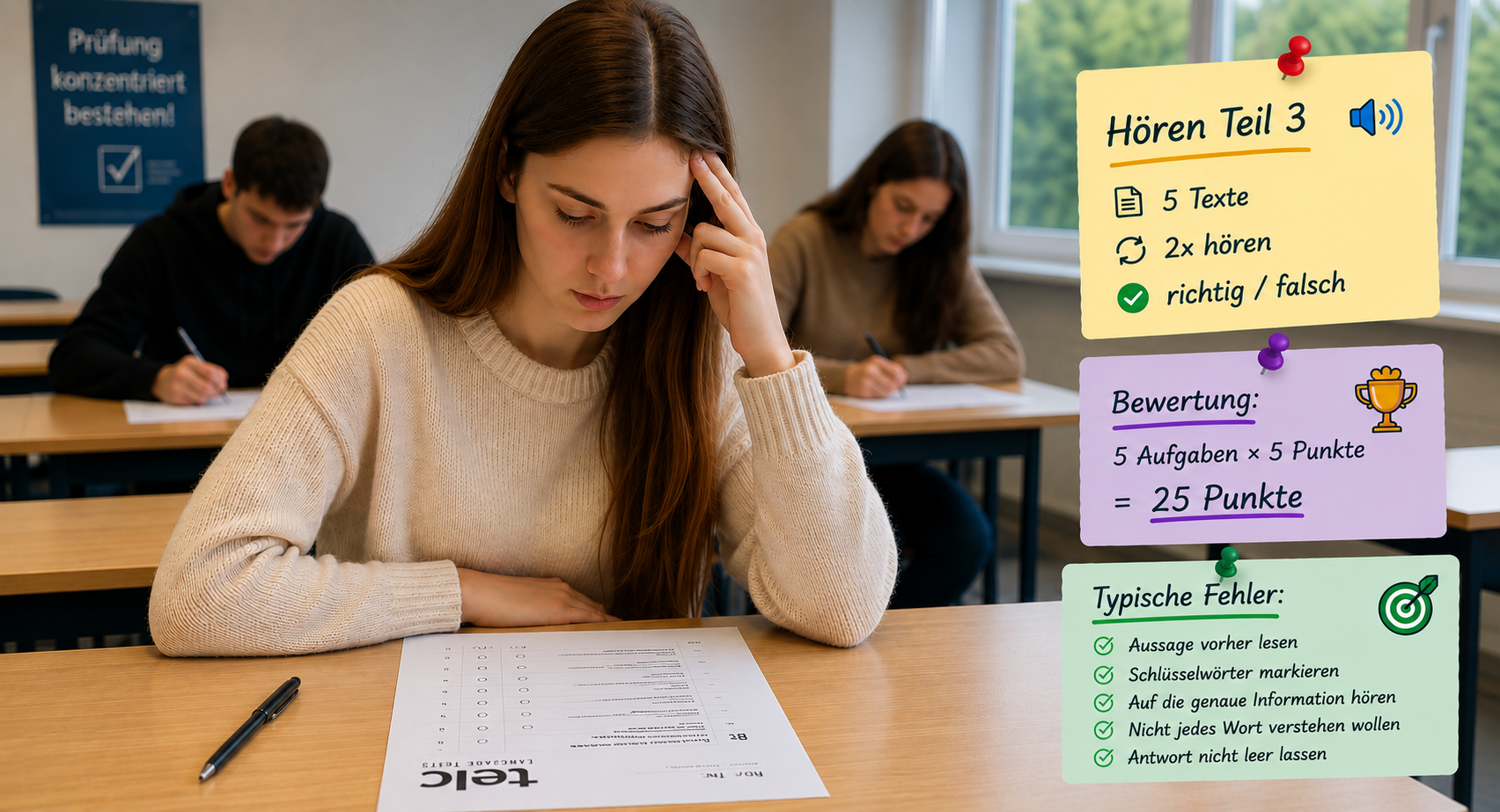
For each of the five items there is exactly one correct solution – either true or false. The exact number of points per item and the weighting of the whole listening section compared with reading, Sprachbausteine (language elements), writing and speaking are laid down officially by telc; these values can change and should always be checked on the current telc website.
Even if you do not understand every word: that is normal and even factored in. Native speakers talk fast, with pauses, self-corrections and colloquial language. The exam tests whether you nevertheless understand the core of what is said – not whether you have a dictionary in your head.
The difference from Listening Part 2 and Part 3
So that your expectations stay realistic, here is the difference from the other two parts of the listening section:
| Feature | Part 1 | Part 2 | Part 3 |
|---|---|---|---|
| Type of text | 5 short, independent texts | 1 long text (e.g. a conversation) | 5 short everyday texts (e.g. announcements) |
| Aim | Understanding the overall sense | Finding details in the long text | Picking out one concrete piece of information |
The 6 most common mistakes learners make
These mistakes have nothing to do with your language level as such – they arise from the wrong approach to the task. Whoever knows them can avoid them in a targeted way.
Mistake 1: reading the statements only while listening
Whoever does not use the reading time and only starts deciphering the statement during the listening automatically misses the beginning of the recording. As each text runs only once, this loss cannot be made up for.
Mistake 2: listening for a single word instead of the whole sentence
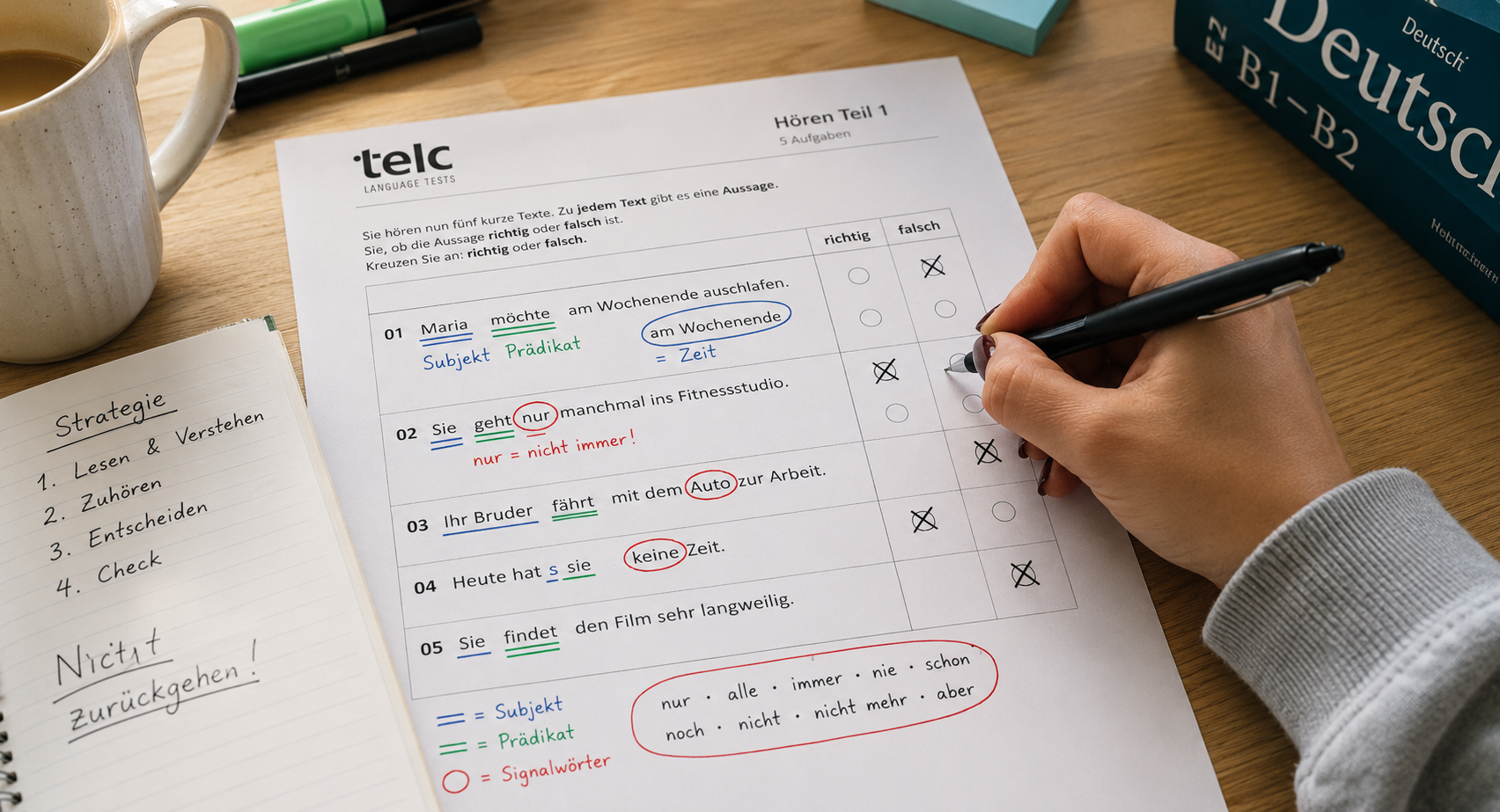
Many learners hear a familiar word from the statement again in the text and immediately mark true. That is dangerous: in the text the word can stand in a completely different context, be negated, or belong to another person.
Mistake 3: losing concentration after the first person
After two or three speakers, attention often drops – especially if the first item was difficult and is still on your mind. Each of the five people deserves the same full concentration, regardless of how the previous item went.
Mistake 4: leaving a box empty when unsure
An empty box is always wrong. A guessed answer has a real chance of 50 per cent of being right – considerably better than any probability in a lottery. There is no reason to leave a box unfilled.
Mistake 5: fear of the task sheet
Some learners do not dare to write on the printed task sheet, to underline or to circle words. That is a misunderstanding: the sheet may and should be worked on actively. Whoever marks important words keeps an overview more easily while listening.
Mistake 6: ignoring the presenter’s introductory question
The question at the beginning (for example Wie stehen Sie zu diesem Thema? / What is your attitude to this topic?) sets the frame for all five answers. Whoever skips it misses important orientation about what the following statements are actually about.
Most mistakes in Listening Part 1 do not arise from a lack of German, but from the wrong approach: reading too late, paying attention to individual words instead of the sense, losing concentration and leaving boxes empty.
Why a word you hear is not yet a correct answer
This is the most important error in thinking in this exam part, which is why it gets a section of its own. A simple example:
Statement on the sheet: Die Sprecherin räumt das Zimmer jeden Tag auf. (The speaker tidies up the room every day.)
In the text the speaker says: Meine Mutter verlangt, dass ich mein Zimmer jeden Tag aufräume – aber ehrlich gesagt mache ich das höchstens einmal in der Woche. (My mother demands that I tidy up my room every day – but to be honest I do it once a week at most.)
The word aufräumen (to tidy up) does actually occur in the text. Nevertheless the statement is false – because the text is about a demand made by the mother, not about the speaker’s actual behaviour. Whoever listens only for the word aufräumen falls into a typical trap.
In Listening Part 1 such traps occur very systematically: a word from the statement turns up in the text, but the actual sense is a different one. Exactly how these traps are constructed and how you can recognise them reliably is explained in the next article in this series, which is devoted exclusively to the strategy and the typical traps.
👉 On to all telc B1 exercises








There are no comments for this article. Leave your comment