





Sprachbausteine Part 1:
all the grammar and the best tips
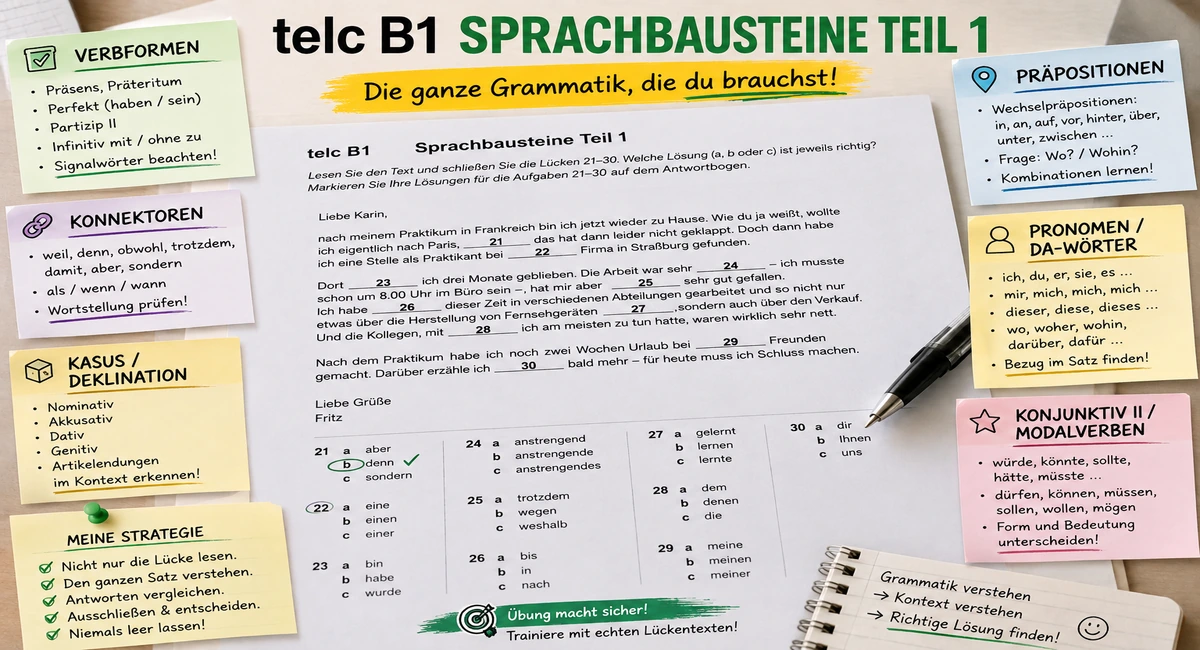
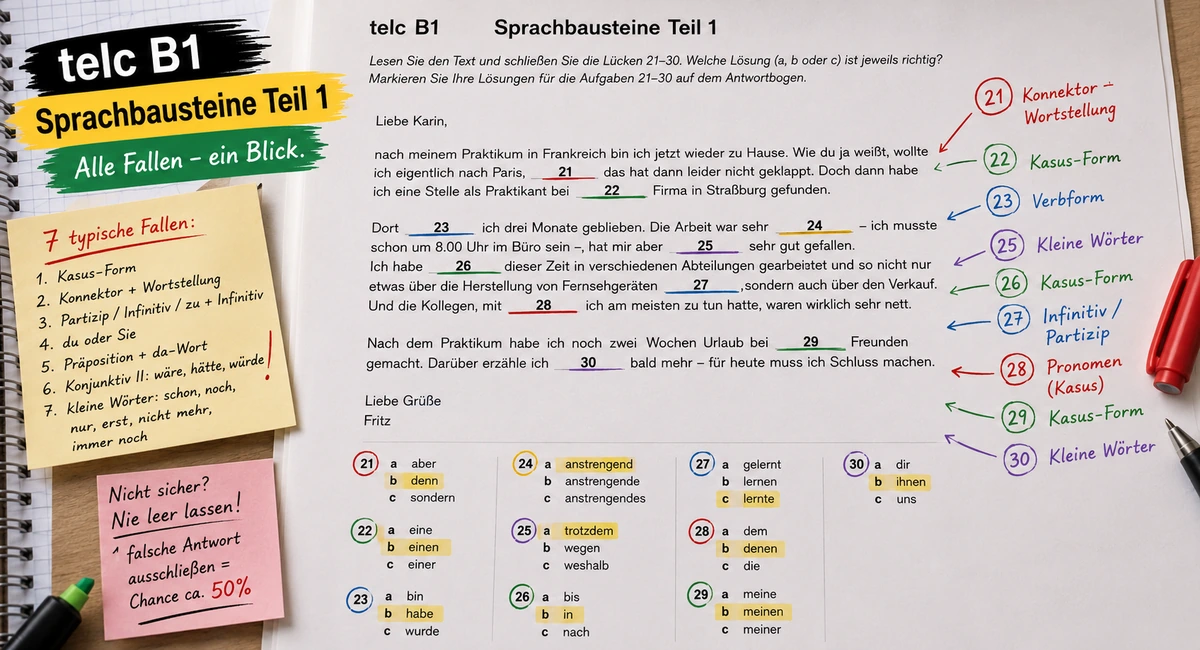
Which grammar do you really need to know for Sprachbausteine Part 1? Here you find all the important areas with clear examples, plus a tried-and-tested step-by-step strategy and a checklist for learning.
Verbformen (verb forms): the heart of it
Verbformen (verb forms) are the most important area in Part 1. You have to recognise the right tense and the right form confidently.
Tenses
- Präsens (present): Ich arbeite hier seit zwei Monaten. (I have been working here for two months.)
- Präteritum (simple past): Am Anfang war ich nervös. (At the beginning I was nervous.)
- Perfekt (present perfect): Ich habe einen Job gefunden. (I have found a job.)
Participle, infinitive and zu-infinitive
Check the signal word in the sentence:
| Signal in the sentence | Form | Example |
|---|---|---|
| haben / sein | Partizip II (past participle) | Ich habe es gemacht. |
| modal verb | infinitive without zu | Ich muss es machen. |
| versuchen, sich lohnen ... | infinitive with zu | Ich versuche, es zu machen. |
Auxiliary haben or sein?
In the Perfekt some verbs need sein instead of haben. These are above all verbs of movement and change:
- with sein: gehen, kommen, fahren, fliegen, bleiben, passieren (Ich bin geblieben. / I stayed.)
- with haben: most other verbs (Ich habe gearbeitet. / I worked.)
First look for the auxiliary or modal verb in the sentence. It tells you immediately which form the other verb must have.
Konnektoren (connectors) and word order
Konnektoren (connectors) join sentences. Important is not only the meaning, but also the word order – that is, where the verb stands.
| Meaning | Connectors | Word order |
|---|---|---|
| reason | weil (subordinate clause), denn (main clause) | weil → verb at the end; denn → normal position |
| contrast | aber, sondern; obwohl; trotzdem | aber/sondern → normal; obwohl → verb at the end; trotzdem → verb right after |
| aim | damit, um ... zu | verb at the end |
| condition / time | wenn, als, falls | verb at the end |
als or wenn?
- als – a one-time event in the past: Als ich ankam, regnete es. (When I arrived, it was raining.)
- wenn – something that repeats, or a condition: Immer wenn ich komme, ist es ruhig. (Whenever I come, it is quiet.)
- wann – only in questions or indirect questions: Ich weiß nicht, wann er kommt. (I do not know when he comes.)
Ich freue mich, (...) ich dich endlich wiedersehe. (I am glad ... I finally see you again.)
a) als b) wenn c) wann
Correct: b) wenn. It is about the future, not a one-time event in the past. als and wann do not fit.
Kasus (case) and Deklination (declension)
Articles, possessive articles and adjectives change their ending according to the case. You have to recognise the case from the sentence.
| Case | Question / signal | Example (der Mann) |
|---|---|---|
| Nominativ (nominative) | Wer oder was? (who or what? / subject) | Der Mann kommt. |
| Akkusativ (accusative) | Wen oder was? (whom or what? / object) | Ich sehe den Mann. |
| Dativ (dative) | Wem? (to whom?) / after a dative preposition | Ich danke dem Mann. |
| Genitiv (genitive) | Wessen? (whose?) / after a genitive preposition | das Auto des Mannes |
Adjective endings briefly explained
- with a definite article (der, die, das): mostly ending -e or -en – der gute Freund, mit dem guten Freund
- without an article: the adjective carries the strong ending – guter Kaffee, gute Freunde
Prepositions with genitive
These prepositions require the Genitiv: trotz, wegen, während, statt. Example: trotz des Regens (despite the rain).
First determine the case, then the ending. Ask: is the word subject, object, or does a preposition stand before it? From that the right form follows.
Präpositionen (prepositions)
With prepositions you have to know two things: the right preposition and the right case.
Two-way prepositions
The prepositions an, auf, in, über, unter, vor, hinter, neben, zwischen can take Dativ or Akkusativ:
- Wo? (place, no movement) → Dativ: Ich bin in dem (im) Haus. (I am in the house.)
- Wohin? (direction, movement) → Akkusativ: Ich gehe in das (ins) Haus. (I go into the house.)
Am Wochenende fahren wir (...) die Berge. (At the weekend we drive ... the mountains.)
a) in den b) in dem c) im
Correct: a) in den. fahren is a movement (Wohin?), so accusative: in die Berge. With masculine singular it would be in den.
Contractions
Preposition and article are often contracted: in dem = im, an dem = am, zu dem = zum, zu der = zur, in das = ins.
With two-way prepositions always ask: Wo (place) or Wohin (movement)? This one question decides between Dativ and Akkusativ.
Pronouns and pronominal adverbs
Personal pronouns in the right case
Pay attention to the case: Er hilft mir (he helps me / dative), Er sieht mich (he sees me / accusative).
Relative pronouns
The relative pronoun follows the reference word (gender, number) and its role in the subordinate clause (case).
Das ist der Kollege, (...) ich oft helfe. (That is the colleague ... I often help.)
a) der b) den c) dem
Correct: c) dem. helfen requires the Dativ: dem ich oft helfe. der (nominative) and den (accusative) do not fit.
Pronominal adverbs (da-words)
When a verb stands with a fixed preposition and the object is a thing, a da-word (da-Wort) is formed:
| Verb + preposition | da-word |
|---|---|
| sich freuen auf | darauf |
| denken an | daran |
| sprechen / erzählen von | davon |
| sich kümmern um | darum |
Always learn verbs together with their preposition. Then you find the right da-word immediately too.
Subjunctive and modal verbs
Konjunktiv II (subjunctive II)
The Konjunktiv II expresses politeness or something unreal. Important: sein and haben have their own forms.
- sein → wäre: Das wäre schön. (That would be nice.)
- haben → hätte: Ich hätte gern einen Kaffee. (I would like a coffee.)
- other verbs → often würde + infinitive: Ich würde gern kommen. (I would like to come.)
Modal verbs and their meaning
| Modal verb | Meaning |
|---|---|
| können | ability, possibility |
| müssen | necessity |
| wollen | intention, will |
| möchten | polite wish |
| dürfen | permission |
| sollen | instruction, recommendation |
Ich (...) Sie höflich um Hilfe bitten. (I ... to ask you politely for help.)
a) muss b) möchte c) soll
Correct: b) möchte. möchte fits the polite request. muss (necessity) and soll (instruction) give a different sense here.
Checklist: what do I need to know?
If you master these areas confidently, you are well prepared for Part 1:
| Area | This is what you should be able to do |
|---|---|
| Verbformen (verb forms) | Präsens, Präteritum, Perfekt; Partizip II; infinitive with and without zu; haben or sein in the Perfekt |
| Konnektoren (connectors) | weil, denn, obwohl, trotzdem, damit, aber, sondern; als / wenn / wann; right word order |
| Kasus and Deklination (case and declension) | Nominativ, Akkusativ, Dativ, Genitiv; adjective endings; prepositions with Genitiv |
| Präpositionen (prepositions) | two-way prepositions (Wo/Wohin); contractions (im, am, zum, zur, ins) |
| Pronomen (pronouns) | personal pronouns in the right case; relative pronouns; da-words (darauf, daran, davon) |
| Subjunctive and modal verbs | wäre, hätte, würde; meaning of können, müssen, wollen, möchten, dürfen, sollen |
| Small words | schon, noch, nur, einfach, erst; fixed combinations like noch nicht, nicht mehr, immer noch |
Work through these areas one after another. After each area do a few gap texts and always read the explanation. This way you quickly see where you still have to practise.
FAQ on grammar and tips
Basis for structure and task type: official telc practice test Zertifikat Deutsch / telc Deutsch B1, telc gGmbH, Frankfurt a. M. You find the official practice test free at www.telc.net.



There are no comments for this article. Leave your comment