






Part 1 of the oral DTZ exam is the introduction: 6 key points, approximately 2 minutes per person, followed by questions from the examiners. Here you will find a simple explanation: How does Part 1 work? What do the examiners want to hear? How many points can you get for 1A and 1B?
DTZ Speaking Part 1 – the short answer
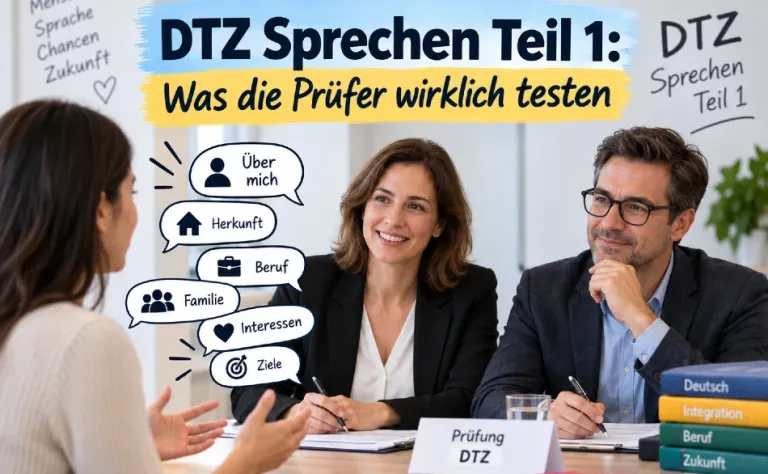
Part 1 of the oral Deutsch-Test für Zuwanderer (DTZ) exam is called „Über sich sprechen“. You receive a sheet with 6 key points: Name, Geburtsort, Wohnort, Arbeit/Beruf, Familie, Sprachen. You introduce yourself using these key points. This is Part 1A. After that, the examiner asks you one or more questions. You answer them. This is Part 1B. It takes approximately 2 minutes per person. With two participants, Part 1 therefore takes approximately 4 minutes.
The entire Speaking section is worth 100 points: 50 points for content (all five tasks: 1A, 1B, 2A, 2B and 3) and 50 points for language throughout the entire conversation. Part 1 is worth a maximum of 10 content points: 5 points for the introduction (1A) and 5 points for the answers (1B). The examiners do not assess language (pronunciation, fluency, accuracy, vocabulary) separately for Part 1. They assess your language once for the entire conversation from Part 1 to Part 3. Your language performance in Part 1 is therefore also included. Part 1 is the first moment when the examiners hear: Is this A2 or B1 according to the Common European Framework of Reference for Languages (CEFR)?
All official information in this article comes from g.a.s.t. This organization administers the DTZ on behalf of BAMF. The sources are the page „Der DTZ auf einen Blick“, the DTZ-Übungssatz 1 (PDF) and the FAQ zum DTZ. Last updated: 11.09.2026.
👉 Exercises for DTZ Speaking Part 1 „Über mich“ with sample textsHow does Part 1 work?
The oral DTZ exam is normally conducted as a paired exam: two participants and two examiners. One examiner speaks with you. The second examiner listens and assesses your performance. There is no preparation time. No aids are allowed. The oral exam takes place on the same day as the written exam, directly afterwards.
Step by step
- The examiners briefly introduce themselves. They tell you that the oral exam has three parts.
- The sheet with the 6 key points is placed on the table. Both participants receive the same sheet.
- Person A introduces themselves (Part 1A, approximately 1 minute).
- The examiner asks a question about your introduction. If your answer is short, the examiner asks 2 or 3 questions (Part 1B, approximately 1 minute).
- The examiner says „Danke“ and moves on to Person B. Person B does the same.
- After approximately 4 minutes, the examiner says: „Danke, wir sind am Ende von Teil 1.“ Then Part 2 begins.
You may stop in the middle of your introduction. That is not a problem. The examiner will then give you a prompt, for example: „Was machen Sie beruflich?“ or „Haben Sie Kinder?“. This is normal and is part of the official procedure. g.a.s.t. describes this procedure in Übungssatz 1 on pages 28–32. The examiners should ask open questions (W-Fragen: Was? Wo? Wie?). They should speak clearly and distinctly and use simple vocabulary at B1 level.
The examiners already have your personal information from your registration. In Part 1, they are not checking facts. They are listening to how you connect these facts in German. It is okay if you do not mention every detail. What matters is that you speak.
Then and now: What has changed since 2023?
Since January 1, 2023, g.a.s.t. has administered the DTZ. Before that, it was administered by telc. The format and tasks have remained the same. g.a.s.t. states this clearly in Übungssatz 1 (page 7). The 6 key points, Parts 1A and 1B, and the points are identical to those in the official examination handbook. Only the organization of the written exam has changed (personalized answer sheets, ballpoint pens instead of pencils, no break). There has been no change to Part 1 of the oral exam.
The 6 key points: What can you say?
The order on the sheet is not important. This is stated in Übungssatz 1 (page 30). The key points are there to help your memory; they are not a form. The difference between A2 and B1 is not: “Did I mention all 6 points?” The difference is: “How much do I say about each point, and do I connect my sentences?”
| Key point | Typical A2 | Typical B1 |
|---|---|---|
| Name | Ich heiße … / Mein Name ist … | Ich heiße …, aber meine Freunde sagen … / Mein Name kommt aus … und bedeutet … |
| Geburtsort | Ich komme aus … / Ich bin in … geboren. | Ich bin in … geboren. Das ist eine kleine Stadt im Norden von … Dort habe ich bis … gelebt. |
| Wohnort | Ich wohne in … / seit zwei Jahren. | Seit … wohne ich in …, weil … Die Stadt gefällt mir, denn … |
| Arbeit/Beruf | Ich bin … von Beruf. / Ich arbeite nicht. / Ich mache einen Deutschkurs. | In meiner Heimat habe ich als … gearbeitet. Jetzt mache ich …, und später möchte ich … |
| Familie | Ich bin verheiratet. / Ich habe zwei Kinder. | Ich lebe mit … zusammen. Meine Tochter geht in die …, mein Sohn … Ein Teil von meiner Familie lebt noch in … |
| Sprachen | Ich spreche … und ein bisschen Deutsch. | Meine Muttersprache ist … Englisch habe ich in der Schule gelernt. Deutsch lerne ich seit … Zu Hause sprechen wir … |
In the right-hand column, you can always see the same principle: one piece of information plus a second element. The second element is a reason („weil“, „denn“), a time reference („seit“, „bis“, „jetzt“, „später“) or a contrast („in meiner Heimat … hier …“). This is exactly what the criteria mean by „detailliertere Informationen“ for B1.
The official sheet contains exactly these 6 key points. Hobbies or plans for the future are not on the sheet. However, the examiners may ask about them in Part 1B. If you have prepared a few sentences on these topics, you have an advantage in Part 1B.
Part 1B: The examiners’ questions
Many participants think that Part 1 is only the introduction. But Part 1B is just as important. The examiner takes a piece of information from your introduction and asks a follow-up question. The questions are not invented spontaneously. The examiners have a catalogue of standard questions. In Übungssatz 1 (page 30), g.a.s.t. provides examples: questions about your job, your children and languages. For example: „Wann und wo haben Sie diese Sprache gelernt?“
Why do the examiners ask questions?
The question has two functions. First, the examiner tests whether you can have a conversation. A memorized text is not a conversation. This is exactly the difference described in the criteria: B1 = „relativ spontan und ausführlich antworten“, A2 = „knapp antworten“, A1 = „mit einzelnen Wörtern oder auswendig gelernten Sätzen antworten“. Second, the question gives you time. Are you finished after 30 seconds? Then you will receive 2 or 3 questions. This gives you another opportunity to fill the minute.
Typical question topics
- Beruf: „Was machen Sie genau in Ihrem Beruf? Möchten Sie später in Deutschland in diesem Beruf arbeiten?“
- Familie: „Haben Sie Kinder? Was machen Ihre Kinder? Wo lebt Ihre Familie?“
- Sprachen: „Wann haben Sie diese Sprache gelernt? Was sprechen Sie zu Hause?“
- Wohnort: „Wie lange wohnen Sie schon dort? Gefällt es Ihnen?“
- Pläne für die Zukunft: „Was möchten Sie nach dem Deutschkurs machen? Möchten Sie in Deutschland bleiben?“
- Hobbys: „Was machen Sie in Ihrer Freizeit? Was machen Sie am Wochenende mit der Familie?“
- Klärung: „Sie haben etwas über Ihren Beruf gesagt. Das habe ich nicht genau verstanden.“
The last point is important: This question does not mean that you spoke badly. It is an official prompt and a second chance. You can say the same information again in a simpler way.
👉 „Über sich selbst erzählen“ exercise with a sample text and your own introductionHow do the examiners assess Part 1?
Two examiners assess your performance independently. The average of the two assessments is then calculated. There are two groups of criteria: content (the criterion „Aufgabenbewältigung“ – meaning: Did you complete the task?) for each individual task, and language (four criteria) for the entire conversation. The points and criteria are listed in the DTZ-Übungssatz 1 from g.a.s.t. on pages 44–48.
Points for content in Part 1
| Task | B1 well fulfilled | B1 fulfilled | A2 well fulfilled | A2 fulfilled | A1 | 0 |
|---|---|---|---|---|---|---|
| 1A Über sich sprechen | 5 | 4 | 3 | 2 | 1 | 0 |
| 1B Auf Fragen antworten | 5 | 4 | 3 | 2 | 1 | 0 |
| Part 1 total (out of 50 content points) | 10 | 8 | 6 | 4 | 2 | 0 |
For comparison: Part 2 is worth 20 points (2A and 2B are worth 10 points each). Part 3 is worth 20 points. Part 1 therefore has the smallest weighting for content. The examiners do not calculate points during the exam. They make their assessment using the criteria: A1, A2 or B1? The points are assigned later during the central evaluation.
What do B1, A2 and A1 actually mean in Part 1?
| Level | 1A – introducing yourself | 1B – answering questions |
|---|---|---|
| B1 | Introduces themselves and also provides details. | Answers relatively spontaneously and in detail. |
| A2 | Introduces themselves but provides only brief, general information. | Answers briefly and/or is only partially understandable. |
| A1 | Gives information without connecting it. | Answers with individual words or memorized sentences. Needs slow, direct questions. |
The most important point is “without connecting it” in the A1 row. An introduction such as „Name: Ahmed. Land: Syrien. Beruf: Elektriker. Familie: verheiratet, zwei Kinder.“ contains all the information. But it is A1 because nothing is connected. The same information in complete sentences with „und“, „aber“, „seit“ is A2. With reasons, time references and details, it becomes B1.
Language is assessed across the entire conversation
Pronunciation/intonation (10 points), fluency (10), accuracy (15) and vocabulary (15) are not awarded separately for Part 1. These 50 points are awarded once for your entire performance from Part 1 to Part 3. This has two practical consequences. First: One mistake in your introduction does not immediately cost you points. The examiners will listen to your German for another 10 minutes. Second: In Part 1, the examiners form an initial expectation of your level. If you introduce yourself fluently and use connected sentences, you are more likely to receive the B1 questions in Parts 2 and 3. If you give short answers, you are more likely to receive the A2 questions. For Part 2, the examiners actually have two lists of questions: one for A2 and one for B1.
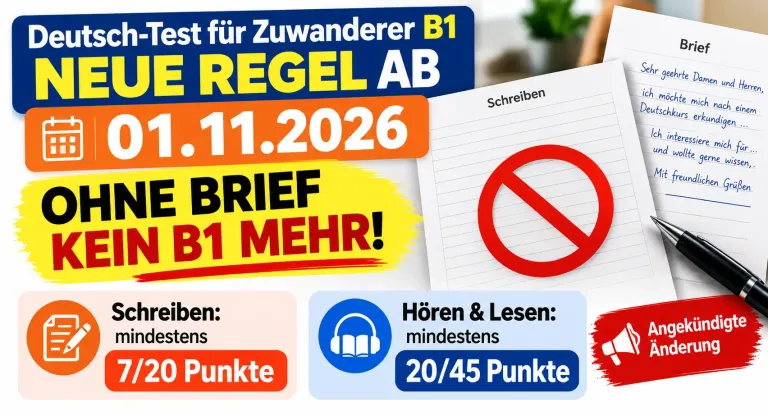
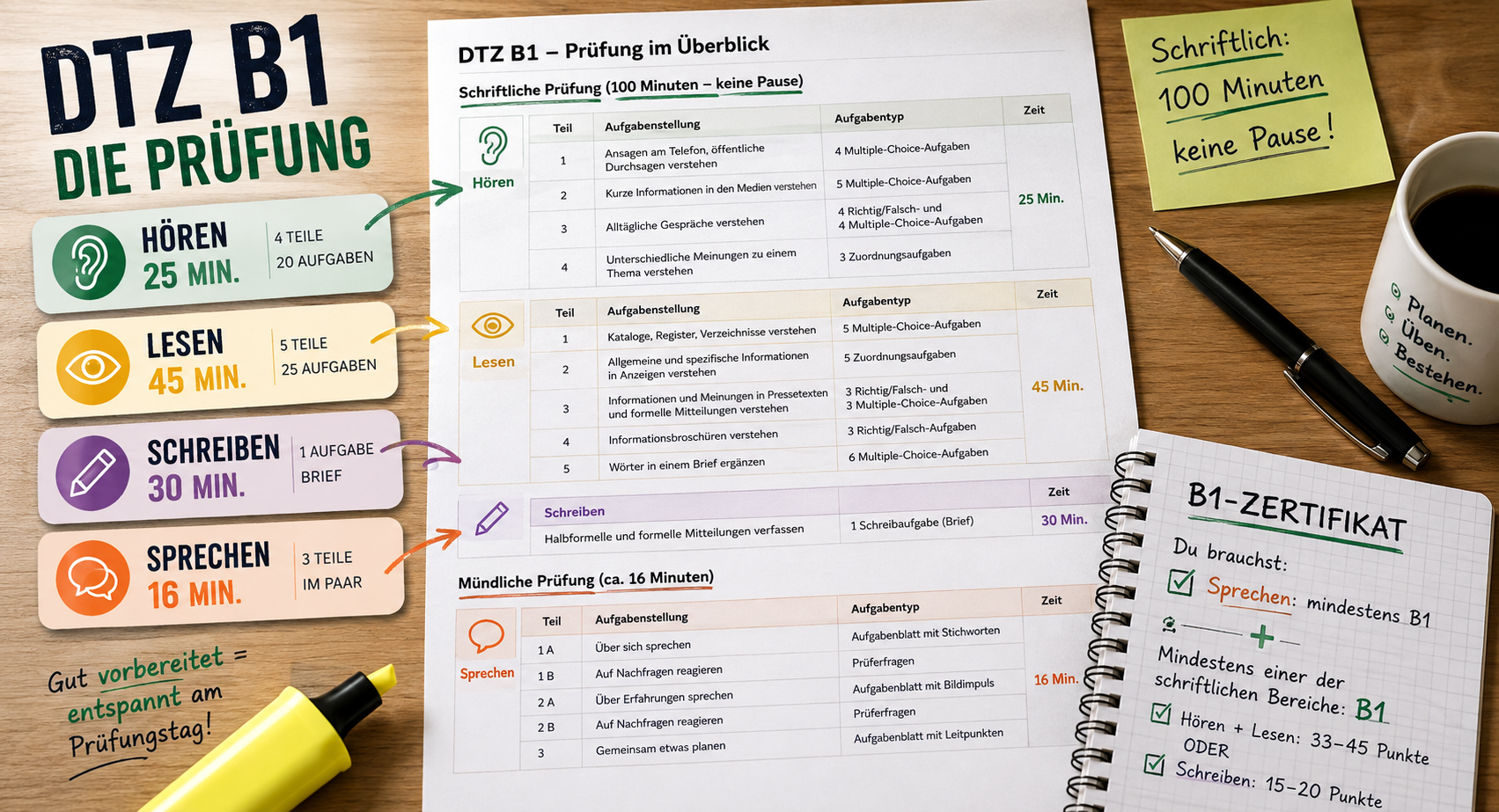
To achieve B1 in Speaking, you need 75 out of 100 points; for A2, you need at least 35 points. If your Speaking result is below A2, you do not receive a DTZ certificate, only a result sheet. This also applies if your results in the written sections are good. This rule is stated on the g.a.s.t. page „Der DTZ auf einen Blick“.
👉 Continue to Part 2: Describe a picture and talk about experiences 👉 All exercises for the DTZ B1 Speaking section





There are no comments for this article. Leave your comment