





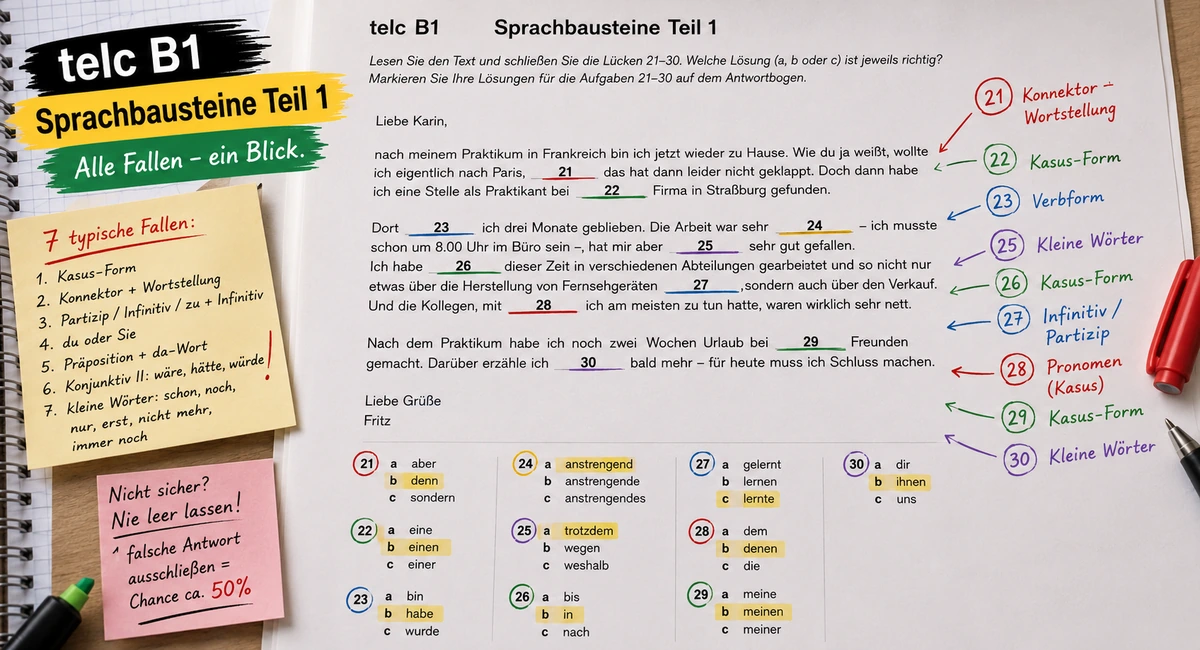
Sprachbausteine Part 1:
all the traps at a glance
In Sprachbausteine Part 1 all three answers often look correct. Here you get to know the typical traps with which the exam tests you – with clear examples and a simple explanation of why the wrong options are wrong.
Why are there traps at all?
In Sprachbausteine Part 1 only one of three answers is correct. The other two are not random words: they are deliberately chosen so that they fit at first glance. Exactly that is the difficulty. A wrong option may sound good, but has the wrong case, the wrong verb form or does not fit the word order.
The good news: it is always the same kinds of traps. If you know these patterns, you recognise the trap already while reading – and choose the right answer with confidence.
A wrong option is almost never completely senseless. It is wrong in only one point: case, form, word order or meaning. Your task is to find exactly this one point.
Trap 1: The dictionary form (Kasus trap)
This is the most common trap. An option shows the word in the form you know from the dictionary (nominative). But the sentence requires a different case – mostly accusative or dative.
Ich danke dir für (...) Hilfe. (I thank you for your help.)
a) dein b) deine c) deiner
Correct: b) deine. danken für requires the accusative: für deine Hilfe. The dictionary form dein (nominative) is the trap.
This trap also occurs with prepositions that describe a place. Here you often have to take the dative:
Wir wohnen seit zwei Jahren in (...) Haus. (We have been living in this house for two years.)
a) dieses b) diesem c) diesen
Correct: b) diesem. in for a place (Wo?) requires the dative: in diesem Haus. dieses (nominative) and diesen (masculine accusative) are the traps.
With every article, pronoun or adjective ask: which case is needed here? Look at the verb (danken für → accusative) or the preposition (in + place → dative).
Trap 2: The connector and word order
Connecting words like aber, denn, weil, obwohl, trotzdem and sondern have similar meanings, but they change the word order differently. The trap: an option fits the meaning, but not the sentence position.
| Type | Examples | Where does the verb stand? |
|---|---|---|
| main-clause connector | und, aber, denn, oder, sondern | verb in the normal position (position 2) |
| conjunctional adverb | trotzdem, deshalb, daher, außerdem | verb directly after (position 2 after the connector) |
| subordinate-clause connector | weil, obwohl, dass, damit, wenn | verb right at the end |
Es war kalt. (...) nahm ich keine Jacke mit. (It was cold. ... I did not take a jacket.)
a) Trotzdem b) Obwohl c) Weil
Correct: a) Trotzdem. After trotzdem the verb comes immediately: Trotzdem nahm ich .... Obwohl and Weil would send the verb to the end (... ich keine Jacke mitnahm) – that does not fit here.
sondern always needs a negation before it: nicht ... sondern. Without nicht or kein, sondern is almost always wrong – then aber usually fits.
Example: Das Buch war nicht teuer, sondern sogar billig. (correct, because nicht stands before it)
Look not only at the meaning, but at the verb: does it stand in second position or at the end? By this you recognise whether a main-clause connector or a subordinate-clause connector fits.
Trap 3: Verb form – participle, infinitive or zu-infinitive?
Very often three forms of the same verb are up for choice, for example gemacht, machen and zu machen. The trap: all three are real forms, but only one fits the construction in the sentence.
| If the sentence has ... | ... then you need | Example |
|---|---|---|
| haben or sein (present perfect) | Partizip II (past participle) | Ich habe es gemacht. |
| a modal verb (können, müssen ...) | infinitive without zu | Ich muss es machen. |
| verbs like versuchen, sich lohnen | infinitive with zu | Ich versuche, es zu machen. |
Ich habe gestern einen langen Brief (...). (Yesterday I wrote a long letter.)
a) schreiben b) geschrieben c) zu schreiben
Correct: b) geschrieben. habe ... geschrieben is present perfect, so Partizip II. schreiben and zu schreiben are the traps.
Es hat sich gelohnt, früh (...). (It was worth getting up early.)
a) aufstehen b) aufgestanden c) aufzustehen
Correct: c) aufzustehen. Es hat sich gelohnt ... requires an infinitive with zu. With separable verbs the zu stands in the middle: aufzustehen.
Look for the signal word in the sentence: a haben/sein (→ Partizip II), a modal verb (→ infinitive without zu) or a verb that requires zu (→ zu-infinitive).
Trap 4: The address du or Sie
Every letter is either on du or on Sie. This address applies to the whole text and decides pronouns and imperative. The trap: an option belongs to the wrong address.
Ich möchte (...) herzlich zu meinem Fest einladen. (I would like to cordially invite you to my party.)
a) dich b) Sie c) euch
Correct: b) Sie. The whole letter is politely on Sie. dich (du) and euch (ihr) are the traps.
(...) mir bitte bald zurück! (... back to me soon, please!)
a) Schreiben Sie b) Schreib c) Schreibt
Correct: b) Schreib. With du the imperative is Schreib. Schreiben Sie (Sie) and Schreibt (ihr) do not fit.
The address does not depend on the tone, but on the form. A very friendly letter can still be on Sie. Look right at the beginning: Liebe ... with du or Sehr geehrte ... with Sie? This decision then applies to all gaps.
Trap 5: Preposition and pronominal adverb
Many verbs and adjectives have a fixed preposition: sich freuen auf, denken an, warten auf, sich kümmern um. The trap: an option offers a preposition that belongs to a different verb.
Ich kümmere mich (...) die Anmeldung. (I take care of the registration.)
a) auf b) um c) an
Correct: b) um. It is sich kümmern um. auf and an belong to other verbs.
When the object is not named, verb + preposition becomes a pronominal adverb with da(r)-: sich freuen auf → darauf, denken an → daran, sprechen von → davon.
Ich freue mich schon sehr (...)! (I am already really looking forward to it!)
a) darauf b) darum c) damit
Correct: a) darauf. sich freuen auf becomes darauf. darum and damit belong to other verbs.
| Verb + preposition | pronominal adverb |
|---|---|
| sich freuen auf | darauf |
| denken an | daran |
| sprechen von, erzählen von | davon |
| sich kümmern um | darum |
| sich gewöhnen an | daran |
Always learn important verbs together with their preposition. Whoever knows that it is sich freuen auf chooses darauf with confidence.
Trap 6: Subjunctive wäre, hätte, würde
The Konjunktiv II (subjunctive II) expresses politeness or something unreal (wäre schön, hätte gern, würde mich freuen). The trap: you confuse wäre and hätte, or you take würde where a simple form is better.
Das (...) wirklich schön. (That would be really nice.)
a) hätte b) wäre c) würde
Correct: b) wäre. sein has its own subjunctive form: wäre. hätte belongs to haben, and würde is not needed here.
Ich (...) mich sehr freuen, wenn Sie kommen. (I would be very glad if you come.)
a) würde b) wurde c) werde
Correct: a) würde. Ich würde mich freuen ... is the polite subjunctive. Careful: wurde (with u) is past tense – that is the trap.
würde (subjunctive, with ü) and wurde (past tense, with u) look almost the same. Read carefully: is it about a polite request or a wish? Then würde is correct.
Trap 7: Small words with a big effect
Sometimes all three options are grammatically possible, and only the meaning decides. This concerns small words like schon, noch, nur, einfach, erst or fixed combinations like nicht mehr, immer noch, noch nicht.
Wir haben die Reihenfolge (...) nicht festgelegt. (We have not yet fixed the order.)
a) schon b) noch c) nur
Correct: b) noch. noch nicht means bis jetzt nicht (not until now). schon nicht and nur nicht make no sense here.
- noch nicht – not until now
- nicht mehr – yes before, not now
- immer noch – still, without change
- erst – not earlier than (in time)
If all three options fit grammatically, it is about the meaning. Read the sentence slowly and ask yourself: which small word really makes sense here?
And if you do not recognise the trap? Guess!
Sometimes you see a gap and simply do not know which answer is correct. No problem. There is a golden rule for Sprachbausteine Part 1:
Never leave a gap empty. When in doubt: guess!
Why is it worth it? Quite simply – do a quick calculation:
| Situation | Your chance for the point |
|---|---|
| leave the gap empty | 0 percent – certainly no point |
| simply guess (a, b or c) | about 33 percent |
| cross out one wrong option, then guess | about 50 percent |
That is much better than any lottery! In the lottery almost no one wins. Here you have at least a one-in-three chance for a point at every gap – and with a clever look even a one-in-two chance.
First cross out the option that seems the most impossible to you. Now you are at a 50-50 chance. And think of the address (du or Sie) – often one option drops out immediately with that.
Every answered gap can be a point. Every empty gap is certainly zero. So always give an answer – you have nothing to lose and one point to gain.
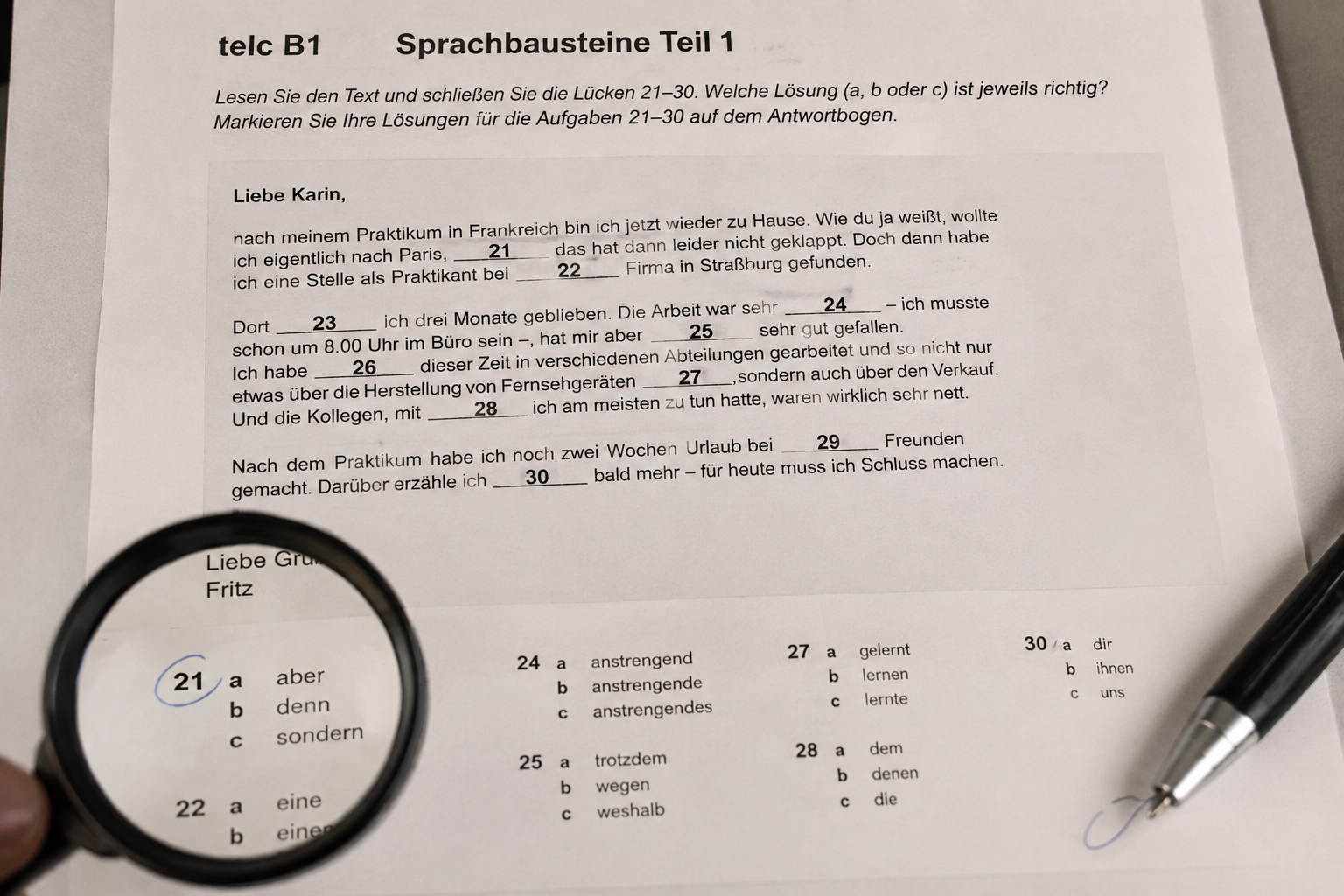
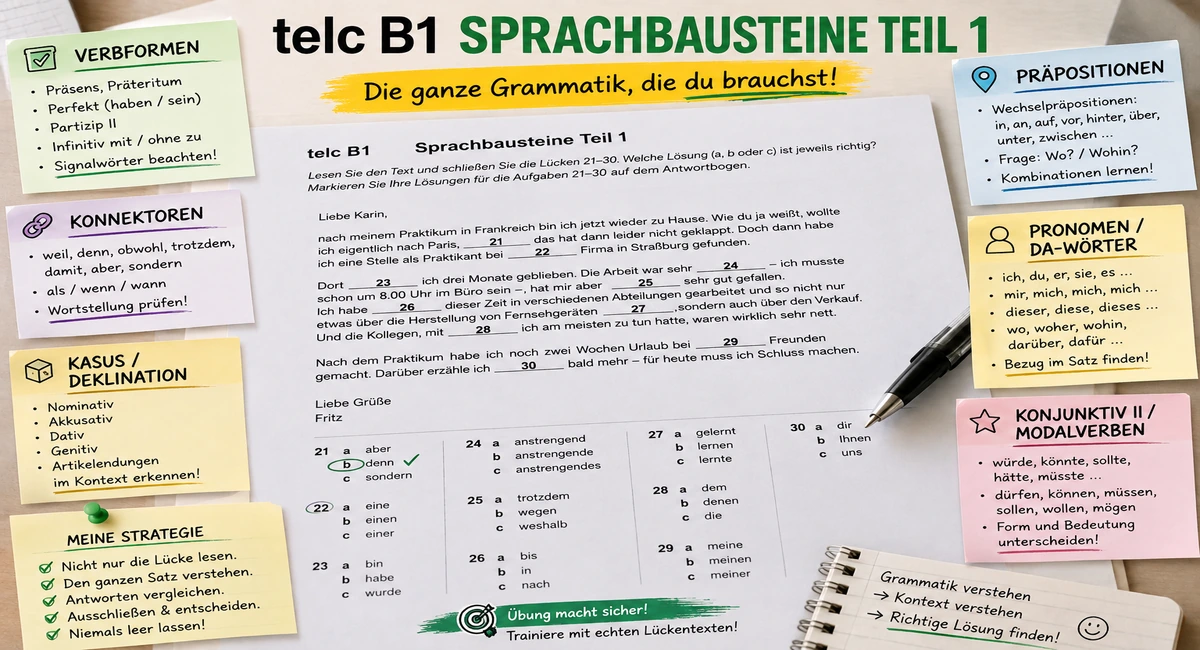
You now know all the traps – but do you also recognise them in a real text? Take the test: open an original task and try to find the trap yourself at every gap. That is the best training for the exam.
FAQ on the traps in Part 1
Basis for structure and task type: official telc practice test Zertifikat Deutsch / telc Deutsch B1, telc gGmbH, Frankfurt a. M. You find the official practice test free at www.telc.net.





There are no comments for this article. Leave your comment