





Goethe B2:
Exam Structure, Tasks and Tips
Goethe B2 at a glance: exam structure, task formats and practical tips for effective preparation and confident success.
What is the Goethe-Zertifikat B2?
The Goethe-Zertifikat B2 is offered by the Goethe-Institut. It confirms an advanced language level and corresponds to the fourth level (B2) of the Common European Framework of Reference for Languages (CEFR). The candidate communicates freely and is able not only to understand the language, but also to use it in everyday and work situations.
The Goethe-Zertifikat B2 is an official document certifying language skills at the corresponding level. It is issued by the Goethe-Institut, one of the most renowned institutions worldwide in the field of German language learning.
Who is the Goethe-Institut B2 exam suitable for?
The Goethe-Zertifikat B2 is suitable for young people and adults who wish to demonstrate advanced knowledge of German. It is recognised as proof of language proficiency in visa procedures for finding an apprenticeship place and may be accepted by universities in Germany. The requirements applicable in each case should always be checked with the respective institution. This level is considered above average. It enables candidates to converse effortlessly with native speakers, conduct complex discussions, represent their own point of view and compose structured, logical documents, messages and comments.
Overview of the structure of the Goethe B2 exam
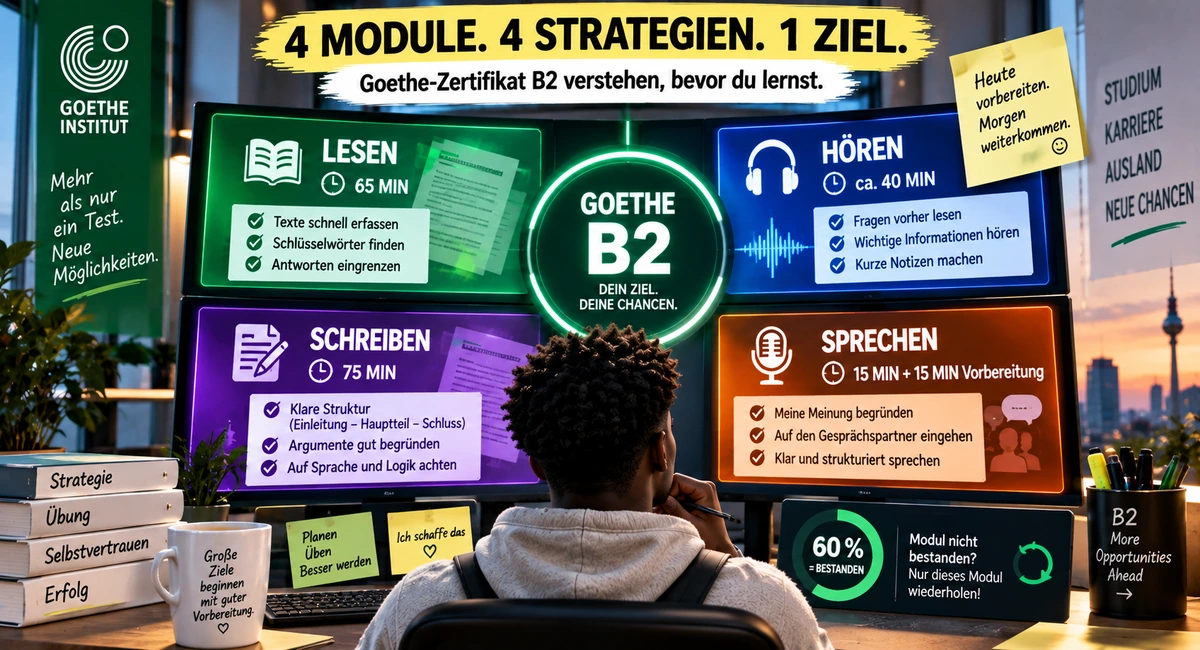
The structure of the Goethe B2 exam consists of four blocks of exercises for testing specific competences. For each module there are typical tasks and a scoring system for assessment.
Reading
The Reading module of the Goethe B2 tests whether participants understand written texts at B2 level and can confidently grasp information, viewpoints and contexts.
Task formats
The Reading module consists of five parts with different task formats, including matching tasks and multiple-choice tasks. Among other things, understanding of information, viewpoints, attitudes, rules and instructions is tested.
Duration
The Reading module lasts 65 minutes and consists of five parts. Participants read several texts and complete various tasks relating to them.
Assessment
The examiner takes into account the accuracy of information retrieval, understanding of context and the ability to draw logical conclusions. The candidate must demonstrate their ability to identify the main ideas of the text, the author's most important ideas, objectives and arguments, and to find specific facts and details in the text. It is important to interpret information correctly. This means not only understanding the obvious content, but also hidden meanings or undertones.
Listening comprehension
The Listening comprehension of the Goethe B2 is the part of the exam that tests the candidate's ability to understand German. The materials can be quite complex, with a fast speaking pace and a large amount of information. The ability to navigate unfamiliar topics and identify the key points is important.
Conversation formats
When taking the Goethe B2 test in the form of a listening comprehension test, candidates work with various types of recordings. The following may be used in this section:
- dialogues and monologues on everyday, social and professional topics;
- interviews;
- lectures or conversations on more abstract topics (politics, culture, economics).
As a rule, all tasks are based on real situations. This means that materials about ordinary everyday events are used.
Note-taking strategies
The ability to take notes quickly while listening to audio recordings enables you to retain as much information as possible while accurately preserving the meaning. During training you must learn to quickly and clearly identify the core ideas and convert them into simple, comprehensible theses. It is practical to record information using abbreviations:
- e.g. — for example;
- re. — regarding;
- due to — due to;
- i.a. — among other things;
- Pro / Con.
Schematic representations also help to record data quickly. You can invent your own representations or use standard ones:
- → consequence;
- ← cause;
- ↔ comparison;
- ↑ ↓ increase/decrease.
The ability to listen attentively to audio recordings, quickly filter out the main ideas and key points, and immediately represent these using diagrams or abbreviations significantly increases the chances of completing the module tasks fully and correctly.
Time structure
The Listening module lasts approximately 40 minutes and consists of four parts. Participants listen to several texts; depending on the task section, these are played once or twice.
Writing
The Writing module lasts 75 minutes and consists of two parts. In Part 1, participants write a forum post; in Part 2, a message.
Text types
In the model set, participants write a forum post on a current topic in Part 1 and a message in a professional context in Part 2. In the model set, a minimum of 150 words is required for Part 1 and 100 words for Part 2.
Assessment criteria
The examiner pays attention to:
- Content (correspondence with the task, logic, sufficient detail);
- Structure (presence of an introduction, main body and conclusion, as well as clarity and comprehensibility of the presentation);
- Language competences (grammatical correctness, range of vocabulary, stylistic adaptation).
The overall assessment for the module depends on compliance with spelling and punctuation rules as well as the appropriateness of the style and tone in accordance with the task format.
Speaking
The Speaking module lasts 15 minutes. The preparation time is 15 minutes. The module consists of two parts: a short presentation with subsequent follow-up questions and a discussion.
Presentation and follow-up questions
The candidate's task is to prepare and deliver a monologue. Several minutes are available for the presentation. It is important that the narrative is coherent and logical, so a standard structure (introduction, main body, conclusion) must be carefully planned and clearly adhered to. The most important assessment criteria are: clarity and richness of language, well-founded justifications, grammatical correctness of phrases and lexical variety.
Discussion
The candidate must interact with the examiner or another student and discuss the proposed topic. The aim of this part is to test the ability to present arguments, listen to and understand the interlocutor, give detailed answers, engage in dialogue and sustain a conversation on complex topics. As a rule, these relate to daily life, interests and experiences.
We present the key information about the Goethe B2 exam in a table for better visual comprehension.
| Module | Duration, min. | Task | Points | Particularities |
|---|---|---|---|---|
| Reading | 65 | Five parts with different task formats | 100 | Tasks for understanding texts of different styles, testing the ability to filter out important information |
| Listening | approx. 40 | Listening to audio recordings, selecting correct answers, filling in gaps | 100 | Working with audio recordings of different formats (public speeches, conversations, interviews), testing listening comprehension |
| Writing | 75 | Writing a forum post and a message | 100 | The ability to justify an opinion, structure a text correctly and use grammatical constructions is tested. |
| Speaking | 15 | Short presentation with follow-up questions and discussion | 100 | The ability to discuss and argue freely, as well as clarity of language and interaction with the interlocutor, are tested. |
Task formats in the Goethe Test B2: detailed analysis
When sitting the B2 German exam at the Goethe-Institut, candidates must complete typical tasks of different formats and levels of difficulty. To prepare properly and successfully pass the Goethe B2 exam, use the practical online exercises from Deutsch Vorbereitung, available around the clock. All tests correspond to the format of the official exam tasks.
Reading: strategies for all parts
To master the B2 reading module, it is not enough to simply have the required knowledge of German. It is important to develop an effective strategy during the learning and training process that leads to a positive result. Let us look more closely at the tried-and-tested tactics.
Skimming
Skimming is a form of speed-reading to quickly grasp the basic idea of a text without getting lost in details. The strategy consists of the following steps:
- Read the heading and subheadings.
- Pay attention to the first and last paragraph.
- Mark keywords (names, dates, proper nouns).
- Skim through the first sentences of each paragraph.
Skimming makes it possible to understand the topic and general content of the text in the shortest possible time.
Multiple choice
To successfully complete the reading section tasks, you should apply a tried-and-tested algorithm:
- Pay attention to the questions before the text.
- Look for keywords.
- Do not get stuck on a single option.
- Immediately eliminate clearly incorrect answers.
The time available for the exam is limited, so maximum concentration and attention are required.
Matching
Quick and correct matching of information from the text to the answer options is facilitated by the following sequence:
- study the structure of the text;
- find synonyms and paraphrases;
- carefully study each answer option;
- carry out a final check of the completed task.
To avoid missing important details and wasting time on repeated research, you can make careful notes during learning.
Listening comprehension: recognising keywords
Both systematic preparation and an effective strategy are important for successfully passing the listening comprehension module. When developing such a strategy, factors such as advance research, the ability to take notes and avoiding distractions can be taken into account.
Advance familiarisation
Learning to make proper use of the time set aside for familiarising yourself with the questions can give you an advantage in the official exam. Looking at the tasks before listening to the audio recording allows you to get accustomed to their format, prepare yourself for dealing with the topic and make short notes to help you navigate more easily during playback.
Notes
It is important to record keywords. They serve as "anchors" when searching for the desired information. It is also necessary to write down new, as yet unknown words. One should try to understand their meaning from context. To navigate more easily through the notes, a system of markers or annotations can be introduced. For example, keywords can be highlighted in bold or in colour, and new words can be underlined.
Avoiding distractions
Listening comprehension often seems difficult because of an inability to concentrate. It is important during training to create conditions as close as possible to those of the actual exam. In addition, one should get used to different accents and speeds of recordings.
Writing: structured argumentation
The Goethe B2 written exam tests not only the candidate's spelling and their ability to use complex constructions and formulate long sentences. Examiners place value on the correct structure of the finished text and the persuasiveness of the arguments presented.
Structure: introduction – main body – conclusion
To confirm level B2, a rich vocabulary and correct but short, concise sentences are not enough. The exam is passed by candidates who can write clear, logical texts corresponding to the structure of introduction – main body – conclusion. Care should be taken to ensure that the transitions from one paragraph to the next are smooth.
Vocabulary
At B2 level, the use of thematic vocabulary (work, education, health, technology, etc.) is a mandatory requirement for confirmation during the written exam. It is important to avoid word repetition by using synonyms and fixed expressions. A good solution is to learn useful patterns. For example, to express one's own opinion, the following phrases are useful: "In my opinion…", "I am convinced that…", "It is important to emphasise…".
Coherence
To ensure the text is consistent and logical, you should create a brief plan before writing. A high B2 level is demonstrated by the following factors:
- Clear structuring of paragraphs. One block – one idea.
- Logical connections between sentences and paragraphs.
- Strict adherence to the task format. Style, presence of a greeting, summary or conclusion.
Speaking: confident argumentation
Confirming B2 level requires the ability to clearly present one's own point of view and to be convincing in dialogue with the interlocutor. To achieve good marks in the exam, it helps to focus on the most important points. Let us look at these more closely.
Justifying an opinion
One must formulate one's position clearly. Where possible, one should be brief so that the interlocutor does not lose the thread. One should choose precise formulations and expressions and demonstrate a rich vocabulary. Examples, comparisons, facts and statistics help to be convincing.
Involving the partner
Examiners evaluate the activity of candidates positively. Answers should not be short and monosyllabic. It is important to maintain the dialogue correctly: ask questions, react to the opinions and utterances of the interlocutor, encourage the exchange of arguments.
Time management
When preparing for the exam, one must learn to manage time correctly. Speech should be fluent and moderately fast, but one should not dwell too long on a particular argument. It is important to address all points planned in advance.
Scoring system and minimum score
To successfully pass the Goethe B2 exam, one must not only learn its structure, practise typical tasks and bear timing in mind, but also thoroughly understand the scoring system. Having familiarised yourself with the details in advance, you will not be tempted during the exam — which is a stressful situation — to distract yourself with speculation about the points and the principles of their allocation.
Explanation of the scoring system
The distribution of points in the Goethe B2 is carried out step by step, taking into account the exam structure. A maximum of 100 points can be achieved in each module. A module is passed when at least 60 points, i.e. 60%, are achieved.
Minimum requirements
To pass the exam, at least 60% of the maximum possible score must be achieved. There are situations where the overall result is well above 60%, but very low results were achieved in one or more modules. This means that the candidate must retake those modules. The points achieved in a successfully completed module remain valid until the next attempt.
Is it possible to retake individual modules?
The Goethe B2 format makes it possible to retake individual parts rather than the entire exam. This feature enables candidates to focus on problematic skills rather than spreading their efforts across all tasks as in previous attempts.
| Module | Maximum score | Minimum score (from 60%) |
|---|---|---|
| Reading | 100 | 60 |
| Listening | 30 | 18 |
| Writing | 100 | 60 |
| Speaking | 100 | 60 |
| Total | 120 | 72 |
Typical mistakes in the Goethe B2 exam
The Goethe B2 exam tests various competences, so candidates must work through a large number of typical tasks during the preparation phase. Training often leads to difficulties. These can be related to stereotypical thinking, incorrect time management or incorrect prioritisation. Let us look more closely at some typical mistakes.
Unstructured texts in the written part
One of the serious mistakes that leads to point deductions is the absence of a clear structure in the essay or letter. If a student has prepared a text with interesting ideas using grammatical constructions, but has not ensured clear paragraphs and smooth transitions between them, a logical sequence of thoughts and the use of linking words, the examiner will award a low score due to the absence of correct organisation. It is important to always work according to a plan: introduction, main body, conclusion.
Answers that are too short in the oral part
One-word answers or very short questions to the interlocutor are a common mistake among candidates who wish to confirm B2 level in German. Such behaviour gives the lasting impression that a particular person's language competence is low. By giving more detailed answers, citing examples and explaining your thoughts, you can demonstrate your extensive vocabulary and language competence.
Time problems with reading
The duration of the Goethe B2 exam is clearly regulated, with only a limited amount of time available to study the material. It is important to learn to manage time during exam preparation. Without discipline, it may happen that not all texts can be read or that answers must be given very quickly, leading to mistakes. It is best to get into the habit of completing the easy tasks first and leaving the more difficult ones for later.
Missing details in listening comprehension
Fast speech in the recording or insufficient concentration by the candidate while listening to the audio are the most common reasons for failing the exam. If important details are missed, it is impossible to give a complete or accurate answer. One should get into the habit of concentrating during the test, highlighting keywords and briefly noting the essentials from the text.
Differences: Goethe B2 vs. Telc B2
There are several exam options for confirming B2 level in German. However, they place emphasis on different skills, differ in task format and may have nuances in the scoring system. To demonstrate competences at the corresponding level, you should familiarise yourself with the differences between Telc B2 and Goethe B2 — a clear understanding of the requirements and particularities enables you to set the right priorities, manage your time effectively and achieve the desired results.
The most important points are listed in the table.
| Criterion | Goethe B2 | Telc B2 |
|---|---|---|
| Focus | Argumentation, logic, attention to detail | Practical use of language, communication in everyday situations |
| Written part | Letter, essay with clear structure | Letter or message, usually shorter and more concrete |
| Oral part | Monologue + dialogue with a partner. Structure and logic are assessed | Dialogues, role plays. Communicative effectiveness is assessed |
| Listening comprehension | Longer texts, detailed understanding | Key details, quick reaction to content |
| Preparation | Train long texts, argumentation, detailed listening comprehension | Train short dialogues, role plays and everyday situations |
| Assessment | Grammar, style, logical sentence structure, vocabulary | Communicative ability, correctness of answer, practical use of language |
Official materials and resources
Proper preparation for the exam increases the chances of successfully confirming Goethe B2 level. For training, you should select official materials and reliable resources offered by professional trainers that replicate the tasks of the actual exam.
Practice materials from the Goethe-Institut
On the Goethe-Institut website you will find useful information on the following topics:
- the structure of the exam and the requirements for language knowledge;
- why the certificate is needed;
- courses organised by the Goethe-Institut;
- the registration procedure and the conduct of tests.
On our website you will find examples in a clear format as well as Goethe B2 exercises for completing practical tasks.
Books and online courses
Candidates who prefer to work with books will find a selection of literature on the Goethe-Institut website that can help them. These are B2-level textbooks with which various competences can be trained: practising speaking, improving grammar, reading texts of the desired type, etc.
Choose a format suitable for you to prepare for B2 level. Various learning materials and exercises are available for the targeted development of specific competences. Use the Deutsch Vorbereitung platform for convenient and effective online learning at any time and from any location.



There are no comments for this article. Leave your comment