





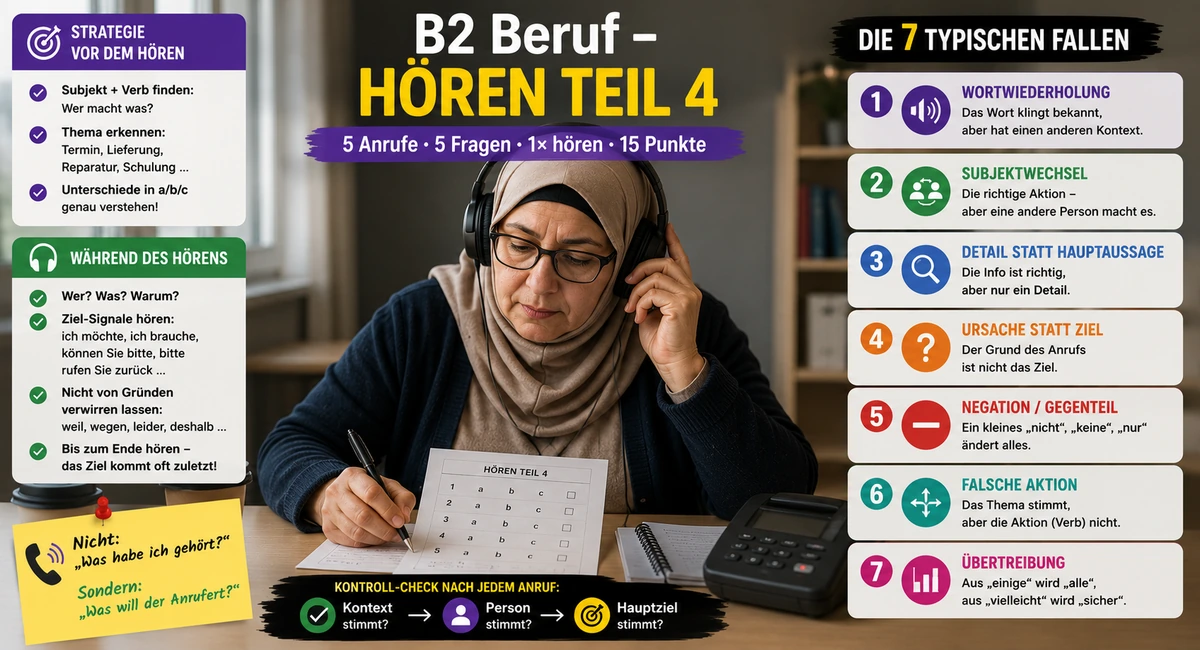
Hören Teil 4:
Strategy and 7 traps you need to know
How to quickly identify the goal of each caller, avoid the typical traps and achieve the full score in Hören Teil 4 of the DTB B2.
What is Hören Teil 4? — Format and basic principle
Hören Teil 4 is, in the opinion of many candidates, the easiest part of the listening exam in the Deutsch-Test für den Beruf B2. The structure is always the same, the task is clear, and there are — compared to other parts of the listening exam — only three answer options per task. That is precisely why many candidates achieve their highest score here.
Nevertheless, it is easy to lose points here if you do not know the typical traps. In this article you will first learn how to prepare and what to pay attention to while listening. Then you will learn about the seven traps that appear in almost every B2 Beruf exam.
The format
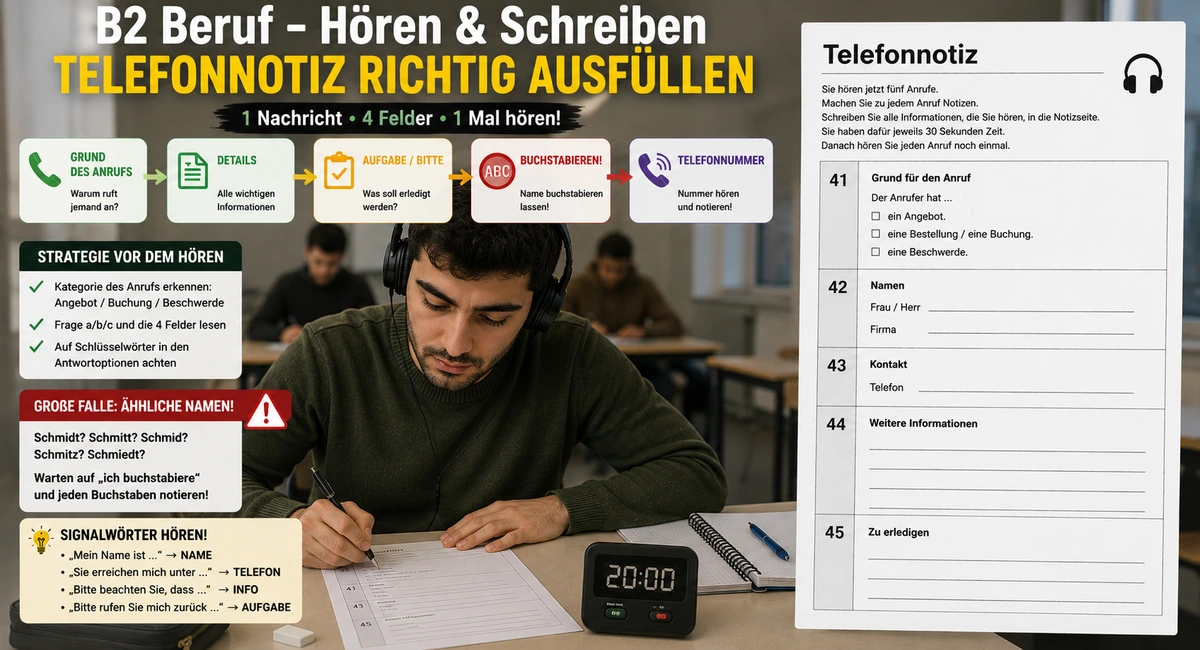
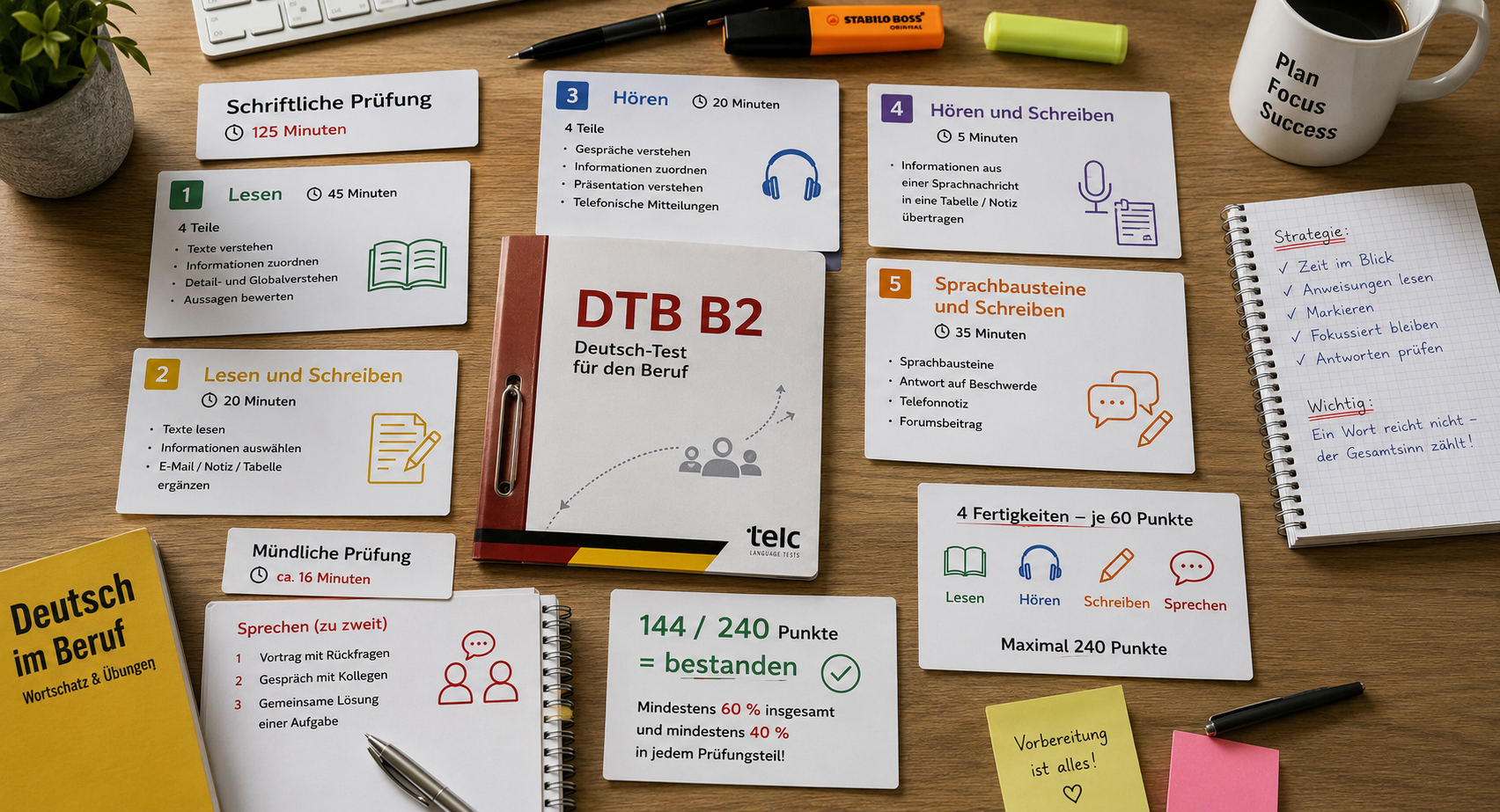
Hören Teil 4 tests the ability to understand short telephone messages from everyday professional life and to identify the caller’s concern. The most important key data:
- 5 short telephone messages — messages on the answering machine or voicemail;
- Each message lasts approx. 20–40 seconds;
- For each message there is a task with three answer options (a, b, c);
- Only one option is correct;
- You hear each message only once;
- 3 points per correct answer — 15 points in total.
What is the content about?
The messages always come from everyday professional life. A colleague cancels an appointment, a business partner orders something, a manager gives instructions, a supplier informs about a delay. You typically hear:
- Cancellations or rescheduling of appointments;
- Requests for a callback, confirmation or help;
- Information about deliveries, orders or complaints;
- Reminders about deadlines or rules;
- Requests for an appointment, a meeting or a presentation.
| Criterion | Hören Teil 4 — key data |
|---|---|
| Number of tasks | 5 telephone messages |
| Format | Multiple choice — 3 options (a, b, c), only one correct |
| Listening frequency | Each message is heard once |
| Points per task | 3 points |
| Total score | 15 points |
| Content focus | Concerns and requests in the workplace |
The central question: What is the goal of the call?
The most important thing from this article is this one rule: Hören Teil 4 is always about the goal of the caller. That means: what does this person want to achieve? Why are they calling?
The correct answer does not describe a detail, not the reason, not the background. It describes what the caller really wants.
In every message there is one main idea and many pieces of secondary information. The wrong options almost always contain secondary information that really does appear in the text — but is not the main goal. That is precisely what makes them so dangerous.
The test in one sentence
After each message, try to summarise the goal in a single sentence. Something like this:
- Die Anruferin will einen Termin verschieben.
- Der Anrufer bittet um Rückruf.
- Die Anruferin informiert über eine verspätete Lieferung.
- Der Anrufer erinnert an eine Frist.
- Die Anruferin bittet einen Kollegen, eine Aufgabe zu übernehmen.
If you can do that, the correct option is easy to find. It is always the option that best translates this sentence into different words — not the one that repeats a word from the text.
Strategy — before listening
Before each listening sequence you have approximately 60 seconds of reading time. This time is worth its weight in gold — use it systematically.
What you do in these 60 seconds
- Read all three options for each task — not just the first one, not just the shortest. You need to know what the wrong options offer.
- Mark the verb in each option. The verb is the action — what is being done: bittet, möchte, informiert, sucht, erinnert, kann nicht, hat...
- Also mark the subject. The subject is the person — who does it: the caller herself, the person being called, or a third party (a customer, a manager, a colleague).
- Look for the topic. What is the task about? Appointment, delivery, repair, training? If you know the topic, you are oriented when listening.
- Pay attention to the differences between the options. Often a, b and c differ in only one word or one person. That one word is usually the trap.
The heart of every option is the subject (who?) and the verb (what?). These two together tell you what the option claims.
In the listening text you will almost never find the subject and verb of the correct option with the same words. You will find them with different words — usually with synonyms or paraphrases.
Example:
In the audio: Ich muss meine Tochter aus der Schule abholen.
Correct option: ...muss sich um seine Tochter kümmern.
The subject is the same (himself). The action is equivalent in meaning: abholen corresponds to sich kümmern. But the words are different. Whoever only waits for identical words will not find the correct answer — and will end up choosing an option that repeats a word from the text but does not describe the goal.
Do not mark names, numbers or dates in the options. These are almost never the key to the correct answer — far more often they are precisely the repetitions that the wrong options use to mislead you.
Strategy — while listening
As soon as the message begins, there are three things you must concentrate on: who, what, why.
Who does what?
In every message there are at least two people — the caller and the person being called. Sometimes further people appear: a customer, a manager, a colleague, a supplier. You must understand exactly who performs which action. One of the most common traps is confusing the person.
Pay attention to signal words
Certain words show you where the goal really is and where only secondary information appears:
- Goal signals: ich möchte, ich brauche, können Sie bitte, ich würde gerne, bitte rufen Sie zurück, könntest du, ich bitte um, ich erinnere an...
- Reason signals (caution — this is not the goal!): weil, wegen, leider, deshalb, da, aufgrund...
- Time signals: heute, morgen, nächste Woche, in den nächsten Tagen, schnell, dringend...
The goal usually comes at the end
In most messages the context is explained first (what it is about), then the reason (why something is not working out), and only then the actual goal (what the caller wants). If you lose the thread at the beginning, stay calm — the most important part often comes only in the last few seconds.
The decision rule — three control questions
If after listening you are wavering between two options, three simple questions will help you. Check each remaining option in turn:
- Is that really in the text — and in the right context? Just because a word appears in the text does not mean the option is correct. Check whether the whole statement is true — not just one word.
- Who does that? The caller herself or someone else? If the option attributes to the caller something that is actually done by the person being called or a third party — it is wrong.
- Is that the main goal or just a detail? A true piece of secondary information is still the wrong answer if it is not the reason for the call.
The correct answer passes all three questions with yes. If an option fails even at one point, it is wrong — no matter how plausible it sounds.
The 7 typical traps
Now let us look at the seven traps that appear again and again in Hören Teil 4. For each trap there is a short mini-situation so that you can recognise the mechanism.
Trap 1 — The word repetition trap
A word from the text appears in exactly the same form in an option — but in the wrong context. This trap is the most common and confuses learners who only listen for individual words instead of the whole sentence.
From the call: ...wir haben kurzfristig eine Besprechung mit unserem Kunden aus Salzburg...
✗ Wrong option: trifft einen Kunden zum Mittagessen.
The word Kunde does really appear in the text — but the customer from Salzburg is the reason for the cancellation, not a conversation partner at lunch.
How to recognise it? When a word from the text appears in an option, ask yourself immediately: Does it appear there in the same context too?
Trap 2 — The subject switch trap
The action in the call is correct — but the option attributes it to the wrong person. Often the caller and the person being called are swapped, or a third person appears incorrectly.
From the call: ...bitte kümmere du dich heute um die Präsentation, ich bin im Krankenhaus...
✗ Wrong option: hält heute die Präsentation.
The presentation is really taking place — but the caller wants the colleague to take it over. He himself cannot.
How to recognise it? Check for every option: Is it the caller herself who does that — or is she asking someone else to do it?
Trap 3 — The detail instead of main statement trap
The statement in the option really is contained in the text — but it is only a secondary detail, not the goal of the call. This trap is particularly difficult because it does not confuse you with false information, but with true information.
From the call: ...wir brauchen die neuen Stühle dringend für die Konferenz nächste Woche. Können Sie mir bitte den Liefertermin heute noch bestätigen?...
✗ Wrong option: braucht die Stühle dringend.
True — she urgently needs the chairs. But that is only a detail. Her actual goal is the confirmation of the delivery date.
How to recognise it? Ask yourself: Is that the reason for the call — or just a piece of information on the side?
Trap 4 — The cause instead of goal trap
Something is mentioned in the text as a reason — and the wrong option presents it as the goal. You recognise this trap by signal words such as wegen, weil, leider, deshalb.
From the call: ...Frau Becker ist wegen einer Inventur diese Woche verhindert. Sie wollte eigentlich das Marketingkonzept besprechen...
✗ Wrong option: möchte eine Inventur auswerten.
The stocktaking is only the reason why Frau Becker cannot make it. The actual topic is the marketing concept.
How to recognise it? What comes after weil, wegen, leider is never the goal. It is always the reason.
Trap 5 — The negation trap
The option says the opposite of what is in the text. This trap is easy to recognise if you listen carefully — but difficult if you only catch one or two words.
From the call: ...bisher gab es nur positive Rückmeldungen zu unseren Workshops...
✗ Wrong option: hat Beschwerden über den Workshop bekommen.
This is the exact opposite of what is said. Pay attention to words like nur, immer, keine, nicht — they often show the correct assessment.
How to recognise it? Check the assessment: positive or negative, much or little, always or never. A small negation can reverse the entire meaning.
Trap 6 — The wrong action trap
The topic and the people are correct — but the verb (the action) is wrong. For example: warten instead of austauschen, kaufen instead of verkaufen, anrufen instead of zurückrufen.
From the call: ...das Schloss am Hintereingang muss ausgetauscht werden, bitte einen Termin mit dem Schlosser vereinbaren...
✗ Wrong option: möchte das Schloss reparieren lassen.
Both verbs relate to the lock — but austauschen and reparieren are two different actions.
How to recognise it? Concentrate on the verb. Verbs carry the action — and the action is the goal.
Trap 7 — The exaggeration trap
The goal is almost correct — but one parameter (time, quantity, frequency) has been made bigger or changed. Schnell becomes bis morgen, einige becomes alle, vielleicht becomes sicher.
From the call: ...die Probleme an den Maschinen müssen schnell behoben werden...
✗ Wrong option: alle Probleme bis Freitag lösen.
The text says schnell — but no specific deadline. The option turns a general request into a precise deadline that was not there.
How to recognise it? If an option suddenly contains a specific date, a specific number or an absolute term (alle, immer, nie, sicher), check carefully whether that was also in the text.
All 7 traps at a glance
You can print out this overview or briefly review it before each practice session:
| No. | Trap type | Control question |
|---|---|---|
| 1 | Word repetition | Does the word appear in the same context as in the text? |
| 2 | Subject switch | Who really does that — the caller or someone else? |
| 3 | Detail instead of main statement | Is that the goal — or just secondary information? |
| 4 | Cause instead of goal | Does it come after weil, wegen, leider — i.e. as a reason? |
| 5 | Negation / opposite | Does the option say the same as the text — or the opposite? |
| 6 | Wrong action | Is the verb correct — or is it a similar but different action? |
| 7 | Exaggeration | Does a vague term in the option suddenly become concrete? |
An option is only correct if it passes all three control questions: the word appears in the right context, the person is correct, and it is the main goal — not a detail or a reason.
Where you can practise Hören Teil 4
The strategy from this article only helps if you practise it regularly on real tasks. On our platform you will find a large collection of messages in the Hören Teil 4 format — with audio recordings, solutions and explanations for each task.
👉 Exercises for B2-Beruf Hören (DTB)





There are no comments for this article. Leave your comment