





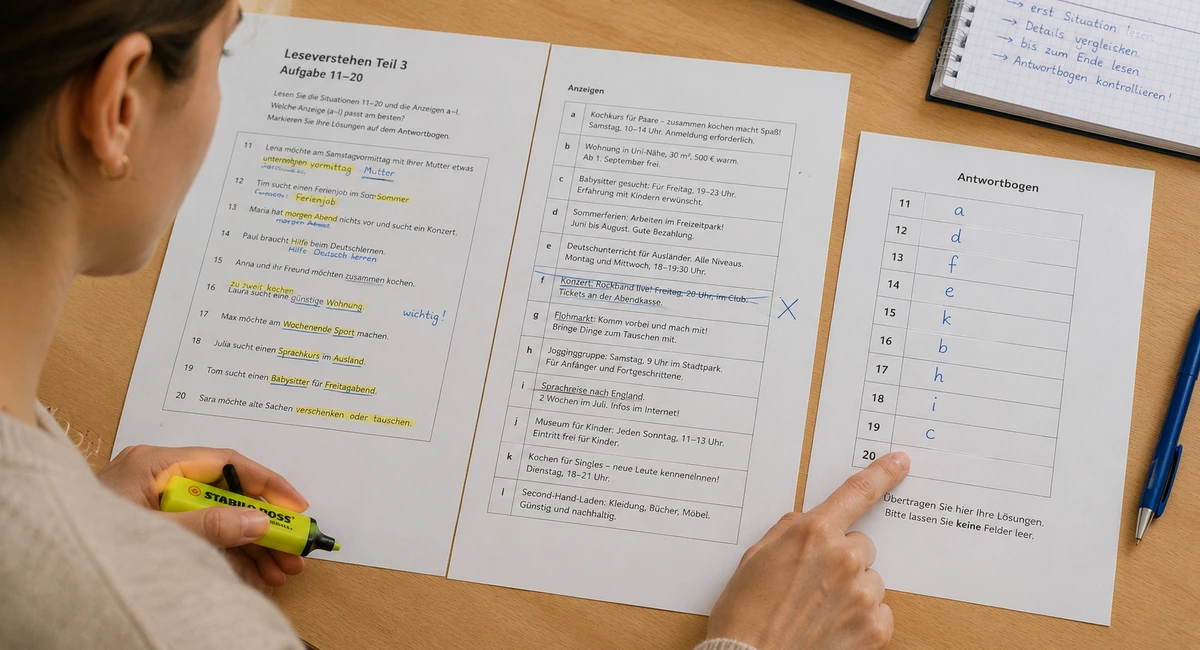
Reading Comprehension Part 3 (telc B1):
typical mistakes and how to avoid them
You know the traps but still lose points? Here you get to know the typical mistakes in Part 3 and receive a simple solution for every mistake.
Why good learners still lose points
Many participants know the traps in Part 3 well. Still, they lose points in the telc B1 exam. Why? Because knowing the traps is only half of it. The other half is your own behaviour: How do you read? In which order? How do you divide the time? And how do you fill in the answer sheet?
Under stress and time pressure many people fall back into old habits. They then make mistakes that have nothing to do with their German. Exactly these mistakes cost the most points — and exactly these mistakes are easy to avoid.
In this article you will see the typical mistakes and, for every mistake, a clear, simple solution. At the end you get a short action plan that is easy to remember.
Mistakes in reading and in the order
Most mistakes arise even before you tick an answer — namely while reading. Here are the three most common ones.
Mistake 1: Reading the advertisements first
Many people read all twelve advertisements first and then the situations. This is very inefficient. You forget the advertisements again and lose time.
How to avoid it: Always read the situation first. Only when you know exactly what you are looking for do you look at the advertisements. This way you read with a clear goal. And as soon as you have found an advertisement that you are one hundred percent sure about, cross it out immediately and move on to the next situation. When you cross things out, your view narrows: you only see the free advertisements and no longer waste valuable seconds on advertisements that are already taken.
Mistake 2: Reading the situation only halfway
Many people read the first words and already believe they have understood everything. Yet the important details often hide at the end of the sentence: an age, a day, a time, a small condition.
How to avoid it: Read every situation right to the end. Underline the two or three most important pieces of information. Always ask yourself: What exactly? For whom? When? Where?
Example: The situation reads: Sie suchen für Ihren 5-jährigen Sohn einen Skikurs. Two things are important here: a Skikurs and the Alter 5 Jahre. Whoever overlooks the age easily picks a wrong advertisement.
Mistake 3: Ticking immediately at the first matching word
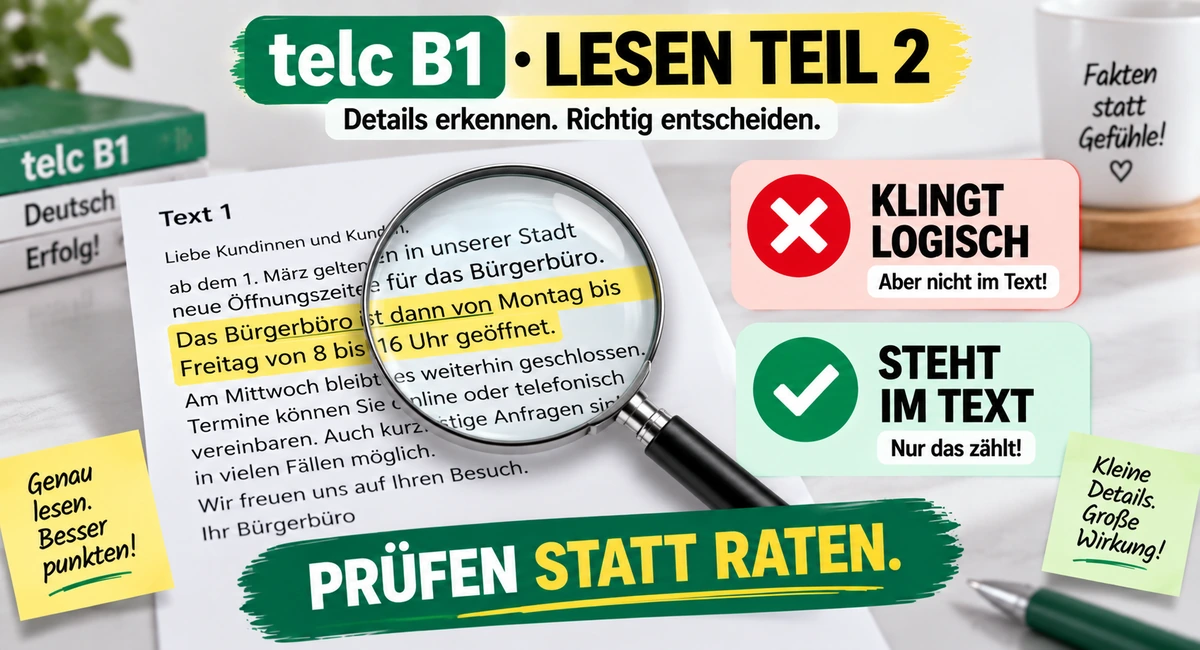
This is the most expensive mistake. You see the same word in an advertisement as in the situation and tick immediately, without reading on.
Example from an exercise: You are looking for a ski course for your son. One advertisement has the heading Skischule and talks about Skikursen. That looks perfect. But if you read on, it says: Wir suchen drei Skilehrer. Bewerbungen an … This is a job advertisement, not a course for your child. The correct advertisement is a different one: a ski resort that offers a kostenlosen Kinderskikurs.
How to avoid it: Always read the advertisement to the end before you decide. An identical word is not yet a correct answer. Check the whole offer.
Mistakes in time management
Part 3 has no clock of its own. You divide the time yourself. Exactly for this reason mistakes happen here that cost many points.
Mistake 4: Getting stuck on one task for too long
Some participants fight with a difficult situation for five minutes. After that there is no time left for the other tasks and for the Sprachbausteine.
How to avoid it: Give yourself only about one to two minutes per situation. If you cannot move forward, choose a preliminary answer, make a small mark next to it and move on. You will come back later. Often another situation helps you to solve the difficult one.
Mistake 5: Not planning time for the answer sheet
Your answers only count if they are on the answer sheet at the end. Many people forget this and become hectic at the end.
How to avoid it: Firmly plan the last minutes for the transfer. Transfer calmly and check the line numbers while doing so.
You only learn the right pace by practising under real conditions. On our website, in the Modelltest section, you can solve whole tests against the clock. This helps a lot before the exam: you get used to the pace, learn to divide your time well, and approach the task much more calmly on exam day.
Mistakes on the answer sheet — and why guessing beats the lottery
On the answer sheet many participants give away easy points. The reason is not the German, but a lack of care when filling it in.
Mistake 6: Slipping in the line
If you skip a situation but enter the answer one line too high or too low, all the following answers shift. This way you lose many points at once.
How to avoid it: Check the number with every transfer. Task 14 belongs in line 14 — always check briefly.
Mistake 7: Leaving fields empty
This is the biggest and most expensive mistake of all. Many participants leave a field empty because they do not know the answer for sure. That is wrong. An empty field brings 0 points for certain.
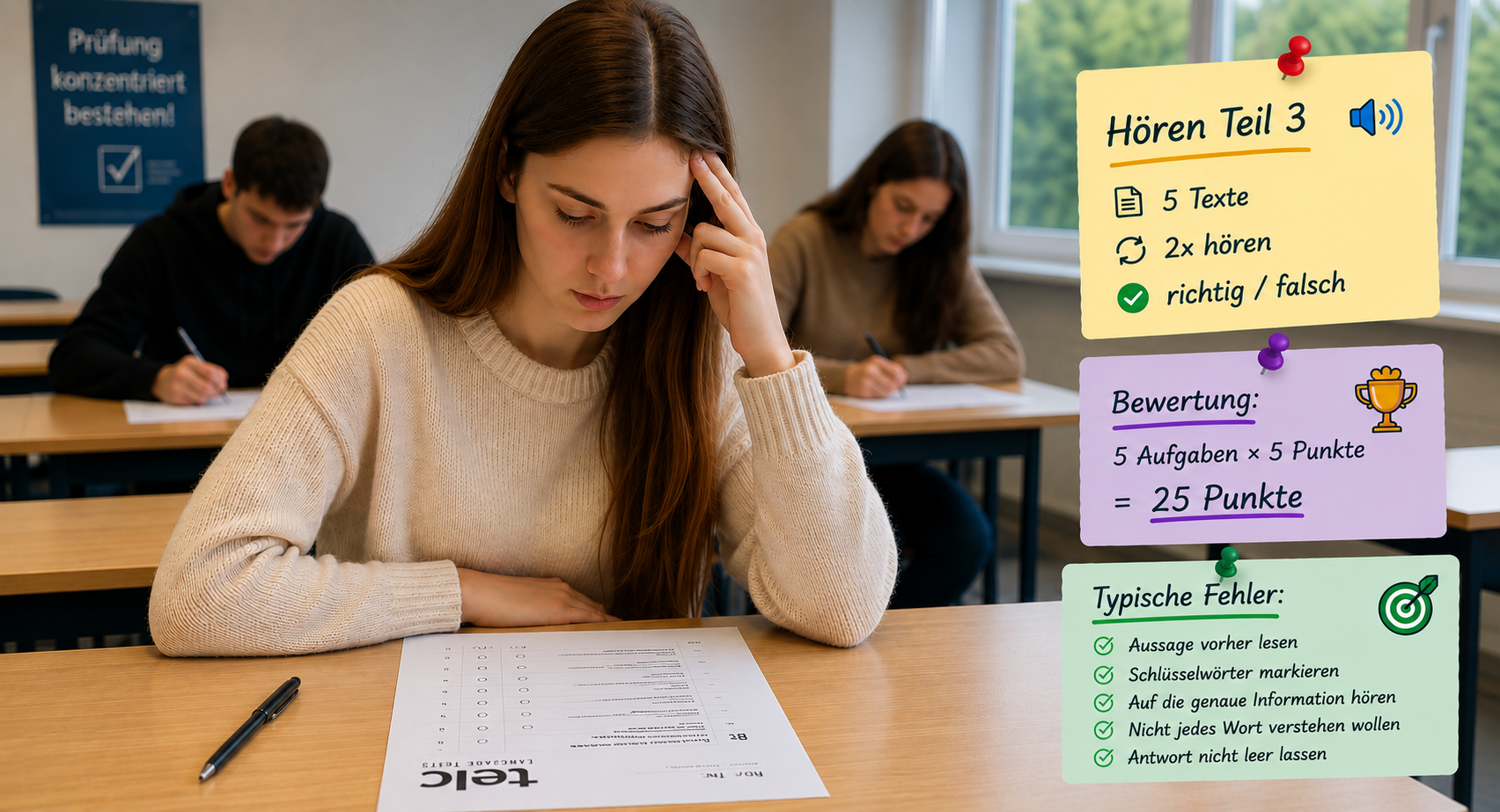
For each task there are only 13 possible answers: the letters a to l or the x. The chance of hitting the right answer by guessing is therefore many times higher than the chance of hitting the right number combination in the lottery — there the probability is many millions to one. Important: there are no minus points for wrong answers. An empty field brings 0 points for certain, a guessed field can bring 2.5 points. So always guess — do not leave a single field empty at the end.
How to guess smartly
- ✅ Enter all the certain answers first.
- ✅ For the uncertain tasks: which advertisement have you not used yet? It is best to pick a letter that is still free.
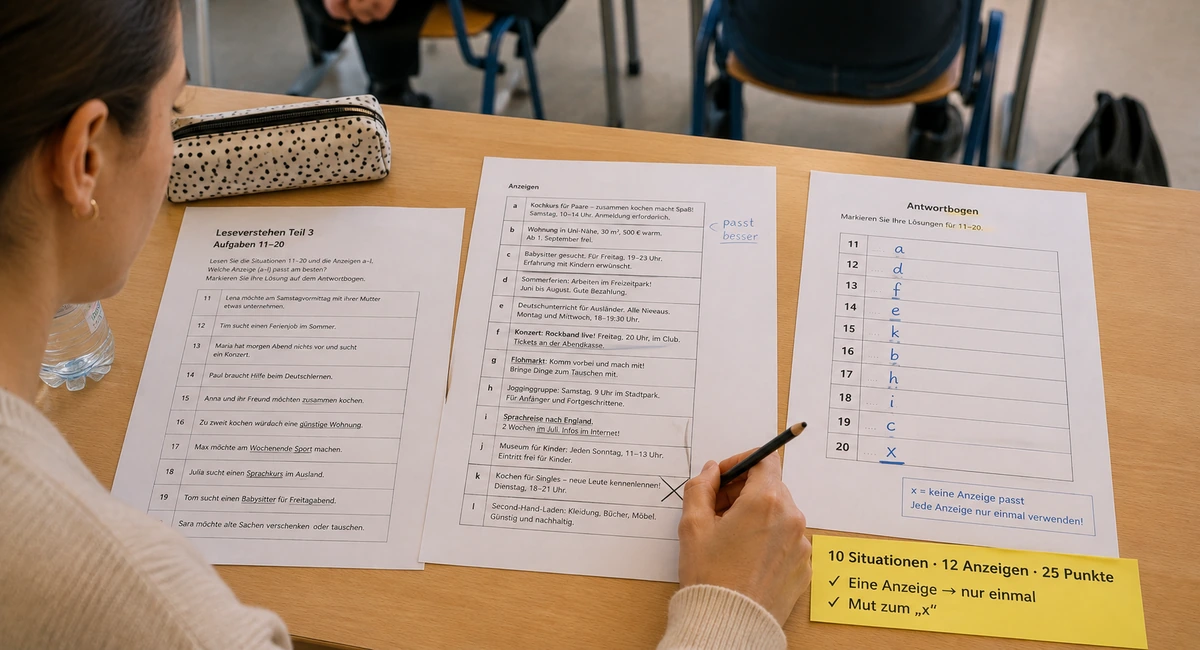
- ✅ If no advertisement really fits anymore, x is often a good and correct choice.
- ❌ Never leave a field empty — not even on the last task.
Mistakes in self-checking
At the end of the task too, many participants give away points because they do not check. With a few simple habits you find your own mistakes yourself.
Mistake 8: Using one advertisement twice
Each advertisement may appear only once. Still, many people write the same letter for two situations without noticing it.
How to avoid it: Cross out each advertisement as soon as you have used it. This way you see immediately which advertisements are still free. It also helps with guessing.
Mistake 9: Fear of the x — or too many x
Two problems often occur: some people write no x at all out of fear, others write five or six out of uncertainty. Both are usually wrong. As a rule there are only one to three x.
Example from an exercise: Eine 72-jährige Mutter sucht eine Gruppe für Menschen in ihrem Alter. But there is only a Kinderclub and a Jugendtreff. Here x is clearly correct. How to avoid the mistake: If you have very many x, check these situations again. Perhaps an advertisement does fit after all.
Mistake 10: Not checking at the end
Whoever does not check at the end overlooks small but expensive mistakes.
How to avoid it: Do a short final check. Check: Do I have ten answers (11 to 20)? Is each advertisement used at most once? Is no field empty? Are the line numbers correct?
Your action plan: the method in 6 steps
If you always do these six steps the same way, you avoid almost all typical mistakes completely automatically.
- Read the situation carefully and underline the most important part. Each situation (number 11 to 20) describes a wish or a problem. Read the sentence right to the end and underline the two or three most important pieces of information. Ask yourself: What exactly is being looked for? For whom (age, person)? When (day, time)? Where? It is exactly these small details that decide the correct answer.
- Tell yourself in one sentence what you exactly need. Before you look at the advertisements, formulate your goal clearly in your head, for example: Ich suche einen Skikurs für ein fünfjähriges Kind. With a clear goal you scan the advertisements faster and fall for similar words less often.
- Skim the advertisements and mark the possible ones. Go quickly through the twelve advertisements (a to l). If an advertisement looks suitable at first glance, make a small mark next to it or circle it. Often two or three possible advertisements remain this way, which you then check more closely.
- Compare the possible advertisements by the detail. Now the detail decides. For each possible advertisement check: Is the age correct? Are the day and time correct? Is the direction correct (is someone offering something, or is someone looking for something)? Is it really the right offer, that is, for example a course and not a job advertisement? Pay attention to synonyms: the correct advertisement often says the same thing with different words.
- Choose the 100 percent match and cross out the advertisement immediately. Take only the advertisement that fulfils your wish exactly. If you are sure, cross out this advertisement immediately and move on to the next situation. When you cross things out, your view narrows: you only see the free advertisements and waste no time on advertisements that are already taken. If no advertisement fits exactly, choose x — that too is a correct answer.
- At the end transfer everything carefully onto the answer sheet. Enter your solutions calmly and check every line number while doing so: task 14 belongs in line 14. At the end check whether you have ten answers and whether no field is empty. Never leave a field empty.
First the situation, then the advertisement. Always read to the end. Pay attention to the small detail. At 100 percent certainty cross out the advertisement immediately and move on. And at the end: no field empty — better to guess than to give points away.







There are no comments for this article. Leave your comment