





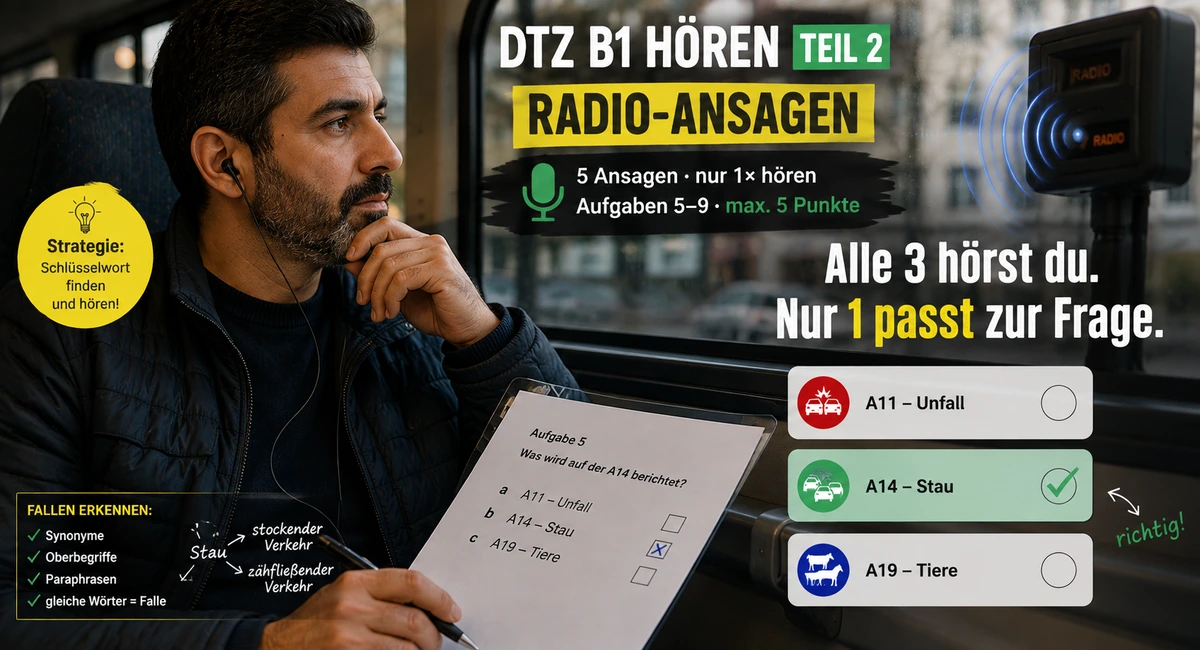
DTZ B1 Hören Teil 2:
Radio announcements, strategy and traps
5 radio announcements, 5 tasks, no example. Here you will find everything in simple language: format, strategy, golden rule, typical traps with examples, FAQ.
DTZ B1 Hören Teil 2 at a glance
The B1 DTZ exam takes place at the end of the integration course. The company g.a.s.t. administers this exam. Teil 2 is the second task in the Hören section of the exam.
| What? | In Teil 2 |
|---|---|
| Source | Radio (not telephone!) |
| Number of announcements | 5 (no example!) |
| Tasks | 5 (numbers 5–9) |
| Answers | a, b or c — only one is correct |
| How many times do you listen? | Only 1 time |
| Maximum points | 5 points (1 per task) |
In Teil 1 there is an example before the tasks. In Teil 2 there is not. You start immediately with task 5! Be concentrated from the very first second.
5 types of radio announcements in DTZ Teil 2
In DTZ Teil 2 you usually hear these 5 types. Learn the typical words. Then you will quickly know what is coming.
| Type | Typical words | Typical question |
|---|---|---|
| Wetterbericht | Sonne, Regen, Schnee, Grad, Norden, Süden, Osten, Westen | Wie wird das Wetter in...? |
| Verkehrsmeldung | Stau, Unfall, Baustelle, Falschfahrer, A 1, A 2, A 8 | Wo gibt es einen Stau? / Auf der A 8... |
| Nachrichten | Das Neueste, Politik, Präsident, Polizei, Berlin, München | Was hören Sie? |
| Veranstaltungstipps | Party, Konzert, Kino, Café, Freitag, Samstag, Sonntag, ab 19 Uhr | Wann kann man...? / Wenn Sie gerne... |
| Spezielle Ansagen | Sterne (Horoskop), gewinnen (Gewinnspiel), Sturm (Warnung), Produkt-Namen (Werbung) | Was sollen Sie tun? / Wie macht man mit? |
Look at the answers — then you immediately know the type:
- A 1 / A 2 / A 22? → Verkehrsmeldung
- Sonne / Regen / kalt? → Wetterbericht
- Freitag / Samstag / Sonntag? → Veranstaltungstipps
Strategy: finding the key word in 3 steps
In Teil 2 the most important strategy is: finding the key word. The key word is the most important word in the question. It shows you what you are looking for.
Step 1: Underline the key word in the question
| Question | Key word |
|---|---|
| Wo gibt es einen Stau? | Stau |
| Wie wird das Wetter im Osten? | Osten |
| Wann kann man tanzen gehen? | tanzen |
| Wie bekommt man Freikarten? | Freikarten |
Step 2: Find the differences in the answers
What is different about a, b and c? These differences are what you need to listen for.
Step 3: Look for the key word in the text
Listen actively. When the key word comes, listen very carefully to what belongs with it.
In Teil 2, all 3 options are often in the text. But only one matches your key word! The other 2 options are also in the text — but for something else (different time, different region, different thing). Do not let yourself be distracted.
Golden rule: synonym, general term, paraphrase
If a word from the answer is exactly the same as in the text — it is often a trap!
The correct answer often has different words with the same meaning.
💡 Type 1: Synonyms (different words, same meaning)
| In the text | In the correct answer |
|---|---|
| Regenfälle | Regen / es regnet |
| Schneefall | es schneit |
| Temperaturen steigen | es wird wärmer |
| Temperaturen sinken | es wird kälter |
| höhere Temperaturen | wärmer |
| Freikarten | Gratiskarten / Eintrittskarten |
| wählen Sie die Nummer | eine Nummer anrufen |
| Wissenschaftler | Forscher |
| möglich | kann sein |
| kostenlos | gratis / frei |
💡 Type 2: General terms (one word for many things)
| In the text (specific) | In the answer (general) |
|---|---|
| Kühe, Pferde, Schafe | Tiere |
| Action-Film, Thriller, Komödie | Filme |
| Verdienstbescheinigung, Mietbescheinigung | Unterlagen / Dokumente |
| Berlin, München, Köln | Städte |
💡 Type 3: Paraphrase (explanation in different words)
| In the text | In the answer |
|---|---|
| alle Parkplätze besetzt | keine Parkplätze mehr |
| Züge fahren nicht + Busverbindung | Züge werden durch Busse ersetzt |
| Blick in die Sterne | ein Horoskop |
| Haus nicht verlassen | zu Hause bleiben |
| Vertretung (vom Arzt) | ein anderer Arzt |
6 typical traps in DTZ B1 Hören Teil 2 with examples
In every example you will see: All 3 options are in the text! But only one matches the key word of the question.
💡 Trap 1: Traffic — many motorways, only one correct
Task: Wo gibt es einen Stau?
- a Auf der A 11.
- b Auf der A 14.
- c Auf der A 19.
In the text: A 11 Richtung Berlin: Unfall, bitte vorsichtig fahren. A 14 zwischen Leipzig und Halle: 6 Kilometer Stau wegen Baustelle. A 19 Richtung Rostock: Kühe auf der Fahrbahn!
| Motorway (in text) | Problem (in text) | Answer? |
|---|---|---|
| A 11 | Unfall | ✗ not Stau |
| A 14 | Stau | ✓ correct! |
| A 19 | Kühe (animals) | ✗ not Stau |
Correct: b
All 3 motorways are in the text. But each one has a different problem. You must connect the problem with the correct motorway.
Traffic words to learn: Stau, Unfall, Baustelle, Umleitung, gesperrt, Falschfahrer, Tiere auf der Fahrbahn, Personen auf der Fahrbahn, Glatteis.
💡 Trap 2: Weather — wrong region chosen
Task: Wie wird das Wetter im Osten?
- a Es regnet.
- b Die Sonne scheint.
- c Es wird kalt.
In the text: Im Westen scheint morgen die Sonne, 18 Grad. Im Osten gibt es starke Regenfälle, nur 10 Grad. Im Süden bleibt es kalt und windig.
| Region (in text) | Weather (in text) | Answer? |
|---|---|---|
| Westen | Sonne | ✗ wrong region (b) |
| Osten | Regenfälle = Regen | ✓ correct! (a) |
| Süden | kalt | ✗ wrong region (c) |
Correct: a
All 3 weather words (Sonne, Regen, kalt) are in the text — but each one is for a different region. Your key word is the region from the question. You hear Regenfälle? That is a synonym for Regen.
💡 Trap 3: Synonym — sinken = kälter werden
Task: Wie wird das Wetter am Wochenende?
- a Es wird wärmer.
- b Es wird kälter.
- c Es bleibt gleich.
In the text: Heute haben wir 15 Grad und Sonne. Auch morgen bleibt das Wetter gleich schön. Am Wochenende aber sinken die Temperaturen auf nur 5 Grad, dazu kommt Wind. Erst nächste Woche wird es wieder wärmer.
| In the text | For which time? | Answer? |
|---|---|---|
| morgen bleibt gleich | tomorrow | ✗ not weekend! (c) |
| am Wochenende sinken | weekend | ✓ correct! (b) |
| nächste Woche wärmer | next week | ✗ not weekend! (a) |
Correct: b
All 3 options are in the text: wärmer, kälter (via sinken), bleibt gleich. But each word refers to a different time: tomorrow, weekend, next week. Your key word is am Wochenende.
Important synonyms:
- Temperaturen sinken = es wird kälter
- Temperaturen steigen = es wird wärmer
💡 Trap 4: Was hören Sie? — recognising the type
Task: Was hören Sie?
- a Den Wetterbericht.
- b Ein Horoskop.
- c Die Nachrichten.
In the text: Liebe Hörer, in einer Minute kommen die Nachrichten — aber zuerst der Blick in die Sterne! Liebe Fische: viel Stress im Beruf. Stier: Glück in der Liebe. Löwe: achten Sie auf Ihre Gesundheit und das Wetter.
| In the text | What really? | Answer? |
|---|---|---|
| kommen die Nachrichten | coming later | ✗ not now! (c) |
| das Wetter | only a tip for Löwe | ✗ not a weather report! (a) |
| Blick in die Sterne, star signs | NOW horoscope | ✓ correct! (b) |
Correct: b (Ein Horoskop)
All 3 types are in the text: Nachrichten, Wetter, stars (horoscope). But NOW the speaker is only talking about the horoscope. The other types are only briefly mentioned — they come later or are just one word inside the horoscope.
Key words for each type:
- Wetterbericht: Sonne, Regen, Grad, Wind, Schnee
- Horoskop: Sterne, Sternzeichen (Fische, Löwe...), Liebe, Glück
- Nachrichten: Politik, Präsident, Polizei, Städte mit News
💡 Trap 5: Event tips — many days, many activities
Task: Wann kann man tanzen gehen?
- a Am Freitag.
- b Am Samstag.
- c Am Sonntag.
In the text: Hier unsere Tipps für das Wochenende! Am Freitag: Theater im Stadttheater. Am Samstag ab 21 Uhr: Disco-Party im Club Neon. Am Sonntag: Brünch im Café Mokka, Buffet für 12 Euro.
| Day (in text) | Activity (in text) | Answer? |
|---|---|---|
| Freitag | Theater | ✗ not dancing (a) |
| Samstag | Disco-Party = tanzen | ✓ correct! (b) |
| Sonntag | Brünch | ✗ not dancing (c) |
Correct: b
- tanzen = Disco, Party, Club, Ball
- frühstücken = Brünch, Café, Buffet am Morgen
- essen gehen = Restaurant, Abendessen, Buffet
- lachen = Komödie, Kabarett, lustige Show
- Sport machen = Fitness-Studio, Yoga, Schwimmen
💡 Trap 6: Complete action — not just one part!
Task: Was sollen Sie tun?
- a Fenster schließen und im Haus bleiben.
- b Fenster schließen und aus dem Haus gehen.
- c Fenster öffnen und im Haus bleiben.
In the text: Achtung Sturmwarnung! Es kommt starker Wind. Bitte schließen Sie alle Fenster — auf keinen Fall öffnen! Bleiben Sie zu Hause und verlassen Sie das Haus nicht!
| In the text | What does it mean? |
|---|---|
| schließen Sie alle Fenster | close ✓ |
| auf keinen Fall öffnen | do not open ✗ |
| bleiben Sie zu Hause | stay ✓ |
| verlassen Sie das Haus nicht | do not go ✗ |
Checking the answers:
| Answer | Part 1 | Part 2 | Correct? |
|---|---|---|---|
| a | schließen ✓ | bleiben ✓ | ✓ both OK! |
| b | schließen ✓ | gehen ✗ | ✗ |
| c | öffnen ✗ | bleiben ✓ | ✗ |
Correct: a
All actions are in the text: schließen, öffnen, bleiben, gehen (verlassen). But 2 of them have the word nicht or auf keinen Fall — that is the opposite! If an answer has 2 parts, BOTH parts must be correct.
Points, assessment and quick tips
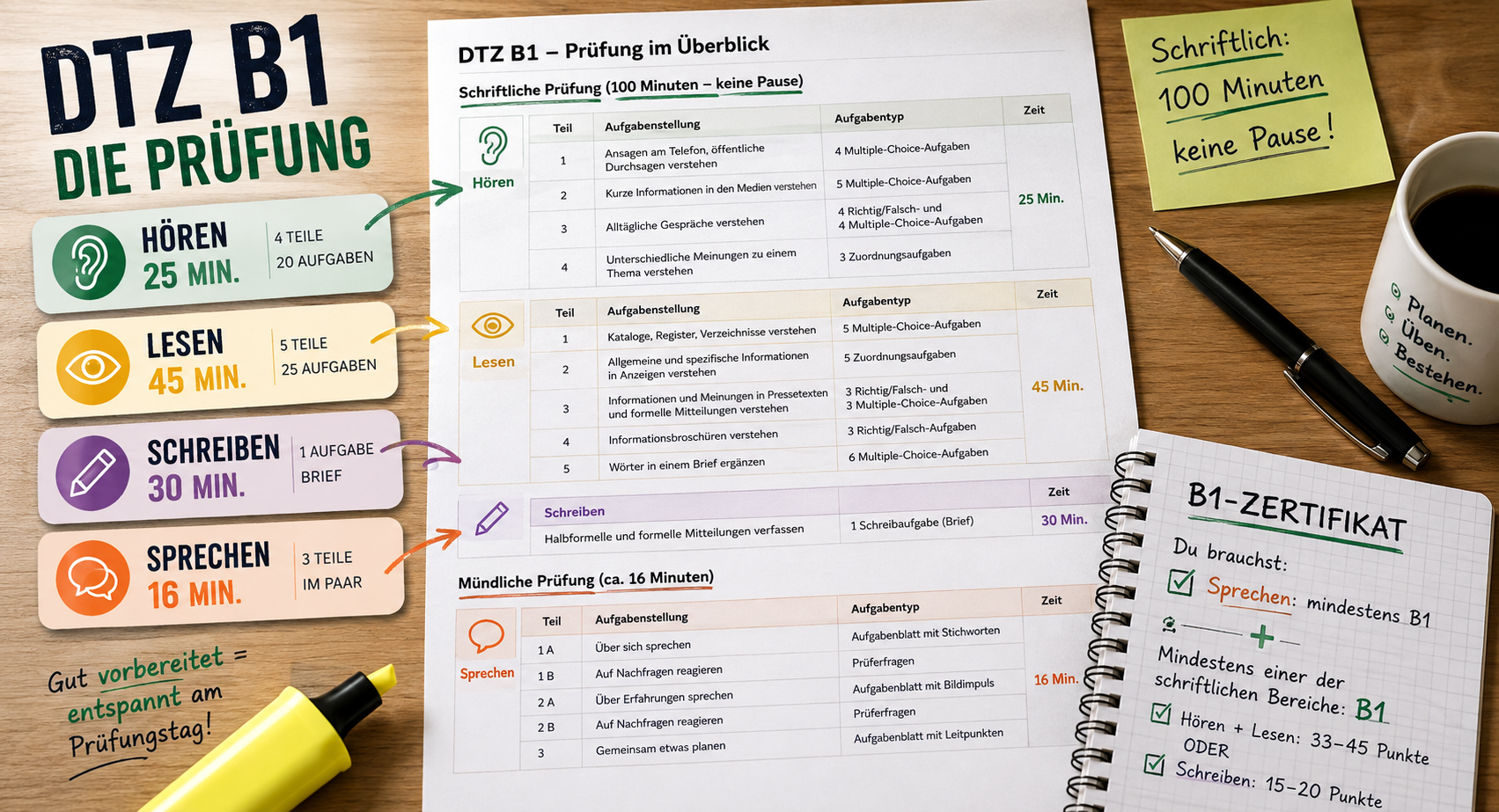
Points: Hören and Lesen count together
Hören has 20 points (Teil 2: 5 points). Hören + Lesen = 45 points together.
| Points (Hören + Lesen) | Level |
|---|---|
| 33–45 | B1 |
| 20–32 | A2 |
| 0–19 | below A2 |
Quick tips for more points
- ✓ Underline the key word — before every task!
- ✓ Compare the answers — what is different?
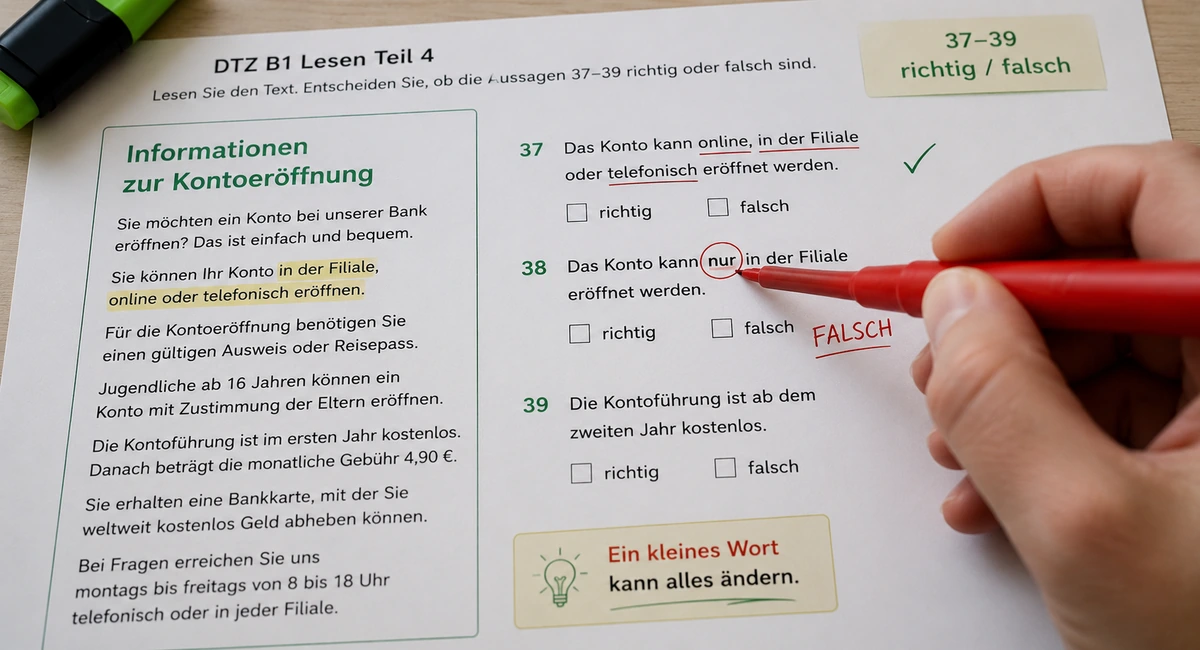
- ✓ Watch out for nicht, kein, aber, leider — they change everything!
- ✓ Listen until the end — the answer often comes at the very end.
- ✓ Check both parts — when the answer is long.
- ✓ Mark immediately — not at the end!
- ✓ Always guess — empty answer = 0 points for certain.
- ✓ Ballpoint pen only — blue or black, no pencil!
You have 3 answers. Guessing gives you a 33% chance. That is good! An empty answer gives a 0% chance. Maybe exactly this point is the point that gets you to B1!


There are no comments for this article. Leave your comment