





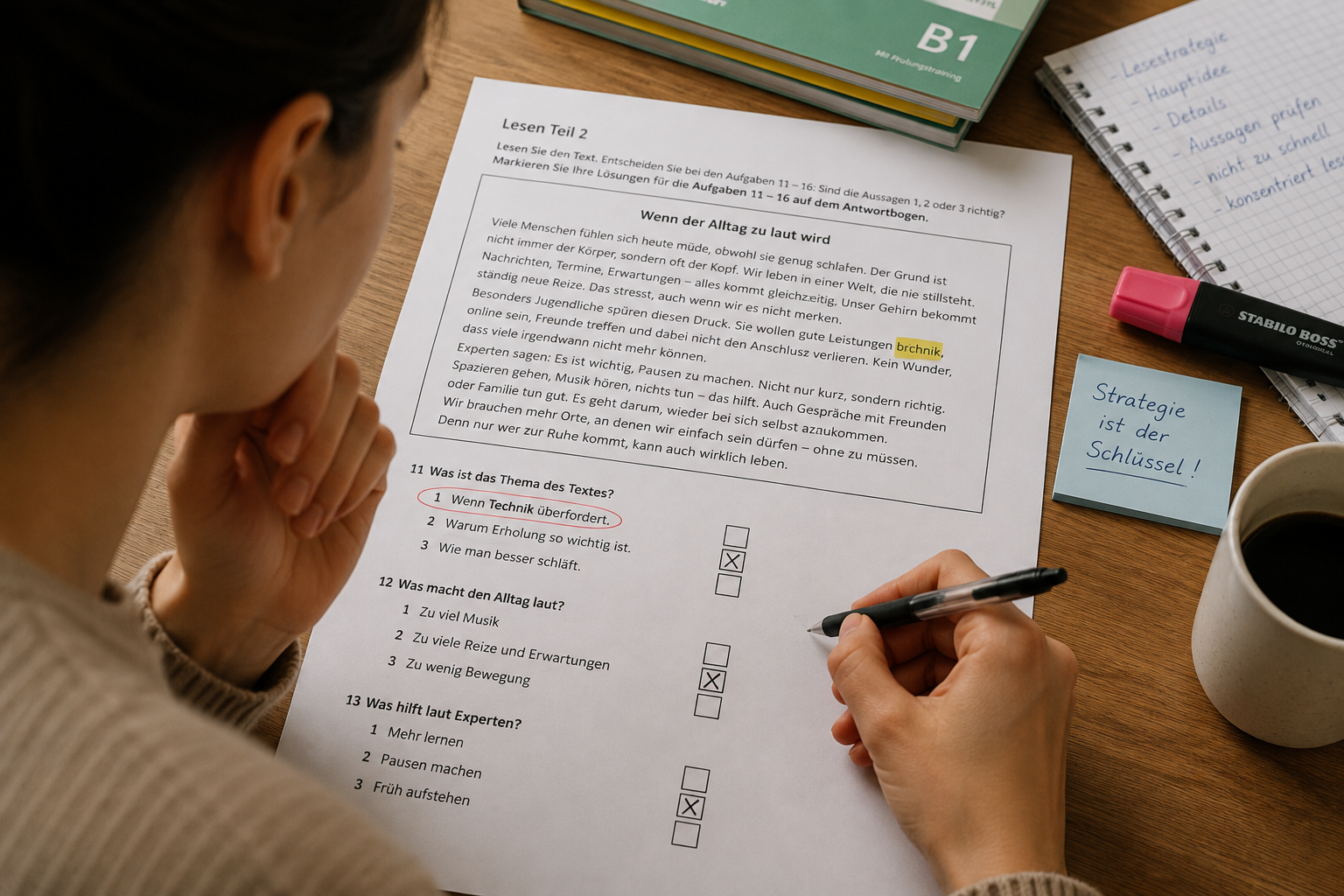
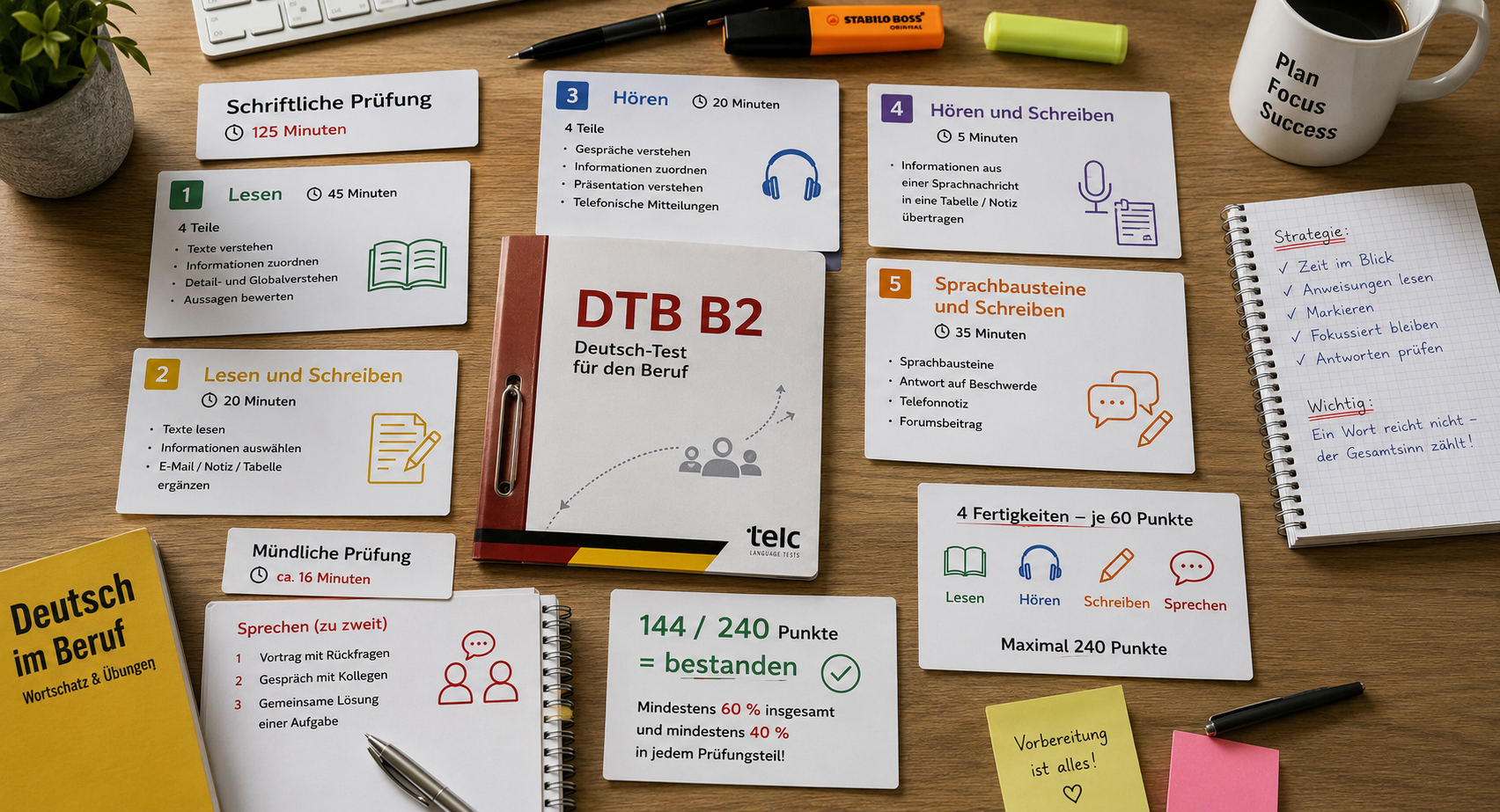
In the official model test, Part 2 in the Reading section consists of 2 True/False tasks and 2 Multiple Choice tasks, and the aim of this part is to understand instructions, briefings, company rules, welcome folders, notices and workplace-related information. The official examination handbook also emphasizes that such tasks test the understanding of real communication in the workplace and not guessing based on the general meaning.
The most important rule
In Reading Part 2, you must not read “approximately”. You must read slowly, precisely and literally.
This part of the exam is designed not to test the general impression of the text, but the ability:
- to find exact information,
- to notice restrictions and conditions,
- to understand paraphrasing,
- to distinguish a fact from something that only looks like a fact.
That means: here, it is not the person who reads quickly who wins, but the person who can carry out a meaning-based check of every single word.
What Reading Part 2 actually tests
Almost all texts belong to one type:
- Arbeitszeit
- Urlaub
- Datenschutz
- Rauchen
- Betriebssport
- Einführungstag
- Zugangskontrolle
- Arbeitsunfälle
- Berichtsheft
- betriebliche Hinweise
This means that the exam wants to see whether you can understand:
- Rules — what is allowed / forbidden,
- Obligations — what employees must do,
- Deadlines — when and by what date,
- Exceptions — in which cases a rule changes,
- Conditions — under what condition something is possible,
- Responsibility — who is responsible for what,
- Consequences — what happens if a rule is violated.
That is exactly why in this part you must not simply catch familiar words. You need to check the relationships between words: who? when? where? how? under what condition? how often?
How to prepare for this type of task
1. Learn to see the structure of a workplace text
Almost all texts of this type have the same logic:
- first, the basic rule is given,
- then come details,
- then exceptions,
- then a contact person, a deadline, a procedure or consequences.
For example:
- Grundregel
- Ausnahme
- Frist
- Ansprechpartner
- Folge bei Verstoß
If, while reading B2 Beruf Lesen, you immediately recognize this structure, the text becomes much easier.
2. Train not on translation, but on comparing meaning
The biggest mistake many candidates make is translating the text word for word and then answering from memory.
The correct method is different:
- you read the question,
- you find the place in the text,
- you compare the meaning of the question with the meaning of the sentence in the text,
- only then do you answer.
In Reading Part 2, it is almost always not the person who translates better who wins, but the person who is better at comparing meanings.
3. Train signal words
In this part there are words that almost always decide the answer.
You must recognize them immediately:
- nur
- auch
- grundsätzlich
- in Ausnahmefällen
- jederzeit
- spätestens
- mindestens
- maximal
- unverzüglich
- nach
- vor
- während
- sofern
- falls
- kann
- muss
- darf
- nicht
These very words often turn the answer into true or false.
The most important principle for finding the answer
Do not look for identical words — look for identical meaning
The B2 Beruf exam loves paraphrases. That means: the question and the text often talk about the same thing, but in different words.
For example:
- einsehen = anschauen / online prüfen
- zulässig = erlaubt
- verpflichtend = man muss teilnehmen
- kostenfrei = gratis
- untersagt / nicht gestattet = verboten
- angerechnet = zählt als
- einreichen = abgeben / vorlegen
- in Kenntnis setzen = informieren
- ausgleichen = abbauen / kompensieren
- zur Verfügung stehen = nutzbar sein / benutzen können
Those who wait for identical words often make mistakes.
Those who look for the same idea answer correctly.
All the most important traps you need to pay attention to
Now the most important thing — a general list of traps that repeat almost all the time.
1. Trap with intensifying words
This is the most frequent trap.
If words appear in the question such as:
- immer
- nie
- alle
- nur
- sofort
- jederzeit
- grundsätzlich
- in jedem Fall
you must immediately be cautious.
Why? Because the text is often formulated more cautiously:
- kann
- unter bestimmten Bedingungen
- in Ausnahmefällen
- nach Rücksprache
- grundsätzlich … aber
- sollte nach Möglichkeit
- spätestens
- bis zu
This is exactly where the exam checks whether you see the difference between:
- always / sometimes
- can / must
- allowed / compulsory
- generally / under a condition
- normally / in exceptional cases
Example of the logic of the trap
Text:
„Ein anteiliger Urlaub ist nach Rücksprache bereits während der Probezeit möglich.“
False conclusion:
„Im ersten halben Jahr ist kein Urlaub möglich.“
The trap word here: kein. In the text there is no prohibition, but on the contrary — a possibility under a condition.
2. Trap with modal verbs
A very important type.
You must clearly distinguish:
- kann = possible
- darf = allowed
- muss = compulsory
- soll = recommended / expected
- ist zulässig = allowed
- ist verpflichtend = obligatory
- ist nicht gestattet / untersagt = forbidden
The exam often replaces one modal meaning with another, and the answer thereby becomes incorrect.
Dangerous replacement:
- „kann“ → „muss“
- „darf“ → „soll“
- „ist möglich“ → „ist immer so“
- „ist erlaubt“ → „ist verpflichtend“
3. Trap with conditions
Very often a rule applies not always, but under a condition.
Signals:
- sofern
- wenn
- falls
- bei Bedarf
- nach Rücksprache
- bei entsprechendem Guthaben
- in Ausnahmefällen
- im Wiederholungsfall
- je nach
- sobald
Many see only the main action and overlook the condition. But the condition is exactly the key to the answer in B2 Beruf exercises.
Typical mistake
Text:
„Bei entsprechendem Guthaben kann einmal pro Monat ein Gleitzeittag genommen werden.“
False conclusion:
„Man kann jeden Monat einige Tage freinehmen.“
Mistake: In the text there are bei entsprechendem Guthaben and einmal pro Monat, not “several days”.
4. Trap with quantity and frequency
A very frequent exam trap.
The words being tested are:
- einmal pro Monat
- bis zu
- maximal
- mindestens
- alle sechs Monate
- jedes Jahr
- alle drei Jahre
- täglich
- wöchentlich
- mehrmals jährlich
You must not confuse:
- jedes Jahr <-> alle drei Jahre
- mehrmals jährlich angeboten <-> jeder muss mehrmals jährlich teilnehmen
- bis zu vier Tage <-> vier Tage
- maximal zehn Stunden <-> man darf beliebig viele Stunden arbeiten
The exam likes to offer answers in which the number is similar, but does not match.
5. Trap with time: vor / nach / während / bis
This is one of the most dangerous zones.
You have to pay very close attention to:
- vor
- nach
- während
- bis
- spätestens
- erst nach
- innerhalb von
- ab
- danach
Why this is dangerous
Because the meaning changes completely:
- erst nach Ablauf ≠ sofort
- spätestens bis ≠ irgendwann
- während der Arbeitszeit ≠ in der Freizeit
- nach dem Unfall ≠ sofort im selben Moment
- ab der siebten Woche ≠ sofort
A great many mistakes in Reading Part 2 arise precisely because of time indications.
6. Trap with the subject: who exactly?
The exam often changes the acting person.
You must check:
- Mitarbeiter
- Personalabteilung
- Arbeitgeber
- Betriebsrat
- Geschäftsführung
- Datenschutzbeauftragter
- Berufsgenossenschaft
- Teamleiter
- Abteilungsleiter
Very often a wrong answer appears when the action really does exist in the text, but is not carried out by that person.
Example
Text:
„Die Personalabteilung richtet Ihnen einen Zugang ein.“
Wrong answer:
„Die Mitarbeiter müssen das Konto selbst anlegen.“
The action fits the topic, but the subject is different.
7. Trap with partial truth
This is perhaps the most unpleasant trap in Multiple Choice.
An answer can be almost correct, but contain one additional word — and because of that it already becomes incorrect.
You must keep the rule in mind: An answer option must match the text completely, not just to 80%. If half of the answer is correct but the other half is distorted, then the answer is wrong.
Typical forms:
- the beginning is correct, but the ending is wrong;
- the topic is correct, but the condition is wrong;
- the fact is correct, but the cause is wrong;
- the action is correct, but the time is wrong;
- the result is correct, but the person carrying it out is wrong.
8. Trap with synonyms and paraphrases
This is not just a difficulty, but a permanent exam mechanism.
You must train pairs like these:
- genehmigt = bewilligt / erlaubt
- einreichen = abgeben / vorlegen
- zur Verfügung stehen = nutzbar sein
- nicht gestattet = verboten
- kostenfrei = gratis
- verpflichtend = obligatorisch / man muss
- angerechnet = zählt als
- unverzüglich = sofort / ohne Verzögerung
- sich an jemanden wenden = kontaktieren / in Verbindung setzen
- übernehmen = bezahlen / tragen
- gewährleisten = sicherstellen
- ausgleichen = abbauen / kompensieren
- Schulung = Training / Seminar / Informationsveranstaltung
- Arbeitszeitkonto einsehen = online anschauen / prüfen
If you do not train such substitutions, it seems as if the answer does not exist in the text, although it is there.
9. Trap with negation
Very dangerous are constructions with:
- nicht
- kein
- nur dann
- nicht nur … sondern auch
- weder … noch
- ausschließlich
- auf keinen Fall
A small nicht often decides the whole answer. Sometimes the whole question is built around a single negation.
Typical risk
Text:
„Sachschäden sind nicht mitversichert.“
If a candidate sees only “versichert”, they can easily make a mistake.
10. Trap with generalization
The exam likes to turn a concrete situation into an answer that is too general.
The text may say:
- in one case,
- in a specific situation,
- for part of the employees,
- under a certain condition.
And in the answer this becomes:
- immer,
- alle,
- generell,
- grundsätzlich,
- in jedem Fall.
That is exactly where the trap lies.
11. Trap with cause and consequence
Sometimes a correct fact is mentioned in the answer, but the cause is explained incorrectly.
For example, the text says:
- a rule exists in order to avoid queues,
- courses are carried out so that employees remain informed,
- the door must be closed so that no smoke enters,
- the report is necessary for proof.
However, a different cause is given in the answer. The fact is familiar, but the explanation does not match.
12. Trap with added information
A very frequent type of mistake: the answer contains information that does not appear in the text at all.
For example:
- Zuschuss
- persönliche Anmeldung
- tägliche Aktualisierung
- Führung durchs Unternehmen
- Arztbericht
- sofortige Zahlung
- private finanzielle Hilfe
If this is not stated directly in the text, you must not add it in your mind. In Reading Part 2, it is forbidden to answer according to life logic.
How to solve True / False
Working algorithm
- Read the statement.
- Find the relevant place in the text.
- Underline key words.
- Check:
- who?
- what?
- when?
- under what condition?
- always or sometimes?
Only then decide: true or false.
The most important rule
For true, the meaning must match completely.
For false, one single wrong element is enough.
How to solve Multiple Choice
Working algorithm
- First find the correct paragraph.
- Do not choose an answer because of familiar words.
- Compare all three options with the text.
- Cross out answers that are:
- too general,
- too strongly formulated,
- with the wrong time indication,
- with the wrong condition,
- with additional information,
- with the wrong subject.
The remaining option is usually the correct one.
Important principle
In Multiple Choice, the correct answer is often the “most modest” one and not the most beautiful one.
Wrong answers usually sound broader, more confident and “more logical” than the text.
Which skill you should train at home
For Reading Part 2, it is best to train not only reading, but these 5 skills:
1. Signal words
Learn to recognize:
- nur
- auch
- bereits
- erst
- spätestens
- bis zu
- mindestens
- maximal
- grundsätzlich
- in Ausnahmefällen
- sofern
- nach Rücksprache
2. Paraphrases
Take one sentence and rewrite it in other words without changing the meaning.
3. Minimal differences
Compare two almost identical sentences and recognize where the meaning has already changed.
4. Legal and workplace-related vocabulary
Very often the following words are repeated:
- Anspruch
- Frist
- Antrag
- einreichen
- genehmigen
- ausgleichen
- zulässig
- verpflichtet
- in Kenntnis setzen
- Zugang
- einsehen
- Nachweis
- Vorgabe
- Richtlinie
- vertraulich
- mitversichert
5. Reading according to a scheme
Immediately divide the text into:
- rule,
- exception,
- condition,
- deadline,
- contact,
- consequence.
The most important advice for the exam
In Reading Part 2, you must not think like this:
“That sounds logical, so it is correct.”
You must think only like this:
“Does that really stand in the text — in exactly this meaning?”
That is the most important exam skill.
Short conclusion
The most important preparation rule:
Learn not to see the topic of the text, but the exact wording of the rule.
The most important traps:
- immer / nie / alle / nur
- kann / darf / muss
- condition instead of a general rule
- number, deadline, frequency
- who carries out the action
- partially correct answer
- paraphrase
- negation
- additional information
- plausible, but inaccurate option
Golden rule:
One wrong element makes the entire answer wrong. Train Reading Part 2 in B2-Beruf consciously and with the right strategy!
Good luck.



There are no comments for this article. Leave your comment