






Telc B2 German:
Exam Structure, Tasks and Tips
Telc B2 German at a glance: exam structure, task formats and practical tips for targeted preparation and greater success in the exam.
What is the Telc B2 exam?
Telc B2 is a standardised language exam developed by Telc GmbH. It is aimed at adult candidates who wish to study or work in a German-speaking environment and want to demonstrate their qualifications.
Level B2 on the CEFR scale means that the language is no longer limited to everyday topics. The candidate must be able to handle abstract concepts and specialist vocabulary with confidence:
- conduct a discussion and justify their position;
- write structured formal letters;
- use various grammatical constructions without significant errors;
- understand interviews, radio programmes and public speeches.
The Telc B2 exam therefore tests not only grammar knowledge, but also the ability to communicate effectively in real situations.
Structure of the Telc B2 German exam
The structure of the Telc B2 exam consists of a written and an oral part. Both parts are assessed separately, but the result is determined on the basis of the total score. The format is clearly regulated, so you can prepare for each type of task in advance.
Written exam
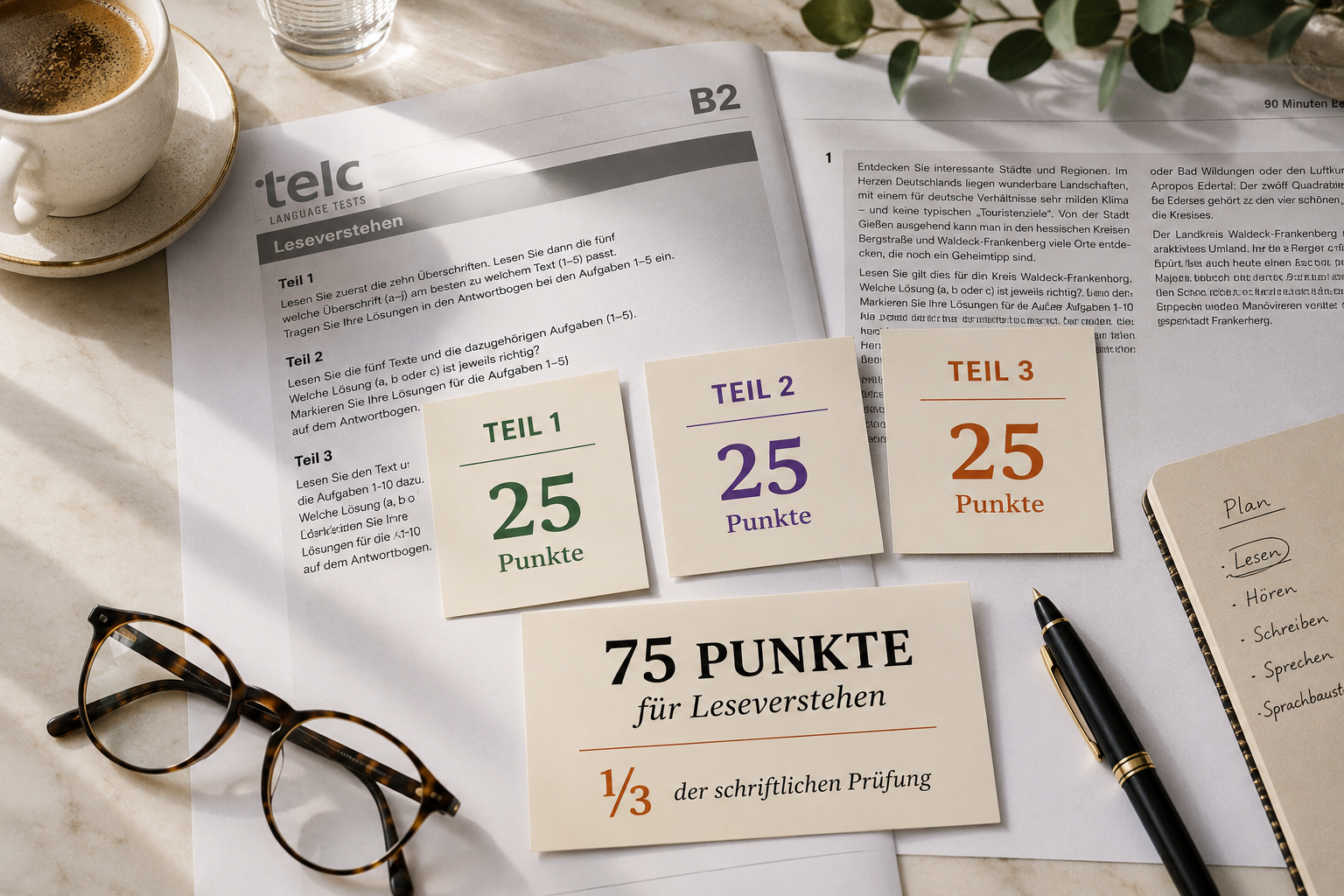
The written exam lasts a total of approximately 140 minutes and covers reading comprehension, language elements, listening comprehension and written expression.
Each task tests specific language competences required for level B2: text comprehension, vocabulary and grammar, listening comprehension and written expression.
It is important to manage time correctly. Even candidates with good language skills can lose points if they work through individual tasks too slowly or are rushed at the end of the test. Therefore, the strategy for taking the exam is no less important than language skills themselves.
Reading
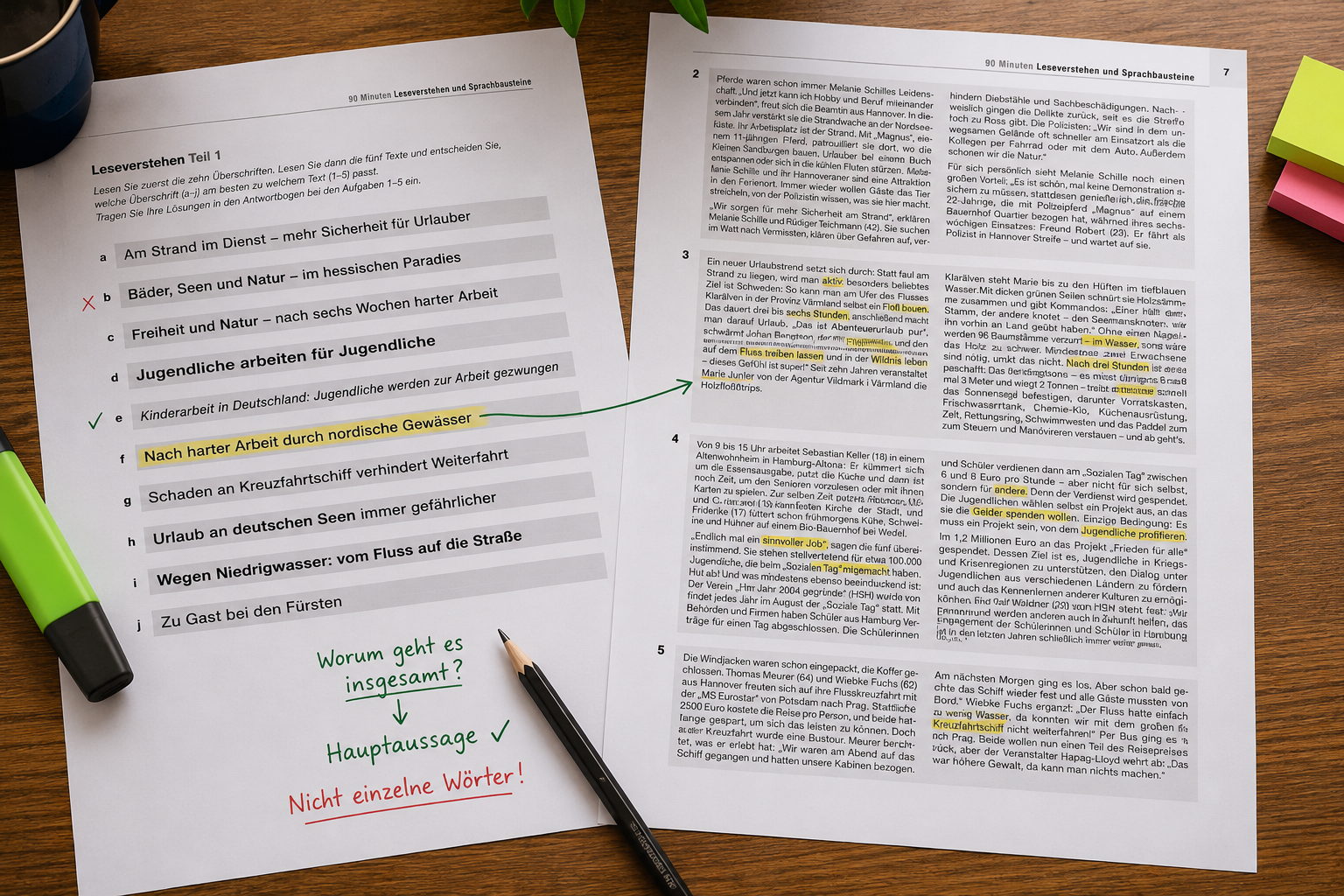
The module involves working with newspaper and magazine articles, informational texts, advertisements and notices. The task aims to test the following:
- general comprehension of the text content (global understanding);
- the ability to find specific information;
- the recognition of the main ideas and positions of the author.
Particular attention should be paid to keywords, synonyms and paraphrases, as the correct answers are often not taken verbatim from the text. To successfully pass the B2 Telc exam, regular practice is essential. The free exercises offered by the Deutsch Vorbereitung service are very helpful for this.
Language elements
This module tests grammar and vocabulary in context, not theoretical knowledge of rules. The candidate must:
- choose the correct grammatical form;
- insert the appropriate conjunction or pronoun;
- use the lexical unit correctly according to the meaning of the sentence.
The focus is on verb tenses, passive voice, modal constructions, prepositions, fixed vocabulary and logical connections between parts of a text.
Listening
The listening comprehension includes dialogues, interviews, radio spots and short monologues modelled on real everyday and professional situations. The listening comprehension consists of three parts. In the official telc B2 exam, the audio texts are played only once. Global understanding, detail understanding and selective understanding are tested.
During the listening comprehension, you should not stop at an incomprehensible section and try to memorise specific words or sentences. If the candidate was distracted or did not understand part of the recording, they should continue listening attentively, as the general meaning often becomes clear from the subsequent context. Trying to recapture the previous moment usually results in losing further information.
Writing
The written part of the Telc B2 exam consists of a semi-formal email in the telc Deutsch B2 exam. 30 minutes are available for this task. The text should contain at least 150 words and adequately address the given guiding points.
Not only linguistic correctness is assessed, but also the logical structure of the text, clear argumentation and the appropriateness of the style for the given task.
Oral exam
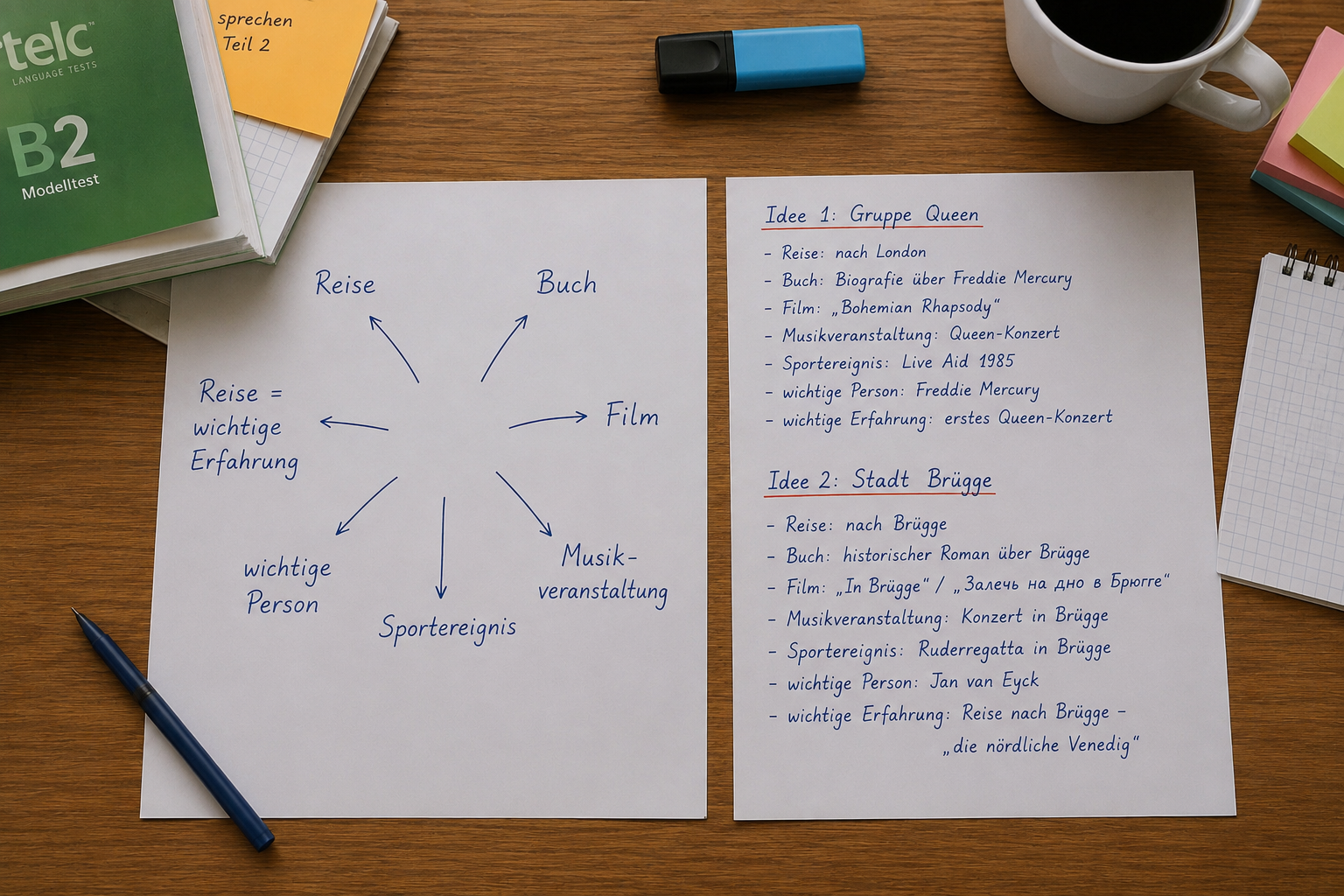
The oral exam is usually conducted as a pair exam. There is a brief introductory phase before it begins, which is not assessed. The assessed part consists of three tasks: Talking about experiences, Discussion and Planning something together. The preparation time is 20 minutes.
Not only linguistic correctness is assessed, but also interactivity: the ability to listen to the partner, respond to their utterances, maintain the conversation, find compromises, etc.
Talking about experiences
In the first assessed part of the oral exam, participants talk about their own experiences. Several topics are available to choose from. Each person speaks for up to 1.5 minutes about a chosen topic. The other person then asks appropriate follow-up questions.
In this phase it is important:
- to structure the speech clearly (introduction, main part, conclusion);
- to build the argumentation logically;
- to use appropriate vocabulary and phrases.
Discussion
In this section, candidates exchange opinions, ask each other questions, agree or disagree. The ability to do the following is assessed:
- justify their own position;
- respond to counter-arguments;
- maintain a natural dialogue.
Successful participation in the discussion depends not only on the correctness of the language, but also on the ability to listen to the partner, build responses logically and maintain a polite and constructive tone during the exchange of opinions.
Planning something together
In the final phase, the partners must reach a joint decision, for example about organising an event, planning a trip or choosing the optimal course of action. Particularly important here are the skills of collaboration, compromise and clear formulation of proposals.
| Part of the exam | Duration (minutes) | Type of task | Points (max.) |
|---|---|---|---|
| Reading | together with Language elements: 90 minutes | Working with texts, searching for details | 75 |
| Language elements | Part of the 90-minute written exam | Grammar and vocabulary in context | 30 |
| Listening | 20 | Listening to dialogues and announcements | 45 |
| Writing | 30 | Writing an argumentative text | 45 |
| Oral part | approx. 15 min. (2 participants) / approx. 25 min. (3 participants) | Presentation and dialogue with a partner | 75 |
The duration of the Telc B2 exam may vary slightly depending on the examination centre.
Telc Test B2: detailed description of task formats
The task format is designed to test various aspects of language competence. The telc Deutsch B2 exam consists of a written and an oral part. Within these two parts of the exam there are several sub-sections with different task formats.
Reading: Strategic text comprehension
First, you should skim the text quickly to identify the topic and keywords. Standard reading exercises for Telc B2:
- tasks for matching headings and paragraphs;
- texts with gaps for inserting words/sentences;
- tests with one correct answer to choose from.
After completing the task, you should check the logic of the text to avoid accidental errors.
Language elements: Grammar and vocabulary
This module checks the correct use of structures. The focus is not on isolated rules, but on the functional application of forms. These include:
- subordinating conjunctions;
- prepositions with objects;
- verb tenses.
Thorough preparation for the Telc B2 exam with regular practice helps to automate the selection of the correct options.
Listening comprehension: Understanding conversations and interviews
The natural speaking speed is maintained. Therefore, in Telc B2 listening comprehension it is important to focus on meaning rather than on every individual word.
Effective techniques:
- note-taking technique while listening;
- identification of keywords;
- analysis of context before selecting the answer.
This way you can avoid loss of information. If part of the audio was missed, do not panic. Continue listening: as a rule, the content becomes clear from the further context.
Writing: Composing official texts
Writing in Telc B2 involves composing a formal or semi-formal text of approximately 150 to 200 words. The module tests not only grammar and vocabulary knowledge, but also the ability to express thoughts logically and in a structured manner in writing.
When preparing for the written task, it is essential to:
- create a brief plan for the text;
- establish the structure, including introduction, main part and conclusion;
- think through the key arguments and examples to support your position.
Typical variants of written tasks:
- Complaint — an official letter describing a problem that needs to be resolved;
- Statement — a request or notification to an official body;
- Formal email — communication with organisations, institutions or employers.
Requirements for the finished text:
- Introduction — brief presentation of the topic and purpose of the message;
- Argumentation — logical presentation of thoughts supported by examples;
- Summary — clear conclusion, final statement or proposed solution.
Do not start writing immediately: first create a plan and think through the structure. This will help you stay logical, save time and make the text more convincing.
Speaking: Structured argumentation
The oral part of the Telc B2 exam assesses the candidate's ability to express their thoughts clearly, logically and coherently, maintain a conversation and interact with their interlocutor in dialogues and discussions. Components of the oral exam:
- Presenting a viewpoint — brief, clear presentation of your own opinion with arguments;
- Making suggestions — the ability to formulate decisions or options for action in a given situation;
- Interaction with the partner — the ability to ask and answer questions, respond to the other participant's arguments and maintain a natural dialogue.
A clear organisation of the utterance significantly increases the assessment. The candidate is recommended to:
- begin with an introductory sentence that outlines the topic;
- build their thoughts logically and divide the arguments into logical sections;
- end the speech with a summary or conclusion, emphasising their own position.
Even if the candidate does not know the exact words, it is important to respond to the partner and maintain the dialogue, as this is also taken into account in the assessment.
Scoring and minimum score for Telc B2
The maximum total score is 300 points. Of these, 225 points are allocated to the written exam and 75 points to the oral exam. To pass the exam, 60% of the maximum score must be achieved in each part of the exam, i.e. 135 points in the written and 45 points in the oral part.
Explanation of the scoring system
The assessment of the Telc B2 exam is based on the total score achieved in the written and oral parts. The first part (reading, language knowledge, listening comprehension, writing) can earn up to 225 points, the second part (presentation, discussion, joint task) up to 75 points.
The assessment follows a scale that takes into account:
- accuracy and correctness of language;
- logical structure and coherence in the presentation of thoughts;
- compliance with the task and the situation.
Success depends not only on grammar and vocabulary knowledge, but also on the ability to communicate logically and clearly and to adhere to the task format.
Minimum score for passing the exam
To pass the exam, at least 60% of the total possible points must be achieved in each part: approximately 135 in the written and 45 in the oral part.
Is a partial retake possible?
If participants did not pass or did not take one of the two parts of the exam — the written or the oral exam — they can retake the relevant part within the current calendar year or in the following calendar year. The overall exam can in principle be retaken any number of times.
| Module | Maximum score | Minimum requirements for passing |
|---|---|---|
| Written part | 225 | 135 |
| Oral part | 75 | 45 |
| Overall result | 300 | 180 |
Preparation for the Telc B2 exam: strategies for each module
Preparation for the Telc B2 exam should cover all key skills: reading, writing, listening and speaking. The optimal preparation time for most candidates is 8 to 12 weeks, so that all parts of the exam can be worked through systematically and time management strategies can be developed.
Correct use of sample tests
Before you begin training, you should familiarise yourself with the official Telc B2 materials. Sample tests help you understand the type of tasks, the expected structure of answers and the assessment criteria. It is recommended to complete the practical B2 Telc exercises for each module separately in order to identify strengths and weaknesses, analyse errors and flag topics that require additional training.
Time management training
One of the key success factors for the exam is the ability to manage time effectively. It is therefore advisable to set a timer for each module during the training phase in order to practise speed and concentration.
It is not recommended to spend too long on difficult tasks. It is better to continue the test and return to the problematic sections at the end. This approach reduces stress and the feeling of rushing during the actual exam.
Simulating the exam under realistic conditions
To be as well prepared as possible, it is advisable to regularly complete the full Telc B2 test without interruptions. This allows you to assess your stamina and concentration during the 2 hours and 20 minutes of the written part. You can simulate the conditions of the oral module by practising a presentation and a discussion with a partner.
Common mistakes in the Telc B2 exam
Even well-prepared candidates can lose points due to typical mistakes. You should therefore bear these in mind during training.
Unstructured texts
The absence of clear logic in the written part worsens the result. Recommendation: before writing the text, create a brief plan with introduction, argumentation and summary.
Time problems with reading
Excessive focus on difficult passages leads to a lack of time. Candidates spend too much time on one section and ultimately do not manage to work through the entire text. As a result, some tasks remain unanswered.
To avoid this, you should control time carefully:
- First skim the text quickly and work through the easier tasks.
- Do not dwell on a difficult question for more than a few minutes.
- Leave the most difficult questions until the end, if time allows.
- Orientate yourself by an approximate time limit for each text.
This way you can distribute your time evenly and increase your chances of a successful result.
Oral contributions that are too short
A short answer is not sufficient to demonstrate your language skills. Therefore prepare a brief plan with introduction, arguments and conclusion. This also applies to a two-minute presentation.
Grammatical errors in conjunctions
The incorrect use of subordinate clauses or conjunctions affects the overall assessment. Recommendation: practise typical B2 patterns in context and do exercises on tense and word order.
Successful preparation for Telc B2 includes working through all modules, time management, simulations under real conditions and the analysis of typical mistakes. Systematic practice over a period of 8 to 12 weeks significantly increases the chances of successfully passing the exam.
Official resources and practice materials
For effective preparation for the Telc B2 exam, it is important to use high-quality and proven materials. These include:
- official Telc test templates, which allow you to familiarise yourself with the task format;
- B2-level textbooks that systematise grammar and vocabulary;
- audio materials with authentic dialogues that help to train listening comprehension;
- thematic dictionaries that allow you to consolidate vocabulary on specific topics.
The Deutsch Vorbereitung service provides training materials free of charge, making preparation accessible to all candidates. In combination with official tests and textbooks, this allows you to prepare optimally for the exam.
It is also helpful to familiarise yourself with information about the course of the exam in order to select the optimal exam format.



There are no comments for this article. Leave your comment