





telc B1 Listening Part 1:
the right strategy and all the typical traps
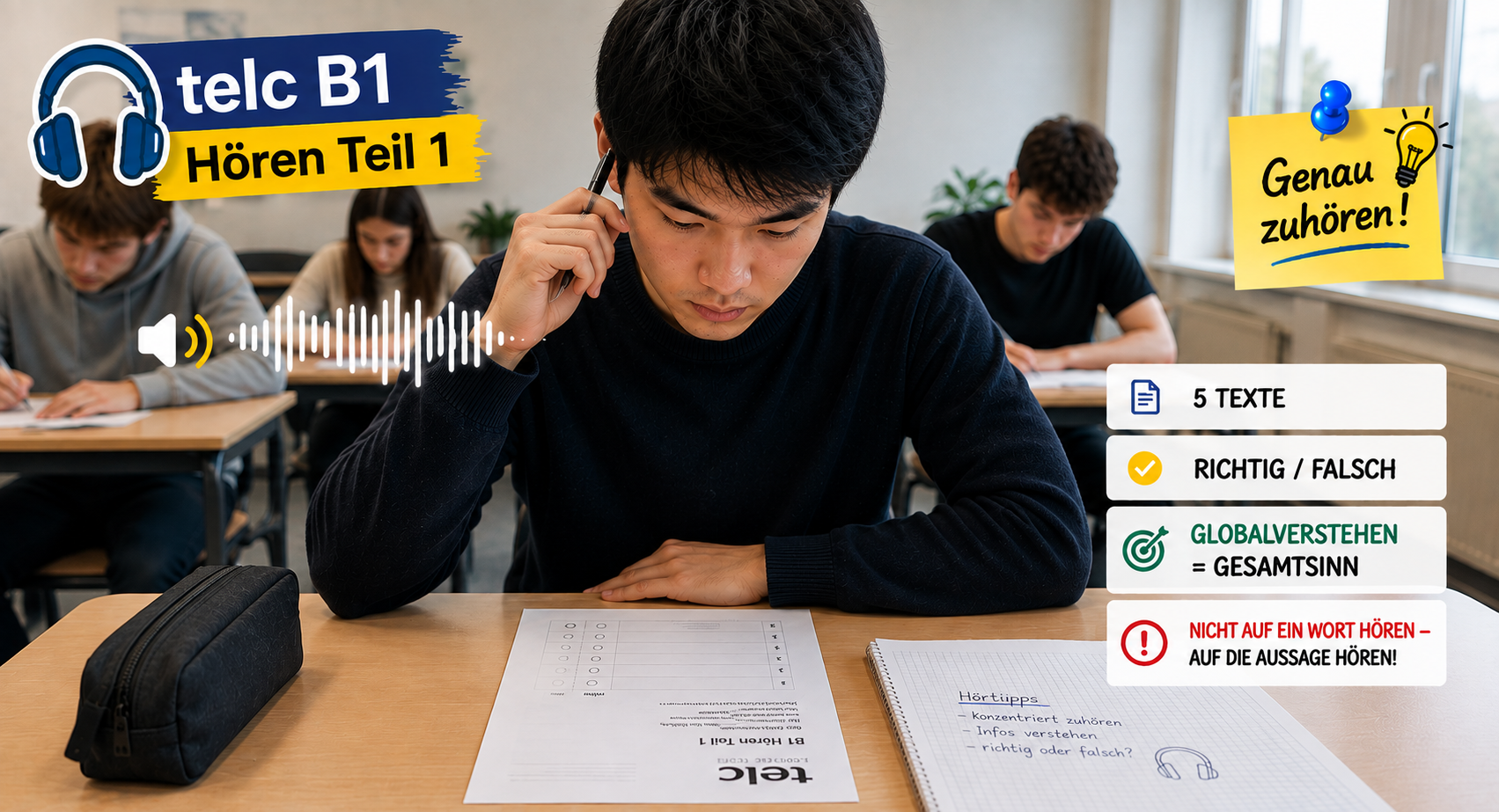
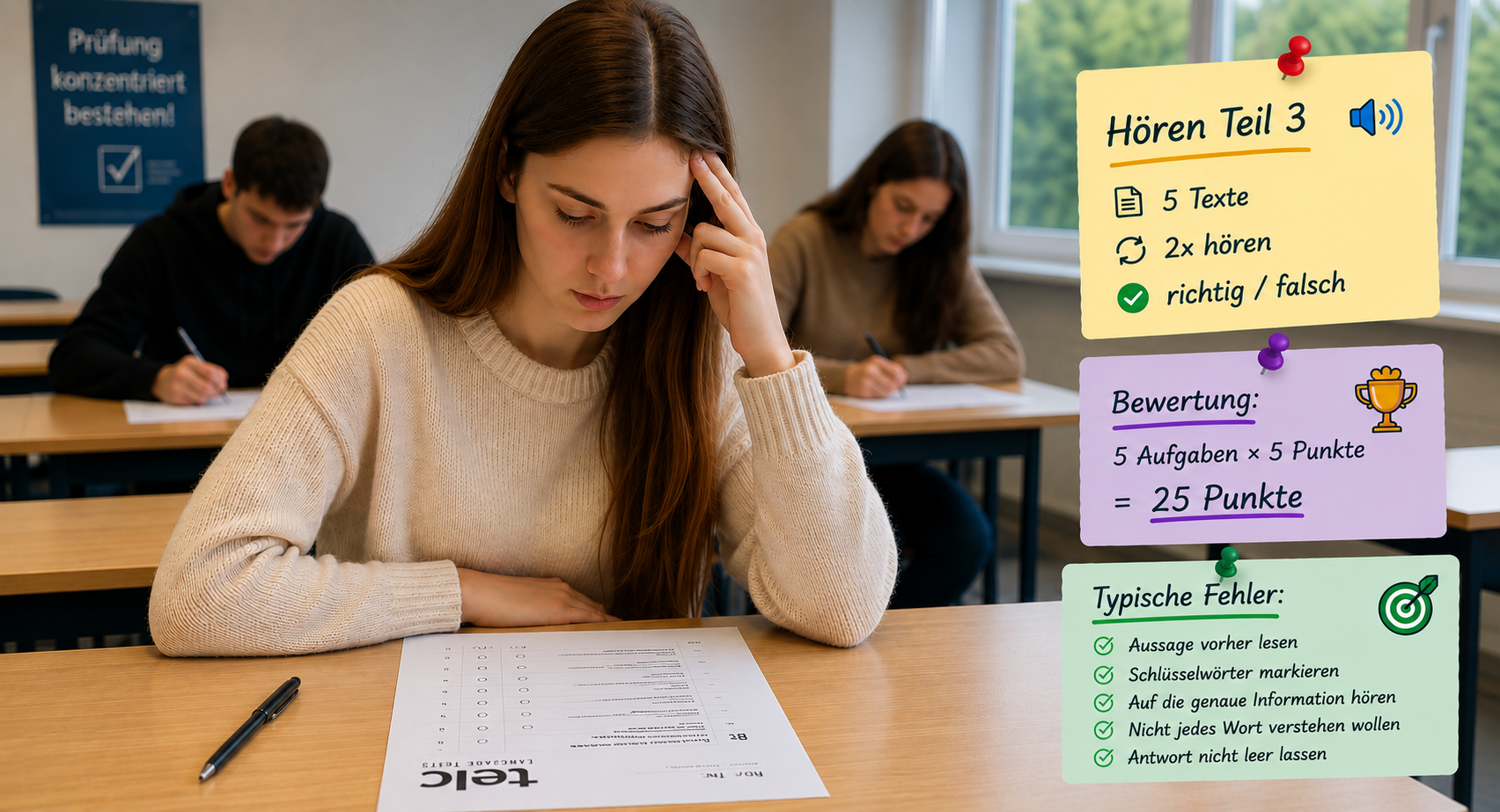
A practical step-by-step method, all the important signal words and all the typical traps you can meet in Listening Part 1 of the telc B1 exam – with concrete examples.
The 3-step method for Listening Part 1
This method describes the timing of the task – that is, when you do what. How to mark the sheet concretely is explained in the next section. Here it is first of all about the right order and the right time management during the whole task.
Phase 1: before the recording – the orientation phase
Use the short reading time not only to decipher the words, but to get an overview of all five statements at the same time. For each statement, briefly ask yourself: what is this about – an opinion, a feeling, a habit, a wish? That way you know before the first sound what you have to pay attention to with which person. Also pay attention to the presenter’s introductory question – it sets the common topic for all five people.
Phase 2: while each person is speaking
With every single person, concentrate on two questions: who exactly is speaking or acting here? And: does the overall sense fit the statement on my sheet? Do not try to translate every word – that costs time and distracts from the overall sense. Let the person finish speaking before you commit definitively; often the decisive information only comes in the last sentence.
Also pay attention to small words like das, dies, damit, dazu (that, this, with it, to it), which refer back to a previous sentence. The decisive sense is often not in a single sentence, but in the connection between two sentences – for example: Der Beruf steht bei uns an zweiter Stelle. Das ist eine Entscheidung gegen Kinder. (Our career comes second. That is a decision against having children.) Only the second das explains what the first sentence was actually about.
Phase 3: the transition to the next person
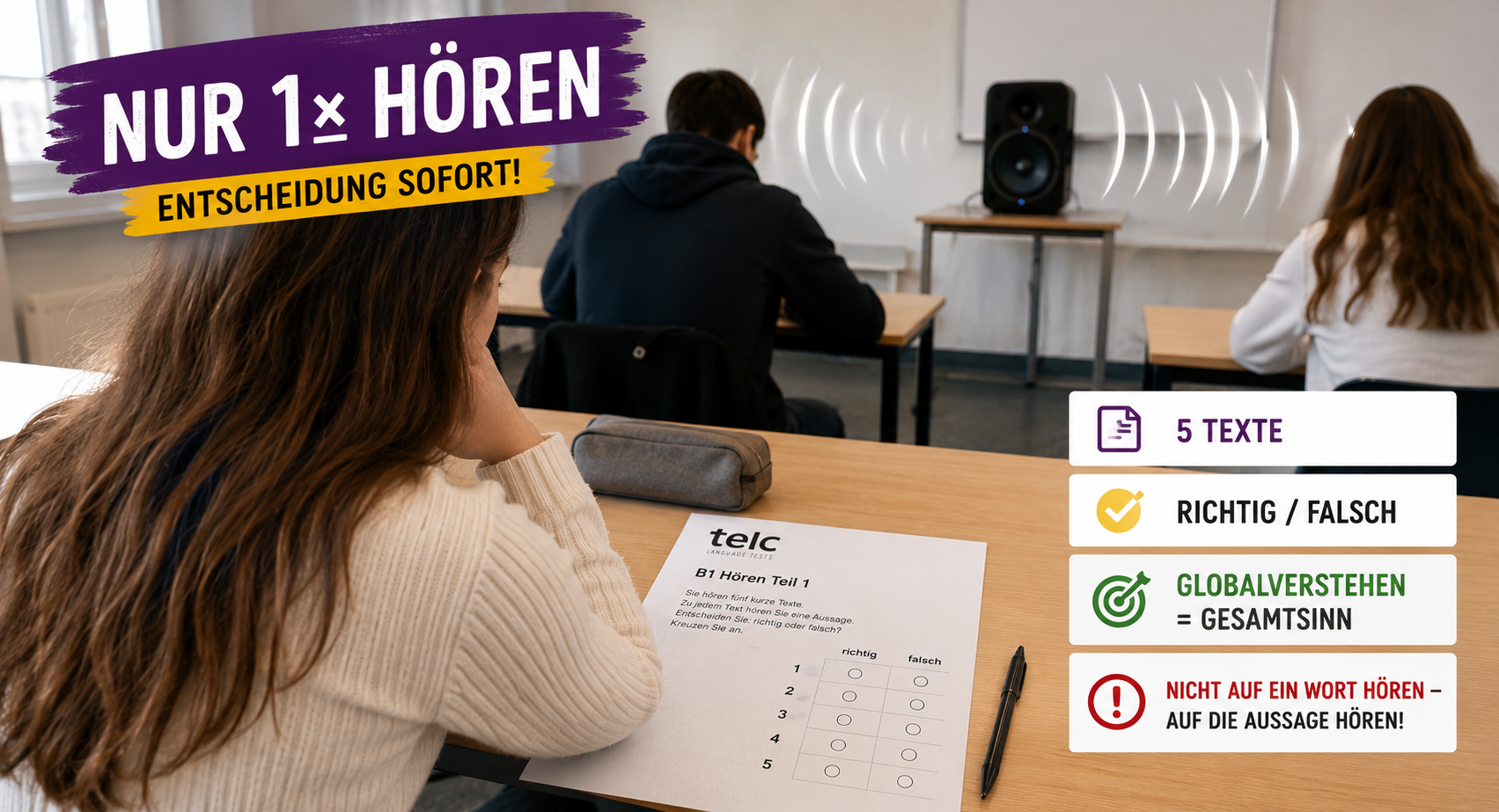
This moment is often underestimated. As soon as one person has finished speaking, the next one begins without a pause. Make your decision in this short moment and mentally close the previous item – even if you are unsure. Looking back or thinking for a long time about the previous statement costs you the beginning of the next person, and this loss cannot be made up for.
Phase 4: after the fifth person – the short check
Once all five people have spoken, there is usually a short moment before the next exam part begins. Use it for a quick look at your sheet: have I really ticked something for all five items? A missing tick can still easily be added at this moment – later, in the next exam part, it cannot.
Orientate, listen, decide immediately, check briefly. These four phases repeat with each of the five people – only the orientation phase (phase 1) takes place once for all five statements together.
How to mark the task sheet correctly
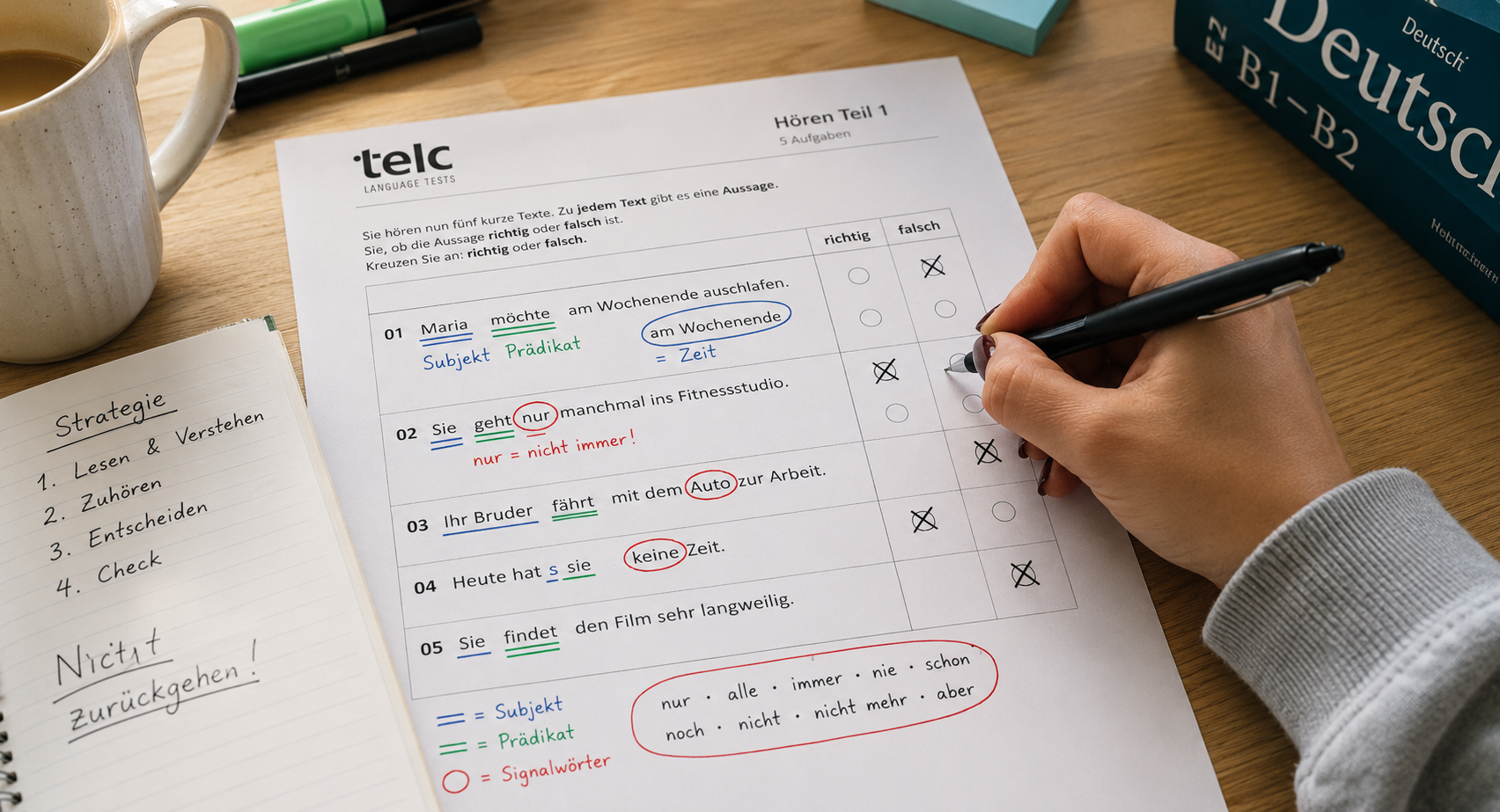
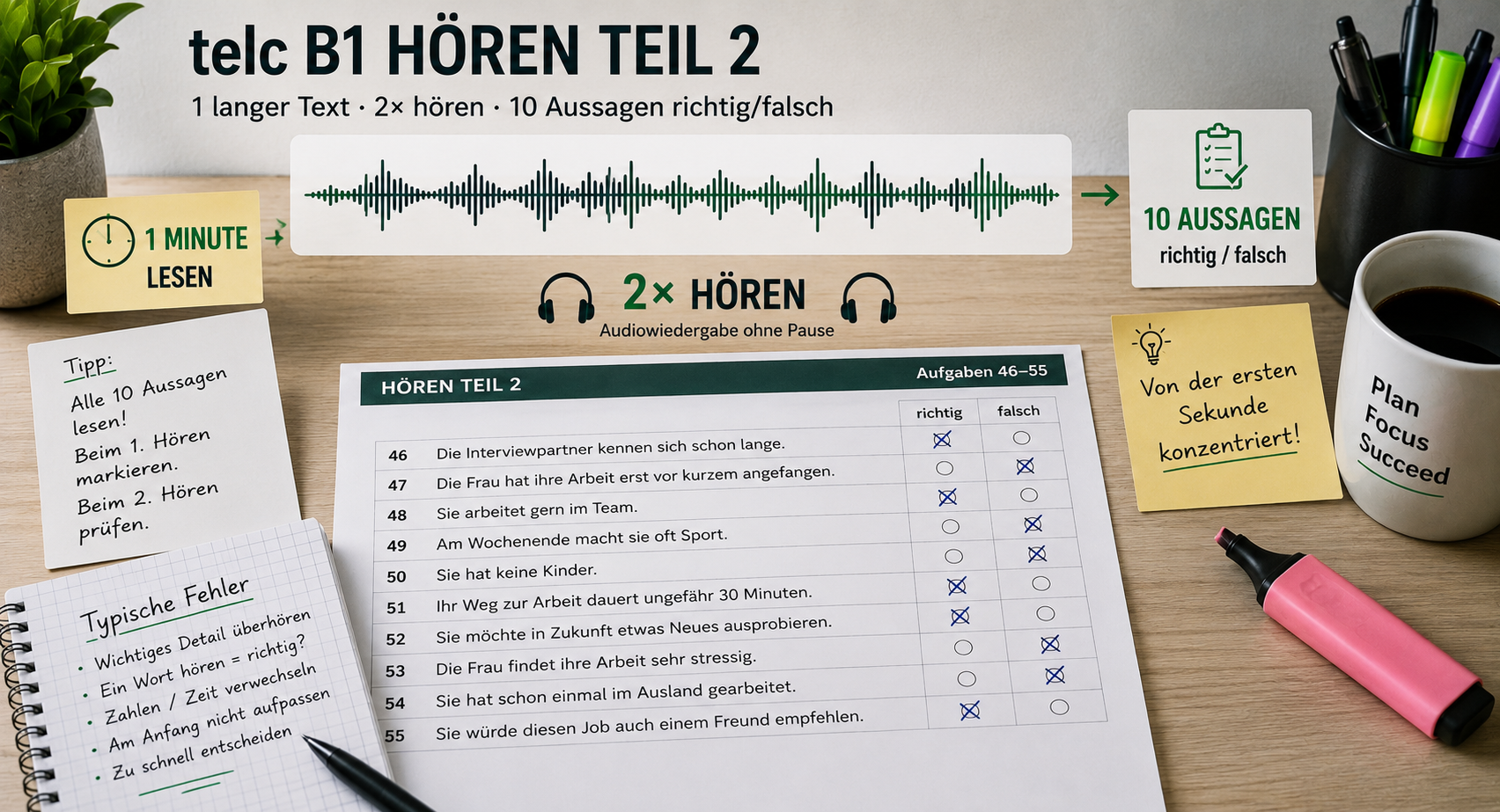
Many learners do not dare to use the task sheet in the exam room. That is a misunderstanding: the sheet belongs to you for the duration of the exam, and active marking is a proven, permitted strategy. Here you will find a concrete system with fixed symbols that you can practise directly during training.
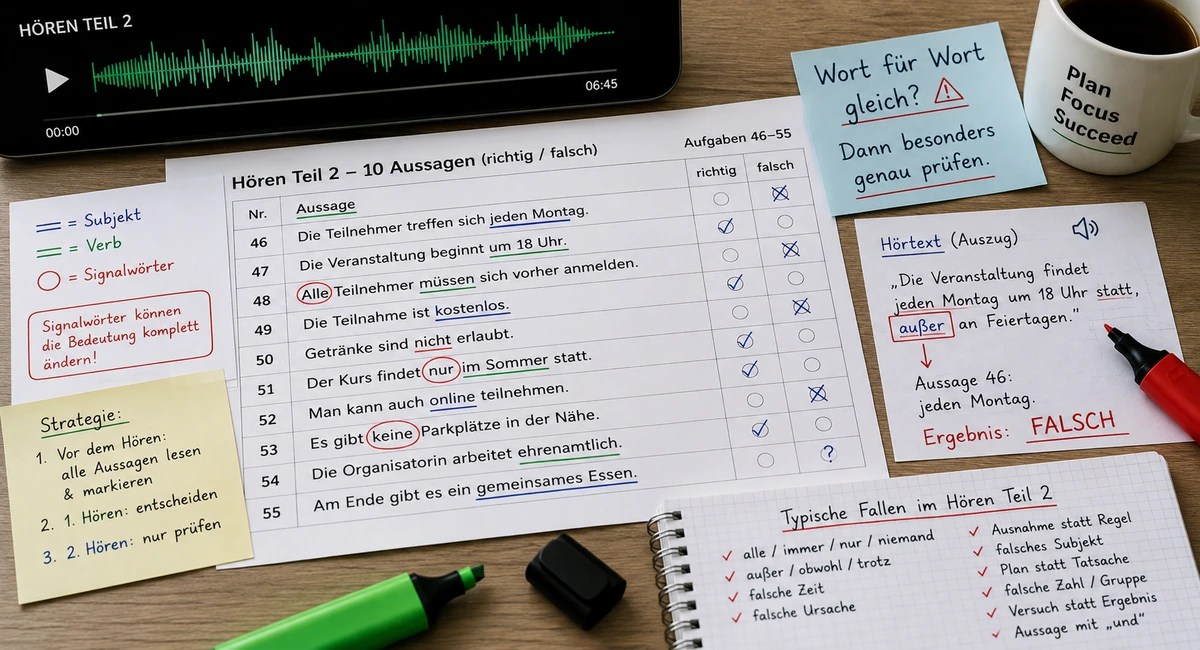
Your symbol system: three fixed marks
| Mark | What for? | Example |
|---|---|---|
| one line | Subject – who acts? | Der Sprecher mag Extremsport nicht. (The speaker does not like extreme sports.) |
| two parallel lines | Predicate – what is done? | Der Sprecher mag Extremsport nicht. |
| circle | all signal words: quantifiers (nur, alle, immer, nie, schon, noch, nicht mehr / only, all, always, never, already, still, no longer) AND time references (früher, jetzt, seit, bis vor Kurzem / earlier, now, since, until recently) | Der Sprecher mag Extremsport ◯nicht◯. |
A worked example
This is what a statement looks like when it is marked before the recording:
Die Sprecherin verbringt ihre Ferien immer mit ihrer Familie. (The speaker always spends her holidays with her family.)
Die Sprecherin verbringt ihre Ferien ◯immer◯ mit ihrer Familie.
While listening, you now know immediately what you have to watch out for: is it really about this person, whom you have marked as the subject (not about a partner, parents or siblings)? Does the marked action (the predicate) really belong to this person? And is the circled word immer (always) correct – or does the text mention an exception, for example a single trip without the family?
Notes during the listening itself
In addition to marking in advance, while listening you can put a simple mark next to the statement to record your first spontaneous reaction before the next person begins:
- Tick: I am fairly sure – true.
- Cross: I am fairly sure – false.
- Question mark: unsure – here I will have to guess at the end.
This quick note-taking system takes only a second, but it prevents you from forgetting at the end how you actually felt about a particular statement.
Marking is not a sign of insecurity, but a professional way of working. Whoever allows themselves to work actively with the sheet keeps an overview more easily in the stressful exam situation.
All signal words and all typical traps – with examples
This section is divided into four groups. For each group you will first find the relevant signal words you should watch out for, and then the traps that belong to exactly this group. That way you know immediately what to look for in each group.
Group A: traps around the person
With this group it is always the same question: who exactly does that – and does this person really do it themselves? Pay attention to the following signal words:
| Signal words | What they point to |
|---|---|
| ich, mein/e, mir, mich (I, my, to me, me) | The speaking person themselves |
| er/sie, sein/ihr, mein Partner, meine Mutter, mein Bruder, meine Freundin (he/she, his/her, my partner, my mother, my brother, my girlfriend) | Another person, often easily confused with the speaker |
| wir, uns, unser (we, us, our) | A group – check which one exactly (e.g. the family or only the adults) |
| selbst, allein, gemeinsam, zusammen mit (oneself, alone, jointly, together with) | Shows whether an action is really carried out by the named person or only experienced alongside |
| zusehen, zuschauen, beobachten (to watch, to look on, to observe) vs. machen, tun, ausführen (to do, to carry out) | Difference between a spectator and a person acting |
Trap 1 – the swapped person: the action is mentioned in the text, but it is carried out by a different person than the statement claims – for example by the partner or the brother instead of the speaking person themselves.
Statement: Der Sprecher spielt selbst gern Gitarre. (The speaker likes playing the guitar himself.)
Text: Mein Mitbewohner spielt jeden Abend Gitarre – mich nervt das ziemlich, ich habe damit nichts am Hut. (My flatmate plays the guitar every evening – it annoys me quite a lot, it is not my thing at all.) → false, because it is not the speaker but his flatmate who plays the guitar.
Trap 2 – the swapped group: similar to trap 1, but instead of two people, two groups are confused – for example Erwachsene (adults) and Kinder (children) within the same sentence.
Statement: Die Kinder des Sprechers bekommen keine Geschenke. (The speaker’s children do not get any presents.)
Text: Wir Erwachsenen machen uns gegenseitig keine Geschenke mehr – die Kinder bekommen aber sowieso schon viel zu viel. (We adults no longer give each other presents – but the children get far too much anyway.) → false, the giving up concerns the adults, not the children.
Trap 3 – general statement instead of personal opinion: a sentence begins with a general observation about people in general (without ich / I) – that is not yet the personal position of the speaking person. The actual opinion often only follows afterwards, usually after an aber (but).
Statement: Der Sprecher findet, dass Haustiere für jede Familie wichtig sind. (The speaker thinks that pets are important for every family.)
Text: Haustiere sind für viele Leute etwas ganz Besonderes. Ich finde aber, so ein Tier braucht Zeit und Geld, die ich einfach nicht habe. (Pets are something very special for many people. But I think such an animal needs time and money that I simply do not have.) → false, the first sentence describes a general opinion of other people, not the speaker’s own position.
Trap 4 – the wrong object of comparison: a quality really is mentioned in the text – but it belongs to the other part of a comparison, not to the one the statement claims.
Statement: Die Sprecherin findet, man kann Gefühle in einer SMS gut ausdrücken. (The speaker thinks you can express feelings well in a text message.)
Text: Ein persönlicher Brief ist viel herzlicher als eine SMS. Da kann man seine Gefühle viel besser zum Ausdruck bringen. (A personal letter is much warmer than a text message. There you can express your feelings much better.) → false, this ability is attributed to the letter, not to the text message.
Trap 5 – spectator instead of person acting: a word from the statement does occur – but the person only observes the action instead of carrying it out themselves.
Statement: Die Sprecherin macht selbst Fallschirmspringen. (The speaker goes parachuting herself.)
Text: Wenn ich beim Fallschirmspringen zusehe, wird mir schon schlecht – das ist nichts für mich. (When I watch parachuting, I already feel sick – that is nothing for me.) → false, she only watches, she does not jump herself.
Trap 6 – travel companion instead of time companion: the named person really does travel along – but does not necessarily spend most of the time with them.
Statement: Die Sprecherin ist im Urlaub die ganze Zeit mit ihren Eltern zusammen. (On holiday the speaker is together with her parents the whole time.)
Text: Ich fahre mit meinen Eltern in den Urlaub, aber ich treffe dort so viele nette Leute – meine Eltern sehe ich eigentlich nur beim Frühstück. (I go on holiday with my parents, but I meet so many nice people there – I actually only see my parents at breakfast.) → false, they travel together, but the time is spent with other people.
Group B: traps around word meaning and sentence sense
With this group the question is: does a word occur, but the sentence as a whole means something different? Pay attention to the following signal words:
| Signal words | What they point to |
|---|---|
| nicht, nie, kein, keine, nirgends, niemand, nichts (not, never, no, nowhere, nobody, nothing) | Negation – reverses the sense of the following word |
| aber, doch, jedoch, allerdings, dabei, trotzdem, obwohl, sondern, im Gegenteil (but, yet, however, though, at the same time, nevertheless, although, but rather, on the contrary) | Contrast – the most important thing often comes directly afterwards |
| oder? nicht wahr? (right? isn’t it?) | Rhetorical question – the person expects agreement with their (often dismissive) opinion |
| auf die Nerven gehen, auf etwas pfeifen, über seinen Schatten springen and similar fixed expressions | Idioms – their literal meaning does not fit the actual statement |
Trap 7 – same word, opposite sense: a key word from the statement really does occur in the text – but in a negation or in a sentence that says exactly the opposite.
Statement: Die Sprecherin hat Angst vor Nebenwirkungen. (The speaker is afraid of side effects.)
Text: Ich habe noch nie gehört, dass jemand ernsthaft Probleme mit diesem Medikament hatte – ich glaube, diese ganze Angst ist total übertrieben. (I have never heard of anyone having serious problems with this medicine – I think all this fear is totally exaggerated.) → false. The word fits the topic, but the sense is exactly the other way round.
The opposite is just as frequent: a correct statement often uses not a single word from the text – it is expressed completely with different words (synonyms). Example: the statement says Der Sprecher teilt sich die Arbeit je nach Situation auf. (The speaker divides up the work depending on the situation.), but the text says Bei uns hängt das immer von der Situation ab. (With us that always depends on the situation.) – true, although not a single word is identical. So never rely on whether a familiar word is missing from or present in the text – what is decisive is always the sense of the whole sentence.
Sometimes a negation even confirms a correct statement instead of refuting it – namely when two negations together produce a positive sense. Example: the statement says Der Sprecher findet ein Leben mit Kindern schön. (The speaker thinks a life with children is lovely.), and the text says Ein Leben ohne Kinder kann ich mir gar nicht vorstellen, da würde einfach etwas fehlen. (I cannot imagine a life without children at all, something would simply be missing.) – true, because ohne Kinder nicht vorstellbar (unimaginable without children) means precisely that life with children is good. With every negation, check exactly how many negations are in the sentence: one negation reverses the sense, two negations together reverse it back.
Trap 8 – mentioned as a rejected example: a place or a thing is mentioned in the text – but only as an example of something the person precisely does not want, not as an actual choice of their own.
Statement: Der Sprecher möchte den Feiertag gern in einem Wellness-Hotel verbringen. (The speaker would like to spend the holiday in a wellness hotel.)
Text: Was soll ich in einem Wellness-Hotel? Ein Zimmer mit Plastikpalme kann doch kein echtes Feiertagsgefühl geben, oder? (What am I supposed to do in a wellness hotel? A room with a plastic palm tree cannot give any real holiday feeling, can it?) → false, the wellness hotel is only mentioned as a rejected negative example.
Trap 9 – mentioned as a side detail, not as the core statement: the word or topic mentioned is true, but it is only an example of a bigger problem – not the actual reason for the complaint in the statement. This trap is one of the most frequent and trickiest of all.
Statement: Die Sprecherin streitet mit ihrer Mutter immer wegen des Telefons. (The speaker always argues with her mother about the phone.)
Text: Bei jedem Streit erinnert sich meine Mutter an etwas ganz anderes aus der Vergangenheit – neulich zum Beispiel, weil ich telefoniert habe. Was hat das denn mit unserem Streit zu tun? (In every argument my mother remembers something completely different from the past – recently, for example, because I was on the phone. What does that have to do with our argument?) → false, the phone is only an example of another, bigger problem.
Search the text specifically for the word that marks the actual reason – usually directly after weil, denn (because, for) or in a sentence with aber (but). Only the reason that is really connected with this signal word counts for the statement. A detail that is only mentioned as an example (zum Beispiel, etwa / for example, such as) is almost never the core of the statement.
Trap 10 – wrong scope of application: a word or a quality from the statement really does occur in the text – but there it refers to something more general or completely different than the statement claims.
Statement: Die Sprecherin meint, dass nur tolerante Menschen laute Musik hören. (The speaker thinks that only tolerant people listen to loud music.)
Text: Jedem gefällt eben was anderes, da muss man schon tolerant sein. (Everyone likes something different, so you do have to be tolerant.) → false, tolerant (tolerant) here refers to tolerance towards other people’s taste in general, not specifically to listeners of loud music.
Trap 11 – idioms and fixed expressions: an expression is misunderstood literally because its real meaning is not known.
Statement: Der Sprecher findet laute Musik gut für die Nerven. (The speaker thinks loud music is good for the nerves.)
Text: Diese Musik geht mir wirklich auf die Nerven. (This music really gets on my nerves.) → false, the idiom means exactly the opposite of gut für die Nerven (good for the nerves).
- jemandem auf die Nerven gehen – to get on someone’s nerves, to annoy them (not: to be good for the nerves)
- auf etwas pfeifen – not to care about something, to ignore it
- über seinen Schatten springen – to overcome a fear or a resistance
- Nee – colloquial for Nein (no), sounds slightly different from the standard word when heard
- das heißt noch lange nicht, dass … – fixed formula to contradict something clearly (that does not mean at all that …)
- das ist doch nicht zu übersehen – fixed formula to confirm something as obvious (that simply cannot be overlooked)
- lassen wir’s – colloquial for: we will do without it, we will not do it
Group C: traps around numbers, time and quantity
With this group the question is: is the number, quantity or time reference mentioned really exact – or only approximate? Pay attention to the following signal words:
| Signal words | What they point to |
|---|---|
| nur, alle, jeder, jede, immer, nie, die meisten, wenige, kein, keine, viele, ganz, überhaupt nicht, gar nicht (only, all, everyone, always, never, most, few, no, many, completely, not at all) | Quantity and frequency – a single exception in the text makes the statement false straight away |
| früher, jetzt, heute, damals, seit, bis vor Kurzem, inzwischen, mittlerweile, neulich, demnächst, noch, nicht mehr, schon (earlier, now, today, back then, since, until recently, meanwhile, by now, recently, soon, still, no longer, already) | Point in time – check whether the statement really refers to the same period as the text |
| Numbers with a unit (Jahre, Wochen, Tage, Euro, Prozent, Personen … / years, weeks, days, euros, per cent, people …) | Always check the unit, not just the digit itself |
| verschieden, unterschiedlich, alle möglichen (different, various, all sorts of) vs. ein einziger, eine einzige Sache (a single one, one single thing) | Difference between variety and a large quantity of the same thing |
Trap 12 – the number trap: a number from the statement occurs in the text – but it refers to a different unit, a different period or a different thing.
Statement: Der Sprecher macht diesen Sport schon seit acht Jahren. (The speaker has been doing this sport for eight years.)
Text: Der Kurs dauert acht Wochen, und danach höre ich meistens wieder auf. (The course lasts eight weeks, and after that I usually stop again.) → false. The number eight is correct, but it refers to weeks, not to years.
Trap 13 – the quantity trap: the quantity as such is correct (for example viele / many), but the statement additionally claims a variety that does not exist in the text – such as viele verschiedene (many different ones) instead of many of one single thing.
Statement: Die Sprecherin hat Poster von vielen verschiedenen Schauspielern. (The speaker has posters of many different actors.)
Text: Mein Zimmer ist der totale Fanshop von einem einzigen Schauspieler – ich habe mir alle seine Filmposter gekauft. (My room is a total fan shop for one single actor – I have bought all of his film posters.) → false, there are many posters, but only of one person.
Trap 14 – wrong point in time: a place, a person or an action is named correctly – but it belongs to a different point in time than the statement claims.
Statement: Die Sprecherin verbringt den Feiertag am liebsten in Spanien. (The speaker most likes to spend the holiday in Spain.)
Text: Wir feiern immer zu Hause. Danach, wenn alles vorbei ist, fahren wir für ein paar Tage nach Spanien, um uns zu erholen. (We always celebrate at home. Afterwards, when everything is over, we go to Spain for a few days to recover.) → false. Spain is correct, but it is about the time after the holiday, not about the holiday itself.
Words like aber, bis vor Kurzem, jetzt, früher (but, until recently, now, earlier) do not automatically indicate a trap. What is decisive is always whether the point in time named by the statement matches the point in time in the text. If, for example, the statement explicitly says am Anfang (at the beginning) or jetzt (now), and the text confirms exactly this point in time, then the statement is true – even if a contrast with aber (but) follows in the text afterwards, referring to a different, later point in time. So do not only check whether a time contrast occurs, but which point in time the concrete statement on your sheet is talking about.
Trap 15 – the quantifier trap (nur, alle, immer): the text names more than one possibility or restricts a statement – but the statement on the sheet claims nur (only) one thing or alle/immer (all/always) without exception.
Statement: Der Sprecher schreibt seine Briefe nur mit der Hand. (The speaker writes his letters only by hand.)
Text: Ich schreibe meine Briefe mit der Hand – oder fast genauso oft am Computer, dann tippe ich alles in Ruhe. (I write my letters by hand – or almost just as often on the computer, then I type everything at leisure.) → false, there are two possibilities, not just one.
Statement: Der Sprecher glaubt, dass alle Kollegen den Computer gut bedienen können. (The speaker believes that all colleagues can use the computer well.)
Text: Die meisten von uns können nicht mit dem Computer umgehen. (Most of us cannot handle the computer.) → false, it is die meisten (most) without computer skills, not alle (all) with computer skills – two different quantifiers that are easily confused.
This construction occurs in the text both as a contradiction and as a confirmation – depending on what exactly the statement claims. If the statement claims only one thing and the text says nicht nur X, sondern auch Y (not only X, but also Y), the statement is false (as in the example above). But if the statement itself already claims nicht nur X (not only X) and the text likewise says nicht nur X, sondern auch Y, the statement is true. So do not just recognise the construction itself, but compare exactly what stands on both sides of sondern auch (but also) – in the text and in the statement.
Sometimes a person says: Wir haben auf die wirklich großen Probleme keinen Einfluss. (We have no influence on the really big problems.) That does not mean that this person does nothing at all for their goal – often concrete, smaller actions are mentioned earlier in the same text. So check whether a statement like X tut gar nichts (X does nothing at all) really claims complete inactivity, or whether the text only shows that influence on a big, global problem is limited – while with smaller, concrete things something certainly is being done.
Group D: traps around feeling, reason and conclusion
With this group the question is: is not only the fact correct, but also the reason, the feeling or the conclusion behind it? Pay attention to the following signal words:
| Signal words | What they point to |
|---|---|
| weil, da, denn, deshalb, deswegen, aus diesem Grund (because, as, for, therefore, that is why, for this reason) | Reason – check whether this really is the reason named in the text |
| würde, hätte, wäre, könnte, müsste, am liebsten, eigentlich (would, would have, would be, could, would have to, most of all, actually) | Konjunktiv II (subjunctive II) – wish, politeness or thought experiment; not automatically a contrast to reality |
| doch, ja, wirklich, tatsächlich, natürlich (indeed, yes, really, actually, of course) | Reinforcement of certainty – shows how convinced the person is of their own statement |
| faul, schrecklich, toll, wütend, froh, genervt (lazy, terrible, great, angry, glad, annoyed) and similar feeling words | Emotional colouring – does the tone really fit the statement on the sheet? |
Trap 16 – wrong emotional colouring: the facts mentioned are correct, but the emotional state in the statement does not fit the tone of the text – for example satisfaction is claimed although the person is clearly complaining.
Statement: Die Sprecherin ist froh, dass ihr Partner so viel im Haushalt hilft. (The speaker is glad that her partner helps so much in the household.)
Text: Mein Partner ist wirklich faul, er macht nur, was ihm Spaß macht, den Rest bleibt an mir hängen. (My partner is really lazy, he only does what he enjoys, the rest is left to me.) → false, here there is clearly annoyance, not satisfaction.
Trap 17 – the wrong reason: the result in the statement is correct, but the reason given does not match the actual reason in the text.
Statement: Die Sprecherin macht diesen Sport nicht, weil sie Angst hat. (The speaker does not do this sport because she is afraid.)
Text: Ich habe da keine Angst, es interessiert mich einfach nicht – ich glaube, das würde mir keinen Spaß machen. (I am not afraid of it, it simply does not interest me – I do not think I would enjoy it.) → false, the result (she does not do the sport) is correct, but the reason is a different one.
With this trap, always check two things separately: is the result itself correct (does she do the sport, yes or no)? And is the concretely named reason correct? A text can even explicitly rule out one possible reason (as in the example above with keine Angst / no fear) and still name another, real reason. Only if both – result and reason – match the statement together is the statement true.
Trap 18 – Konjunktiv II: wish instead of reality: the whole text is in Konjunktiv II (subjunctive II, an imagined wish), but the statement claims that this is already reality.
Statement: Der Sprecher lebt schon in seinem Traumhaus. (The speaker already lives in his dream house.)
Text: Am liebsten hätte ich ein Haus mit großem Garten – aber so etwas ist kaum zu finden und viel zu teuer. (Most of all I would like a house with a big garden – but something like that is hard to find and far too expensive.) → false, it remains a wish.
The Konjunktiv II (subjunctive II) is used very often in Listening Part 1 – but not every time to express an unfulfilled wish. With every Konjunktiv II sentence, check which of the following four patterns it belongs to:
| Pattern | Meaning | Example |
|---|---|---|
| 1. Wish in contrast to reality | Signals false if the statement claims this as a fact | Am liebsten hätte ich ein Haus mit Garten – aber das ist unbezahlbar. (Most of all I would like a house with a garden – but that is unaffordable.) |
| 2. Emotional reinforcement, no contrast | Expresses strong feelings, but confirms the person’s real attitude | Ohne meine beste Freundin könnte ich nicht leben! (I could not live without my best friend!) → means: friendship really is very important to her. |
| 3. Argument that supports the correct answer | Explains why something is (currently) not done – thus confirms the fact | Wenn wir jetzt ein Baby bekämen, wüssten wir gar nicht, wie wir das schaffen sollten. (If we had a baby now, we would have no idea how we would manage it.) → means: they do not want a baby now, and that really is the case. |
| 4. Condition not yet fulfilled | Describes neutrally what is missing, without expressing a wish or disappointment | Wir müssten erst extra ausgebildet werden, bevor wir das machen können. (We would first have to be specially trained before we can do that.) |
Only pattern 1 is a real trap. So always check: does the statement on the sheet claim that something is already reality, although the text only describes a wish, an emotion, an argument or an open condition? Only then is the statement false.
Trap 19 – the hidden conclusion without a signal word: the hardest trap: the text names only neutral facts, without a single word like aber (but), nein (no) or nicht (not). The correct answer only emerges when you mentally put all the facts together.
Statement: Die Sprecherin sucht eine Wohnung außerhalb der Stadt. (The speaker is looking for a flat outside the city.)
Text: So eine Wohnung hätten wir letztes Jahr haben können, aber das lag weit draußen. Ich hätte dann jeden Tag eine Stunde zur Arbeit fahren müssen, und die Kinder hätten ihre Freunde verloren. (We could have had such a flat last year, but it was far out. I would then have had to travel an hour to work every day, and the children would have lost their friends.) → false. No word directly says that they do not want it – the conclusion only emerges from the whole chain of facts.
Not only false but also correct statements sometimes only emerge from several examples together, without a single sentence confirming the statement directly. Example: the statement says Der Sprecher findet, viele Menschen geben zu viel Geld für unwichtige Dinge aus. (The speaker thinks many people spend too much money on unimportant things.) In the text there is no sentence with exactly this meaning – instead several individual examples are given: Jugendliche geben ihr ganzes Taschengeld für das neueste Handy aus (young people spend all their pocket money on the latest phone), die Eltern beschweren sich, wenn die Milch zwanzig Cent teurer wird, aber kaufen Zigaretten (the parents complain when milk gets twenty cents more expensive, but they buy cigarettes). Only the sum of these examples produces the correct, generalised statement. So practise consciously drawing a general conclusion yourself from several concrete examples.
A word in the text that also occurs in the statement is never on its own a proof of true. Always check: who exactly does that? When exactly? How many? For what reason? And is the sense really the same – or is it just a single word?
The guessing rule: why you should never leave a box empty
For every item in Listening Part 1 there are only two possibilities: true or false. That means: even if you have not understood a statement at all, the probability of hitting the right answer by pure guessing is 50 per cent.
A chance of 50 per cent is enormously high – considerably higher than any chance of winning in a lottery or in other games of chance. An empty box, on the other hand, guarantees zero points.
That is why a simple rule applies: if you are unsure, decide on an answer anyway. Where possible, use the traps described in this article as orientation – often you will at least remember a detail that points in one direction. But even without any memory of it, the rule holds: guessing is always better than an empty box.
Checklist for the exam
You can read through this checklist once more briefly before training or before the exam.
- I read all five statements completely before the recording begins.
- I underline the subject and the predicate in each statement.
- I circle signal words: nur, alle, immer, nie, schon, noch, nicht mehr (only, all, always, never, already, still, no longer).
- While listening, I pay attention to who exactly is speaking and who is being spoken about.
- I follow words like das or dies (that, this) which refer back to a previous sentence.
- I bear in mind that a word I hear is on its own no guarantee of true – and that a correct answer is also possible entirely without identical words.
- With a negation I count how many negations are in the sentence – two negations can cancel each other out.
- With weil (because) sentences I distinguish between the result and the concretely named reason.
- I decide immediately and do not look back at the previous item.
- I never leave a box empty – when in doubt, I guess.



There are no comments for this article. Leave your comment