





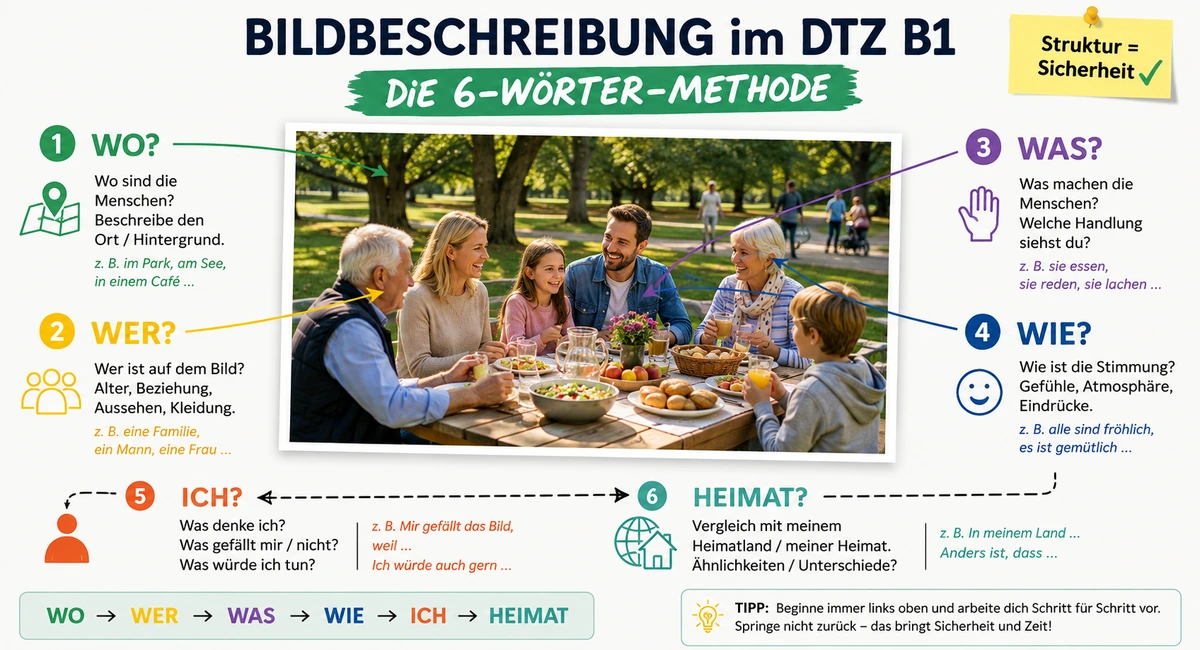
Picture description in the DTZ B1:
The 6-word method
Are you afraid of the photo in DTZ Sprechen Teil 2? With the 6-word method you always know what to say. A simple strategy, set phrases and tips for migrants from all over the world.
Overview: What is Teil 2 in DTZ B1 Sprechen?
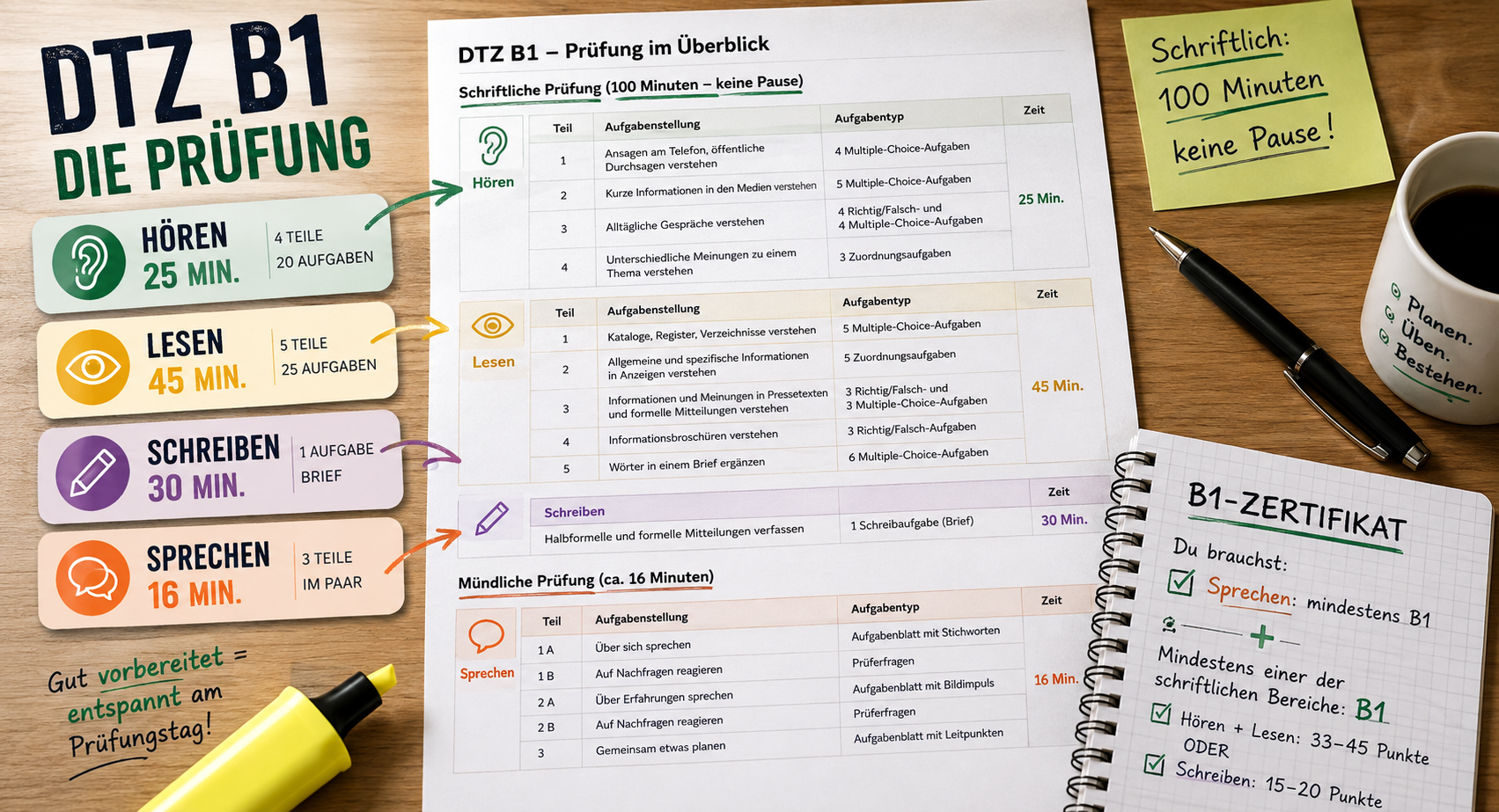
The oral exam section of the Deutsch-Test für Zuwanderer (DTZ) consists of three tasks. Teil 2 is officially called Über Erfahrungen sprechen and lasts approximately 6 minutes. This task is often referred to in the B1 DTZ as picture description, because candidates receive a photo and are asked to speak about it.
Both candidates receive different photos on a similar topic. They speak about their photo one after the other. There is no preparation time — candidates see the picture and begin speaking immediately.
Important to know: this task is not only about describing the photo. You are also expected to talk about your own experiences and draw a comparison with your home country. This is precisely where it becomes clear whether you have reached level B1 or remain at level A2.
Structure of Teil 2 at a glance
| Parameter | Information |
|---|---|
| Official name | Über Erfahrungen sprechen |
| Duration | approx. 6 minutes (for both candidates together) |
| Preparation time | none |
| Material | One photo per candidate (different pictures, same topic) |
| Assessment | maximum 20 points (10 for the description + 10 for the experiences) |
| Order | TN 1 first, then TN 2 — not simultaneously |
The task consists of two parts. In the first part you should describe what you see in the photo and what situation is shown. In the second part you should talk about your own experiences with the topic. Afterwards the examiner asks additional questions or gives speaking prompts.
👉 Exercises to prepare for the DTZ B1 examWhy a clear strategy is important
Many candidates know the task well, have learnt vocabulary and can form sentences — and yet they panic in the exam when they see the photo. Why? Because they do not know where to start and where to go next.
The problem is not the language level, but the absence of a clear plan. Those who speak without a strategy often get stuck at the beginning and only describe the colours or clothing in the photo. This means the most important points — personal experiences and comparison with the home country — remain unsaid. Yet these are precisely the points that are decisive for level B1.
The photo is only a starting point. The examiners do not want to hear every detail of the picture. They want to see how well you can talk in German about your own life and your culture. Anyone who only describes the photo demonstrates at most level A2.
What happens in the exam without a strategy?
- The candidate spends 4 minutes talking about colours, clothing and unimportant details.
- There is no time left for personal experiences and comparison with the home country.
- The examiners have to help with many additional questions.
- The result is often A2 rather than B1.
What happens with a clear strategy?
- The candidate immediately knows what to say first.
- The language flows calmly and logically.
- All important points are covered — including experiences and comparison.
- The examiners hear typical B1 structures.
The 6-word method — your plan in your head
The solution is simple: learn a fixed sequence of six words by heart. These six words are your plan for every photo you will see in the exam. They work like a navigation system in your head.
WO → WER → WAS → WIE → ICH → HEIMAT
These six stations guide you step by step through the entire task. You move upwards as if climbing a staircase — no jumping, no going back, no stopping. Each station gets a few sentences, then you move on to the next station.
What do these six words mean?
1. WO — Where is the situation? (Park? Kitchen? Restaurant? Street?) Here you briefly describe the location and the general surroundings.
2. WER — Who is in the photo? (A family? Two women? Children? A group?) Here you name the people.
3. WAS — What are the people doing? (Are they eating? Talking? Working? Playing?) Here you describe the action.
4. WIE — How do the people appear? (Happy? Tired? Concentrated?) Here you also name the topic of the photo.
5. ICH — And you yourself? Do you know this situation? What have you already experienced? Here comes a small story from your own life.
6. HEIMAT — How is it in your home country? The same or different? Here you compare Germany with your homeland.
Only a few sentences per station — no more! If you talk about the photo for too long, you will have no time for ICH and HEIMAT. But these are precisely the two stations that demonstrate level B1.
How many sentences per station?
| Station | Recommended number of sentences | Content |
|---|---|---|
| 1. WO | 3 to 4 sentences | Location and surroundings |
| 2. WER | 3 to 4 sentences | People in the photo |
| 3. WAS | 3 to 4 sentences | Action and activity |
| 4. WIE | 3 to 4 sentences | Mood and topic |
| 5. ICH | 4 to 5 sentences | Personal experience — most important part! |
| 6. HEIMAT | 3 to 4 sentences | Comparison with the home country |
Set phrases for each of the six steps
Here you will find concrete set phrases for each station. Learn two to three sentences from each block by heart — that is enough for every photo that can appear in the DTZ exam.
Station 1: WO — Where is it?
- Auf dem Foto sehe ich …
- Das ist in einem … / in einer …
- Ich glaube, das ist in einem Park / Restaurant / Supermarkt / Büro.
- Das ist zu Hause / draußen / auf der Straße.
- Vielleicht ist das im Sommer / Winter / am Wochenende.
Station 2: WER — Who is in the photo?
- Ich sehe eine Familie / zwei Frauen / einen Mann / Kinder.
- Auf dem Foto sind zwei Personen / drei Leute / eine Gruppe.
- Die Personen sind jung / alt / vielleicht Freunde.
- Das ist wahrscheinlich eine Mutter mit ihrem Kind.
- Im Vordergrund ist … Im Hintergrund sehe ich …
Station 3: WAS — What are the people doing?
- Sie sprechen miteinander / essen zusammen / arbeiten.
- Sie spielen / lachen / kaufen ein / kochen.
- Es sieht so aus, als ob sie Spaß haben.
- Die Personen machen gerade … / sind gerade beim …
- Ich glaube, sie feiern / helfen sich / lernen etwas.
Station 4: WIE — How are the people? What is the topic?
- Sie sehen glücklich / fröhlich / müde / entspannt aus.
- Die Atmosphäre ist schön / ruhig / freundlich.
- Die Personen wirken zufrieden / gestresst / konzentriert.
- Hier geht es um das Thema Familie / Arbeit / Gesundheit / Freundschaft.
- Das Foto zeigt das Thema …
Station 5: ICH — And me? (most important part)
- Das kenne ich gut. Bei mir ist das auch so.
- Ich mache das auch oft, zum Beispiel …
- Das erinnert mich an …
- Letzte Woche / Vor einem Jahr habe ich …
- Ich finde das gut / schön / wichtig, weil …
- Mir gefällt das, denn …
- Für mich ist das positiv / schwierig, weil …
Station 6: HEIMAT — In my country
- In meinem Heimatland ist das anders / ähnlich.
- Bei uns zu Hause machen wir das so: …
- In Deutschland …, aber in meinem Land …
- Bei uns gibt es das nicht / auch.
- Das ist so, weil unsere Kultur / unser Wetter anders ist.
- Mir gefällt es in Deutschland besser, weil …
- Beide Länder haben Vorteile.
The eye trick: eyes guide the mouth
There is a simple trick that makes the 6-word method even more effective: your eyes guide your mouth. You look at a specific part of the photo — and your mouth automatically speaks about what your eyes see.
The brain works better when seeing and speaking function together. This means that in the exam you do not have to think about what to say — your eyes know the way.
The eye route through the photo
| Step | Eyes look … | Mouth says … |
|---|---|---|
| 1. WO | at the background | Location and surroundings |
| 2. WER | at the people as a whole | Who is there, how many people |
| 3. WAS | at the hands and movements | What action is happening |
| 4. WIE | at the faces | Feelings and topic |
| 5. ICH | away from the photo, briefly to the side | Personal experience, personal story |
| 6. HEIMAT | briefly upwards | Comparison with the home country |
With practice this eye movement becomes a physical habit. After a few weeks of training the body reacts automatically: the eyes move across the photo in the right sequence and the mouth follows with the appropriate sentences.
Find a new photo from the internet or a magazine every day. Speak aloud while your eyes follow the route. After one week you will notice: the plan works by itself.
Important rules and emergency sentences
The 6-word method works best when you observe a few important rules. There are also emergency sentences that help you when you briefly do not know how to continue in the exam.
The most important rules at a glance
- Do not stay too long on one station. A maximum of three to four sentences, then move on to the next station.
- Do not describe every detail. Colours, clothing and unimportant objects do not bring additional points.
- Always name the topic. The examiners must hear that you have understood the main topic of the photo.
- Personal experiences are the most important thing. Without ICH and HEIMAT the result stays at A2 level.
- Simple sentences are better than complicated ones. Short, clear and without mistakes — that is B1.
- Use weil and denn. A reason or justification is a typical feature of level B1.
- Speak calmly. Rushing worsens pronunciation and grammar.
Emergency sentences when you do not know how to continue
It is completely normal to need a moment to think in the exam or to forget a word. The important thing is just that you do not stay silent. With the following emergency sentences you keep the conversation alive:
- Moment bitte, ich denke kurz nach.
- Wie sagt man das auf Deutsch?
- Können Sie die Frage bitte wiederholen?
- Ich weiß das Wort nicht, aber das ist so ein Ding zum …
- Das war es eigentlich.
- Mehr fällt mir dazu nicht ein.
If you politely ask for clarification when you have not understood something, this is assessed positively. It shows that you command an important communication strategy. You do not have to understand everything perfectly!
How to train the 6-word method
The method works best when you practise it regularly. Say the six words aloud every day — for example before going to sleep. After one week the sequence is firmly fixed in your head, and in the exam the plan comes automatically.
- Say aloud every day: WO — WER — WAS — WIE — ICH — HEIMAT
- Find a new photo on the internet every day and speak about it for two minutes.
- Record yourself on your mobile phone and listen back — this is how you recognise your own mistakes.
- Practise with a partner or a tandem partner who speaks German.




There are no comments for this article. Leave your comment