





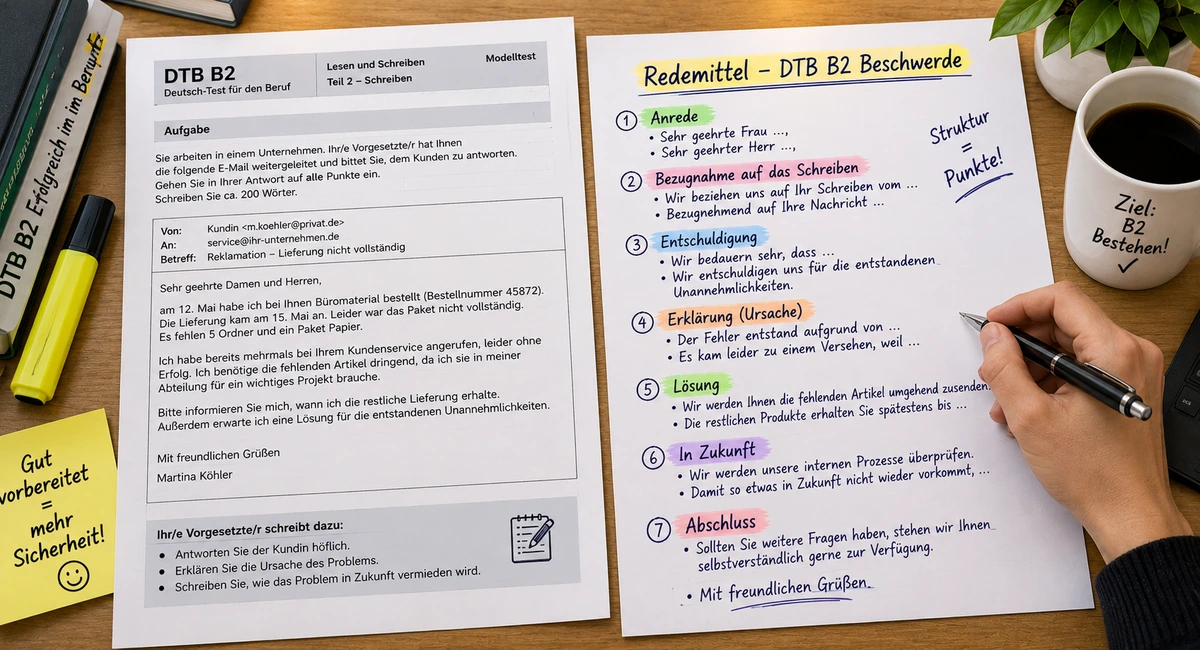
Set phrases DTB B2 complaint:
Structure, phrases and typical mistakes
Which set phrases do you need for the complaint in DTB B2? Here you will find the official structure, all important phrases for reference, explanation, solution and conclusion — with concrete examples and common mistakes.
What is the complaint task in DTB B2?
The complaint belongs to the Reading and Writing section of DTB B2 (Deutsch-Test für den Beruf B2). In this task a professional context is given: a customer, a business partner or an employee has complained about a problem — and candidates must respond to it in writing. This means it is not a matter of writing a complaint yourself, but of composing a reply to a complaint.
This task simulates a real professional situation: a company receives a complaint and must respond professionally, politely and in a solution-oriented manner. This is exactly what is assessed in DTB B2 — not only the language, but also the ability to communicate appropriately in a formal business letter.
In the B2 Beruf exercises, the reply is written on behalf of the company — not as a private individual. The tone is formal, polite and factual. Colloquial formulations or personal evaluations are not appropriate.
The complaint reply is assessed according to the official DTB B2 assessment criteria. The following aspects play a role:
- Content: Were all required points of the task addressed?
- Communicative design: Is the letter clearly structured and appropriate to the situation?
- Linguistic means: Are B2-typical structures and set phrases used correctly?
- Register: Is the formal tone maintained throughout?
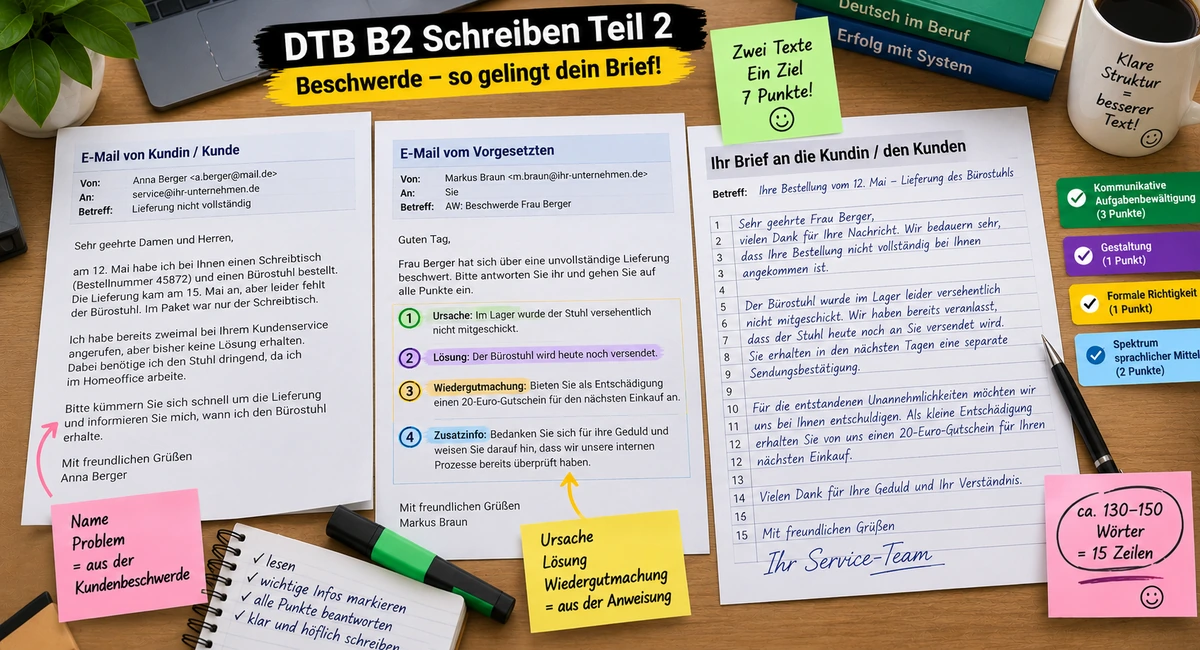
Official structure of the complaint
The complaint reply in DTB B2 follows the structure of a formal business letter. Anyone who knows this structure and applies it consistently automatically fulfils the content requirements of the task. Each part has a clearly defined function — and omitting a part directly costs assessment points.
The mandatory parts of the complaint reply
| Part | Content | Mandatory? |
|---|---|---|
| 1. Salutation | Sehr geehrte Frau [Name], / Sehr geehrter Herr [Name], | ✅ Yes |
| 2. Reference | Refer to the letter / message — no thanks! | ✅ Yes |
| 3. Apology | Express regret, take responsibility | ✅ Yes |
| 4. Explanation | Explain the cause of the problem objectively | ✅ Yes |
| 5. Solution | Name a concrete measure or remedy | ✅ Yes |
| 6. Goodwill gesture | Goodwill offer, discount, replacement — only if the task requires it | ⚠ Only if required |
| 7. Conclusion | Emphasise collaboration, offer to answer questions | ✅ Yes |
| 8. Closing formula | Mit freundlichen Grüßen, + name + position | ✅ Yes |
A widespread mistake is to begin the letter with „Vielen Dank für Ihre Nachricht". In a real complaint context this sounds unnatural and is not customary in formal German business correspondence. The letter begins with the reference — that is, with the indication of which letter one is responding to.
How long should the complaint reply be?
The official requirement for the B2 Beruf exam is a business letter of approximately 150 to 200 words. All mandatory points of the task must be addressed — but without unnecessary repetitions or lengthy explanations.
Set phrases: salutation and reference
The salutation and the reference form the opening of the letter. Both must be formal and precise. The reference immediately tells the reader what the letter is about — without detours and without courtesy phrases that are not customary in the German business letter.
Set phrases for the salutation
- Sehr geehrte Frau [Nachname],
- Sehr geehrter Herr [Nachname],
- Sehr geehrte Damen und Herren, — only if no name is known
In a business letter, the salutation is always followed by a comma, after which the text begins with a lower-case letter: „Sehr geehrte Frau Müller, wir beziehen uns auf Ihr Schreiben ..."
Set phrases for the reference
The reference replaces the thanks. It directly names the letter or message being responded to:
- Wir beziehen uns auf Ihr Schreiben vom [Datum] bezüglich [Thema].
- In Ihrem Schreiben vom [Datum] haben Sie uns über [Problem] informiert.
- Wir haben Ihre Nachricht vom [Datum] erhalten und nehmen dazu gerne Stellung.
- Ihr Schreiben vom [Datum] zum Thema [Problem] liegt uns vor.
- Wir haben Ihre Reklamation vom [Datum] erhalten und möchten uns dazu äußern.
| Formulation | Assessment | |
|---|---|---|
| ❌ | Vielen Dank für Ihre Nachricht, in der Sie uns über Probleme informiert haben. | Not customary in formal complaint context |
| ✅ | Wir beziehen uns auf Ihr Schreiben vom [Datum] bezüglich [Problem]. | Correct, direct, professional |
| ✅ | In Ihrem Schreiben haben Sie uns über [Problem] informiert. | Correct, factual, B2-appropriate |
Set phrases: apology and explanation
After the reference comes the company's reaction to the complaint. Two things must be made clear here: firstly, that the company takes the problem seriously (apology), and secondly, how it came about (explanation). Both parts are important for the assessment.
Set phrases for the apology
The apology should sound sincere but factual. Overly effusive formulations seem unnatural in German business correspondence:
- Wir bedauern sehr, dass es zu dieser unangenehmen Situation gekommen ist.
- Es tut uns leid, dass Sie diese Unannehmlichkeiten erfahren mussten.
- Wir möchten uns aufrichtig für die entstandenen Unannehmlichkeiten entschuldigen.
- Wir bedauern, dass dieser Vorfall eingetreten ist, und nehmen Ihre Beschwerde sehr ernst.
- Selbstverständlich hätte dies nicht passieren dürfen, und wir bedauern dies aufrichtig.
Set phrases for the explanation
The explanation names the cause of the problem. It should be factual and comprehensible — without attributing blame to third parties and without lengthy details:
- Nach interner Prüfung haben wir festgestellt, dass der Vorfall auf [Ursache] zurückzuführen ist.
- Der Fehler entstand aufgrund von [Ursache].
- Nach eingehender Prüfung können wir bestätigen, dass [Erklärung].
- Die Ursache des Problems lag in [Bereich], was zu [Folge] geführt hat.
- Dieser Vorfall ist auf einen internen Fehler zurückzuführen, den wir bereits identifiziert haben.
Common causes in exam tasks
| Problem area | Typical cause in the letter |
|---|---|
| Delivery / order | ein interner Bearbeitungsfehler / ein technisches Problem im System |
| Invoice | ein Buchungsfehler / eine fehlerhafte Datenübertragung |
| Device / product | ein Produktionsfehler / ein Qualitätsproblem beim Transport |
| Service / staff | ein organisatorisches Problem / ein Kommunikationsfehler |
| Website / software | ein technischer Fehler / eine fehlerhafte Systemaktualisierung |
The explanation should show that the company has analysed the situation. It should not be too long — one to two sentences are sufficient. It is important that the formulation sounds professional: not „Der Mitarbeiter hat einen Fehler gemacht", but „Aufgrund eines internen Bearbeitungsfehlers kam es zu ..."
Set phrases: solution and measures
The solution section is the most important content section of the complaint reply. Here it is concretely explained what the company is doing to resolve the problem. A good solution section is precise, realistic and shows that the company is capable of acting.
Universal set phrases for the solution
- Wir werden umgehend Maßnahmen ergreifen, um diesen Vorfall zu beheben.
- Wir haben den Fehler bereits identifiziert und korrigiert.
- Wir können Ihnen versichern, dass sich ein solcher Vorfall nicht wiederholen wird.
- Wir haben unsere Mitarbeiterinnen und Mitarbeiter entsprechend informiert.
- Die notwendigen Schritte wurden bereits eingeleitet.
Set phrases for concrete solution offers
Depending on the task, the solution can be more or less concrete:
- Gerne senden wir Ihnen bis zum [Datum] einen Ersatz zu.
- Sie erhalten in Kürze eine korrigierte Rechnung.
- Ein Techniker wird sich in Kürze mit Ihnen in Verbindung setzen.
- Wir werden die Lieferung umgehend erneut veranlassen.
- Der Fehler auf der Website wurde bereits behoben.
- Wir werden die betroffene Bestellung kostenfrei ersetzen.
Formulations such as „Wir werden uns darum kümmern" are too vague for B2 level. A concrete statement is better: „Wir senden Ihnen bis zum [Datum] einen Ersatz zu und übernehmen die Versandkosten." This demonstrates linguistic competence and content precision.
Reassurance for the future
At the end of the solution section it is customary to give an assurance for the future:
- Wir möchten sicherstellen, dass sich dieser Vorfall nicht wiederholt.
- Wir haben interne Prozesse überprüft, um ähnliche Vorfälle in Zukunft zu vermeiden.
- Wir werden alles daran setzen, damit Sie in Zukunft den Service erhalten, den Sie erwarten dürfen.
Set phrases: goodwill gesture
The goodwill gesture is an optional part of the complaint reply in DTB B2. It is only used when the task explicitly requires it — for example when a discount, a credit note or a replacement offer is to be made. Anyone who includes the goodwill gesture without a task-related reason wastes space and risks a worse assessment of the communicative design.
Set phrases for the goodwill gesture
- Als Zeichen unseres Entgegenkommens möchten wir Ihnen einen Rabatt von [X %] auf Ihren nächsten Auftrag anbieten.
- Wir möchten Ihnen als Ausgleich eine Gutschrift in Höhe von [Betrag] gewähren.
- Als Entschädigung für die entstandenen Unannehmlichkeiten bieten wir Ihnen [Leistung] an.
- Selbstverständlich übernehmen wir die Kosten für [Leistung].
- Wir bieten Ihnen kostenfreien Ersatz für das beschädigte Produkt an.
The goodwill gesture does not belong to the standard structure of every complaint reply. It is only used when the task explicitly requires it — for example: „Bieten Sie dem Kunden eine Entschädigung an." Without this indication in the task, this part is not necessary.
Set phrases: conclusion and closing formula
The conclusion of the complaint letter has two functions: firstly, it signals that the company is interested in continued collaboration. Secondly, it shows openness to further questions. This part is short but absolutely necessary — a letter without a conclusion seems abrupt and unfinished.
Set phrases for the conclusion
- Wir hoffen, dass wir mit dieser Lösung zu Ihrer Zufriedenheit beitragen konnten.
- Wir freuen uns auf eine weiterhin gute und erfolgreiche Zusammenarbeit.
- Wir bedanken uns für Ihr Verständnis und hoffen auf eine weitere gute Zusammenarbeit.
- Sollten Sie weitere Fragen haben, stehen wir Ihnen jederzeit gerne zur Verfügung.
- Bei Rückfragen können Sie sich jederzeit an uns wenden.
The most effective approach is to combine the conclusion and the offer to answer questions in one sentence: „Wir hoffen auf eine weiterhin gute Zusammenarbeit und stehen Ihnen für Rückfragen jederzeit zur Verfügung." This saves space and appears professional.
Set phrases for the closing formula
The business letter closes with a formal closing formula:
- Mit freundlichen Grüßen
- Mit freundlichem Gruß
After the closing formula follow:
- First and last name
- Position in the company (e.g. customer service, sales)
- Company name (if given in the task)
In a formal business letter one must not write: „Liebe Grüße" or „Viele Grüße". These formulas belong to the collegial or private register. The only acceptable formula in a business letter is: Mit freundlichen Grüßen.
Common mistakes in the DTB B2 complaint
Many candidates make similar mistakes when writing the complaint reply. Anyone who knows these can specifically avoid them and significantly improve their assessment.
Mistake 1: letter begins with thanks
The most common mistake is beginning the letter with „Vielen Dank für Ihre Nachricht". In the formal German complaint context this is unnatural. The letter begins with the factual reference to the customer's letter.
Mistake 2: explanation is missing
Many learners apologise but do not name any cause. However, the explanation is a mandatory point. Without it an important content point is missing — this directly affects the content assessment.
Mistake 3: solution is too vague
Formulations such as „Wir werden das Problem lösen" or „Wir werden uns darum kümmern" are not sufficient for B2 level. The solution must be concrete: what exactly will be done? By when? By whom?
Mistake 4: wrong tone or register
Some candidates write too personally („Ich finde das wirklich schade") or too distantly and coldly („Ihr Schreiben wurde zur Kenntnis genommen"). The correct tone is: professional, polite, factual — and constructive.
Mistake 5: goodwill gesture without task-related reason
If the task does not require a goodwill gesture, one should not include it. Every additional element that is not required uses up space and increases the risk of errors without earning additional points.
| Mistake | ❌ Wrong | ✅ Correct |
|---|---|---|
| Letter opening | Vielen Dank für Ihre Nachricht ... | Wir beziehen uns auf Ihr Schreiben vom [Datum] ... |
| Explanation | Es tut uns leid. (end) | Der Fehler entstand aufgrund von [Ursache]. |
| Solution | Wir werden das Problem lösen. | Wir senden Ihnen bis zum [Datum] einen Ersatz zu. |
| Closing formula | Liebe Grüße, [Vorname] | Mit freundlichen Grüßen, [Vor- und Nachname] |
| Tone | Ich finde das wirklich sehr schade. | Wir bedauern die entstandenen Unannehmlichkeiten. |



💯 Nützlich
Sie sind einfach Toll.
Hätte ich früher mit ihrem Webseit kennengelernt.😍