





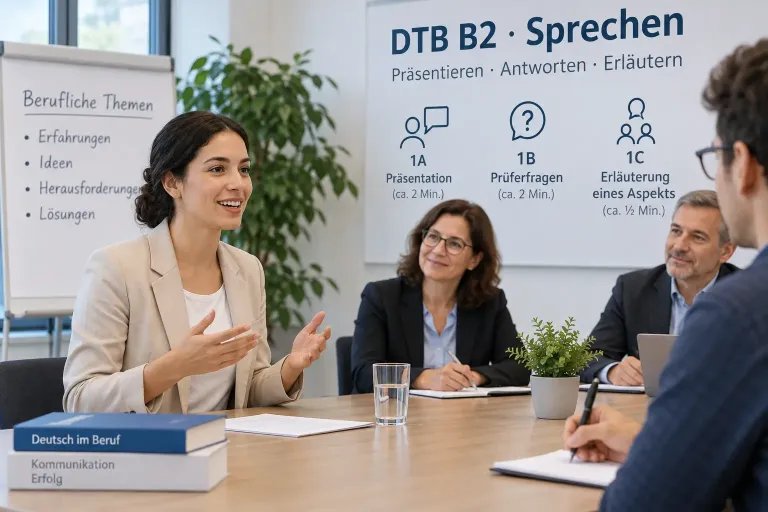
Speaking Part 1 of the German Test for the Workplace B2 consists of three steps: presentation, examiner questions and explanation of one aspect. Here you will find the official procedure, all eight topics, the assessment criteria and a method that allows you to prepare all eight topics using one structure and one set of vocabulary.
Speaking Part 1 in the DTB B2 at a glance
Speaking Part 1 of the German Test for the Workplace B2 is a presentation on a work-related topic followed by a conversation. You choose one of two topics offered to you, speak freely about it for approximately two minutes, then answer questions from the examiners and listen while your partner gives their presentation – because at the end, you have to explain one aspect from your partner’s answers.
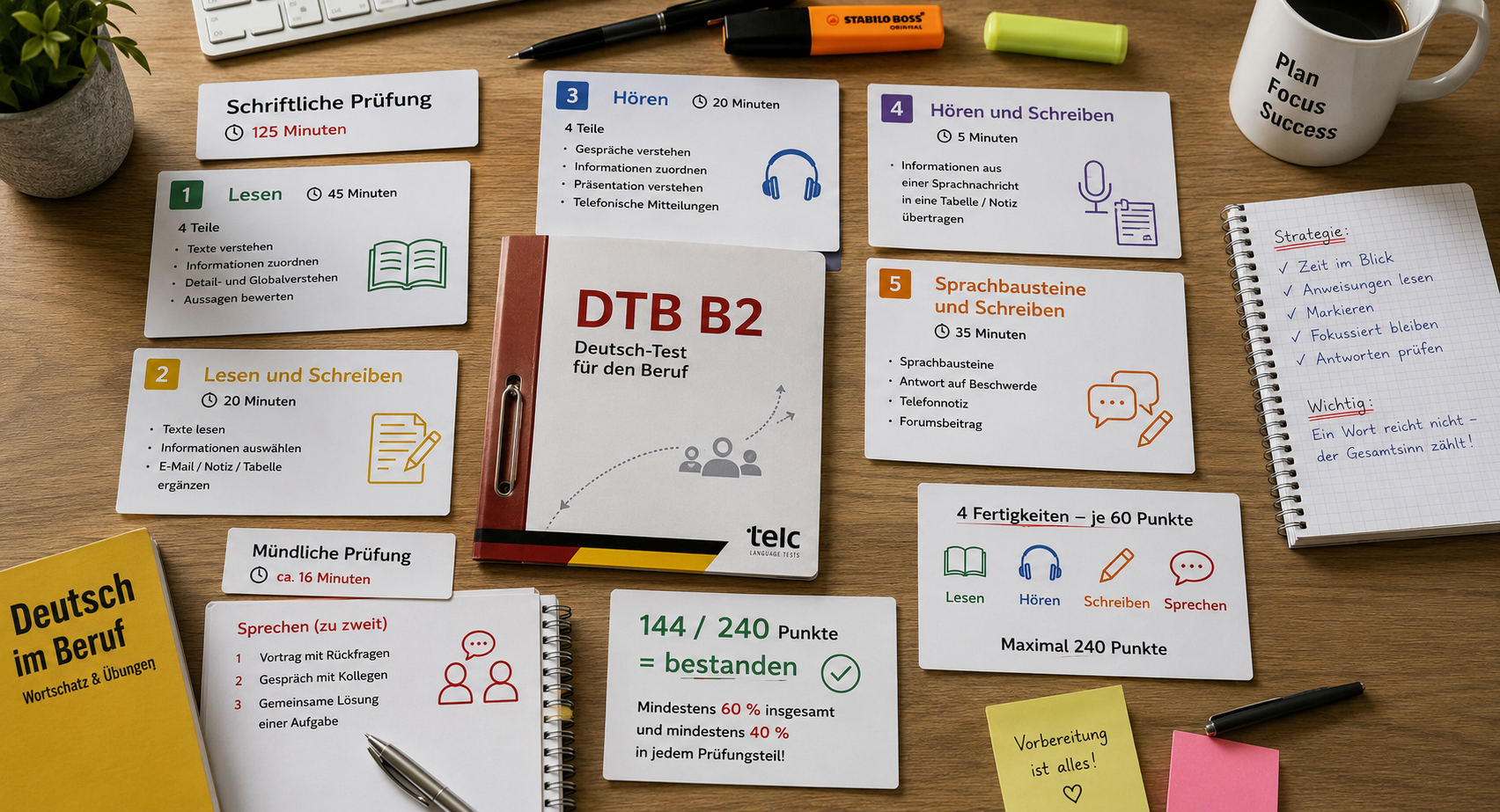
The German Test for the Workplace B2 (DTB B2) is the final examination of the basic B2 vocational language course under Section 45a of the German Residence Act (AufenthG). The examination was developed by telc gGmbH on behalf of the German Federal Ministry of Labour and Social Affairs, with professional support from BAMF, and is based on level B2 of the Common European Framework of Reference for Languages (CEFR). The Speaking subtest is a paired examination with two examiners and lasts approximately 16 minutes in total – with no preparation time.
| Feature | Speaking Part 1 (DTB B2) |
|---|---|
| Task | Speak about a work-related topic (monologue), answer follow-up questions, explain one aspect |
| Subsections | 1A Presentation · 1B Examiner questions · 1C Explanation of one aspect |
| Topics | 8 fixed topics, 2 of which are offered for selection in the examination |
| Time per participant | approx. 2 min. (1A) + approx. 2 min. (1B) + approx. ½ min. (1C) |
| Preparation time in the examination | none |
| Materials | Topic sheet with key points; your own notes on your partner’s presentation (for 1C) |
| Assessment | 4 criteria; task achievement for 1A, 1B and 1C assessed separately (A–D) |
The information on the procedure, timing and topics comes from the official telc practice test for the German Test for the Workplace B2 and the BAMF model test. Last updated: 10 September 2026.
How does Part 1 work? Parts 1A, 1B and 1C
Part 1 consists of three consecutive steps for each participant. Only after Participant A has completed all three steps does Participant B begin their presentation. The person who is not presenting still has an active role: listening and taking notes.
Part 1A – Speaking about a topic (approx. 2 minutes)
You receive a sheet with two topics and choose one of them. Each topic includes three to five key points in brackets as prompts. The official instruction essentially says: Choose one topic and speak about it for approximately two minutes – show what you can do. The key points are there to help you; they are not a mandatory checklist. You do not have to cover every single one, but you should address the main aspects of the topic.
During these two minutes, only you speak. The examiners listen, while your partner takes notes. It is a coherent presentation, not a conversation.
Part 1B – Examiner questions (approx. 2 minutes)
Afterwards, the examiners ask you questions about your presentation. These questions relate to what you have said – they may explore one point in more detail, ask for an example or ask for your opinion. While you answer, your partner continues taking notes.
Part 1C – Explaining one aspect (approx. ½ minute)
Now the perspective changes. The second examiner turns to your partner and asks them to explain one aspect from your answers. In the official practice test, this is formulated approximately as follows: „Teilnehmer/in A hat über … gesprochen. Das habe ich leider nicht ganz verstanden. Können Sie mir das noch einmal erläutern?“ Your partner then explains the information in their own words.
This is exactly what you will also have to do when your partner gives their presentation: You listen, note down the most important points and explain one of them at the end. Part 1C therefore tests not only speaking but also listening comprehension and the ability to pass on information – a skill that is constantly needed in everyday working life.
| Step | Who speaks? | What does the partner do? | Time |
|---|---|---|---|
| 1A Presentation | Participant A | listens, takes notes | approx. 2 min. |
| 1B Examiner questions | Examiners ask questions, A answers | listens, takes notes | approx. 2 min. |
| 1C Explanation | Participant B explains one aspect from A’s answers | A listens | approx. ½ min. |
| Changeover | The same three steps are completed for Participant B, followed by Part 2 and Part 3 | approx. 4½ min. | |
No preparation time during the examination means that all preparation has to take place before the day of the exam. This is entirely manageable because all eight topics are officially published and do not change. If you have a fixed structure in mind for each topic, all you need to do in the examination is choose your topic and start speaking.
The eight presentation topics in the DTB B2
There are exactly eight topics for Part 1A of the DTB B2. In the examination, you are given two of them to choose from. The key points in the right-hand column also appear in this form on the topic sheet in the examination.
| No. | Topic (task) | Key points on the topic sheet |
|---|---|---|
| 1 | Einen Arbeitgeber beschreiben, für den Sie gearbeitet haben oder arbeiten möchten | Branche, Produkte und Dienstleistungen, Abteilungen und ihre Aufgaben, Besonderheiten |
| 2 | Beschreiben, wie Sie sich ein gutes Arbeitsumfeld vorstellen | Jobsicherheit, Lohn/Gehalt, Karrierechancen, Kommunikation in der Firma, Beispiele aus Ihrer Berufserfahrung |
| 3 | Ereignisse und Erfahrungen beschreiben, die Ihre Berufswahl beeinflusst haben | Stationen, wichtige Personen, Motivation, Folgen |
| 4 | Eine Person aus Ihrem Umfeld beschreiben, die für Sie ein berufliches Vorbild ist | Beziehung zu dieser Person, Eigenschaften, Einfluss auf Sie |
| 5 | Das Vorgehen bei der Arbeitssuche für ein Land Ihrer Wahl beschreiben | Angebote finden, Erstkontakt, Bewerbungsunterlagen oder -gespräch |
| 6 | Beschreiben, worauf es bei einem Bewerbungsgespräch ankommt (Land Ihrer Wahl) | Berufsfeld, Vorbereitung, Kleidung, typische Fragen |
| 7 | Ein Produkt / eine Dienstleistung Ihrer Wahl beschreiben | Merkmale, Nutzen für Kunden, Vor- und Nachteile, Erfolg |
| 8 | Sie möchten sich selbstständig machen: Ihre Geschäftsidee beschreiben | welches Produkt / welche Dienstleistung, Besonderheiten, Zielgruppe |
Which topic should you choose?
The topics can be divided into three groups. This helps you make a decision during the examination when you only have a few seconds to think:
- Experience topics (1, 3, 4): You talk about something you have personally experienced. Advantage: The content is familiar to you, so you do not need to invent anything. Challenge: You need to use past tenses confidently.
- Opinion and process topics (2, 5, 6): You explain how something works or what you consider important. Advantage: They are easy to plan and work well with a fixed structure. Challenge: You need to give reasons, not merely list points.
- Description topics (7, 8): You present a product or an idea. Advantage: The key points provide a very clear structure. Challenge: You need to be specific – use a real or clearly imagined example rather than speaking generally about “a good product”.
Choose the topic for which a concrete example comes to mind immediately. A concrete example will support a two-minute presentation more reliably than a topic that merely “sounds easier”.
From my exam preparation work with learners, I have noticed a recurring pattern: As a rule, one topic from the first half of the list (1–4) is combined with one topic from the second half (5–8). This combination is not officially fixed, so you should not rely on it – but it is a good reason to prepare both halves of the list equally thoroughly.
Topics 5 and 6 explicitly say „für ein Land Ihrer Wahl“. This means you may talk about job hunting or a job interview in your country of origin. A comparison with Germany is possible, but it is not required.
How is Speaking Part 1 assessed?
Oral performance in the DTB B2 is assessed by two examiners according to four criteria. One criterion concerns content, while three concern language:
| Criterion | What is assessed? | How is it rated? |
|---|---|---|
| I Kommunikative Aufgabenbewältigung | Has the task been completed appropriately in terms of content and language level? Has the topic been addressed appropriately, have the questions been answered, and has the aspect been explained clearly? | A / B / C / D – separately for Parts 1A, 1B and 1C |
| II Aussprache und Intonation | Intelligibility, stress, sentence melody | well fulfilled / fulfilled / below the required level – assessed across Parts 1–3 |
| III Formale Richtigkeit | Grammar: sentence structure, verb position, cases, tenses | Level B2 / B1 / A2 – assessed across Parts 1–3 |
| IV Spektrum sprachlicher Mittel | Vocabulary and structures: Can the person express themselves in a differentiated way even when discussing more complex matters? | Level B2 / B1 / A2 – assessed across Parts 1–3 |
What does this mean in practice for Part 1?
Two points follow directly from the assessment sheet:
- 1A, 1B and 1C are assessed separately. A strong presentation does not automatically compensate for a weak answer to the examiners’ questions. The reverse is also true: If you have a shaky start in 1A, you can still demonstrate good task achievement in 1B and 1C. Each step is a separate opportunity.
- Language is assessed across the entire examination. Pronunciation, grammar and vocabulary are not assessed separately for each task, but jointly across Parts 1 to 3. One grammatical error in the presentation therefore does not determine anything on its own – the overall impression from all three parts is what counts.
A maximum of 60 points can be awarded for the entire Speaking subtest; 240 points are available across the whole examination, with 25% allocated to each of Reading, Listening, Writing and Speaking. The DTB B2 is passed with 144 points, provided that at least three of the four skills are also above 60%; one skill may be between 40% and 60% and can then be compensated for. Details of the scoring system for the entire examination can be found in the article German Test for the Workplace B2: exam format, tasks and assessment.
The assessment criteria are described in the official practice test (section „Bewertungskriterien Sprechen“); the exact description of levels A to D may differ in detail and should be checked there.
How to structure your presentation (with a model and useful phrases)
At a normal speaking speed, two minutes correspond to approximately 200 to 250 words. This is enough for a clear structure – and you can use the same structure for all eight topics. This is the core of the method I use with my learners for the DTB B2: instead of learning eight different presentations, learn one fixed framework into which you insert only the topic-specific content.
Step 1: The universal opening sentence
The first sentence is the same for every topic and includes the title of your chosen topic:
- „Heute möchte ich über einen Arbeitgeber, für den ich gearbeitet habe, sprechen.“
- „Heute möchte ich über ein gutes Arbeitsumfeld sprechen.“
- „Heute möchte ich über meine Geschäftsidee sprechen.“
This sentence is memorised and will come automatically even if you are very nervous at the beginning. It gives you confidence during the first few seconds and immediately shows the examiners which of the two topics you have chosen.
Step 2: Your professional profile (4–5 sentences)
After the opening sentence, give a short paragraph about yourself – but not „Ich heiße …, ich bin … Jahre alt, ich komme aus …“. This information says nothing about your professional situation and does not fit any of the eight topics. Instead, formulate four to five sentences about your profession, education and career goal in Germany:
„In meiner Heimat habe ich ein Hochschulstudium als Lehrerin abgeschlossen und danach zehn Jahre an einer Schule unterrichtet. In Deutschland möchte ich in diesem Bereich weiterarbeiten, weil mir gefällt, wie das Bildungssystem hier aufgebaut ist. Besonders interessant finde ich, dass Schulen und Sprachschulen hier eng mit Betrieben zusammenarbeiten. Deshalb habe ich mich in den letzten Monaten intensiv mit diesem Berufsfeld beschäftigt.“
This professional profile remains the same for all eight topics. It connects you to the topic and creates a natural transition to the main part: After the profile of a teacher, it is logical for her to describe a language school as an employer (Topic 1), explain her career choice (Topic 3), name a mentor as a professional role model (Topic 4), or present a tutoring platform as a business idea (Topic 8).
Step 3: The key points in brackets – prepared at home
The key points in brackets on the topic sheet form the main part of your presentation. For each key point, write two to three sentences at B2 level at home: using subordinate clauses (weil, dass, obwohl, damit), relative clauses and connectors – but with simple, reliable vocabulary. Complex sentence structures with simple words are rated more highly under Criteria III and IV than simple sentences containing difficult words that are then used incorrectly.
With three to five key points, this gives you 8 to 15 sentences – exactly the amount needed to fill two minutes together with the opening and professional profile. You do not have to spend the same amount of time on every key point; points that you can say more about may receive more attention.
Step 4: A closing sentence
Use one sentence that clearly signals the end of your presentation so that the examiners know you have finished and can move directly to Part 1B: „Damit bin ich am Ende meiner Präsentation.“
Model presentation for Topic 1: Describing an employer
This is what the four steps look like together (a suggested B2-level version, approximately two minutes):
„Heute möchte ich über einen Arbeitgeber sprechen, für den ich gerne arbeiten möchte.
In meiner Heimat habe ich ein Hochschulstudium als Lehrerin abgeschlossen und danach zehn Jahre an einer Schule unterrichtet. In Deutschland möchte ich in diesem Bereich weiterarbeiten, weil mir gefällt, wie das Bildungssystem hier aufgebaut ist. Besonders interessant finde ich, dass Schulen und Sprachschulen hier eng mit Betrieben zusammenarbeiten. Deshalb habe ich mich in den letzten Monaten intensiv mit diesem Berufsfeld beschäftigt.
Der Arbeitgeber, den ich vorstellen möchte, ist eine private Sprachschule in meiner Stadt. Zur Branche: Die Schule gehört zum Bereich Bildung und Weiterbildung. Sie bietet vor allem zwei Dienstleistungen an – zum einen Integrationskurse und Berufssprachkurse, zum anderen Firmenkurse, die direkt in den Betrieben stattfinden.
Die Schule ist in drei Abteilungen gegliedert. Die Verwaltung kümmert sich um Anmeldungen und Verträge, die Kursleitung plant die Kurse und teilt die Lehrkräfte ein, und die Lehrkräfte unterrichten und bereiten die Teilnehmenden auf die Prüfungen vor.
Eine Besonderheit ist, dass neue Lehrkräfte in den ersten Wochen von einer erfahrenen Kollegin begleitet werden. Das finde ich sehr wichtig, weil man dadurch die Abläufe schneller versteht und Fragen jederzeit stellen kann.
Damit bin ich am Ende meiner Präsentation. Vielen Dank.“
Notice what this example achieves: The opening sentence and professional profile can be reused. All four key points from the topic sheet (Branche, Produkte und Dienstleistungen, Abteilungen, Besonderheiten) are covered with two to three sentences each. The structures are typical of B2 – subordinate clauses with „weil“ and „dass“, relative clauses, „zum einen … zum anderen“ – while the vocabulary remains simple. And the ending is clearly marked.
Useful phrases for the presentation
| Function | Useful phrases |
|---|---|
| Introduce the topic | Heute möchte ich über … sprechen. / Ich habe mich für das Thema … entschieden. |
| Establish a professional connection | In meiner Heimat habe ich … / In Deutschland möchte ich … / Deshalb habe ich mich mit … beschäftigt. |
| Structure the presentation | Zunächst … / Anschließend möchte ich auf … eingehen. / Ein weiterer wichtiger Punkt ist … / Abschließend … |
| Give an example | Ein Beispiel dafür ist … / Konkret bedeutet das, dass … / In meinem Fall war es so, dass … |
| Give reasons | Das ist deshalb wichtig, weil … / Aus diesem Grund … / Das hat dazu geführt, dass … |
| Conclude | Zusammenfassend lässt sich sagen, dass … / Damit bin ich am Ende meiner Präsentation. / Vielen Dank für Ihre Aufmerksamkeit. |
Parts 1B and 1C: answering questions, listening and explaining
Many participants prepare only for the presentation. However, 1B and 1C are assessed using the same scale as 1A – and both can be practised systematically.
Part 1B: How to answer the examiners’ questions
The examiners ask about what you have just said. Typical question forms include: „Sie haben … erwähnt – können Sie das genauer beschreiben?“, „Warum war das für Sie wichtig?“, „Wie würden Sie … bewerten?“ or „Gab es dabei auch Schwierigkeiten?“. A good B2-level answer has three elements:
- Direct answer in one sentence.
- Reason or example in one or two sentences.
- Brief conclusion – an assessment or summary.
Two sentences are not enough, because the examiners may then see that you can only express yourself briefly when prompted; however, they are not asking for another monologue either. Around 20 to 30 seconds per answer is a good guideline. If you do not understand a question, ask for clarification – this is a normal communicative action in professional life and is not assessed negatively: „Entschuldigung, meinen Sie damit …?“ or „Könnten Sie die Frage bitte wiederholen?“
Part 1C is mediation – what that means
Part 1C is the task in the DTB B2 in which mediation is directly tested. Mediation means passing on information that another person has said in such a way that a third person can understand it. In everyday professional life, this is one of the most common communicative activities: a colleague explains something and you later summarise it for your manager; a customer calls and you pass their request on to the relevant department.
This is exactly what Part 1C simulates: The second examiner “did not quite understand something” and asks you to explain one aspect from your partner’s answers. The assessment focuses on whether you understood the content correctly and can communicate it clearly in your own words – not whether you repeat the statement word for word.
Taking notes: everything, in any language
This leads to the most important rule for the time when your partner is speaking: Write down everything they say – both during the presentation and in their answers to the examiners’ questions. You do not know in advance which aspect the examiners will choose. If you only take notes during the presentation and put your pen down during the examiner questions, the point you are asked about in 1C is often exactly the one you did not write down.
The notes are only for you. Therefore, it does not matter which language you use: German, your native language, abbreviations, symbols – anything is possible as long as you can read it yourself half a minute later. If you try to write everything in complete German words, you lose speed and miss information. An example of useful notes: „Sprachschule – 3 Abt.: Verw., Kursltg., Lehrkr. – neu: Begleitung durch Kollegin – Frage Prüfer: warum wichtig? → Abläufe schneller“.
When the examiner addresses you, reproduce the point in your own words:
- „Wenn ich es richtig verstanden habe, hat sie gesagt, dass …“
- „Er hat erklärt, dass … Das bedeutet, dass …“
- „Sie meinte damit, dass … Als Beispiel hat sie … genannt.“
In terms of language, indirect speech is useful here – a classic B2 feature. If you reproduce the statement using „dass“-clauses or Konjunktiv I, you demonstrate exactly what Criterion IV (Spektrum sprachlicher Mittel) requires. Half a minute corresponds to three or four sentences; you do not need more.
If you no longer remember the requested aspect precisely, reproduce what you have safely noted down and say so openly: „Den Punkt habe ich nicht ganz genau mitbekommen, aber sie hat erklärt, dass …“. An honest, linguistically correct partial reproduction is considerably better than remaining silent.
Typical mistakes and traps in Part 1
The following points regularly arise when preparing learners for the DTB B2. For each point, you will also see what you should do instead.
Traps built into the task format
- Treating the key points as a list of questions. If you “tick off” each key point with a single sentence, you will have nothing left to say after 40 seconds. The key points are topic areas: each one needs a statement and an example.
- Overlooking „Ein Land Ihrer Wahl“. For Topics 5 and 6, some participants automatically talk about Germany even though they know the process in their country of origin much better. Choose the country you can discuss in the greatest detail.
- Underestimating the listener’s role. Part 1C surprises many participants because, while listening to the other person’s presentation, they are already thinking about their own topic. If you understand the task as mediation, you consciously plan the note-taking phase.
- Treating the examiners’ questions as a knowledge test. There is no “correct answer” – the examiners want to see whether you can spontaneously elaborate, give reasons and evaluate. A well-reasoned opinion is always a good answer.
Mistakes participants make themselves
- Memorising eight complete texts. That is a lot of material, it sounds recited, and if you have a blackout, the whole presentation can collapse. Only the opening sentence, professional profile and useful phrases should be memorised; the main part is put together freely from the sentences you have prepared for the key points.
- Starting with personal details. Your name, age and country of origin fill 15 seconds with A1-level sentences and lead nowhere. The professional profile uses the same amount of time for B2 structures and creates a genuine transition to the topic.
- Stopping after 60 seconds. Usually, the personal connection or examples are then missing. A self-test with a timer quickly shows whether your presentation fills the full two minutes.
- Using only simple main clauses. The content may be correct, but linguistically it remains at B1 level – which affects Criteria III and IV. Deliberately include subordinate clauses, relative clauses and connectors.
- Leaving out the conclusion. Without a closing sentence, an unclear pause arises and the examiners have to ask whether you have finished. A sentence such as „Damit bin ich am Ende meiner Präsentation“ solves this problem.
- Remaining too general. „Ein gutes Arbeitsumfeld ist wichtig, weil man sich dann wohlfühlt“ is not a B2-level statement. It becomes specific with an example: „In meiner letzten Firma gab es jeden Montag ein kurzes Teamgespräch. Dadurch wussten alle, wer welche Aufgaben hat.“
Preparation: how to practise Part 1 effectively
One profession for all eight topics
The examination is not a police investigation: Nobody checks whether the company, person or business idea in your presentation actually exists exactly as you describe it. Your language is what is assessed. Therefore, my most important recommendation is: Choose the profession for which you have the largest vocabulary and build all eight topics around this one profession.
This has a specific linguistic advantage. If a care worker talks about an employer (Topic 1), a good working environment (Topic 2), a professional role model (Topic 4) and a service (Topic 7), they use the same vocabulary in all four presentations – Station, Schicht, Patienten, Dokumentation, Pflegedienstleitung. Repetition makes these words more secure, and the same professional profile works for every topic. If, by contrast, you choose a different professional field for every topic, you have to learn eight different vocabulary fields and will not develop routine in any of them.
This also applies if you are currently working in Germany in a different field from the one you originally trained for: Choose the profession you can talk about most fluently.
Practice plan for two to three weeks
- Write and automate your professional profile. Prepare four to five sentences about your education, professional experience and goal in Germany – say them repeatedly until they come without having to think.
- Develop the key points for each of the eight topics. Prepare two to three sentences for each key point using subordinate clauses, all within the vocabulary of your chosen profession. This is the main work – around 80 to 100 sentences in total, with considerable overlap between them.
- Give and record each presentation with a timer. Check: Did you reach two minutes? Are there subordinate clauses? Is the ending clearly recognisable?
- Simulate examiner questions. Ask a learning partner, colleague or teacher to ask you three questions after your presentation. Answer using the pattern: answer – reason – conclusion.
- Practise mediation. Listen to someone else’s presentation (in class or in a video), note down everything using your fastest form of writing and reproduce one point using indirect speech. This is your practice for Part 1C.
Once the structure has become automatic, it is worth doing a complete run-through of the entire oral examination so that you are also familiar with the transition to Part 2 (Gespräch mit Kollegen) and Part 3 (Lösungswege diskutieren).
👉 Model test for the German Test for the Workplace B2 👉 Overview of all exercises for the B2 Workplace examination



There are no comments for this article. Leave your comment