





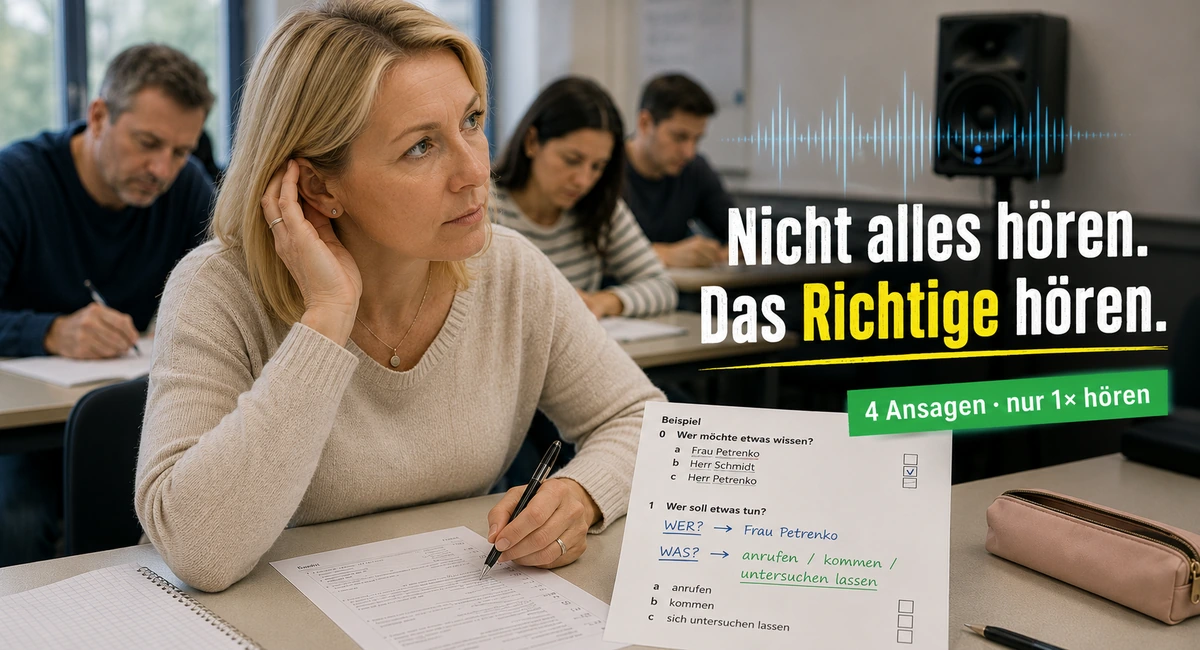
DTZ B1 Hören Teil 1:
Format, strategy and examples
What does DTZ B1 Hören Teil 1 look like? What traps are there? What strategy helps? Here you will find everything in simple language — with examples, tips and answers to frequently asked questions.
What is DTZ B1 Hören Teil 1? Overview of the exam
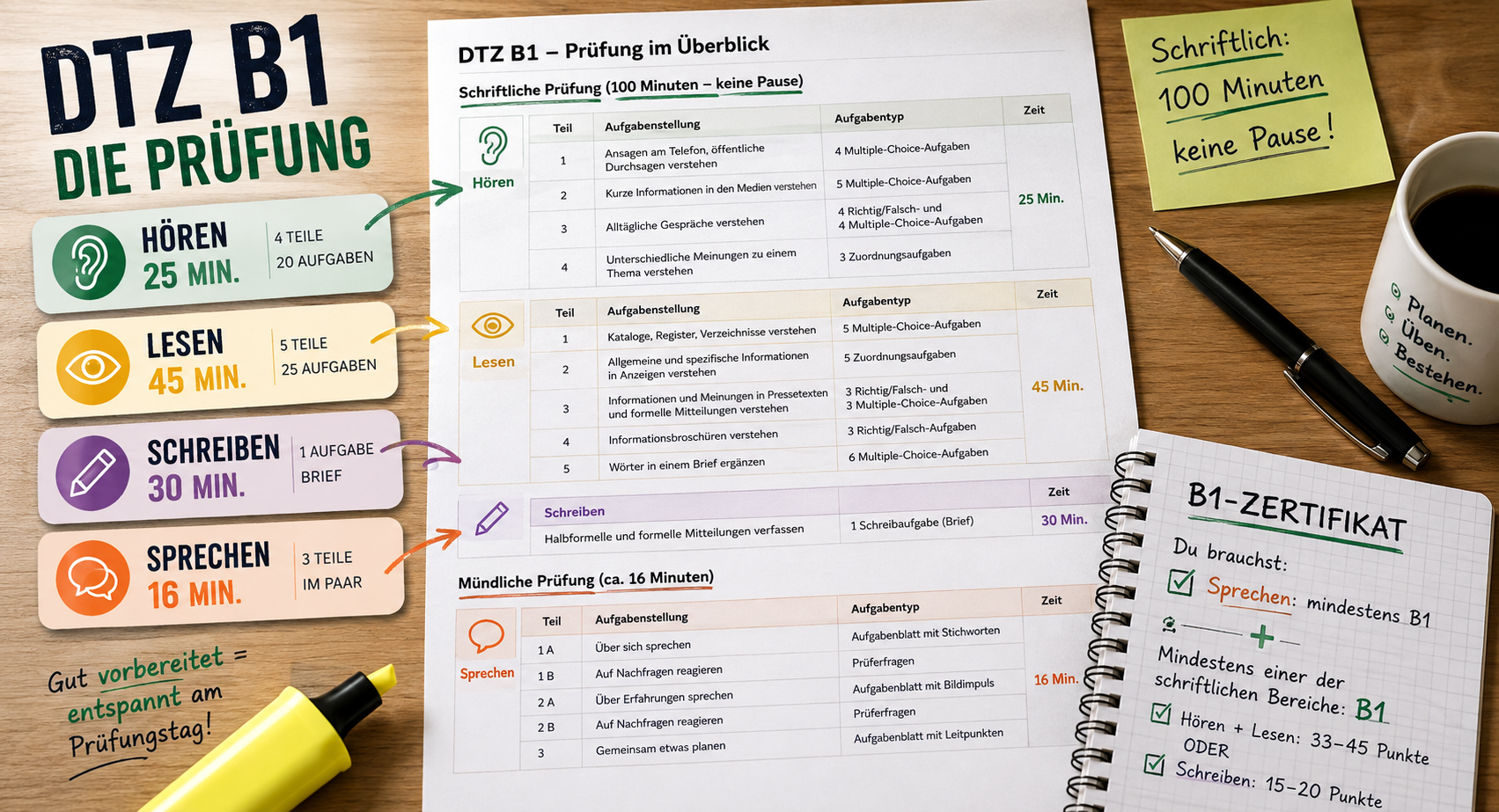
The DTZ is the exam at the end of the integration course. DTZ stands for: Deutsch-Test für Zuwanderer. The company g.a.s.t. administers this exam. The DTZ tests your German at two levels: A2 and B1.
The B1 DTZ exam has four parts:
- Hören (approx. 25 minutes)
- Lesen (45 minutes)
- Schreiben (30 minutes)
- Sprechen (approx. 16 minutes)
Hören has 4 parts with a total of 20 tasks. Teil 1 is the first task in Hören. Here you listen to 4 short texts. Teil 1 is very important: it is the start of the exam.
What you need to know about Teil 1
- You listen to 4 announcements (short texts).
- For each text there is 1 question with 3 answers (a, b, c).
- Only 1 answer is correct.
- You hear each text only once!
- For each correct answer: 1 point. Maximum: 4 points.
What do you hear in Teil 1?
The texts come from everyday life in Germany. For example:
- A message on the answering machine (from the doctor, from the office, from school).
- An announcement at the train station or on the bus.
- A recorded message from a company or an insurance firm.
- A short piece of information from everyday life.
In every text only one person speaks. There is no conversation. This makes Teil 1 easier than Teil 3.
👉 Exercises for DTZ B1 HörenFormat and structure: What do the tasks look like?
The instruction at the beginning is always the same:
Sie hören vier Ansagen. Zu jeder Ansage gibt es eine Aufgabe. Welche Lösung (a, b oder c) passt am besten? Markieren Sie Ihre Lösungen für die Aufgaben 1–4 auf dem Antwortbogen.
Before the 4 real tasks there is always one example. The example does not count. It shows you how the task works.
What a task looks like
Every task has:
- A short question (for example: Was soll Frau Müller tun?)
- Three answers: a, b, c
- Every answer is very short (only 2 to 5 words)
Answer sheet: Very important!
You must write your answer on the Antwortbogen (answer sheet). Only the answer on the answer sheet counts!
- Write with a blue or black ballpoint pen.
- No pencil!
- Mark the box with a cross.
- If you make a mistake: fill in the box completely and mark a new box.
| Information | Teil 1 |
|---|---|
| Number of texts | 4 announcements + 1 example |
| Number of tasks | 4 (tasks 1–4) |
| Task type | Multiple choice (a, b, c) |
| How many times do you listen? | Only 1 time |
| Length of a text | approx. 20–40 seconds |
| Maximum points | 4 points |
The most important strategy: finding subject and predicate
This is the most important strategy for Teil 1. Please learn this strategy very well. With this strategy you will listen much more effectively.
Before listening you have a few seconds. You can read the question. Use these seconds well!
Step 1: Underline two words in the question
In every question there are two important words:
- Subject — this is the person (WHO does something).
- Predicate — this is the verb (WHAT the person does).
Example:
1 Was soll Frau Petrenko machen?
Here the subject = Frau Petrenko. The predicate = machen. Now you know:
- WHO? — Frau Petrenko
- WHAT am I looking for? — Her action (what she must do)
Step 2: Underline the verbs in the answers
Example:
- a In der Praxis anrufen.
- b In die Praxis kommen.
- c Sich untersuchen lassen.
Now you have 3 actions: anrufen, kommen, untersuchen lassen. One of these is the correct answer.
In the announcement a person often talks about many actions and many people. If you know: I am looking for what Frau Petrenko must do — then you listen much more clearly. You do not listen to everything, only to what matters.
Step by step: before, during and after listening
Three phases are very important. Do this for every task.
Phase 1: Before listening (during the pause)
- Read the question and all three answers.
- Underline in the question: subject (who?) and predicate (what to do?).
- Underline the verb in each answer (a, b, c).
- Think: what am I about to hear? What do I need to pay attention to?
Phase 2: While listening
- Listen actively. Do not write down the whole text.
- Listen for the name from the question. Then listen very carefully to what follows.
- Pay attention to important words: nicht, kein, nur, aber, leider, erst, zuerst, sofort, schnell, bitte.
- Listen until the end! The correct information often comes at the end.
Phase 3: After listening
- Mark the answer on the answer sheet immediately.
- Not sure? Guess! Mark something.
- Move on to the next task immediately. Read the new question.
There are 3 answers (a, b, c). If you guess, the chance is 33%. That is very good! An empty answer gives 0 points for certain. A guessed answer can give 1 point. Maybe exactly this one point is the point that gets you to B1!
So: Always put a cross, even if you are unsure.
Golden rule: the correct answer often contains different words
This is a very important rule. Please remember this rule.
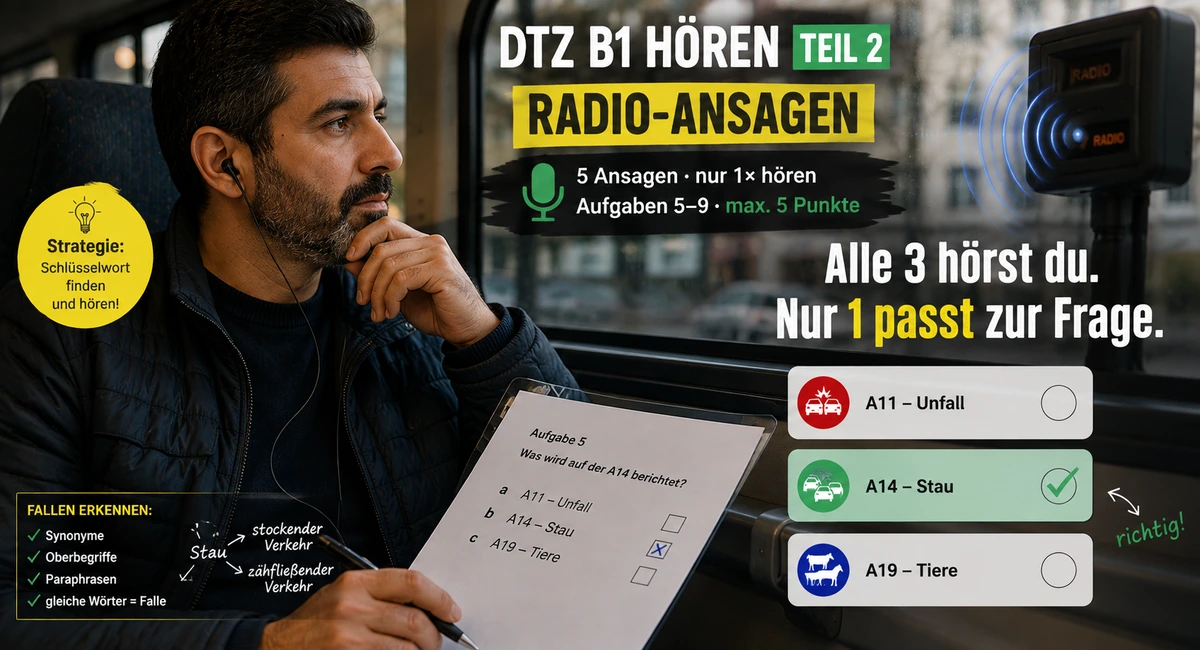
If a word from the answer is exactly the same as a word in the text — this is often a trap!
The correct answer often contains different words. But these words have the same meaning.
In the DTZ there are three types of different words. You must know all three types!
Type 1: Synonyms — words with the same meaning
A synonym is a different word with the same meaning. Two words, one meaning.
Here are real synonyms for the DTZ:
| Word in the text | Synonym in the answer | Meaning |
|---|---|---|
| überweisen | bezahlen | to give money |
| einen Termin ausmachen | einen Termin vereinbaren | to plan an appointment |
| bekommen | erhalten | to get something |
| schicken | senden | to give by post or email |
| brauchen | benötigen | to need something |
| sagen | mitteilen | to give information |
| sprechen | reden | to communicate with someone |
| möchten | wollen | to want to have or do something |
Type 2: General term — one general word for many specific things
Sometimes the text mentions many specific things. But in the correct answer there is only one word: a general word that summarises all these things. This is called a general term (Oberbegriff).
Examples of general terms:
| Specific things in the text | General term in the answer |
|---|---|
| Apfel, Banane, Birne | Obst |
| Hund, Katze, Hamster | Haustier |
| Mathe, Deutsch, Englisch | Schulfach |
| Bus, U-Bahn, Straßenbahn | öffentliche Verkehrsmittel |
| Verdienstbescheinigung, Mietbescheinigung, Pass | Unterlagen / Dokumente |
| Kopfschmerzen, Fieber, Husten | Beschwerden / Krankheit |
| Klassenlehrerin, Mathelehrer | Lehrer / Lehrerin |
When you hear several specific things in the text (e.g. two or three documents), the correct answer often contains the general word for them (e.g. Unterlagen). Ask yourself while listening: What do these things have in common? How can I say them with one word?
Type 3: Paraphrase — an explanation in simple words
A paraphrase is an explanation. The text contains a difficult word. The answer contains a simple explanation for it.
Examples of paraphrases:
| Word in the text (difficult) | Explanation in the answer (simple) |
|---|---|
| Vertretung | ein anderer Arzt |
| gestrichen | fährt nicht / kommt nicht |
| geschlossen | ist zu / nicht offen |
| Anrufbeantworter | eine Nachricht hinterlassen |
| Sprechstunden | wann man zum Arzt kommen kann |
| Antrag stellen | ein Formular ausfüllen |
When listening you must understand the meaning, not just the words. When the correct answer:
- Has a synonym — a different word with the same meaning.
- Has a general term — one word for many specific things.
- Has a paraphrase — a difficult word is explained simply.
An answer with the exactly same word as in the text is often wrong!
Typical traps in DTZ B1 Hören Teil 1 with examples
Here you will see the most important traps. Learn these traps well. Then you will quickly see where the trap is.
💡 Trap 1: Synonym — same words are a trap
Task:
Was soll Frau Yilmaz tun?
- a Eine Rechnung bezahlen.
- b Die Polizei anrufen.
- c Mit der Versicherung sprechen.
What you hear (example):
Hallo Frau Yilmaz, Autowerkstatt Berger hier. Wegen Ihrer Reparatur: Überweisen Sie uns bitte zuerst das Geld. Danach melden Sie den Schaden bei der Versicherung. Sie haben uns gesagt, die Polizei war nach dem Unfall da — das ist gut.
Analysis:
| In the text | In the answer | Correct? |
|---|---|---|
| Versicherung melden | c. Mit der Versicherung sprechen | ✗ Trap! Same word. |
| Polizei war da | b. Die Polizei anrufen | ✗ Trap! Same word. |
| Überweisen Sie das Geld | a. Eine Rechnung bezahlen | ✓ Synonym — correct! |
Correct answer: a (Eine Rechnung bezahlen)
What does überweisen mean? When you send money from your bank account to another bank account, you überweisen the money. This is a form of bezahlen. When you transfer a bill, you pay it. Both words mean: give money. These are real synonyms.
What is the trap? In the text you also hear the words Versicherung and Polizei. These words appear in exactly the same form in answers b and c. But be careful! These are typical traps: when a word is exactly the same as in the text, the answer is often wrong.
How do you find the correct answer? In the text there is the word zuerst. This shows: this is the most important action. Always pay attention to words like: zuerst, jetzt, bitte, sofort, schnell. They show what you really must do.
💡 Trap 2: General term — one word for several specific things
Task:
Was soll Frau Nguyen tun?
- a Einen Antrag mitbringen.
- b Unterlagen mitbringen.
- c Einen Termin vereinbaren.
What you hear (example):
Guten Tag, Frau Nguyen, Becker vom Sozialamt. Es geht um Ihren Antrag auf Wohngeld. Wir brauchen noch eine Verdienstbescheinigung von Ihrem Mann und eine Mietbescheinigung. Bitte bringen Sie diese Sachen zu uns. Sie können einfach in unsere Sprechzeiten kommen, einen Termin brauchen Sie nicht.
Analysis:
| In the text | In the answer | Correct? |
|---|---|---|
| Ihren Antrag auf Wohngeld | a. Einen Antrag mitbringen | ✗ Trap! Same word. |
| einen Termin brauchen Sie nicht | c. Einen Termin vereinbaren | ✗ Trap! Word nicht! |
| Verdienstbescheinigung + Mietbescheinigung | b. Unterlagen mitbringen | ✓ General term — correct! |
Correct answer: b (Unterlagen mitbringen)
What are Verdienstbescheinigung and Mietbescheinigung? These are two specific documents. A Verdienstbescheinigung is a paper showing how much money someone earns. A Mietbescheinigung is a paper for the flat. But both are papers or documents for the office.
What is the general word for them? The German word for these documents is Unterlagen. Unterlagen is a general term. That means: one word for many specific things. In the text you therefore hear specific names (Verdienstbescheinigung, Mietbescheinigung). But the correct answer has the general word: Unterlagen.
How do you recognise this trap? When you hear several specific things in the text (e.g. two or three documents), think immediately: What is the general word for them? Look in the answers for a word like Unterlagen, Dokumente, Sachen, Papiere.
Plus: The word nicht! You also hear: Termin brauchen Sie nicht. The word nicht is very important. It means: the answer with Termin is wrong.
💡 Trap 3: Negation — nicht changes everything
Task:
Wie können Sie heute mit dem Zug nach Bremen fahren?
- a Mit dem Zug um 19.45 Uhr.
- b Gar nicht.
- c Über Hannover fahren und dort umsteigen.
What you hear (example):
Achtung Gleis 7: Der Zug um 19.45 Uhr nach Bremen fährt heute nicht. Sie können aber um 20 Uhr nach Hannover fahren, dort umsteigen, und kommen so nach Bremen.
Analysis:
| In the text | In the answer | Correct? |
|---|---|---|
| Zug um 19.45 Uhr fährt nicht | a. Mit dem Zug um 19.45 Uhr | ✗ Trap! Word nicht! |
| Sie können aber um 20 Uhr fahren | b. Gar nicht | ✗ Wrong! There is an option! |
| nach Hannover, dort umsteigen | c. Über Hannover, dort umsteigen | ✓ Correct! |
Correct answer: c
What happens in this task? The text first gives a bad piece of information: the train at 19.45 is not running today. But then comes a good piece of information: there is another option — take the train to Hannover and change there.
Why is answer a wrong? The train at 19.45 does appear in the text. But directly afterwards comes the word nicht. This changes the whole meaning. If you miss the word nicht, you choose the wrong answer.
Why is answer b wrong? This is a logical trap. Many people think: If the train is not running, I cannot travel at all. But the text says: Sie können aber um 20 Uhr fahren. The little word aber is very important! It shows: there is still an option. You must listen until the end!
Important words to watch out for: nicht, kein, leider, geschlossen, gestrichen, ausgefallen (bad news). But also: aber, jedoch, doch — these small words signal a new, often good piece of information!
💡 Trap 4: Paraphrase — a difficult word is explained simply
Task:
Was soll Frau Petrenko tun?
- a Einen anderen Arzt anrufen.
- b Bis zum 20. Mai warten.
- c Heute noch einmal in der Praxis anrufen.
What you hear (example):
Guten Tag, dies ist der Anrufbeantworter der Praxis Dr. Wagner. Wir machen Urlaub und sind erst ab dem 20. Mai wieder für Sie da. In dringenden Fällen wenden Sie sich bitte an unsere Vertretung: Dr. König, Bahnhofstraße 8, Telefon 45 67 89.
Analysis:
| In the text | In the answer | Correct? |
|---|---|---|
| ab dem 20. Mai wieder da | b. Bis zum 20. Mai warten | ✗ Trap! Same date. |
| Praxis macht Urlaub (ist zu) | c. Heute in der Praxis anrufen | ✗ Practice is closed! |
| Vertretung: Dr. König | a. Einen anderen Arzt anrufen | ✓ Paraphrase — correct! |
Correct answer: a (Einen anderen Arzt anrufen)
What does the word Vertretung mean? This is a difficult word. Vertretung means: one person does the work for another person. When a doctor is on holiday, they cannot work. Then another doctor does their work. This other doctor is the Vertretung.
How do you understand the word in the exam? You do not need to know the word Vertretung perfectly! In the text you hear: Praxis Dr. Wagner macht Urlaub + Vertretung: Dr. König. Who is Dr. König? Another doctor. The correct answer has a simple explanation for this: ein anderer Arzt. This is a paraphrase: a difficult word is explained in simple words.
What is the trap with the date? You hear the date 20. Mai. The same date appears in answer b: Bis zum 20. Mai warten. But be careful! In the text the 20th of May is the day when the practice is open again. That is not the same as waiting until the 20th of May. If you are ill, you cannot wait that long — you must go to another doctor now.
Golden rule for dates: When you hear a date, ask yourself: What is this date for? For opening? For closing? For an appointment?
💡 Trap 5: Who says ich? Who performs the action?
Task:
Was soll Herr Achmadov tun?
- a Das Reisebüro anrufen.
- b Den Flug buchen.
- c Ins Reisebüro kommen.
What you hear (example):
Guten Tag, Herr Achmadov, Reisebüro Sonne hier. Ihr Flug nach Istanbul am 18. Juli ist leider gestrichen. Es gibt einen Flug am 19. Juli. Soll ich den Flug für Sie buchen? Bitte kommen Sie schnell mit Ihrem Ticket vorbei!
Analysis:
| In the text | In the answer | Correct? |
|---|---|---|
| Reisebüro Sonne hier (the travel agency calls itself) | a. Das Reisebüro anrufen | ✗ Wrong! You are not supposed to call. |
| Soll ich den Flug buchen? | b. Den Flug buchen | ✗ Trap! ich = the travel agency, not you! |
| Bitte kommen Sie vorbei | c. Ins Reisebüro kommen | ✓ Correct! (vorbeikommen = kommen) |
Correct answer: c (Ins Reisebüro kommen)
Who speaks? Who listens? The travel agency Sonne calls Herr Achmadov. So: the travel agency is the person who speaks. Herr Achmadov is the person who listens (and in the exam that is you!).
Why is Soll ich den Flug buchen? a trap? The word ich here means: the travel agency. The travel agency asks: Soll ich (= the travel agency) den Flug buchen? So: the travel agency wants to book the flight, not Herr Achmadov! If you only hear the word buchen, you might choose answer b. But answer b would be the action of Herr Achmadov — and that is not correct.
What must Herr Achmadov do? The text says: Kommen Sie schnell vorbei! The word Sie = Herr Achmadov. So: Herr Achmadov must come to the travel agency. That is answer c.
Golden rule: Always pay attention to ich and Sie in the text. Look for an action with Sie or with the name from the question. An action with ich is an action by the person calling — not by you!
Points and assessment: how many points do you need?
How many points are there in Hören Teil 1? And how many points are needed for B1?
Points in Teil 1
For each correct answer: 1 point. There are 4 tasks. So: maximum 4 points in Teil 1.
Points in Hören (all 4 parts)
| Part | Tasks | Points |
|---|---|---|
| Hören Teil 1 | 4 | 4 |
| Hören Teil 2 | 5 | 5 |
| Hören Teil 3 | 8 | 8 |
| Hören Teil 4 | 3 | 3 |
| Hören total | 20 | 20 |
Hören and Lesen are assessed together
In the DTZ, Hören and Lesen are assessed together. Both have 45 points in total (20 + 25). How many points do you need for each level?
| Points (Hören + Lesen) | Level |
|---|---|
| 33–45 points | B1 |
| 20–32 points | A2 |
| 0–19 points | below A2 |
You receive a B1 certificate when you have level B1 in Sprechen and also level B1 in either Hören and Lesen or in Schreiben.
The most common mistakes and how to avoid them
Many participants make the same mistakes. If you know these mistakes, you will not make them!
| Mistake | What to do instead |
|---|---|
| Subject and predicate not underlined | Always underline before listening! |
| Answer chosen because the word was in the text | Listen to the context: in which sentence does the word appear? |
| Missed the word nicht | Always pay attention to nicht, kein, leider! |
| Stopped listening after the first sentence | Listen until the end! The answer often comes at the end. |
| Left the answer blank | Guess! Chance is 33%, blank = 0 points for certain. |
| Wrote down the whole text | Only small notes: numbers, names. |
| All answers transferred to answer sheet at the end | Mark immediately after each task! |
| Answer written in pencil | Only blue or black ballpoint pen! |





There are no comments for this article. Leave your comment