





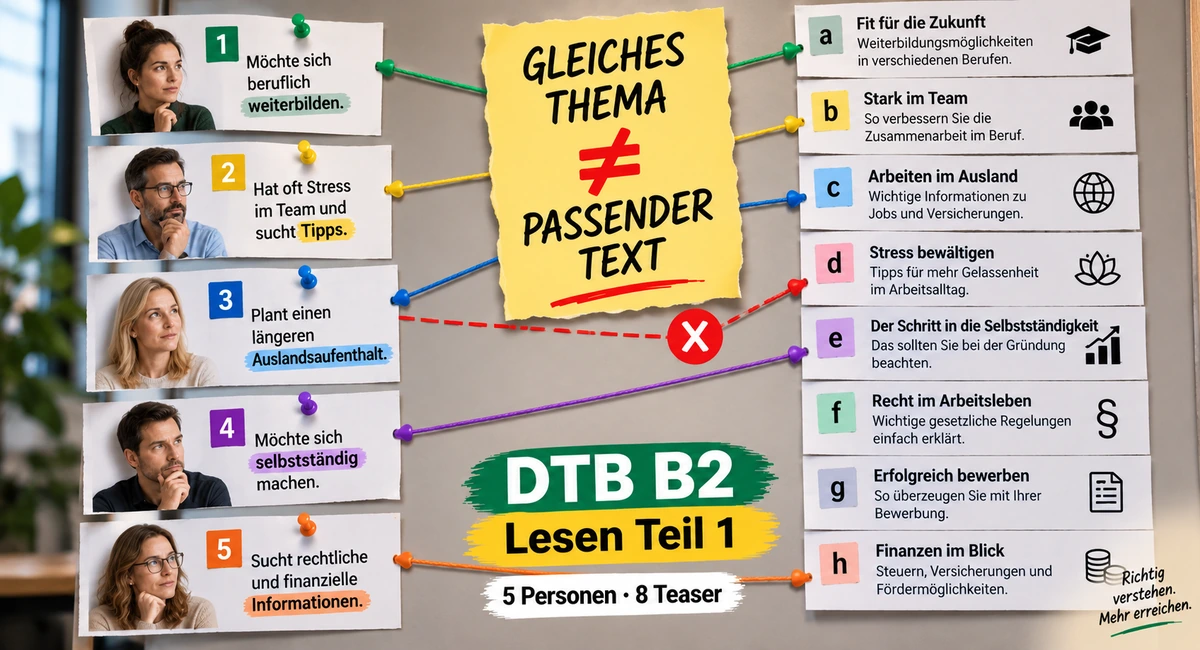
Many learners lose unnecessary points in Lesen Teil 1 (Zuordnung), even though they actually understand the vocabulary. In most cases, the problem is not the language, but the strategy.
In this part of the B2 Beruf exam, you have to match five people with eight short texts. This means you must match quickly, precisely, and logically.
What is Lesen Teil 1 in the Deutsch-Test für den Beruf B2?
In Lesen Teil 1 of the B2 Beruf exam, you read short descriptions of people and short teasers for online articles. Your task is to find the matching teaser.
What is important here:
- You do not have to understand every detail.
- You must recognize what the person actually needs.
- You must decide which text will really help them.
The basic principle: Do not search for a topic, search for a function
This is the most important rule of all.
Many people make the mistake of thinking: “This person and this text have the same topic. So it must fit.”
In this task, that is not enough.
Several texts can belong to the same general topic, for example:
- Work
- Further training
- Abroad
- Rights
- Career
- Self-employment
But only one text fulfills the correct function.
Therefore:
The correct text is not the most similar one, but the most useful one for that specific person.
Always ask yourself:
Does this text really help the person?
What does this task actually test?
This task tests three things at the same time:
- Understanding the person – You must quickly grasp the person’s situation.
- Understanding the teaser – You must recognize what the text is really about.
- Logical matching – You must decide whether the text truly addresses the person’s question, problem, or goal.
That is why Lesen Teil 1 is also a small logic test.
How to read the person descriptions correctly
Each person usually contains three pieces of information:
The situation
Where is the person currently in their professional life?
The problem
What is missing? What is the difficulty?
The goal
What does the person want to know, clarify, find, or achieve?
If you clearly identify these three points, the task becomes much easier.
The best exam trick: Reduce the person to one core sentence
After reading each person description, try to immediately formulate a simple core sentence:
- Diese Person sucht Informationen über …
- Diese Person braucht Hilfe bei …
- Diese Person möchte wissen, wie …
- Diese Person sucht Möglichkeiten für …
- Diese Person braucht Orientierung bei …
This short core sentence becomes your internal search task. Then you will read the teasers much more clearly and purposefully.
The most important tool: Compare subject and predicate
A very powerful strategy for high scores is comparing the subject and predicate.
This means:
- Who is the person?
- What do they want?
- What are they looking for?
- What is their action or goal?
Then check the teaser:
- What does this text do?
- What does this text offer?
- What action is contained in it?
This is often the key.
The words in the task and the text do not have to be identical. Very often synonyms are used. Nevertheless, the logic must match.
Therefore:
The subject and predicate must match in meaning in both the task and the text, even if different words are used.
Not the wording, but the meaning is decisive.
Why identical words often lead in the wrong direction
A typical mistake is so-called “word matching”.
You see a similar word in the task and in the text and immediately choose it.
This is dangerous.
Good exam tasks intentionally work with:
- similar vocabulary,
- related topics,
- similar situations,
- but a different function.
So never ask only:
Does something similar appear?
Instead always ask:
Does this text solve the person’s problem?
Very important: How to read teasers correctly
A teaser usually consists of:
- a headline,
- a short introduction,
- and an indication of what the article is about.
Many learners read only the headline. That is a mistake.
Headlines can be:
- general,
- emotional,
- promotional,
- or deliberately vague.
The real help is often found only in the first or second sentence.
Therefore: Never read only the headline. Always check the explanatory text below it.
Which texts are usually strong candidates in Lesen Teil 1?
The best candidates for the correct solution are usually texts that clearly show that they:
- inform
- explain
- advise
- show possibilities
- clarify rights
- provide orientation
- offer tips
- summarize
- mention sources of help
These texts are functionally clear. That is exactly what is needed for matching.
Which texts are often distractors?
Distractors are incorrect answers that look very similar at first glance.
Very often these are texts that:
- have the same general topic,
- but are intended for a different target group,
- speak only in general terms,
- only open a discussion,
- or describe the problem instead of solving it.
In other words: A text may appear linguistically close but still be incorrect in meaning.
Very important rule: When a teaser only introduces a question
This point is especially important for Lesen Teil 1.
Some teasers contain formulations such as:
- Wie kann man …?
- Worauf sollte man achten?
- Welche Möglichkeiten gibt es …?
- Was muss man beachten …?
Many people immediately think: “This must fit because the person also has a question.”
But in this task the logic is different.
Main rule
If a teaser only introduces a question, it is usually not the correct solution.
Why?
Because the people in tasks 1–5 are not looking for new questions. They are looking for:
- answers
- orientation
- specific information
- tips
- possibilities
- solutions
Therefore, the correct teaser is usually not the one that raises a question, but the one that shows that the text:
- provides answers
- offers orientation
- delivers concrete information
- offers tips or options for action
If a teaser only introduces a topic but does not promise recognizable help, that is often a warning sign.
The best order during the exam
Many strong candidates work particularly reliably with the following order:
- First read all five people.
- For each person determine:
- Situation
- Problem
- Goal
- Formulate a core sentence in your mind.
- Read the teasers and always ask:
- What does this text offer?
- Does it provide concrete help?
- Compare subject and predicate.
- Eliminate texts that only sound similar.
- At the end check: Is this real help — or only thematic similarity?
The most common mistakes in Lesen Teil 1
- Focusing only on the topic – The topic alone is never enough.
- Focusing only on a single word – One word is not a reliable solution.
- Reading only the headline – The real information is often below it.
- Misinterpreting questions in teasers – New questions are not important; recognizable answers are.
- Choosing an “almost fitting” text – Precision is crucial in this task.
What you should train if you want high scores
If you want to master this task type confidently, you should mainly train these four skills:
- Recognizing the reading intention – What does the person actually need?
- Recognizing the function of the text – Does the text inform, advise, explain, or provide orientation?
- Understanding synonyms – Different words can have the same meaning.
- Identifying distractors – Similar does not mean suitable.
The most important takeaway at the end
If you remember only one rule, remember this:
The correct teaser is the text that concretely helps the person.
Not the text with the most similar word.
Not the text with the same general topic.
Not the text with the most interesting headline.
But the text that:
- provides answers
- offers orientation
- delivers concrete information
- offers tips or solutions
- and therefore fits exactly the person’s situation and goal
This is exactly how you solve Teil 1 (Zuordnung) in Lesen B2 Beruf at a high level.




There are no comments for this article. Leave your comment