





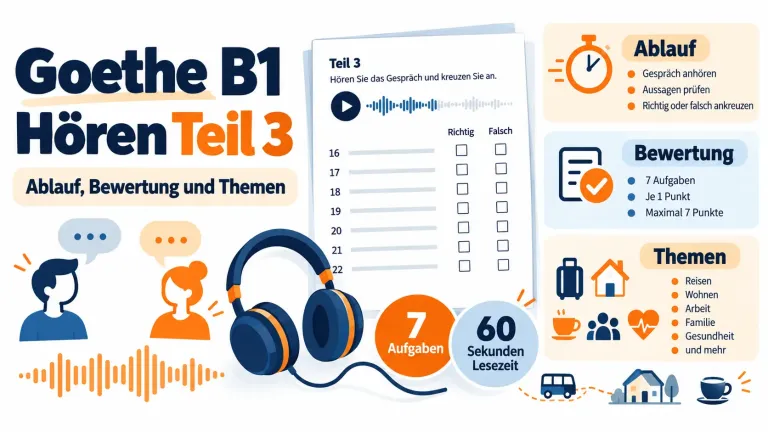
Goethe B1 Listening Part 3 explained simply: You listen to a dialogue between two people only once and decide whether seven statements are "True or False". Here you will find information about the procedure for this part of the B1 listening exam, the points awarded, typical topics and a sample dialogue with answers – including references to the official Goethe-Institut materials.
Listening Comprehension B1 in the Goethe-Zertifikat: What Does Part 3 Test?
In short: In Listening Part 3, you hear an everyday conversation between two people who know each other. There are seven statements about this conversation. For each statement, you decide whether it agrees with what was said in the conversation (True) or not (False). You hear the conversation only once.
The third part of the listening comprehension exam focuses on specific information from a private conversation. For example, the two people might meet on a tram, on a train or at a bus stop and tell each other about what they have experienced or what they are planning. You do not need to understand every word. What matters is listening carefully to the details: Who did what? When? Why? And did something actually happen, or was it only a plan?
Part 3 in the Listening Module – Overview
The Listening module of the Goethe-Zertifikat B1 consists of four parts and a total of 30 tasks. Part 3 is the only part in which you listen to a conversation between two private individuals and hear it only once.
| Part | Type of Text | How Often? | Format | Time | Points |
|---|---|---|---|---|---|
| Part 1 | Short everyday audio texts (announcements, answering machine messages) | 2× | True/False and a/b/c | approx. 10 min. | 10 |
| Part 2 | Presentation or guided tour (one speaker) | 1× | a/b/c | approx. 5 min. | 5 |
| Part 3 | Private conversation between two people | 1× | 7 × True/False | approx. 8 min. | 7 |
| Part 4 | Radio discussion (three people) | 2× | Match statements to speakers | approx. 12 min. | 8 |
You have approximately 40 minutes for the entire Listening module. This includes 5 minutes at the end to transfer all your answers to the answer sheet.
Source: Goethe-Institut, "Tips and Tricks for Exam Preparation – Goethe-Zertifikat B1, Listening" (PDF).
Procedure for Part 3 of the B1 Listening Exam – From the Introductory Sentence to the Answer Sheet
In short: You hear the instructions, have 60 seconds to read the introductory sentence and statements 16 to 22, listen to the conversation once and mark your answers while listening. You transfer your answers to the answer sheet only at the end of the entire module.
What Is on the Task Sheet?
- The instructions: You are told that you will hear a conversation once, complete seven tasks and have 60 seconds to read the statements.
- The introductory sentence: It describes in one sentence where you are, who is speaking and often what they are talking about. An example in the style of the exam: "Sie sitzen im Zug und hören, wie sich zwei Kolleginnen über ihren Urlaub unterhalten." Sometimes the sentence also mentions the names of the two people.
- Seven statements numbered 16 to 22: Each statement is a short sentence. Next to it are the options "Richtig" (True) and "Falsch" (False).
- No example: Unlike Part 4, Part 3 does not include a completed sample task. You start directly with task 16.
The Procedure in Five Steps
- Listen to the instructions: The voice on the recording explains that you will now hear a conversation, and that it will be played only once.
- Read for 60 seconds: Read the introductory sentence and the seven statements. Mark the most important word in each statement.
- Listen to the conversation: The conversation lasts approximately three minutes. The speakers greet each other, share their experiences and say goodbye at the end.
- Mark your answers while listening: Because there is no second playback, you must decide immediately as you listen. Part 4 begins straight afterwards.
- Transfer your answers: After Part 4, you have 5 minutes to transfer the answers from all Listening parts to the answer sheet.
Statements 16 to 22 appear in the same order as the corresponding information in the conversation. This means you hear the information for task 16 first and the information for task 22 last. The Goethe-Institut also confirms this in its exam preparation tips.
| Key Information | Listening Part 3 |
|---|---|
| Type of text | Private conversation, everyday dialogue |
| Speakers | Two people who know each other (friends, neighbours, colleagues, acquaintances) |
| Task format | True or False |
| Task numbers | 16 to 22 (7 tasks, no example) |
| Reading time | 60 seconds |
| Number of playbacks | Once |
| Length of conversation | Approximately 3 minutes |
| Total time for this part | Approx. 8 minutes |
Points and Passing the Exam: How Much Does Part 3 Count?
In short: You receive 1 point for each correct answer. With all seven tasks, you can earn a maximum of 7 out of the 30 raw points available in the Listening module. This corresponds to approximately 23 out of 100 scaled score points. You need 60 scaled score points to pass the module.
From Raw Points to Scaled Score Points
- Each task is worth either 1 point or 0 points. There are no half points.
- No points are deducted for an incorrect answer.
- The raw points for the entire module (maximum 30) are converted using a factor of 3.33 and then rounded.
- The Listening module is considered passed with 60 scaled score points (60%). This corresponds to 18 correct answers out of 30.
| Correct Answers in Part 3 | Scaled Score Points (Rounded) | What This Means |
|---|---|---|
| 7 out of 7 | 23 | More than one third of the 60 points needed to pass |
| 5 out of 7 | 17 | Slightly more than one quarter of the passing threshold |
| 4 out of 7 | 13 | Approximately what you might achieve by guessing |
| 2 out of 7 | 7 | ❌ Less than you would expect by chance – a sign that you may be falling for typical traps |
With two possible answers, the probability of guessing correctly on each task is 50%. Someone who guesses will therefore get an average of three to four points. However, the statements in Part 3 are designed so that your first reaction often leads to the wrong answer. If you are unfamiliar with the typical traps, you may sometimes score even lower than you would by random guessing.
The Goethe-Zertifikat B1 consists of the Reading, Listening, Writing and Speaking modules. You can take them individually or together. A good result in one module cannot compensate for a poor result in another: You need to achieve the required 60 points in the Listening module itself.
Source: Goethe-Institut, Regulations for Conducting the Goethe-Zertifikat B1 Examination (PDF). All scaled score points in the tables are rounded.
Conversation Situations and Topics in Listening Part 3
In short: Two acquaintances meet by chance or by arrangement in a public place and tell each other about their everyday lives: their weekend, a trip, a celebration, work or health. Usually, one person does most of the talking while the other asks questions and responds.
Where Does the Conversation Take Place?
| Location | Typical Situation |
|---|---|
| Tram, bus, train | Two acquaintances sit next to each other and talk until they reach their stop. |
| Bus stop, train platform | People wait and chat until the bus arrives. |
| Café, university cafeteria, canteen | Friends or colleagues meet during a break. |
| Waiting room | Two patients start a conversation while waiting to see the doctor. |
| Supermarket, market square | Two people unexpectedly meet again after a long time. |
What Do They Talk About?
| Topic Area | Examples of Conversation Content |
|---|---|
| Free time and weekends | Hiking, excursions, visiting relatives, sports |
| Celebrations and events | Town festival, birthday, wedding, concert |
| Travel and holidays | City break, accommodation, weather, food during a holiday |
| Work, university studies, vocational training | New job, career choice, university cafeteria, internship |
| Health | Accident, doctor's appointment, sick leave |
| Housing and family | Moving house, renovation, pet, children |
Who Is Speaking to Whom?
- Storyteller and questioner: This is the most common format. One person gives a detailed account, while the other asks short questions ("Und wie war das Wetter?") and reacts ("Wirklich?").
- Switching roles: One person tells a story first, and the other takes over in the second half. In this case, the tasks contain statements about both speakers.
- Problem and advice: One person has a question or a problem, and the other offers advice. The tasks may also ask what someone recommends or is worried about.
The speakers use the informal German form of address "du" if they are friends, and the formal "Sie" if they know each other only slightly – for example, older neighbours or patients in a waiting room. Other people who are not actually present are often mentioned in the conversation: a sister, a colleague or the children. A statement may also refer to one of these people.
There is no official list of topics for Part 3. This overview is based on the Goethe-Zertifikat B1 Practice Test for Adults (PDF), sample tests from specialist educational publishers and reports from exam participants. Any everyday topic may appear in the exam.
B1 Exam Dialogue: An Example with Answers
In short: Here is a short extract from a dialogue in the style of Listening Part 3, with three statements and their answers. In the actual exam, the conversation is approximately three times as long and includes seven statements.
Sie warten am Bahnsteig und hören, wie sich zwei Kollegen über ein Konzert unterhalten.
Ben: Und, wie war das Konzert am Samstag?
Lea: Super! Na ja, die ersten zwanzig Minuten habe ich verpasst – der Bus kam einfach nicht. Aber dann hat die Band fast drei Stunden gespielt.
Ben: Bist du mit deiner Schwester hingegangen?
Lea: Das war der Plan. Aber sie hatte Fieber, also ist mein Nachbar mitgekommen.
Ben: Und die Karten waren bestimmt teuer, oder?
Lea: Das dachte ich auch. Im Vorverkauf habe ich aber nur 30 Euro bezahlt – an der Abendkasse wären es 45 gewesen.
| No. | Statement | Answer | Why? |
|---|---|---|---|
| 16 | Lea war von Anfang an beim Konzert. | ❌ False | She missed the first twenty minutes. |
| 17 | Lea war mit ihrer Schwester beim Konzert. | ❌ False | That was only the plan – her neighbour actually went with her. |
| 18 | Lea hat für ihre Karte weniger als 45 Euro bezahlt. | ✅ True | She paid 30 euros. The ticket would have cost 45 euros at the door. |
Lea starts by saying "Super!", but she was not there from the beginning. She first mentions her sister, but she actually went with her neighbour. And although two prices are mentioned, only one is the price she actually paid. This is exactly the pattern used to construct statements in the B1 listening exam. You can find more information in the article about "Traps and Strategies in Listening Part 3".
Checklist: What You Should Know Before the Exam
In short: If you know the following points, you will not encounter any unpleasant surprises in Listening Part 3.
- ✅ The conversation is played only once. There is no repetition.
- ✅ You have 60 seconds to read the introductory sentence and seven statements – approximately 8 seconds per statement.
- ✅ There is no sample task. Task 16 is already a real exam task.
- ✅ The information appears in the same order as the tasks.
- ✅ You mark your answers while listening. Part 4 begins immediately afterwards.
- ✅ "False" means that the conversation says something different – or that the information is not mentioned at all.
- ✅ There is no penalty for an incorrect answer. Do not leave any answer blank.
FAQ – Goethe B1 Listening Part 3
Deutsch-Vorbereitung is an independent learning platform and is not affiliated with the Goethe-Institut. "Goethe-Zertifikat" and "Goethe-Institut" are trademarks of the Goethe-Institut e. V. All information about the examination procedure and scoring is based on official publications of the Goethe-Institut (as of October 2026). The current examination regulations and the information provided by your examination centre are always authoritative.



There are no comments for this article. Leave your comment