





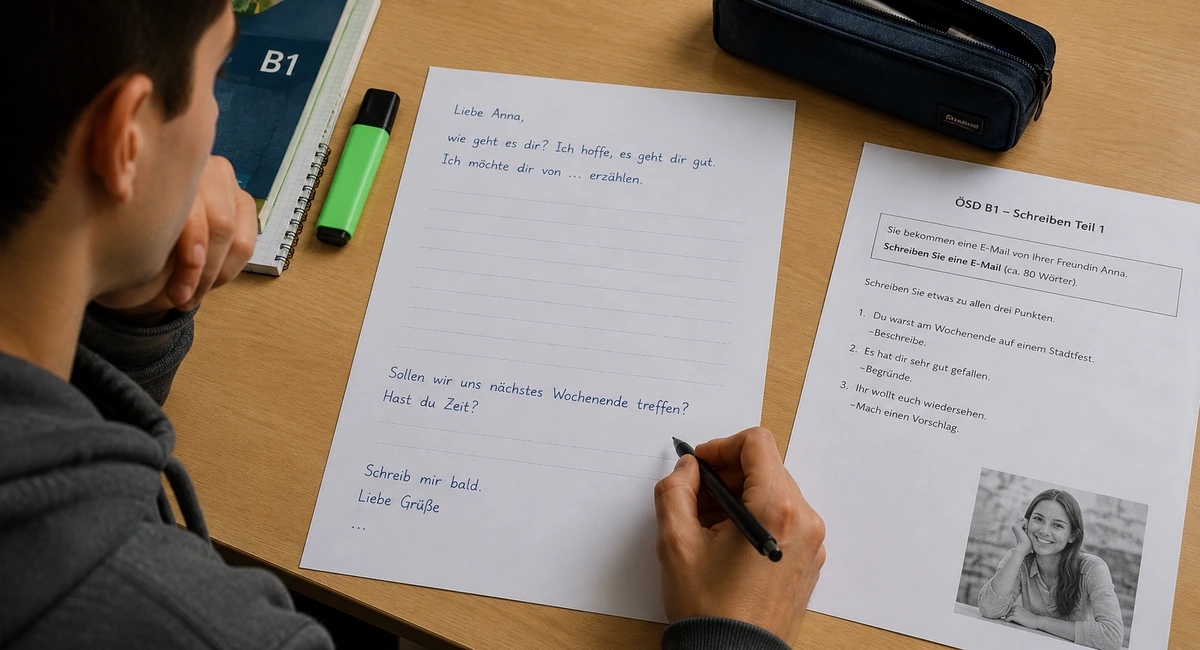
B1 ÖSD Writing Part 1:
topics, universal sentences and set phrases
Which topics often appear in B1 ÖSD Writing Part 1? Here you find common topics, universal sentences for the beginning and the ending, as well as useful set phrases with examples — explained simply.
Which topics often appear in B1 ÖSD Writing Part 1?
In Writing Part 1 you always write an informal email to a friend. The situation changes, but the logic stays almost always the same: you have experienced or done something and you tell about it. That is why it is worth knowing the common topics.
Most topics belong to personal everyday life. Very often it is about an event (something you experienced), about a new hobby or a course, or about a piece of news from your life.
Events and celebrations
- a birthday celebration or a party;
- a city festival, a concert or a theatre visit;
- a wedding or a class reunion;
- an outing, a hike or a holiday trip.
Courses, learning and hobbies
- a new language course, German course or cooking course;
- a dance course or a gym;
- a new hobby (for example photography or learning an instrument);
- the driving licence or an internship.
News from life
- a new car, a new flat (a move) or a new job;
- a new pet or a found animal;
- a museum or exhibition visit;
- a visit to the market or flea market.
Very often the situation says that a friend could not be there — for example because he or she was ill, had to work or had no time. This hint is important, because it explains why you are writing and why you suggest a meeting at the end.
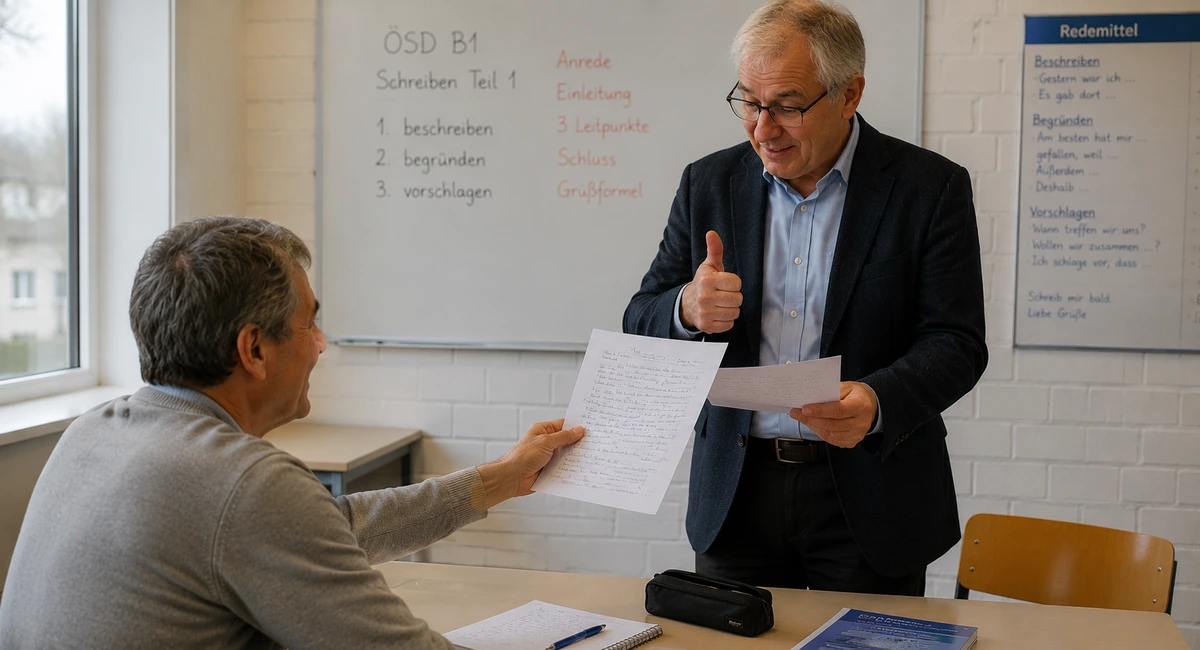
✅ The three guiding points are almost always built the same way: beschreiben (describe — what happened?), begründen (give reasons — why was it nice / important?) and einen Vorschlag machen (make a suggestion — usually for a meeting). Once you know this logic, you can prepare quickly for almost any topic.
Universal sentences for the beginning and the ending
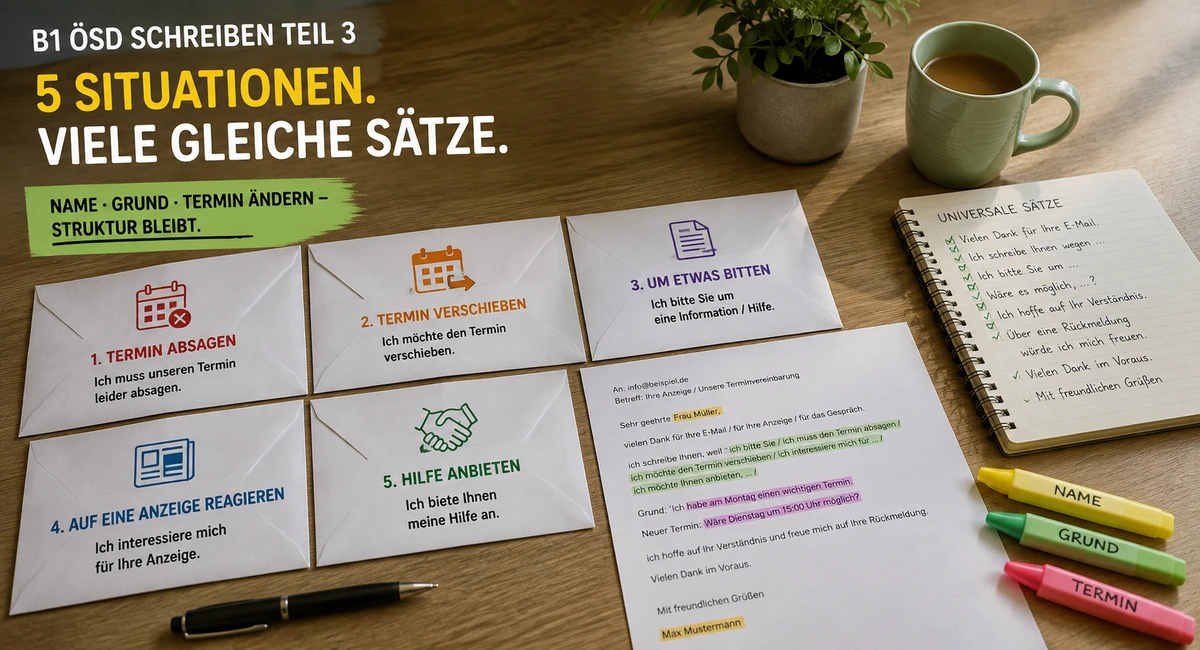
A big advantage of Writing Part 1: the beginning and the ending are almost always the same. You can prepare fixed sentences and simply use them in the exam. This way you save time and make fewer mistakes.
Universal beginning
After the salutation there always follows a short, friendly introduction. These sentences fit almost any topic:
- Liebe Anna, / Lieber Tom, / Hallo Anna, — the informal salutation;
- wie geht es dir? Ich hoffe, es geht dir gut. — the fixed beginning;
- Ich möchte dir von … erzählen. / Es gibt etwas Neues. — a transition to the topic (here you insert the topic, for example von meiner Party).
⭐ If the friend was ill, you change only one sentence: instead of Ich hoffe, es geht dir gut you write Ich hoffe, du bist wieder gesund. This way you show a connection to the situation, and that improves the coherence.
Universal ending
At the end you make a suggestion for a meeting, write a closing sentence and a closing formula. This order fits any topic:
- Wann treffen wir uns? Wir haben uns schon lange nicht mehr gesehen.
- Sollen wir uns nächstes Wochenende treffen? Hast du Zeit?
- Schreib mir bald. — the closing sentence;
- Liebe Grüße, deine Olena / dein Tom — closing formula and name.
Only one small sentence matters, the one that connects the suggestion with the topic. This way the invitation feels logical. For example: after a party Dann zeige ich dir die Fotos, after a course Dann erzähle ich dir alles genau, or after a concert Dann gehen wir das nächste Mal zusammen.
| Part of the email | Universal sentence |
|---|---|
| Anrede (salutation) | Liebe Anna, / Lieber Tom, |
| Einleitung (introduction) | wie geht es dir? Ich hoffe, es geht dir gut. |
| Übergang zum Thema (transition to the topic) | Ich möchte dir von … erzählen. |
| Vorschlag (suggestion, meeting) | Wann treffen wir uns? Sollen wir uns nächstes Wochenende treffen? |
| Schlusssatz (closing sentence) | Hast du Zeit? Schreib mir bald. |
| Grußformel (closing formula) | Liebe Grüße, deine Olena |
Universal set phrases with examples
Set phrases are fixed expressions that you can use for every guiding point. They are like a building block: you only insert the topic, and the sentence is finished. Here you find set phrases for all three speech acts.
Set phrases for Beschreiben (describing)
With these sentences you tell what happened:
- Gestern war ich … / Am Samstag war ich auf … — Am Samstag war ich auf einem Stadtfest.
- Es war wirklich … — Es war wirklich schön und die Stimmung war toll.
- Es gab dort … — Es gab dort viele Stände und Live-Musik.
- Wir haben … gemacht. — Wir haben gegessen, getanzt und gelacht.
- … geht gut / nicht so gut — Meiner Freundin geht es nicht so gut, denn sie hatte einen Unfall.
Set phrases for Begründen (giving reasons)
With these sentences you explain why something was nice or important. Important for the coherence: connect the sentences with small words.
- Am besten hat mir … gefallen, weil … — Am besten hat mir das Konzert gefallen, weil die Band fantastisch war.
- … gefällt mir besonders, weil … — Der Kurs gefällt mir besonders, weil ich schnell Fortschritte mache.
- Ich wünsche mir … / Ich möchte gern … — Ich möchte gern wieder hingehen, denn es hat mir Spaß gemacht.
- Außerdem … — Außerdem habe ich nette Leute kennengelernt.
- …, deshalb … / …, denn … — Das Wetter war herrlich, deshalb hatten alle gute Laune.
Set phrases for the Vorschlag (suggestion)
With these sentences you suggest a meeting:
- Wann treffen wir uns?
- Sollen wir uns nächstes Wochenende treffen?
- Wollen wir zusammen …? — Wollen wir nächste Woche zusammen ins Kino gehen?
- Ich schlage vor, dass … — Ich schlage vor, dass wir uns am Samstag treffen.
- Es wäre schön, wenn … — Es wäre schön, wenn du mitkommen könntest.
- Ich plane … Machst du mit? — suitable when you invite to an activity.
There are also fixed expressions for the ending: Sag bitte Bescheid, ob …, Bitte antworte mir bald. or Ruf mich an.. As a closing formula, Liebe Grüße, Viele Grüße, Herzliche Grüße or Bis bald fit well.
Do not copy the set phrases word for word from the task. Copying whole sentences or phrases from the task wording leads to a deduction of points. Always formulate in your own words and only insert your own topic.
| Speech act | Set phrase | Example with a topic |
|---|---|---|
| Beschreiben | Am Samstag war ich auf … | Am Samstag war ich auf einer Hochzeit. |
| Beschreiben | Es war wirklich … | Es war wirklich wunderschön. |
| Begründen | Am besten hat mir … gefallen, weil … | Am besten hat mir der erste Tanz gefallen, weil der Moment so romantisch war. |
| Begründen | Außerdem … | Außerdem haben alle bis spät getanzt. |
| Vorschlag | Sollen wir uns … treffen? | Sollen wir uns nächstes Wochenende treffen? |
Official source with sample tasks
It is best to prepare with the official materials of the ÖSD. There you see exactly how a task in Writing Part 1 looks and what the examiners pay attention to in the assessment.
ÖSD — official materials for the certificate B1
On the official website of the ÖSD you find the description of the Writing module, the assessment criteria and practice materials for the ÖSD certificate B1:
- Official ÖSD website: www.osd.at
- ÖSD assessment criteria Writing (PDF): osd.at/wp-content/uploads/2018/10/zb1_kriterien_schreiben.pdf
In these materials you see a real sample task (a situation with three guiding points) and the four assessment criteria (Erfüllung, Kohärenz, Wortschatz, Strukturen). This way you know exactly what is expected of you in the exam.
✅ Check the links directly at the ÖSD, since the provider updates its materials occasionally. This way you always have the newest official version for the ÖSD certificate B1.


There are no comments for this article. Leave your comment