





Goethe B1 Reading Part 2:
the right strategy and all typical traps
This is how you solve Reading Part 2 step by step, recognise every typical trap and get the maximum score. The complete trap map and a clear strategy – perfect to read before your training.
Overview: structure, time and points
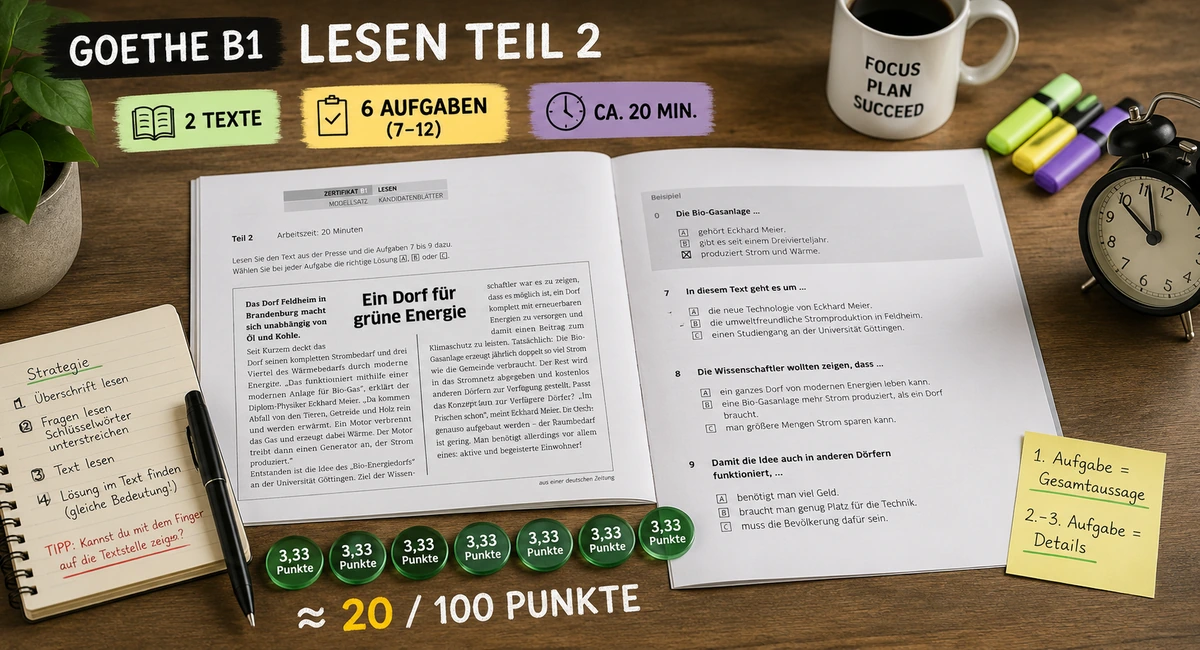
Reading Part 2 is the second of five parts in the Reading module. Here you read two factual texts – for example a newspaper or magazine article, a text from a brochure or an information leaflet. Each text has three tasks. For each task you have to choose the right solution: a, b or c. Only one answer is correct.
| Feature | Reading Part 2 |
|---|---|
| Texts | 2 factual texts (article, brochure, leaflet) |
| Tasks | 6 tasks (no. 7–12), 3 per text each |
| Task type | multiple choice (a / b / c), one correct solution |
| Points | 6 points |
| Time | about 20 minutes |
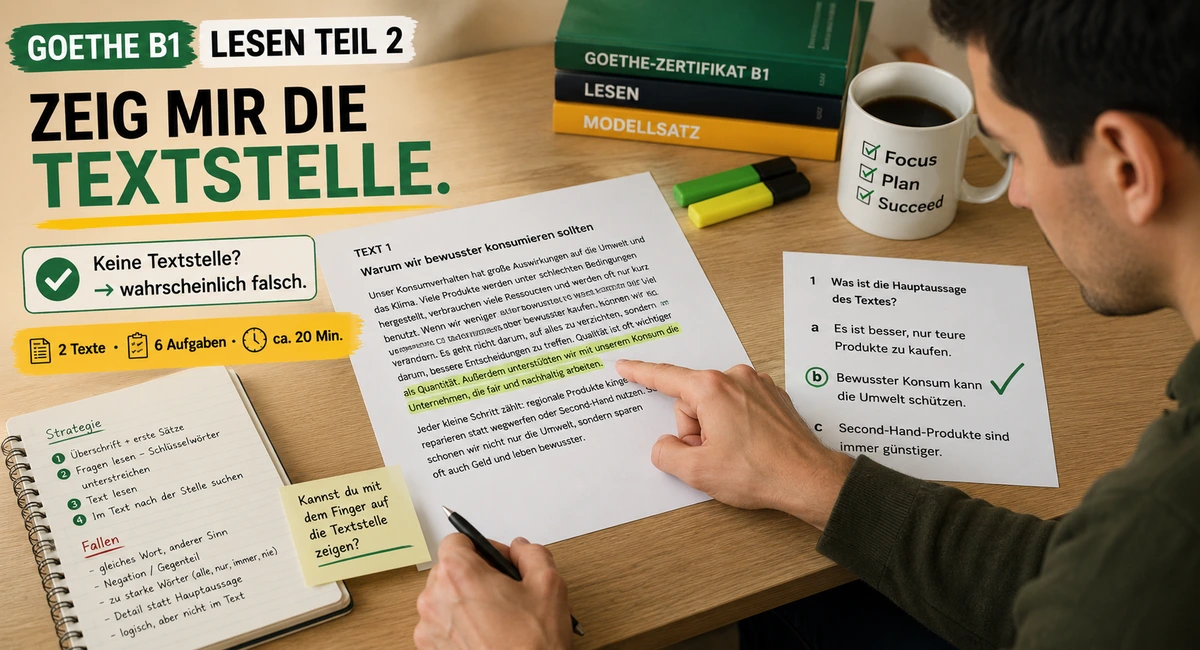
The most important pattern: first question = main statement
There is a fixed rule that helps you immediately: the first task for each text always asks about the overall statement – that is: Worum geht es im Text? (what is the text about?). The two other tasks ask about details. If you know this, you read each text with a clear plan.
For a wrong answer there is no point deduction. Your chance when guessing is about 33%. That means: never leave a field empty – always tick something, even if you are unsure.
Tasks first, then the text? The right order
The short answer: yes. Read the tasks first and underline the key words – and only after that the text. But careful, here lies the biggest thinking error of many learners: key words only help you to find the right place in the text. You almost never recognise the correct answer by identical words, but by the meaning.
The recommended order in 6 steps
- Read the heading and the first sentences. This way you immediately get the topic of the text.
- Read the tasks (the questions) and underline the key words. Understand exactly what is being asked.
- Read the text once and first solve the first task (overall statement).
- Search for the places for the detail questions. Good news: the detail questions usually follow the order of the text – question 8 comes before question 9 in the text.
- Compare the text place and a/b/c and decide by the meaning (not by identical words).
- Transfer the solutions cleanly and always tick a field.
For each task you search for the matching place in the text and then check: does the text say the same with other words (synonym) → that is usually the correct answer. Or does an answer use an identical word in a different context, or say the opposite → that is a trap.
Tip for a difficult text: If the first text is very hard for you, feel free to start with the second text and come back later. The only important thing is that in the end you manage both texts in 20 minutes and transfer the solutions.
Underlining key words – but correctly
Key words are the most important words in the question and in the answers: nouns, names, numbers, important verbs and negations (nicht, kein). You underline them in order to find the right place in the text quickly. But that is only the first step.
Three relations between task and text
When you compare an answer option with the text, there are exactly three cases:
- ✅ Synonym / paraphrase: the text says the same with other words. → That is almost always the correct answer.
- ❌ Identical word, different context: the word is in the text, but it is about something else. → Trap.
- ❌ Opposite / contradiction: the answer says the opposite of what is in the text. → Wrong.
An identical word is no proof. Always ask yourself: Steht das wirklich so im Text? (does it really say it like that in the text?) Check the whole sentence, not only the one familiar word.
A short example (invented)
Imagine the text says: Das Schwimmbad ist im Sommer nur am Wochenende geöffnet. (in summer the swimming pool is open only at the weekend.)
- ❌ Answer with a trap: Das Schwimmbad ist im Sommer geöffnet. – The words Sommer and geöffnet are correct, but the important condition nur am Wochenende is missing.
- ✅ Correct answer (paraphrase): Unter der Woche kann man im Sommer dort nicht schwimmen.
The big trap map: all typical traps
In Reading Part 2 the same trap types repeat again and again. We have sorted them into five groups. If you know this map, you already smell the wrong answers before you look closely.
Group 1: word traps (familiar word)
| Trap | How it works | Your remedy |
|---|---|---|
| Key-word trap | Identical word as in the text, but in a different context. | Read the whole sentence, not only the word. |
| Double-meaning trap | A word has two meanings (e.g. früh = in advance / in the morning). | Check which meaning is meant in the text. |
Group 2: meaning traps (meaning twisted)
| Trap | How it works | Your remedy |
|---|---|---|
| Opposite / negation trap | The answer says the opposite; often a nicht/kein is overlooked. | Look for negations in the text (nicht, kein, gar nicht). |
| Meaning shift | Same noun, but different verb, object or reason (e.g. warnt vor becomes verursacht). | Ask: who does what exactly – and why? |
| Confusion trap | Swaps who does or says something, or the direction (A helps B ↔ B helps A). | With several people: who exactly is meant? |
Group 3: said-too-strongly traps (exaggeration)
| Trap | How it works | Your remedy |
|---|---|---|
| Absolute-word trap | Words like alle, nur, immer, nie, jeder, ausschließlich. | The text usually says viele, oft, meist. Absolute word = warning sign. |
| Frequency trap | manchmal in the text becomes meist/immer in the answer. | Pay attention to frequency words (manchmal, oft, selten). |
| Comparison / superlative trap | genauso wie becomes mehr als; besser becomes am besten. | Read comparisons carefully: equal, more or most? |
| Modal trap | kann / ist möglich becomes muss / ist nötig. | Possibility is not obligation. |
| Certainty trap | vielleicht / man weiß nicht becomes a definite statement. | Look for: ob, vielleicht, möglicherweise, scheint. |
| Single-case trap | einmal / ein anderes Mal becomes a general rule. | Once is not always. |
Group 4: relevance traps (true, but not an answer)
| Trap | How it works | Your remedy |
|---|---|---|
| Focus trap | The statement is correct, but does not answer the question or is only a small detail. | Ask: does this really answer this question? |
| Not-in-the-text trap | Sounds logical, but is nowhere in the text. | Can you point to the place? If no → wrong. |
| Expectation trap | With the overall statement: the cliché that the text is just refuting. | Viele denken X, aber … → X is the trap. |
Group 5: detail-assignment traps (wrongly linked)
| Trap | How it works | Your remedy |
|---|---|---|
| Time trap | gibt es schon becomes ist geplant; or a wrong time reference. | When exactly? already / planned / yesterday / always? |
| Number trap | A number belongs to something else (e.g. a year instead of a quantity). | What does the number really belong to? |
| Condition trap | The condition is swapped (nur bei A becomes nur bei B). | Which condition is really in the text? |
The most important traps in detail
All examples here are invented – this way you see the mechanism without having to memorise concrete texts.
⭐ Trap 1: the identical word (the most common trap)
This is trap number one in Part 2. A word from the text reappears in a wrong answer, but in a different context. The word draws your eye – and that is exactly the intention.
- Text: Das Café sucht eine Aushilfe für die Küche.
- ❌ Trap: Das Café sucht einen neuen Koch für die Küche. (the word Küche is correct, but what is sought is a temporary helper, not a cook.)
⭐ Trap 2: the opposite
The answer says exactly the opposite. Very often this happens because a small nicht or kein is overlooked.
- Text: Tickets sind nur im Voraus günstig.
- ❌ Trap: Tickets sind immer günstig. (the word nur makes the difference.)
⭐ Trap 3: said too strongly
Pay special attention to absolute words: alle, nur, immer, nie, jeder, ausschließlich. B1 texts almost always phrase things cautiously (viele, oft, meist). An absolute word in the answer is therefore a strong warning sign.
- Text: Viele Teilnehmer fanden den Kurs gut.
- ❌ Trap: Alle Teilnehmer fanden den Kurs gut. (viele is not alle.)
The modal trap belongs to the same group: man kann auch im Chor singen becomes man muss im Chor singen in the answer. A possibility is not an obligation.
⭐ Trap 4: true, but not an answer (focus trap)
This is the meanest trap, because the statement is actually correct – it just does not answer the question that was asked. You check is that true?, but you have to check: does that answer the question?
- Question: Warum kam Herr M. zu spät? (why was Herr M. late?)
- ❌ Trap: Herr M. arbeitet in einer Bank. (this may be in the text and is true – but it is not a reason for being late.)
⭐ Trap 5: not stated like that in the text
The answer sounds logical and reasonable, but it is not in the text. Here a simple question helps: can you point at the place with your finger? If not, the answer is wrong – no matter how sensible it sounds.
Time trap: es gibt den Service schon becomes der Service ist geplant. Always check: already there or only planned?
Number trap: a number in the text is, for example, a year, but in the answer a quantity. Ask yourself: what does the number belong to?
Confusion trap: in texts with several people, who does what is swapped. Ask yourself: who exactly?
Step by step + checklist
Your procedure per text
- Read the heading and the first sentences → grasp the topic.
- Read the three questions, underline the key words.
- Read the text and first solve the overall-statement question (what is it about altogether?).
- For the detail questions, search for the matching places (they follow the text order).
- Compare the text place and a/b/c – decide by the meaning, not by identical words.
- With two texts: at the end transfer both solutions cleanly onto the answer sheet (Antwortbogen).
Time plan for the 20 minutes
- about 8–9 minutes per text including tasks.
- about 2 minutes at the end for transferring and checking.
- Do not get stuck on a difficult task. Put a question mark, carry on and come back later.
Checklist before the answer
- ✅ Have I found the matching place in the text?
- ✅ Is the correct answer a paraphrase (synonym)?
- ✅ Have I paid attention to negations (nicht, kein)?
- ✅ Is there an absolute word (alle, nur, immer) in an answer? Then be careful.
- ✅ With the overall statement: does the answer fit the whole text or only a detail?
- ✅ Is every field ticked – also when guessing?
Searching only by identical words · overlooking a small nicht/kein · choosing a true but wrong answer (focus trap) · with the overall statement taking a detail instead of the main topic · getting stuck too long on one task · forgetting to transfer.


There are no comments for this article. Leave your comment