





Speaking Part 3 in telc B1:
structure, assessment and the most common mistakes
Find out how Speaking Part 3 (Gemeinsam eine Aufgabe lösen / solving a task together) in telc Deutsch B1 works, how the examiners assess this part, which mistakes in joint planning cost the most points, and with which Redemittel (set phrases) you reach a real agreement with your partner.
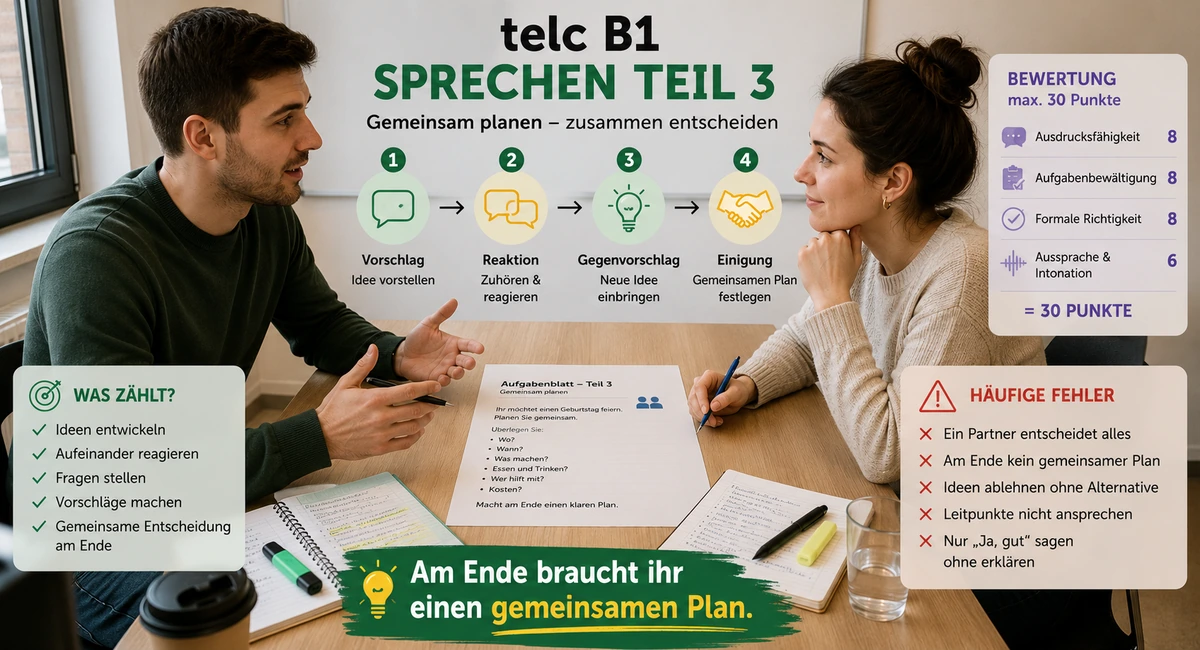
Structure of Speaking Part 3 – how does this exam part work?
In telc Deutsch B1, Speaking Part 3 is called Gemeinsam eine Aufgabe lösen (solving a task together). You and your conversation partner receive the same task sheet with an everyday situation that has to be planned together – for example a party, a gift or an outing. The sheet lists several guide points that serve as orientation and are not complete: you can also bring in your own ideas.
Unlike in Part 2, where each partner has different information, in Part 3 both partners have the same task. Your task is to make suggestions together, react to your partner’s ideas and, at the end, agree on a joint plan.
Preparation time and procedure
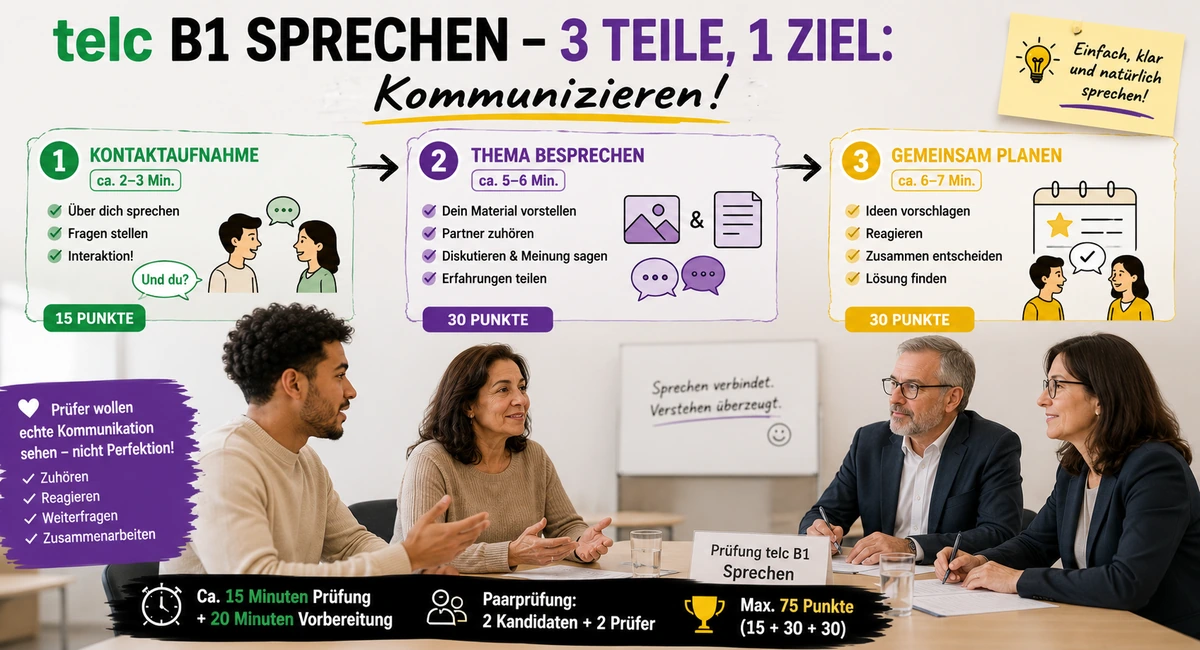
Before the actual conversation, you have 20 minutes to prepare individually for all three parts of the oral exam. Handwritten notes from this preparation time may be used during the conversation – but reading directly from the sheet is not allowed. The whole oral exam then lasts about 15 minutes and is conducted by two trained examiners with a telc licence.
| Feature | Speaking Part 3 |
|---|---|
| Task sheet | Both partners have the same sheet |
| Goal of the conversation | Make suggestions, react, agree together |
| Aids | Your own handwritten notes (no reading aloud) |
| Maximum points | 30 points |
Just like Part 2, Part 3 counts twice as much as Part 1 (Kontaktaufnahme / making contact) and is thus one of the two most important sections of the oral exam.
Assessment criteria – what do the examiners look for?
As in the other parts of the oral exam, the examiners assess Part 3 according to four criteria. What is decisive here is above all how actively both partners reach a solution together – and not whose idea wins in the end.
| Criterion | What does that mean concretely in Part 3? | Maximum points |
|---|---|---|
| I. Ausdrucksfähigkeit (expressive ability) | Vocabulary around suggestions, agreement, rejection and reasons | 8 |
| II. Aufgabenbewältigung (task completion) | Joint planning, reacting to the partner, reaching an agreement | 8 |
| III. Formale Richtigkeit (formal accuracy) | Grammar, especially in reasons with weil (because) and weil clauses | 8 |
| IV. Aussprache und Intonation (pronunciation and intonation) | Intelligibility, especially with numbers, times and places in the plan | 6 |
Asking questions and helping each other are explicitly assessed positively here. If you don’t understand one of your partner’s ideas, a follow-up question is not a disadvantage but a sign of active conversation participation.
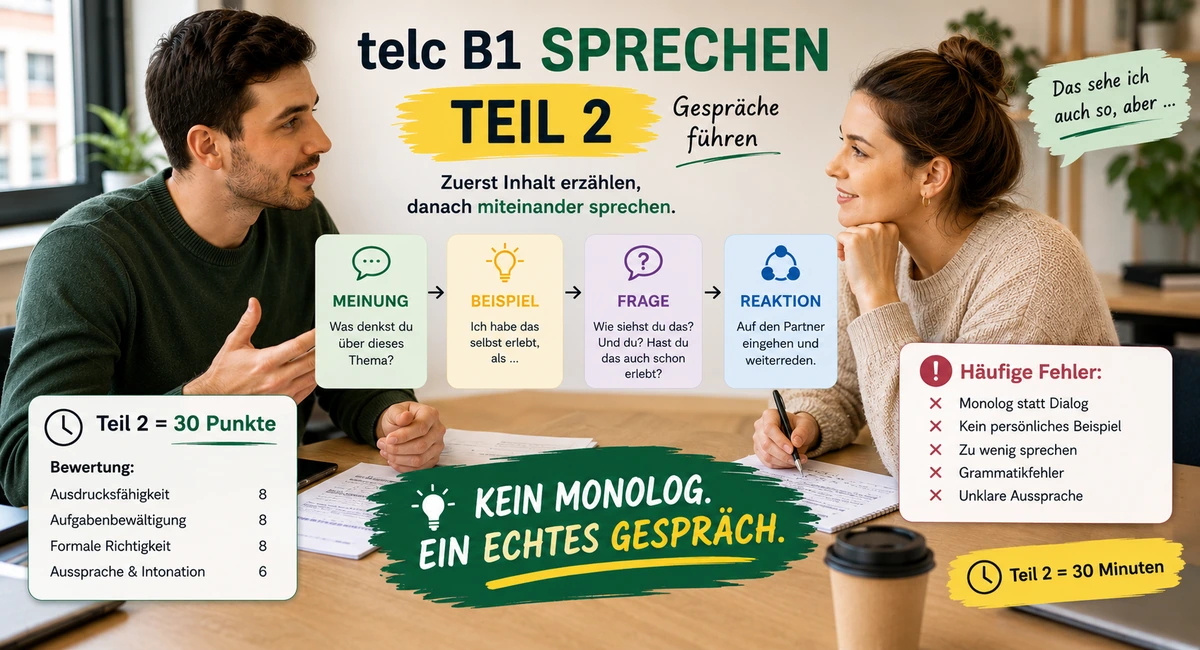
The decisive difference from Part 2
While Part 2 is mainly about opinion and a personal example, Part 3 additionally tests a completely different ability: reaching a result together. A conversation without a clear agreement at the end counts as incompletely solved in task completion, even if both partners spoke a lot.
Typical mistakes and traps in Speaking Part 3
The following five traps are especially common in joint planning.
Trap 1: one person decides alone
One partner quickly makes a plan and the other only agrees, without making their own suggestions. The conversation then does not seem like joint planning, but like an announcement. Both partners should actively bring in ideas.
Trap 2: no real agreement at the end
Both talk a lot, express different ideas – but at the end it remains unclear what the two have now actually decided on. Without a clear conclusion, a central part of the task is missing.
Trap 3: rejecting without an alternative
A suggestion is rejected (Das finde ich nicht so gut / I don’t think that’s so good), but no counter-suggestion follows. As a result the conversation stalls, and no further development of the idea arises.
Trap 4: guide points are skipped
The task sheet lists several guide points as orientation, for example place, time, food and drinks or costs. If only one or two points are discussed, the planning seems incomplete, even if the conversation was fluent.
Trap 5: only agreeing without a reason
A simple Ja, gut (yes, good) or Genau (exactly) is not enough for the assessment. Agreement and rejection should always be briefly justified, so that expressive ability becomes visible.
Speaking Part 3 is successfully solved when there is a joint, clearly formulated plan at the end – not when one person spoke especially much or especially correctly.
Practical tips – how to plan together like a team
The following Redemittel (set phrases) and strategies cover the four steps of good planning: make a suggestion, react, make a counter-suggestion, agree.
Tip 1: make a suggestion
- Wir könnten die Party am Samstag machen. (We could have the party on Saturday.)
- Wie wäre es, wenn wir das Fest im Park feiern? (How about we celebrate the party in the park?)
- Ich schlage vor, dass wir das Essen gemeinsam kochen. (I suggest that we cook the food together.)
- Vielleicht könnten wir zuerst über das Datum sprechen. (Maybe we could talk about the date first.)
- Mein Vorschlag wäre, die Getränke selbst mitzubringen. (My suggestion would be to bring the drinks ourselves.)
Tip 2: agree with a reason
- Das finde ich gut, weil das Wetter im Park meistens schön ist. (I think that’s good, because the weather in the park is usually nice.)
- Genau, das spart uns wirklich Zeit. (Exactly, that really saves us time.)
- Da bin ich ganz deiner Meinung, das ist praktischer. (I completely agree with you there, that’s more practical.)
- Das ist eine gute Idee, so haben alle etwas davon. (That’s a good idea, that way everyone benefits.)
- Einverstanden, das klingt vernünftig. (Agreed, that sounds sensible.)
Tip 3: reject and make a counter-suggestion
- Das finde ich nicht so gut, weil das Wochenende schon voll ist. Wie wäre es stattdessen mit Freitag? (I don’t think that’s so good, because the weekend is already full. How about Friday instead?)
- Ich bin nicht sicher, ob das reicht. Vielleicht sollten wir noch mehr einladen. (I’m not sure that’s enough. Maybe we should invite more people.)
- Das ist eine Möglichkeit, aber ich hätte noch eine andere Idee. (That’s one option, but I’d have another idea.)
- Eigentlich lieber nicht, weil das zu teuer wird. Können wir nicht etwas Einfacheres machen? (Actually rather not, because that gets too expensive. Can’t we do something simpler?)
- Das sehe ich anders. Meiner Meinung nach wäre es besser, wenn wir es kleiner planen. (I see that differently. In my opinion it would be better if we plan it smaller.)
Tip 4: agree at the end
- Dann machen wir das also so. (Then we’ll do it like that.)
- Wir sind uns also einig, dass wir am Samstag feiern. (So we agree that we’ll celebrate on Saturday.)
- Gut, dann bleibt es dabei. (Good, then that’s settled.)
- Also fassen wir zusammen: Wir treffen uns um sechs Uhr im Park. (So let’s summarise: we’ll meet at six o’clock in the park.)
- Perfekt, dann haben wir jetzt einen Plan. (Perfect, then we now have a plan.)
Tip 5: systematically tick off all guide points
Go through the guide points on the task sheet consciously one after another during the conversation, instead of only talking about the easiest point. A short summary at the end helps to check whether all points were really covered:
- Wir haben jetzt über den Ort und die Zeit gesprochen. Was ist mit dem Essen? (We’ve now talked about the place and the time. What about the food?)
- Und wer kümmert sich um die Einladungen? (And who takes care of the invitations?)
- Haben wir an alles gedacht, oder fehlt noch etwas? (Have we thought of everything, or is something still missing?)


There are no comments for this article. Leave your comment