





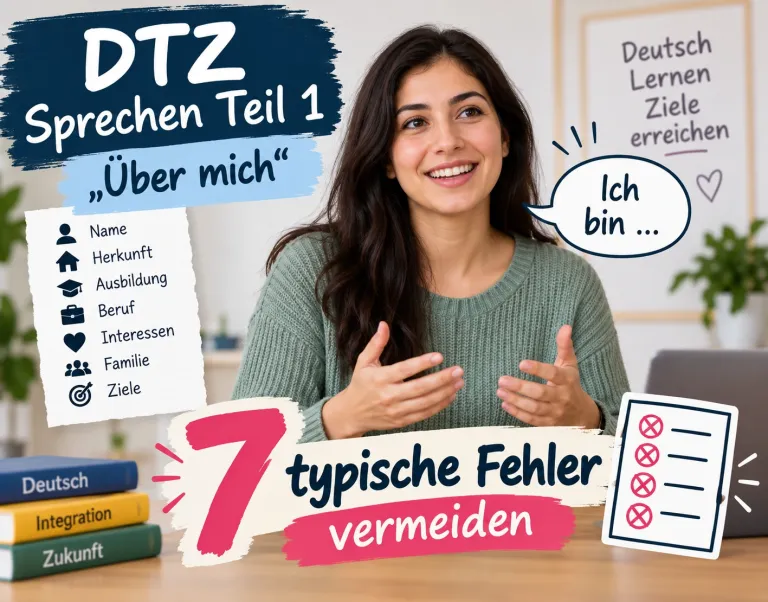
Most points in Part 1 are not lost because of grammar, but because of behavior: stating your age, memorizing a text, reading from the sheet, answering with one word. Here are the 7 most common mistakes we see in practice – and a method you can use to prepare for Part 1 without memorizing a text.
The short answer: The mistakes in Part 1 are behavioral mistakes
Part 1 „Über sich sprechen“ is the task you can prepare for best. You know the 6 prompts in advance. Nevertheless, many participants lose points here – not because of grammar, but because of their behavior. They say things that are not on the sheet. They memorize a text. They read from the sheet. They answer questions with one word.
These mistakes have one thing in common: The person prepares a text, but the exam is a conversation. The official assessment criteria from g.a.s.t. (DTZ Practice Test 1, page 45) state for B1: „detailliertere Informationen“ and „relativ spontan und ausführlich antworten“. All 7 mistakes in this article work against exactly these two ideas: details and spontaneity.
For each mistake, you will read: What happens? Why does it happen? What should you do instead? At the end, you will find a method that allows you to prepare for Part 1 without memorizing a text – with a complete example. Last updated: 11.09.2026.
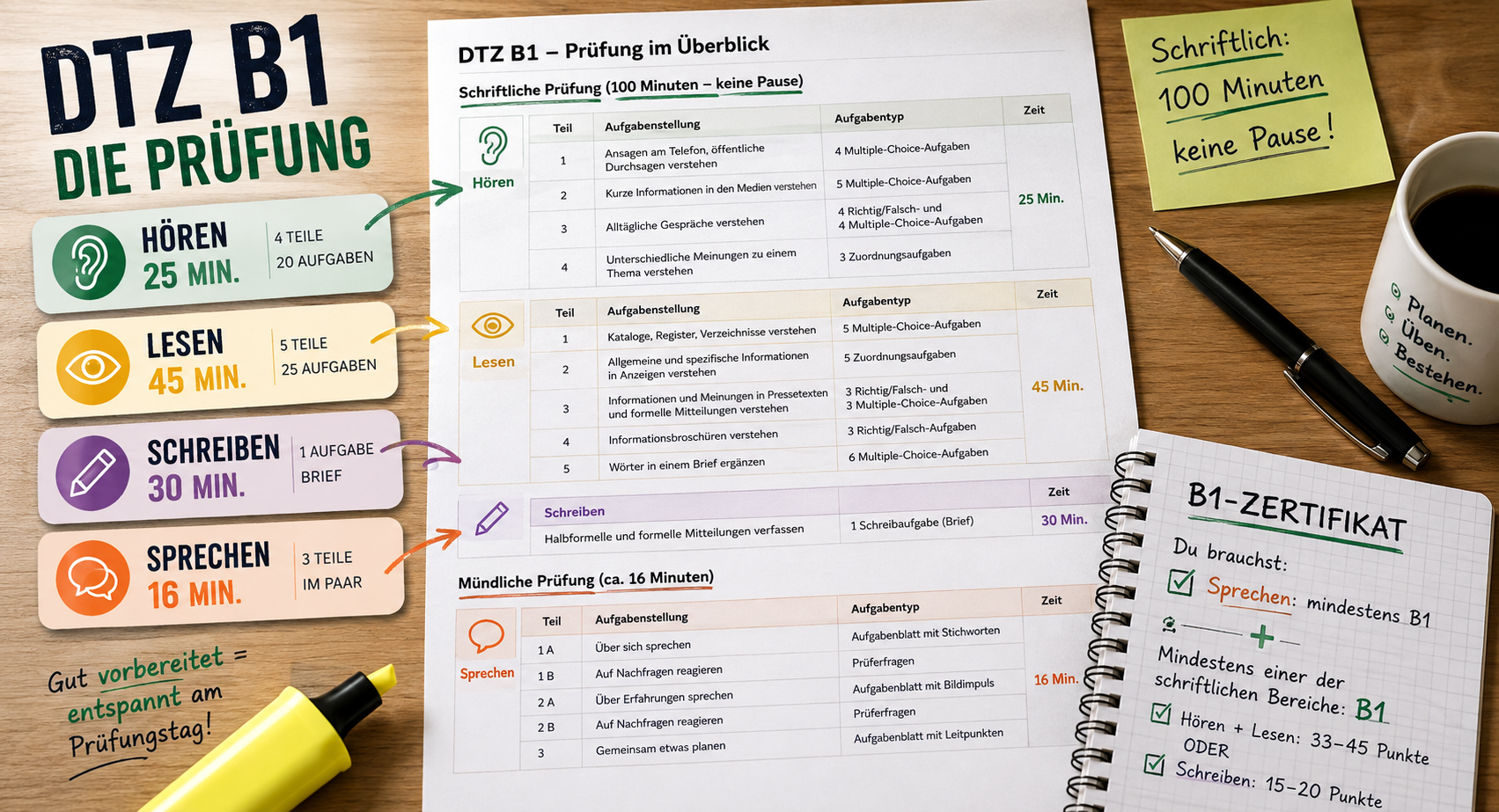
You can find the procedure and points for Part 1 in our article about structure and assessment. The hidden rules examiners use are explained in the article “What the examiners are really testing.” Here, we focus only on your behavior.
👉 Exercises for DTZ Speaking Part 1 „Über mich“Mistake 1: Stating your age – and other things that are not on the sheet
What happens: Almost every introduction begins like this: „Ich heiße …, ich bin 38 Jahre alt, ich komme aus …“. The age comes automatically, directly after the name.
Why this is a mistake: The official task sheet contains 6 prompts: Name, Geburtsort, Wohnort, Arbeit/Beruf, Familie, Sprachen. Age is not listed there. It does not earn any points for task completion, and it takes up time. The examiners also see that this person is not speaking based on the sheet, but is reciting a text learned in a German course. Stating the age is usually the first sign of this.
This mistake is so automatic that it even happened to us: The first sample text for this article series began with „Ich bin 34 Jahre alt“. We only noticed it when we compared the text with the task sheet. This shows that the mistake does not come from poor German, but from habit.
What you should do instead: Actually read the sheet during the exam. The 6 prompts are your task. Every second you spend giving a detail about one of the prompts is more valuable than stating your age. If the examiner asks your age, answer naturally – but only then.
Hobbies, plans for the future, favorite food: All of these can come up as questions in Part 1B. In Part 1A, they are not part of the task. People who start with these topics often still have not covered the actual prompts after one minute.
Mistake 2: Writing a text at home and memorizing it
What happens: The person writes a 150-word text at home, corrects it with a teacher or an app, and memorizes it word for word. During the exam, they recite the text very quickly and without pausing.
Why this is a mistake: Examiners immediately recognize a memorized text. It sounds monotonous, the pace is too fast, and the person does not look at the examiners but stares into the air. If the examiner gives a prompt, the person does not react – they search for the right place in the memorized text. And in Part 1B, the whole system breaks down: The question does not fit the text, and suddenly the person can only produce individual words. In the assessment criteria, „auswendig gelernte Wendungen“ appear directly in the A1 category. So the polished text may earn points in 1A, but in 1B and in the language assessment for the conversation as a whole, more can be lost.
What you should do instead: You do not need a text. You need 2 to 4 simple sentences for each prompt – in your head. You can say these sentences in any order, and you can also use them to answer a question. You can read exactly how this works in Section 9.
A text has a fixed order. If one sentence is missing, everything that follows is missing too. Building blocks have no fixed order. If one building block is missing, you simply use the next one. That is exactly the difference between „auswendig gelernt“ (A1) and „spontan“ (B1) in the assessment criteria.
Mistake 3: Reading from the sheet
What happens: The person looks at the sheet and says: „Name – Ahmed. Geburtsort – Aleppo. Wohnort – Essen. Beruf – Elektriker. Familie – verheiratet, zwei Kinder. Sprachen – Arabisch, Deutsch.“ Finished after 15 seconds.
Why this is a mistake: All the information is there, but nothing is connected. In the assessment criteria for Part 1A, the A1 level includes „Informationen unverbunden vortragen“. Reading from the sheet is an exact example of A1 – even if every word is correct. The person has understood the prompts as a form to fill in, not as support for a conversation.
What you should do instead: Turn each prompt into a complete sentence with a verb – and add a second element. „Beruf – Elektriker“ becomes: „Von Beruf bin ich Elektriker. In Syrien habe ich zehn Jahre in einer Firma gearbeitet.“ „Familie – zwei Kinder“ becomes: „Ich habe zwei Kinder. Mein Sohn geht schon in die Schule, meine Tochter ist noch im Kindergarten.“ The step from A1 to A2 is the verb. The step from A2 to B1 is the second element: „weil“, „seit“, „aber“, or an example.
Mistake 4: Stopping after 20 seconds
What happens: The person says one short sentence for each prompt and then stops. They look at the examiner and wait. The introduction lasted 20 to 30 seconds, although one minute was planned.
Why this is a mistake: The sentences may be correct, but „knappe, allgemeine Informationen“ is the description of A2 in the assessment criteria. The person also gives the examiner no material for follow-up questions. The examiner now has to fill the time with two or three questions – and whether the answers will then be detailed is uncertain.
What you should do instead: Use the rule “one fact plus one detail” for every prompt. Not: „Ich wohne in Essen.“ Instead: „Ich wohne in Essen, seit zwei Jahren. Die Stadt gefällt mir, weil sie nicht so groß ist.“ If you apply this rule to all 6 prompts, you will automatically speak for 50 to 60 seconds. Practice this with your phone: Start recording, give your introduction, check the time.
Mistake 5: Answering questions with one word
What happens: The examiner asks: „Haben Sie Kinder?“ – „Ja.“ – „Was machen Ihre Kinder?“ – „Schule.“ – „Und Ihr Mann, arbeitet er?“ – „Ja, Fahrer.“
Why this is a mistake: This is exactly what Part 1B is designed to test: The examiners want to see whether you can say more than one word in response to a question. „Ja.“ is a correct answer, but the assessment criteria place „mit einzelnen Wörtern antworten“ at A1 and „knapp antworten“ at A2. For B1, the criterion is „ausführlich“. Many participants answer with one word because they think: The examiner only wants the information. No – the examiner wants a conversation.
What you should do instead: Use the rule “answer plus two sentences.” For „Haben Sie Kinder?“: „Ja, ich habe zwei Kinder. Mein Sohn ist zwölf und geht aufs Gymnasium. Meine Tochter ist noch klein, sie ist im Kindergarten.“ When answering a yes/no question, always say yes or no plus an example or a reason. This is not grammar – it is a habit that you can practice at home.
„Ich habe keine Arbeit.“ – Full stop. This is a common place to stop. Keep talking: „Ich habe im Moment keine Arbeit, weil ich zuerst den Deutschkurs mache. Früher war ich Verkäuferin, und das möchte ich hier auch wieder machen.“ A negative fact is not the end; it is a reason that you can explain.
Mistake 6: Not listening to the question
What happens: The examiner asks: „Was machen Ihre Kinder?“ The person answers: „Ich arbeite als Krankenschwester, in meiner Heimat habe ich acht Jahre …“ They did not hear or understand the word „Kinder“ and say the sentence that was already in their head.
Why this is a mistake: The answer may be linguistically good, but it does not match the question. For task completion in 1B, what matters is: Did you respond to the question? An answer to a different question is not a response. This happens especially often with people who have memorized a text – they do not listen to the question; they are simply waiting for their chance to continue speaking.
What you should do instead: Listen for the question word and the topic. Repeat the topic in the first sentence of your answer: „Meine Kinder? Mein Sohn geht in die vierte Klasse …“. This way, you can check for yourself that you understood correctly. And if you really did not understand the question: „Entschuldigung, können Sie die Frage bitte wiederholen?“ That is better than answering the wrong question.
Mistake 7: As Person B, repeating Person A’s sentences
What happens: Person A speaks first. Person B listens and thinks: That was good, I will do it the same way. Then Person B says almost the same sentences with different personal details: „Ich heiße …, ich komme aus …, ich wohne in …, ich bin … von Beruf.“
Why this is a mistake: The examiners hear both introductions directly one after the other. They notice immediately when Person B simply copies the structure used by Person A. This is not against the rules, but it does not demonstrate independent language use. In addition, Person B misses the most important information they can get while listening to Person A’s introduction: the examiner’s questions.
What you should do instead: If you are Person B, do not focus on Person A’s introduction. Listen to the examiner. What question does the examiner ask in 1B? The questions come from a question bank, and a similar question may also be asked to you. You then have a one-minute advantage to build your answer in your head. You already have your own introduction prepared as building blocks – it does not need a model.
The method: 2 to 4 sentences per prompt – in your head, not on paper
All 7 mistakes have one solution: Do not prepare a text; prepare building blocks instead. For each prompt, prepare 2 to 4 simple sentences that you can say without paper. This is how the method we use with our learners during exam preparation works.
Step 1: Build the sentences in your native language – but with German word order
You can start with your native language. This is allowed and even practical because you can think quickly in your own language. But you build the sentence using the German structure. The most important rule: The verb is in position 2. Not at the end, not at the beginning. Say the sentence in English – but structure it the way you would structure the German sentence. For example: “I live in Essen” – „Ich wohne in Essen“. The sentence starts in your language, but you are already thinking in the German sentence structure.
Step 2: Say the same sentence in German
Now say the same sentence in German. The word order is already correct because you built it in Step 1. You only need to replace the words. Do this aloud with every sentence: English with German structure – then German. After a few days, Step 1 disappears. The German sentence comes directly.
Step 3: Mix the sentences
Say your building blocks in different orders: first Familie, then Beruf, then Sprachen. Also use the building blocks to answer questions: „Was machen Sie beruflich?“ – use the sentences from the prompt Beruf. When this works, you no longer have a memorized text, but an introduction that works in any situation.
Example: Building blocks for all 6 prompts
The example is deliberately longer than one minute. This gives you several sentences to choose from for each prompt. In the exam, use 2 to 3 sentences from each paragraph – and keep the other sentences in reserve for Part 1B.
Name: „Hallo! Ich heiße Natali. Mein Name ist in der Ukraine sehr populär. Meine Freunde in Deutschland nennen mich einfach Nata.“
Geburtsort: „Ich komme ursprünglich aus Odessa in der Ukraine. Das ist eine große Stadt am Schwarzen Meer. Dort bin ich geboren und zur Schule gegangen. Ich mag meine Heimatstadt sehr, weil sie viele Parks und einen schönen Strand hat.“
Wohnort: „Zurzeit wohne ich in Essen. Ich lebe seit zwei Jahren in Deutschland. Am Anfang war alles neu für mich, aber jetzt kenne ich die Stadt gut. In Essen besuche ich einen Integrationskurs, um mein Deutsch zu verbessern.“
Arbeit/Beruf: „Von Beruf bin ich Krankenschwester. In der Ukraine habe ich acht Jahre in einem Krankenhaus gearbeitet. Im Moment arbeite ich noch nicht, weil ich zuerst die Prüfung B1 brauche. Mein Wunsch ist es, später wieder in meinem Beruf zu arbeiten, sobald ich gut genug Deutsch spreche.“
Familie: „Meine Familie ist mir sehr wichtig. Ich bin verheiratet, und mein Mann arbeitet als Fahrer. Wir haben eine Tochter. Sie ist acht Jahre alt und geht hier in die Grundschule. Meine Eltern leben noch in der Ukraine, und wir telefonieren jeden Tag.“
Sprachen: „Meine Muttersprache ist Ukrainisch. Russisch spreche ich auch sehr gut, und ein bisschen Englisch habe ich in der Schule gelernt. Deutsch lerne ich seit zwei Jahren. Die Grammatik finde ich schwer, aber ich verstehe schon viel im Alltag.“
Notice what is not included in this example: no age, no hobbies, no favorite food. And what is included: one fact plus one detail for each prompt – a time reference, a reason with „weil“, a contrast with „aber“, a goal with „um … zu“. Every sentence is simple. No sentence needs to be memorized because every sentence comes from your real life.
👉 Exercise „Über sich selbst erzählen“: Build your own introduction 👉 All exercises for the DTZ B1 Speaking exam section




There are no comments for this article. Leave your comment