





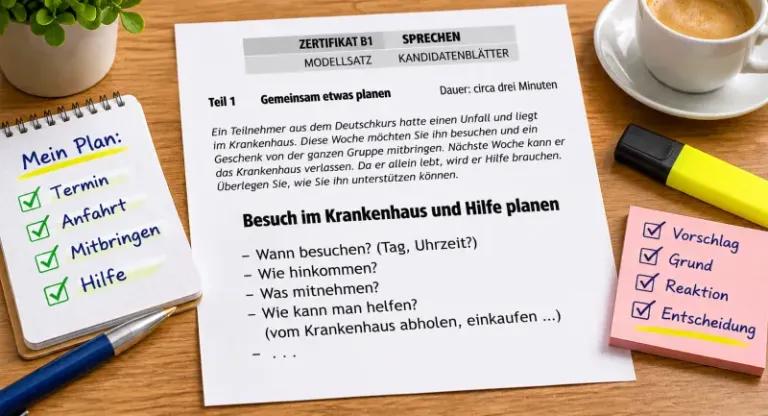
“Gemeinsam etwas planen” is the paired conversation in the B1 speaking exam: you and your partner receive the same task sheet with an everyday situation and several prompts, and you work together to make a plan. Here you will learn which topics appear in DTZ, telc, Goethe, ÖIF and ÖSD, how long the task takes, who starts and how many points it is worth.
What is “Gemeinsam etwas planen” in the B1 exam?
“Gemeinsam etwas planen” is an interactive speaking task at B1 level of the Common European Framework of Reference for Languages (CEFR). Two candidates receive the same task sheet: a short everyday situation followed by several prompts. Together, they make suggestions, respond to each other's ideas and finally decide what to do.
This task appears in several exams. The part number, duration and weighting vary, but the basic principle is the same:
| Exam | Exam part | Duration | Preparation | Weighting |
|---|---|---|---|---|
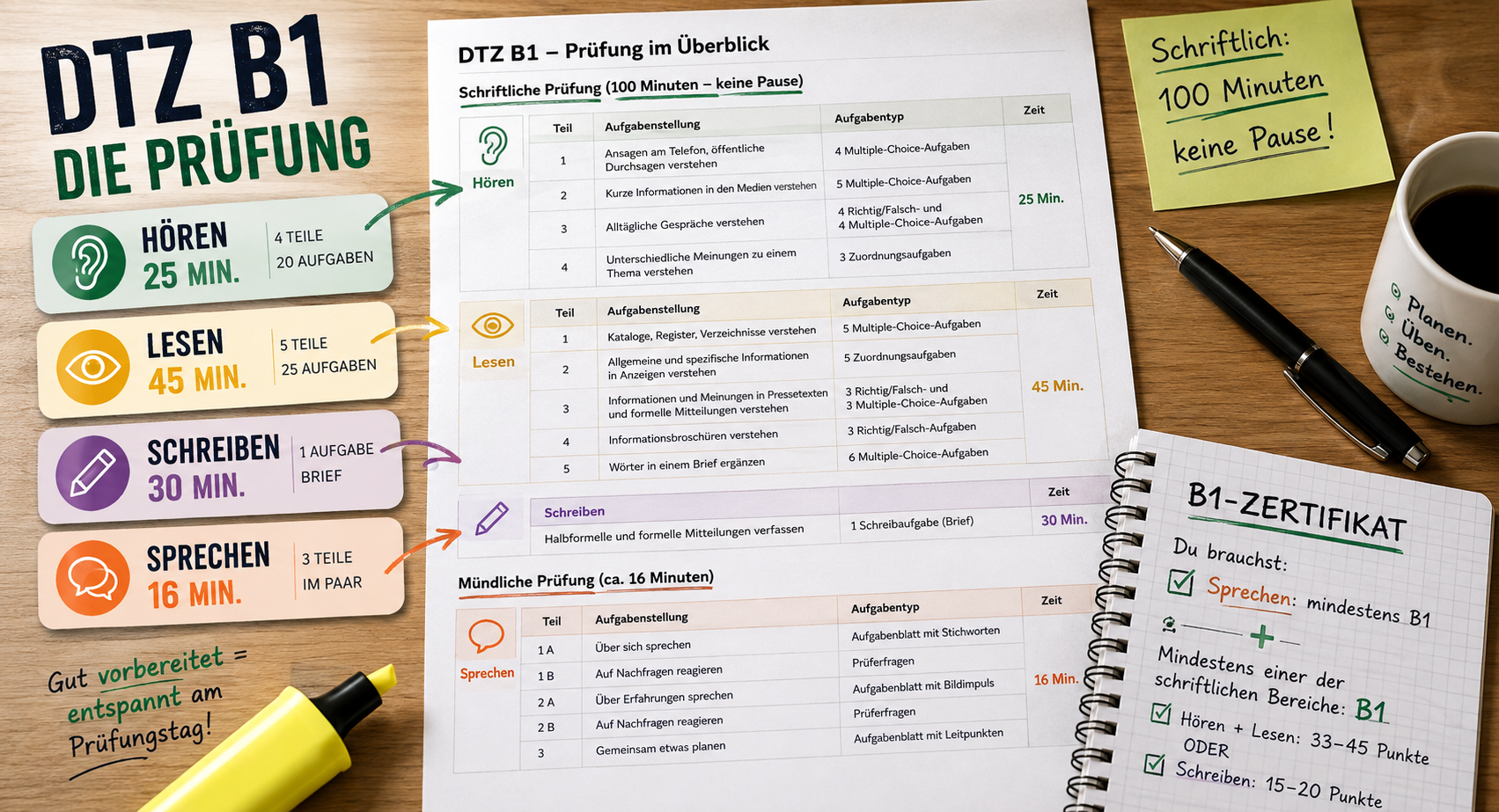
| DTZ (g.a.s.t.) | Speaking Part 3 | approx. 6 min. | No separate preparation time, only a short time to read | Task achievement: max. 20 out of 100 points in Speaking |
| telc Deutsch B1 | Oral Expression Part 3 | approx. 6 min. | 20 min. for all three parts | max. 30 out of 75 points |
| Goethe-Zertifikat B1 | Speaking Part 1 | approx. 3 min. | 15 min. for all three parts | Part of the Speaking module (max. 100 points, pass mark: 60) |
| ÖSD Zertifikat B1 | Speaking Part 1 | approx. 3 min. | 15 min. for all three parts | Same as Goethe (jointly developed exam) |
As of 02 November 2026. Sources: g.a.s.t. DTZ Practice Test 1, telc Deutsch B1 Practice Test 1, Goethe-Zertifikat B1 Model Test, ÖSD Zertifikat B1 Speaking Model Test.
The ÖSD Zertifikat Deutsch Österreich B1 (ZDÖ) is a different exam from the ÖSD Zertifikat B1. In that exam, the comparable task is called “Gemeinsam eine Aufgabe lösen” and is Task 3. In the newer telc Deutsch A2·B1 exam, “Gemeinsam etwas planen” appears as Part 2 of the exam. Therefore, always check exactly which exam is listed on your registration.
Which topics appear in “Gemeinsam etwas planen”?
The topics always come from everyday life: trips, celebrations, visits and helping friends or colleagues. The official practice tests and model tests show what kinds of situations you can expect:
| Topic | Prompts | Source |
|---|---|---|
| Hiking trip with the German course | Where to? · What to visit? · Stay overnight? · Food? · Who should come? · …? | DTZ Practice Test 1 (g.a.s.t.) |
| Visiting a friend in Vienna | When/How long? · Train? Car? Plane? · Activities together? · Information about Vienna? · Gift? · …? | DTZ Practice Test 2 (g.a.s.t.) |
| Farewell party during a holiday | When? · Where? · Food · Drinks · Who pays for what? · … | telc Deutsch B1 Practice Test 1 |
| Hospital visit and helping someone | When to visit? · How to get there? · What to bring? · How can you help? · … | Goethe and ÖSD B1 Model Tests |
| Class party and gift | When? Where? · Who else to invite? · Food, drinks? · Gift? · … | ÖSD B1 Model Test for Young People |
The topic framework: five types of questions that appear again and again
When you compare the official tasks, the same types of questions keep appearing, regardless of the topic:
- Time and place: When? Where? How long?
- Travel and transport: How to get there? By train, car or plane?
- Food and things to bring: What to bring? Food, drinks? A gift?
- People: Who should come? Who to invite? How can you help?
- Money and responsibilities: Who pays for what? Who takes care of which task?
If you prepare a few reliable sentences for each of these question types, you will be ready for almost any topic, even one you have never seen before.
You can find typical practice topics in the topic lists for your exam:
- DTZ B1 Speaking: Topics for “Gemeinsam etwas planen”
- telc Deutsch B1 Speaking: Topics for “Gemeinsam etwas planen”
- Goethe-Zertifikat B1 Speaking: Topics for “Gemeinsam etwas planen”
- ÖSD Zertifikat B1 Speaking: Topics for “Gemeinsam etwas planen”
- ÖIF B1 Speaking: Topics for “Gemeinsam etwas planen”
How does “Gemeinsam etwas planen” work?
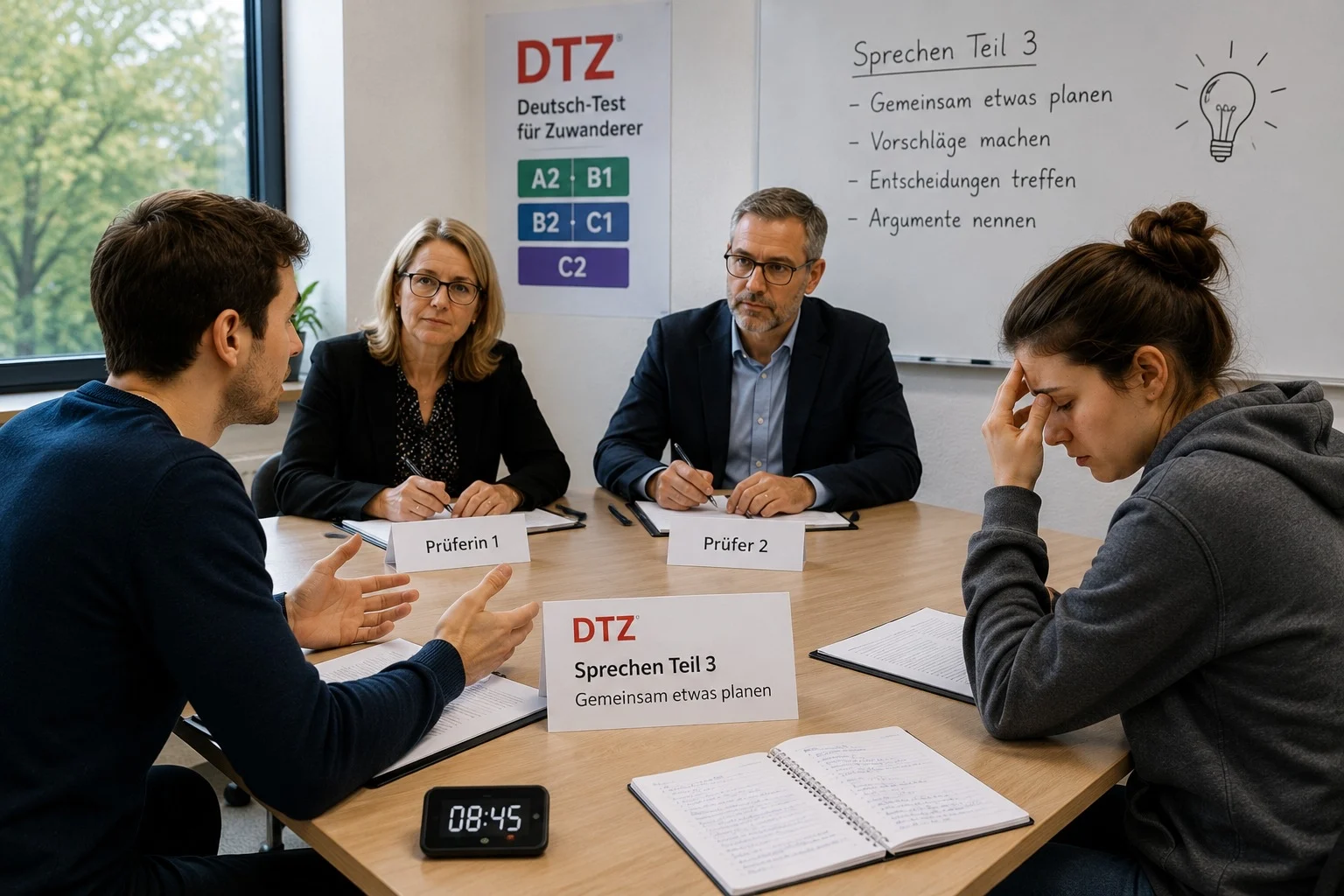
The procedure is similar in all four exams: both candidates receive the same task sheet, the examiners briefly explain the situation, and then the two candidates plan together. The examiners listen, intervene only when necessary and end the task when the time is up.
How is the task sheet structured?
At the top, there is a short situation, such as a trip, a celebration or a visit. Below it, there are usually four or five prompts in the form of questions or individual words. At the bottom, there are often three dots “...”. The prompts indicate what you should discuss, while the dots leave room for an additional idea of your own.
How much preparation time do I have?
- DTZ and ÖIF: There is no separate preparation time. You receive the task sheet during the speaking exam and have only a short time to read it.
- telc B1: You prepare all three parts beforehand in the preparation room and write notes only on officially stamped sheets. You may take your notes into the exam, but you should not read directly from them.
- Goethe and ÖSD: You prepare individually, may make notes for each task and should speak freely during the exam.
Who starts?
The examiners decide this, not the candidates. In ÖIF and DTZ, both candidates receive the same task sheet and a short time to read it. According to the official practice tests from g.a.s.t., the examiner may ask who would like to begin if necessary. However, the examiner may also directly ask one person to start. In telc, the moderator asks one candidate to present their suggestions and then asks the second candidate to respond. In Goethe and ÖSD, the examiners briefly introduce the situation and ask the pair to begin planning. So wait for the examiners' signal.
What do the examiners do during the conversation?
- DTZ and ÖIF: One examiner leads the conversation while the second observes. In Part 3, the leading examiner supports the planning conversation only if necessary and makes sure that both candidates have a reasonably equal opportunity to speak.
- telc B1: The moderator speaks as little as possible. They intervene if one candidate dominates too much or barely participates, addressing the candidate who has spoken less. If the conversation stops, the moderator uses open questions to get it going again.
- Goethe and ÖSD: The examiners introduce the task and end the planning conversation when the time is up.
What the task sheet really requires
The task sheet looks simple. However, some details in its structure determine whether you complete the task fully.
The instructions require more than the prompts
The prompts ask questions such as When, Where or What. But the instructions require more: in telc, you must clarify what needs to be done and who will take responsibility for each task, and agree on a joint proposal. In the Goethe and ÖSD certificates, the task sheet states that you should plan and make decisions together. If you only collect ideas without assigning responsibilities or making decisions, you complete the task only partially.
The situation sets limits
The sentence above the prompts contains information that limits which suggestions are appropriate. In the Goethe model test, a colleague lives alone and needs help after leaving hospital. In the DTZ practice test, the entire course is going hiking. A suggestion that does not fit the situation may make it seem as though you have not understood the task. Therefore, always read the situation first.
The examples in brackets give you useful vocabulary
Some prompts contain examples. In the DTZ practice test, for instance, one prompt says “Wohin (in den Wald, an den Fluss, in die Stadt …)?” These are not fixed options you must choose from. You can use these words if you cannot think of anything immediately, but you are equally free to suggest your own ideas.
More prompts than the time might suggest
Four or five prompts plus “...” may not seem like much. But if you calculate the available time, Goethe and ÖSD allow less than one minute per prompt, while DTZ and telc allow approximately one minute. The task therefore rewards pairs who make decisions quickly and then move on to the next point.
How is “Gemeinsam etwas planen” assessed?
What is assessed is not whether your plan is good, but how you plan: whether you make suggestions, give reasons, respond to your partner and move the conversation forward. Two licensed examiners assess each candidate individually, not the pair as a team.
DTZ: Part 3 has the highest weighting for task achievement
In DTZ, task achievement is assessed separately for each part, and Part 3 carries more points than either of the other parts. According to the assessment criteria published by g.a.s.t., the difference between A2 and B1 lies in how you participate in the conversation:
- A2: You participate in the planning conversation and express ideas, opinions and suggestions in a simple way.
- B1: You can start and maintain the conversation, plan spontaneously, make suggestions and respond to suggestions.
Pronunciation, fluency, accuracy and vocabulary are assessed throughout the entire speaking exam, so Part 3 also contributes to these criteria. The two examiners assess independently, and the final result is the average of their scores. To receive a DTZ B1 certificate, you need a B1 result in the Speaking section. You can read about what changed in the passing requirements from 1 November 2026 in the article DTZ B1 Exam from November 2026.
telc Deutsch B1: four criteria with double weighting
In telc, each part of the speaking exam is assessed according to four criteria. In Part 3, they carry twice as much weight as in Part 1:
| Criterion | What is assessed | Points in Part 3 (A / B / C / D) |
|---|---|---|
| Ability to express yourself | Vocabulary, appropriate expressions, ability to communicate your intended message | 8 / 6 / 2 / 0 |
| Task achievement | Participation in the conversation, communication strategies, fluency | 8 / 6 / 2 / 0 |
| Grammatical accuracy | Sentence structure and grammatical forms | 8 / 6 / 2 / 0 |
| Pronunciation and intonation | Whether deviations make understanding difficult | 6 / 4 / 2 / 0 |
| Total for Part 3 | max. 30 |
You pass the telc speaking exam if you achieve at least 60 percent of the available points. Important: according to telc, asking follow-up questions and helping each other are assessed positively. So asking your partner a question can help you earn points.
Goethe and ÖSD: task fulfilment and interaction
In Part 1 of the Goethe and ÖSD B1 certificates, examiners assess task fulfilment (language functions such as making suggestions or agreeing, content and scope), interaction (starting, maintaining and ending a conversation; ability to respond; appropriate language register), vocabulary and grammatical structures. Pronunciation is assessed across all three parts. If a candidate's contribution to the conversation cannot be assessed, the entire task receives 0 points.
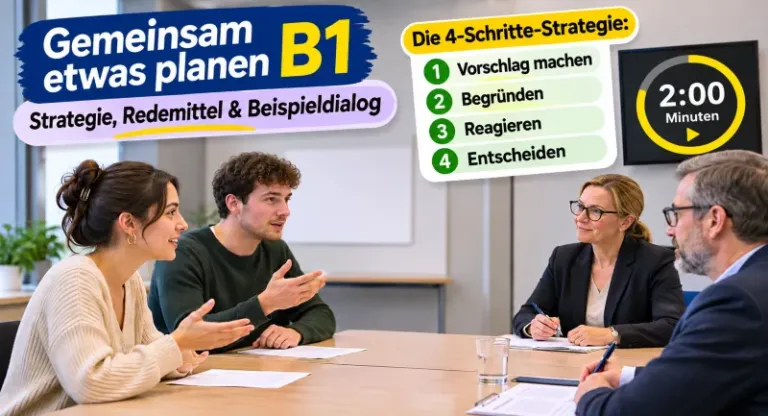
👉 How to meet these criteria in the conversation: strategy, useful phrases and sample dialogue





There are no comments for this article. Leave your comment