





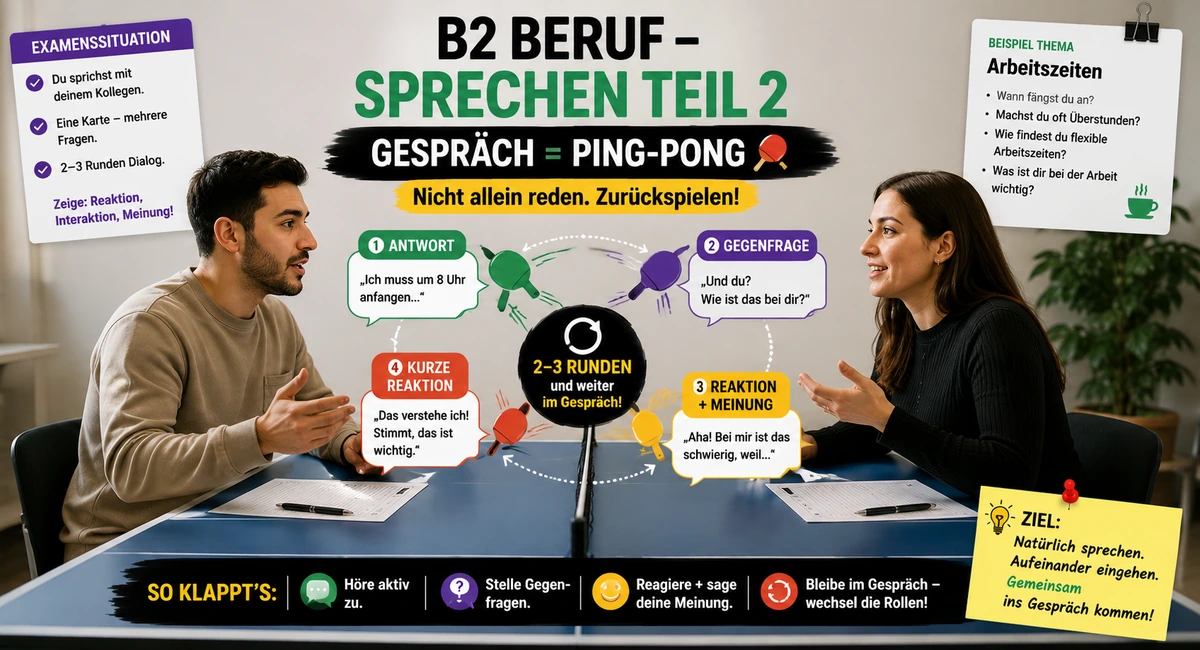
Talking with colleagues:
Anti-panic strategy for Teil 2
Discover the proven 4-step strategy to eliminate panic, lead dialogues naturally and achieve maximum points in Sprechen Teil 2. With set phrases, examples and universal card types.
What causes panic in Teil 2?
When you see a card task in Sprechen Teil 2, a thought chaos quickly arises in your head:
- ❌ “I don’t know what to say!”
- ❌ “I have to speak perfectly!”
- ❌ “What if I go silent?”
- ❌ “My partner doesn’t understand me!”
- ❌ “How do I start?”
The result: the learner falls silent or recites a memorised text (and gets fewer points).
The problem is not your German. The problem is that nobody has told you that Sprechen Teil 2 has a very simple, predictable structure. With this structure the panic disappears. With this structure you always know what to say.
What is Sprechen Teil 2 really?
This is NOT Sprechen Teil 2
- ❌ No perfect grammatical sentences
- ❌ No long monologue
- ❌ No perfect pronunciation
- ❌ No memorised text
- ❌ No answer to every possible question
This IS Sprechen Teil 2
- ✓ A natural dialogue (like a coffee break with a colleague)
- ✓ You speak in turns with your partner
- ✓ You answer your partner’s question
- ✓ You ask a counter-question
- ✓ 3 minutes in total for two people (approx. 1.5 minutes per person per card)
The assessment focuses on:
- Dialogführung: Are you leading a dialogue, not a speech?
- Fluency: Do you speak naturally, without long pauses?
- Reaction: Do you react to your partner?
How does the exam proceed?
Step 1: Your partner (TN B) receives the first card with a prompt + question
Step 2: He/she reads it aloud
Step 3: You both talk about this topic (approx. 1.5 minutes)
Step 4: You (TN A) receive the second card
Step 5: You read it aloud
Step 6: You both speak (again approx. 1.5 minutes)
Done! Teil 2 is finished. Approximately 3 minutes in total.
The 4-step anti-panic strategy
When you hear a question, exactly the following happens — in this order:
STEP 1: Answer the question (2–3 sentences)
Your partner reads aloud: «Wann musst du morgens anfangen?»
You answer with 2–3 sentences:
«Ich muss um 8 Uhr anfangen. Meine Arbeit ist nicht weit von zu Hause. Ich brauche 30 Minuten.»
This is the most important thing! 2–3 sentences, simple language, a direct answer to the question.
STEP 2: Ask a counter-question immediately
Directly after your 2–3 sentences: counter-question!
«Und du? Wie lange brauchst du zur Arbeit?»
This is the key to a real dialogue. Without a counter-question it sounds like a speech.
STEP 3: React to your partner’s answer + add your opinion
Your partner answers. You:
- React briefly: «Verstanden!», «Aha!»
- THEN give your opinion (advantage or disadvantage on the topic)
«Verstanden! Bei mir ist es manchmal schwierig, weil ich lange fahre. Aber der Vorteil ist, dass ich pünktlich fertig bin.»
This shows: I am listening AND I am thinking about the topic.
STEP 4: Brief reaction to partner’s comment
When your partner comments on your opinion, react briefly:
«Das ist praktisch!» or «Das verstehe ich!» or «Bei mir ähnlich!»
1–2 words. This shows the examiner: you are a real conversation partner, not a robot.
Then the cycle repeats itself…
These 4 steps repeat themselves 2–3 times per card. This fills the 1.5 minutes per person.
The anti-panic formula (visualised)
| Step | What you do | Length | Concrete example |
|---|---|---|---|
| 1 | Answer to the question | 2–3 sentences | «Ich muss um 8 Uhr anfangen. Meine Arbeit ist nicht weit. Ich brauche 30 Minuten.» |
| 2 | Ask a counter-question | 1 question | «Und du? Wie lange brauchst du?» |
| 3 | Reaction + opinion (advantage/disadvantage) | 2–3 sentences | «Verstanden! Bei mir ist es manchmal schwierig, weil ich lange fahre. Der Vorteil: ich bin pünktlich fertig.» |
| 4 | Brief reaction to their comment | 1–2 words | «Das ist praktisch!» or «Bei mir auch!» |
These 4 steps are NOT 4 blocks one after the other. They are 4 positions in a natural dialogue flow. Steps 1 + 2 always go together (answer + question). Then the partner speaks. Then Step 3 (you react + opinion). Then the partner comments. Then Step 4 (you react briefly). And the cycle repeats itself.
Universal set phrases for every step
STEP 1: Answer to the question
Ich + Verb + Objekt = done!
Universal examples:
- Ich muss um 8 Uhr anfangen.
- Ich arbeite im Büro.
- Mir gefällt mein Job.
- Ich fahre mit der U-Bahn.
- Ich habe zwei Kinder.
- Ich mag Fußball.
- Am Wochenende schlafe ich lange.
STEP 2: Opinion — advantage OR disadvantage
Advantage:
| Structure | Examples |
|---|---|
| Das ist gut/praktisch/schön, weil… | Das ist praktisch, weil ich mehr Zeit für die Familie habe. |
| Das gefällt mir, denn… | Das gefällt mir, denn ich bin selbständig. |
| Der Vorteil ist… | Der Vorteil ist: Ich bin am Ende des Tages frei. |
| Positiv ist… | Positiv ist, dass ich die U-Bahn nicht nehmen muss. |
Disadvantage:
| Structure | Examples |
|---|---|
| Das ist schwierig/anstrengend, weil… | Das ist schwierig, weil die Fahrt lang ist. |
| Das ist stressig, denn… | Das ist stressig, denn morgens ist es dunkel. |
| Das Problem ist… | Das Problem ist, dass ich wenig Zeit für mich habe. |
| Negativ ist… | Negativ ist, dass ich müde bin. |
STEP 3: Counter-question
Universal counter-questions (for ANY card):
- The simplest: «Und du?»
- General: «Wie ist das bei dir?»
- Specific: «Du auch?» / «Magst du auch?» / «Machst du das auch?»
- With detail: «Wie lange brauchst du…?» / «Wo arbeitest du…?»
STEP 4: Reaction to your partner’s answer
Universal reactions:
| Agreement | Surprise | Sympathy |
|---|---|---|
| Das verstehe ich. | Das ist interessant! | Das ist stressig. |
| Da stimme ich zu. | Oh, das wusste ich nicht! | Das tut mir leid. |
| Bei mir auch! | Echt? Das ist cool! | Das kenne ich! |
| Genau! | Wow! | Ich auch! |
Universal card types and practical examples
The topics in Sprechen Teil 2 of the B2-Beruf exam are always everyday and practical: working hours, family, leisure, commute, hobbies, childcare. You have personal experience with all of these topics!
On our website you will find real examples compiled by experienced teachers for all typical card types — with detailed models, set phrases and analyses:
👉 Topics and examples for B2-Beruf SprechenThere you will find:
- Card types: working hours, leisure activities, family, commute and many more
- Model dialogues with realistic answers
- Set phrases and expressions for each topic
- Tips for avoiding common mistakes
Do not memorise! Use the examples to understand the structure and practise your own answers. With the 4-step strategy and the set phrases you can speak spontaneously about any topic.
Common mistakes and how to avoid them
| ❌ Mistake | ✓ How to do it |
|---|---|
| Long pauses (thinking about the answer) | Start immediately: «Ich… ja, ich denke, dass…» Pauses are normal! |
| Long monologue (partner cannot intervene) | 2–3 sentences per answer. Then ask a counter-question! |
| Only facts, no opinion | Add: «Das gefällt mir…» or «Das ist schwierig, weil…» |
| I don’t listen to my partner (they speak, I don’t react) | After every answer: «Aha!», «Genau!», «Das ist interessant!» |
| I don’t ask a counter-question | ALWAYS ask a counter-question: «Und du?» |
| I speak too perfectly (checking every word) | Speak quickly and naturally. Mistakes are OK! |
| I have memorised a text | Speak in your own words. The examiner immediately hears that it is memorised! |
| I forget the counter-question | End EVERY contribution with a question: «Und du?» |
Checklist before the exam
Before you enter the exam room, ask yourself:
- ✓ Do I understand that this is a dialogue, not a monologue?
- ✓ Do I remember the 4 steps: answer → opinion → question → reaction?
- ✓ Do I know set phrases for advantage and disadvantage?
- ✓ Do I remember that the key question is «Und du?»?
- ✓ Am I ready to speak in my own words, not from memory?
- ✓ Do I know that pauses and mistakes are normal?
- ✓ Am I looking at my partner, not at the examiners?
If all these points are “yes” — you are ready! 🧠



There are no comments for this article. Leave your comment