





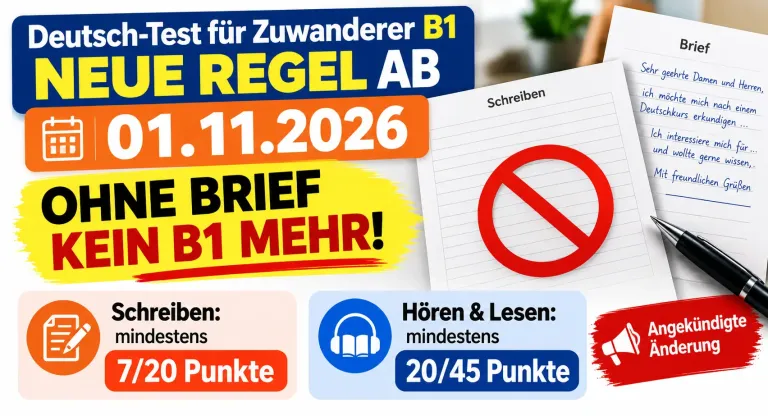
No more B1 without a letter. The Federal Ministry of the Interior is changing the rules for the German Test for Immigrants. Find out what now applies to DTZ B1 Writing, Listening and Reading – and how you can still pass with confidence.
What is changing in the DTZ B1 exam?
From November 1, 2026, you can only achieve B1 in the DTZ if none of the exam sections is below A2. Submitting a blank writing answer sheet will no longer be enough. This was announced by the Federal Ministry of the Interior (BMI) under Minister Alexander Dobrindt (CSU). The basis is an amendment to the Integration Course Testing Ordinance (IntTestV). The newspaper “Bild” was the first to report on it. The dpa news agency confirmed the ministry's information on October 19, 2026 (dpa report).
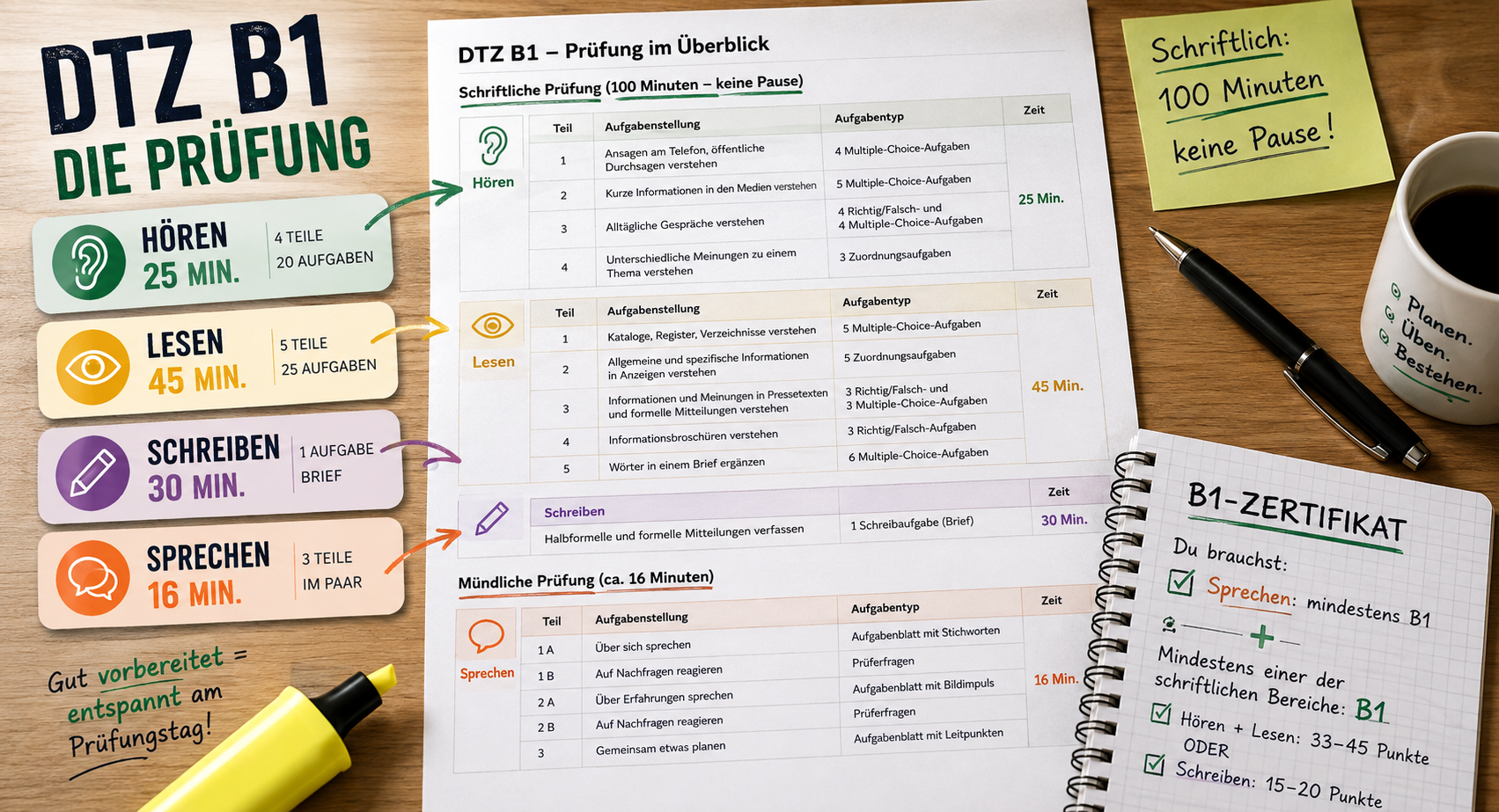
What does this mean in practice? The previous basic rule remains: You need B1 in Speaking. In addition, you need B1 in either “Listening and Reading” or “Writing”. What is new is the requirement for the third section. It must now be at least A2. In Writing, that means 7 out of 20 points. In Listening and Reading, it means 20 out of 45 points.
For most participants, this is quite achievable. It only becomes a problem for people who previously intended to “skip” one section. In this article, you will learn who is affected by the rule, how points are awarded in DTZ B1 Writing, and which DTZ B1 tasks await you in Listening and Reading.
The Ministry of the Interior has announced the change. However, we have not yet found the final text of the ordinance – either in the Federal Law Gazette or on the BAMF and g.a.s.t. websites. Those sites still show the previous rule under Section 10(1) IntTestV. We will update this article as soon as the official text is available.
Why is the Ministry of the Interior tightening the DTZ rules?
The reason is cheating. The ministry reports an increasing number of attempts to cheat in the exam. The method was always the same: Participants illegally bought exam questions and answers online. They then selected those answers in the “Listening and Reading” section. They often left the letter in the “Writing” section completely blank.
Under the previous rules, this did not prevent them from achieving B1 overall. With B1 in Listening and Reading and B1 in Speaking, they still received a B1 certificate. This is exactly the loophole Dobrindt now wants to close. According to the ministry, written German skills are an essential requirement for sustainable integration. Anyone who writes nothing should therefore no longer receive B1.
What already happens if someone cheats?
Cheating was already prohibited. Under Section 8 IntTestV, anyone who cheats or uses unauthorized aids is disqualified. This also applies afterward: If cheating is only discovered after the exam, the participant's result is invalidated retroactively. A certificate obtained through cheating is therefore never secure.
How many people take the DTZ?
The figures come from BAMF and were published by dpa. Last year, 318,550 immigrants took the DTZ. Of these, 175,193 (55 percent) achieved B1. Another 102,663 (32.2 percent) achieved A2. The remaining 40,694 (12.8 percent) scored below A2. The ministry has not said how many B1 results would have been different under the new rule.
What do politicians say?
The plans are controversial. Alexander Throm, the parliamentary group's spokesperson on domestic affairs for the CDU/CSU, believes the higher requirements are appropriate. For him, language skills are important evidence of integration. Criticism comes from the Greens. Their budget policy spokesperson Leon Eckert told the “Neue Osnabrücker Zeitung” that the measure was more about saving money than preventing cheating. He argues that BAMF should first close its security loopholes.
Before and from November: Comparing the DTZ B1 exam rules
The DTZ does not have one overall point total. There are three separate results: “Listening and Reading”, “Writing” and “Speaking”. Each result is B1, A2 or “below A2”. These three levels determine the overall result.
| Requirement for B1 | Until October 31, 2026 | From November 1, 2026 |
|---|---|---|
| Speaking | B1 | B1 (unchanged) |
| One written section | B1 | B1 (unchanged) |
| The other written section | Any result, even blank | At least A2 |
The score thresholds themselves remain unchanged. They have been officially published by the test provider g.a.s.t.:
| Level | Listening and Reading (max. 45) | Writing (max. 20) | Speaking (max. 100) |
|---|---|---|---|
| B1 | 33–45 | 15–20 | 75–100 |
| A2 | 20–32 | 7–14 | 35–74.5 |
| Below A2 | 0–19 | 0–6 | 0–34.5 |
So the scoring scale is not changing. What is changing is that the lowest category now matters. Previously, “below A2” in one written section did not matter. From November, it will prevent you from achieving B1.
Who is affected by the new rule?
Two of the five ways to achieve B1 will disappear. The official DTZ Practice Test 2 from g.a.s.t. shows exactly five combinations that previously led to B1. We have applied the new rule to them:
| Case | Listening and Reading | Writing | Speaking | Previously | From Nov. 1, 2026 |
|---|---|---|---|---|---|
| 1 | B1 | B1 | B1 | ✅ B1 | ✅ B1 |
| 2 | B1 | A2 | B1 | ✅ B1 | ✅ B1 |
| 3 | B1 | Below A2 | B1 | ✅ B1 | ❌ No B1 |
| 4 | A2 | B1 | B1 | ✅ B1 | ✅ B1 |
| 5 | Below A2 | B1 | B1 | ✅ B1 | ❌ No B1 |
Case 3 is exactly the situation the ministry is referring to: good Listening and Reading, good Speaking, but no letter. Case 5 is the opposite. Here, someone writes a good letter but has fewer than 20 correct answers in Listening and Reading. This is more likely to happen to people who write well but are less confident in Listening or cannot finish the Reading section in time.
An example: Same performance, different result
A participant scores 78 points in Speaking. That is B1. She scores 36 points in Listening and Reading, also B1. In Writing, she submits almost nothing and receives 3 points. In October 2026, she would still receive a B1 certificate. From November, she would not. Her Writing is below A2, so she cannot achieve B1. Because her Speaking and Listening and Reading results are above A2, she would receive an A2 certificate under the current A2 rule.
The difference is just four points. With 7 instead of 3 points for the letter, she would still have achieved B1 from November onward.
Our conclusion that this case would result in “A2 instead of B1” is based on the current A2 rule. So far, the ministry has only mentioned a change to the B1 rule. We will only know for certain once the text of the ordinance has been published.
DTZ B1 Writing: How to earn the points you need
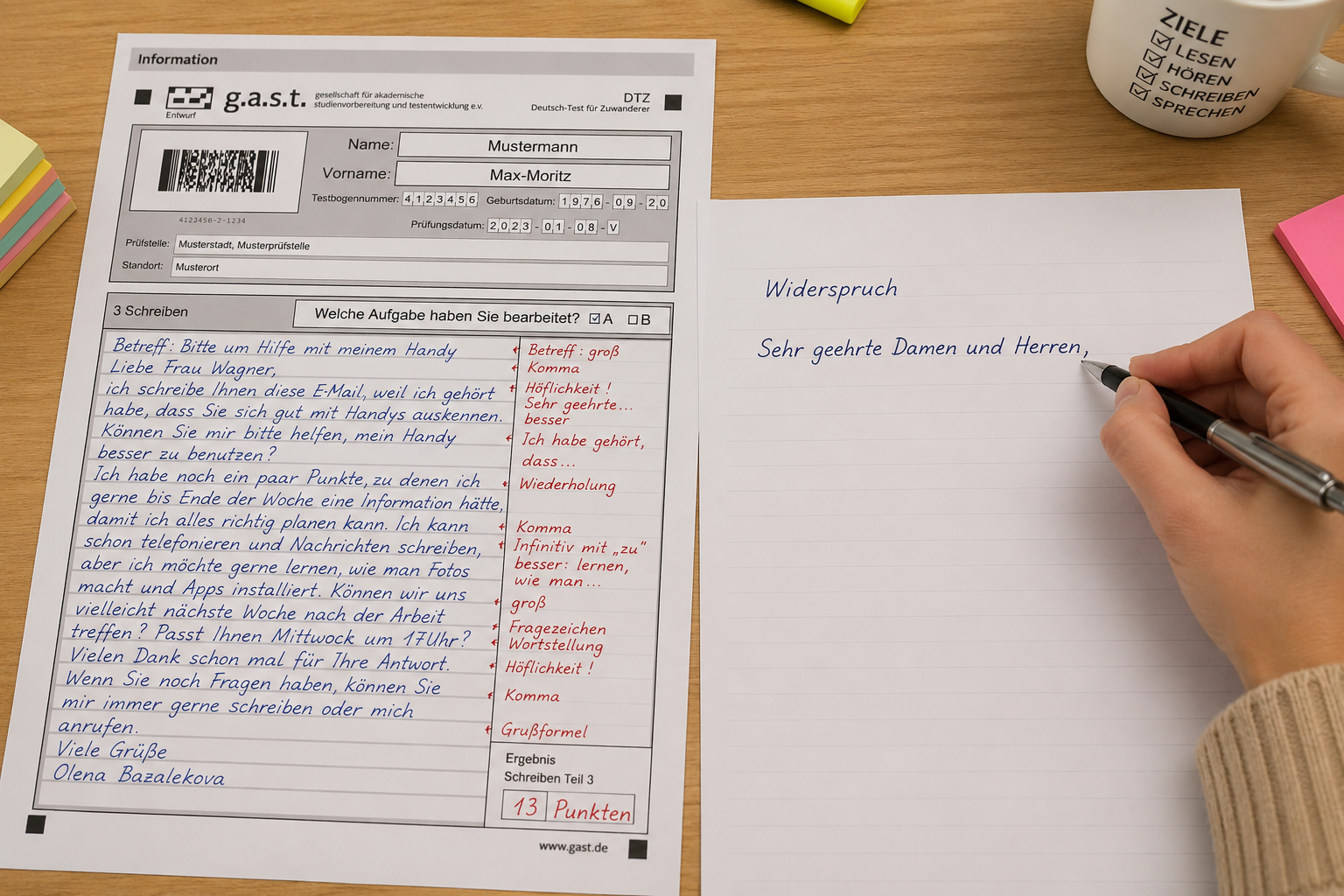
You do not need a perfect letter to achieve A2 in DTZ B1 Writing. You need a simple letter that matches the task. You have 30 minutes. There are two tasks, A and B. You choose one. Four criteria are assessed. Each is worth up to 5 points. This is how they are presented in the official g.a.s.t. assessment criteria:
| Criterion | B1 well fulfilled | B1 fulfilled | A2 well fulfilled | A2 fulfilled | A1 | 0 |
|---|---|---|---|---|---|---|
| Task achievement (content) | 5 | 4 | 3 | 2 | 1 | 0 |
| Communicative organization | 5 | 4 | 3 | 2 | 1 | 0 |
| Accuracy | 5 | 4 | 3 | 2 | 1 | 0 |
| Vocabulary | 5 | 4 | 3 | 2 | 1 | 0 |
| Total | 20 | 16 | 12 | 8 | 4 | 0 |
Anyone who “fulfills” all four criteria at A2 level receives 8 points. That is enough for A2. And A2 does not mean “error-free” here. You are allowed to make mistakes. What matters is that the reader understands you. You should be able to connect sentences using “und”, “aber” and “weil”. You should be able to write a request or provide information clearly.
The four guiding points earn you the most points
Each task lists four guiding points as keywords. You should write something about each one. This is the most important way to improve your score in the entire DTZ B1 Writing section. If you clearly address all four points, you receive the full 5 points for content. If you address all four but the reader has to infer some details, you receive 4 points. If you clearly address only two points, you receive just 3. Addressing a single point earns 1 to 2 points. The calculation is simple: Two or three short sentences for each guiding point already earn you more than half the points you need for A2.
The biggest trap: Missing the topic = 0 points in every criterion
The assessment rubric contains a strict rule. If your text does not match the task, or barely matches it, you receive 0 points in all four criteria. Even excellent German will not help then.
This is especially important from November onward. Many learners memorize ready-made letters. That is useful for greetings, introductions and closing phrases. But anyone who copies an entire memorized letter that does not fit the task risks scoring “below A2”. From November, that also means losing B1.
An example from the official practice test illustrates this well. In Task B, the windows in your apartment do not close properly. It is cold. You have already called your landlord, Mr. Schneider. But nothing has happened. You must write why you are contacting him, why a cold apartment is a problem, what you want and what you will do if nothing happens. A memorized letter about a broken heating system is only partly relevant. It says nothing about the windows. It does not mention that you have already called. The letter must reflect the situation described in the task. Only then is a template useful.
Small rules that can cost you a lot of points
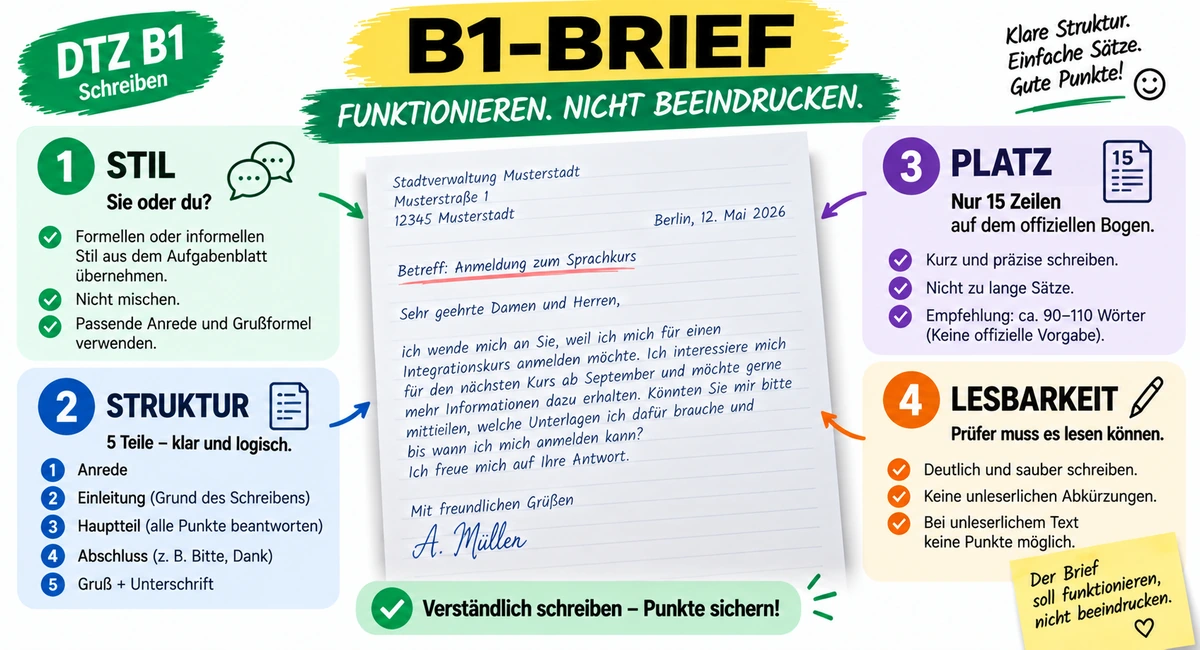
Only what is written on the writing answer sheet is assessed. Notes in the question booklet do not count. Anyone who writes the letter in the booklet first and then runs out of time to copy it onto the answer sheet receives 0 points. There is only one writing answer sheet, with a front and back. No extra sheets are provided. On the sheet, you mark whether you chose Task A or B. You may only write with a black or blue ballpoint pen, not a pencil. And do not forget the greeting and closing phrase. The task explicitly requires both.
👉 DTZ B1 Writing: Practice letter tasks just like in the examDTZ B1 Listening and Reading: Tasks and minimum scores
From November, you need at least 20 out of 45 correct answers in Listening and Reading – even if your letter is excellent. Each correct answer earns one point. It does not matter whether it comes from Listening or Reading. These are the DTZ B1 tasks you can expect (according to the official practice test):
| Part | What you need to understand | Tasks |
|---|---|---|
| Listening 1 | Telephone announcements, public announcements | 4 × a/b/c |
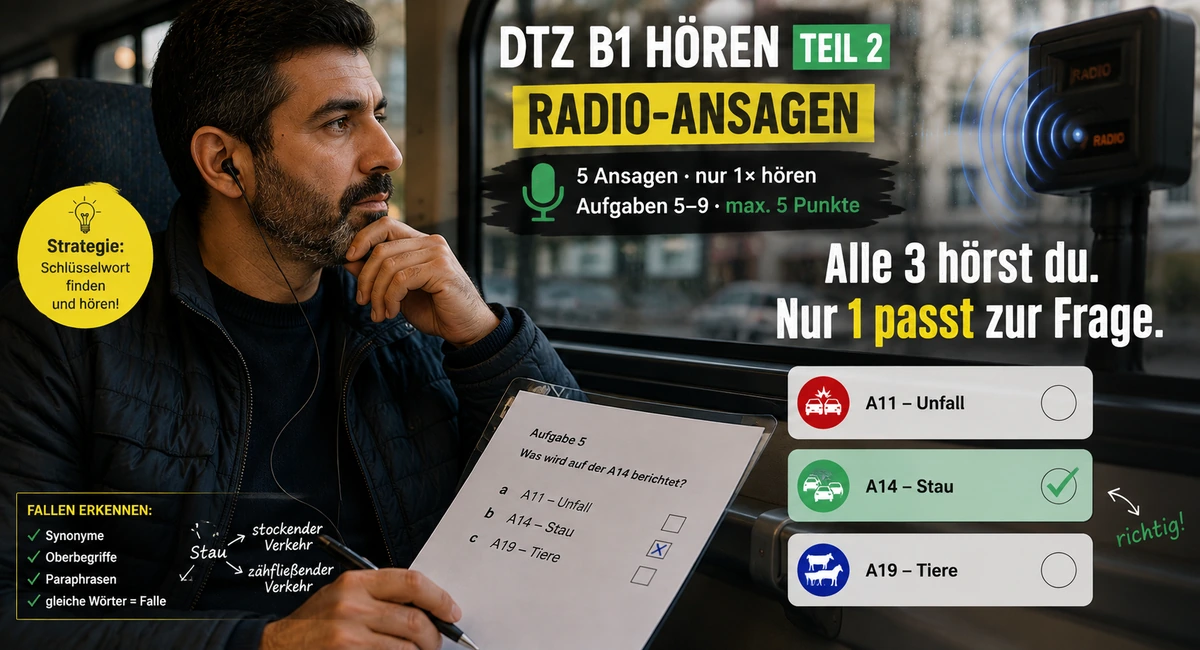
| Listening 2 | Short information segments on the radio | 5 × a/b/c |
| Listening 3 | Everyday conversations | 4 × true/false + 4 × a/b/c |
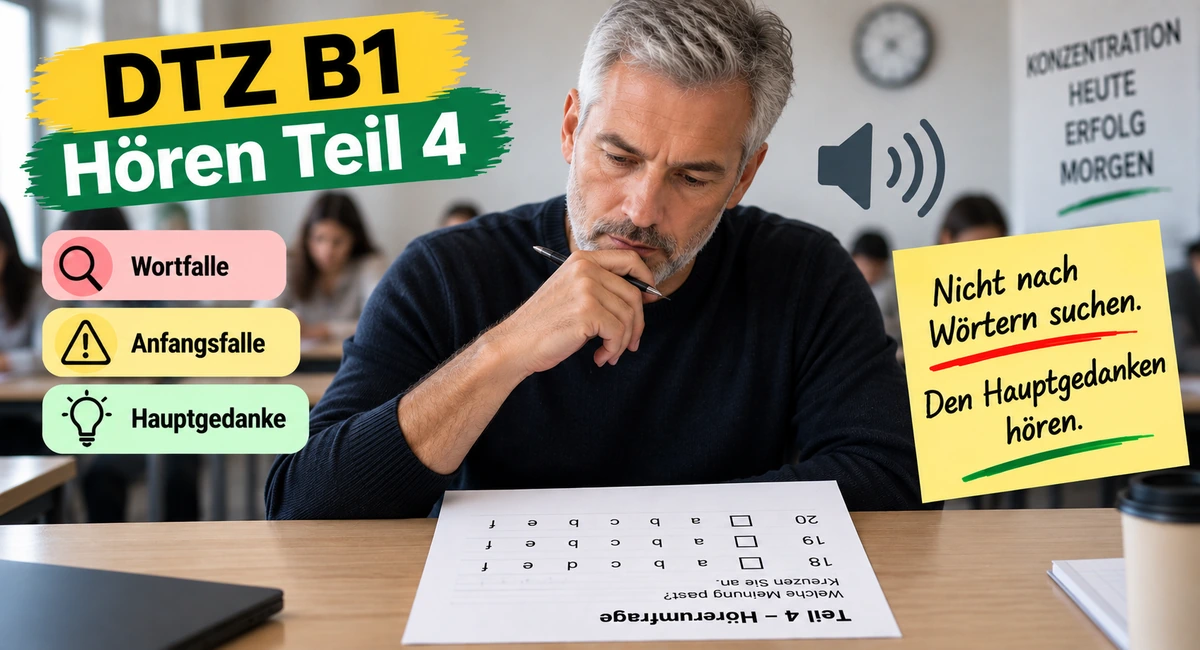
| Listening 4 | Opinions on a topic | 3 × matching |
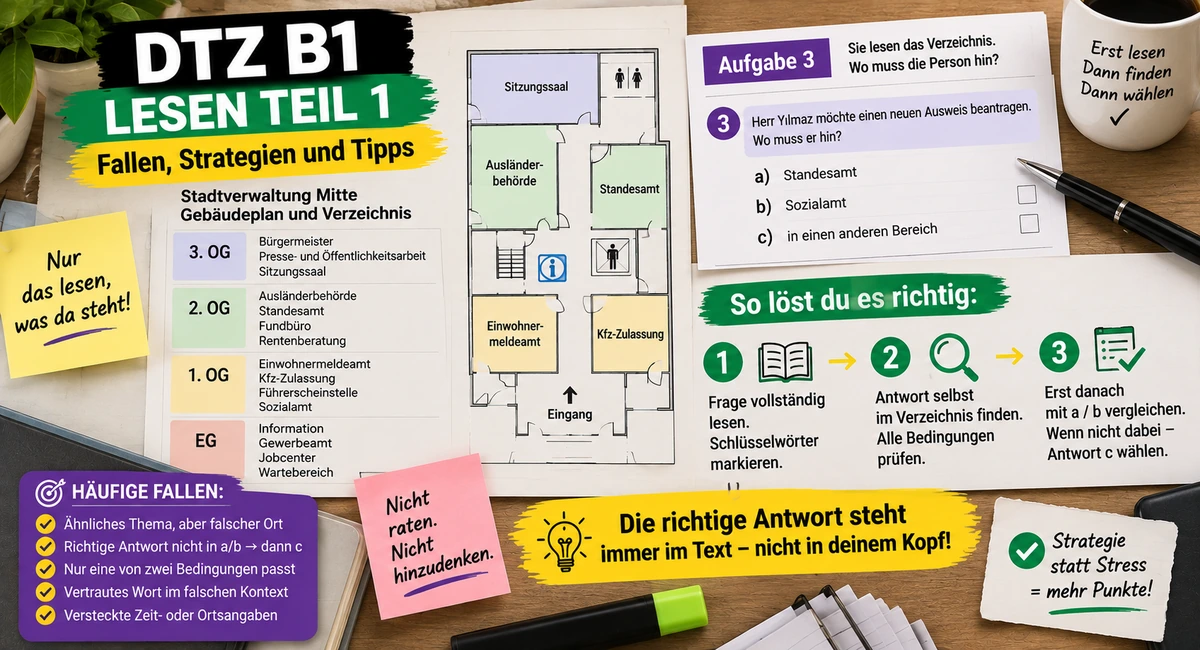
| Reading 1 | Tables of contents, catalogs | 5 × a/b/c |
| Reading 2 | Advertisements | 5 × matching |
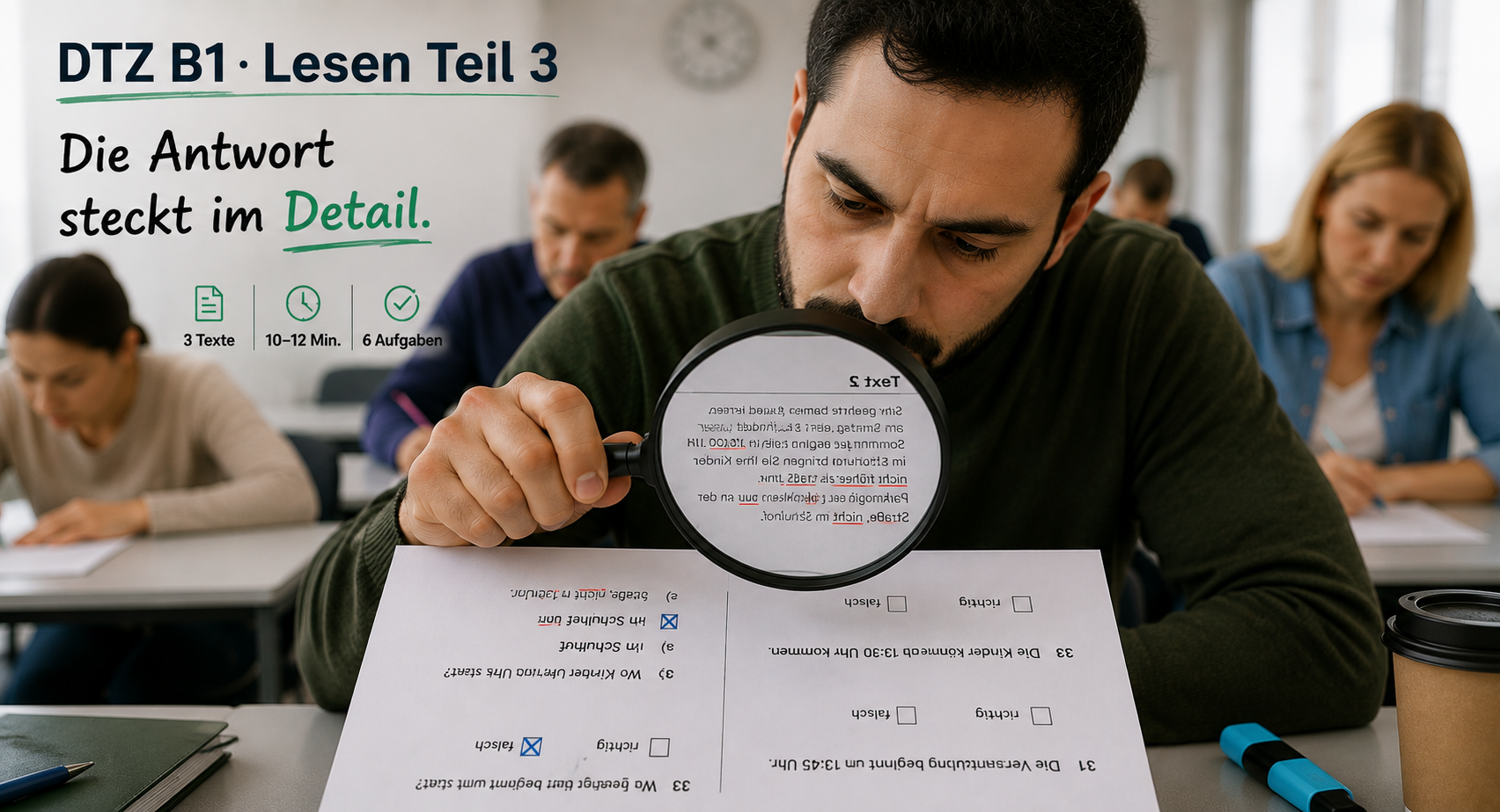
| Reading 3 | Newspaper articles, letters from public authorities | 3 × true/false + 3 × a/b/c |
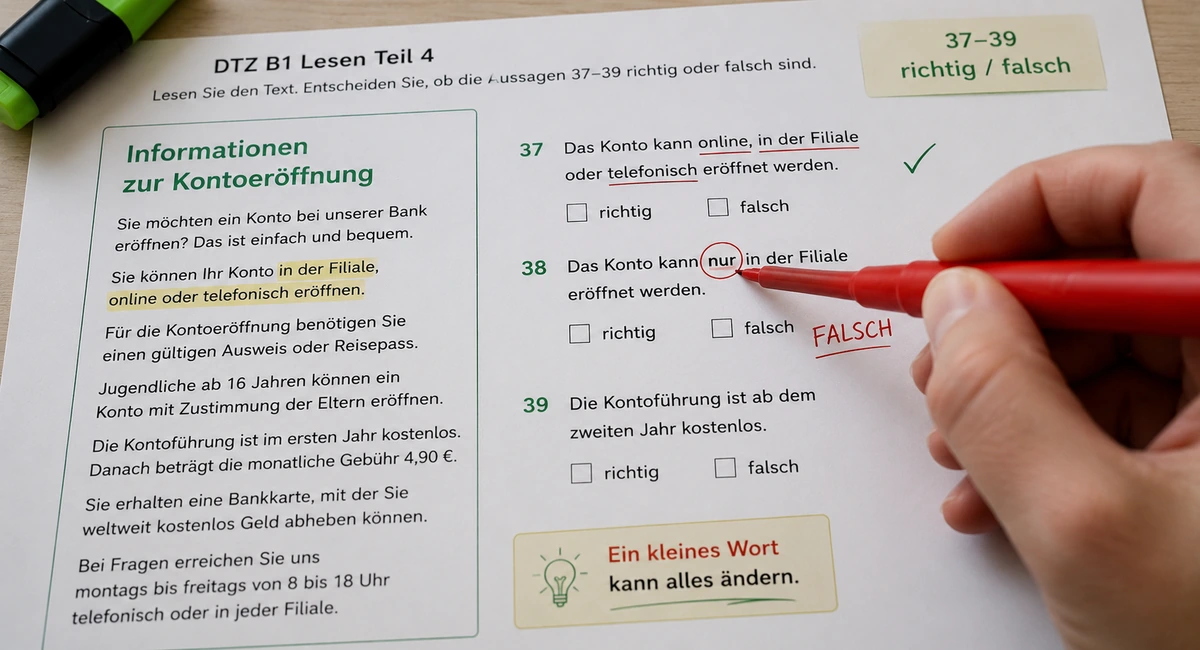
| Reading 4 | Information brochures, rules | 3 × true/false |
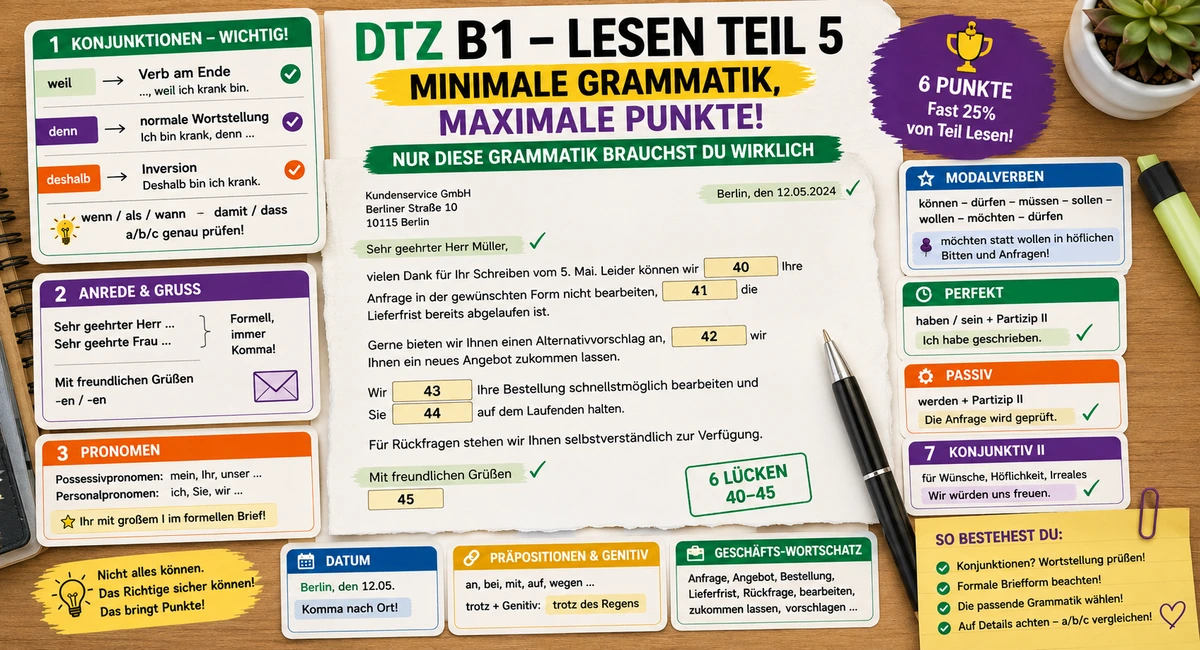
| Reading 5 | Gaps in a letter | 6 × a/b/c |
| Total | Listening approx. 25 min. · Reading 45 min. | 45 tasks |
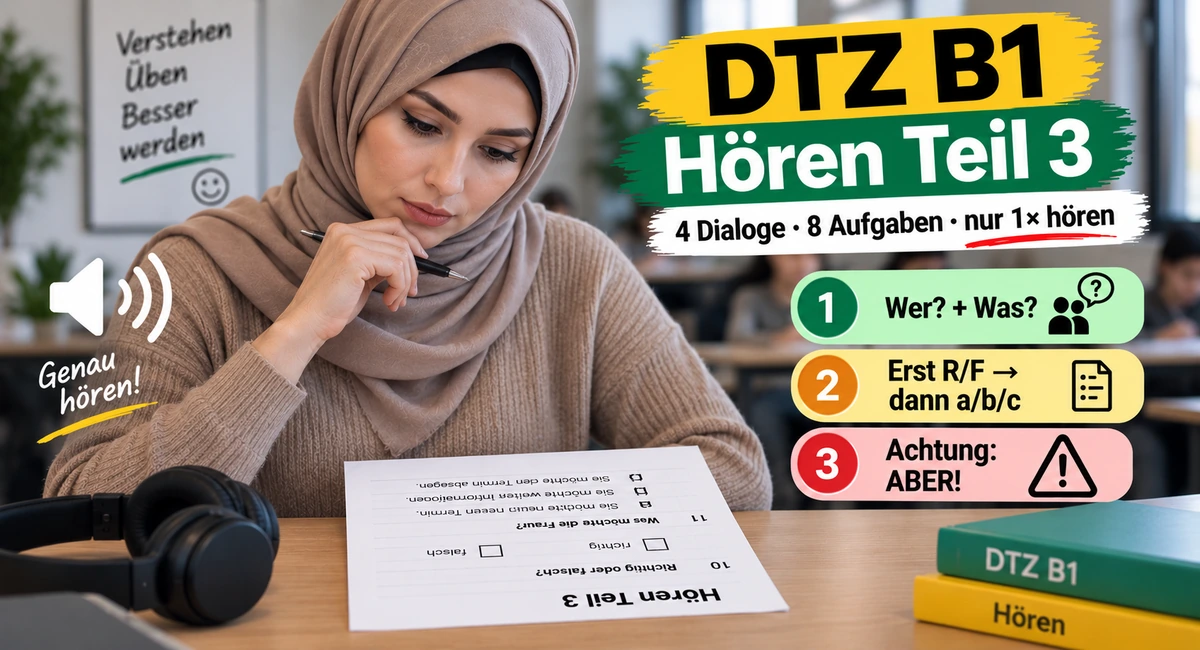
In Listening, you hear each recording only once. So always read the task before the recording starts. Then you will know what to listen for. In Reading, there is a typical trap in Part 2: One situation does not match any advertisement. In that case, mark “x”. If you do not know this, you may spend too long searching and lose time.
Never leave an answer blank. A blank answer definitely earns no points. With three options, even a well-considered guess has a chance of being correct. Transfer your answers to the answer sheet in good time. Only answers written there are counted. You can find targeted practice for DTZ B1 Reading and Listening here:
👉 DTZ B1 Listening: Exercises with audio 👉 DTZ B1 Reading: Practice all five partsWhat stays the same in the DTZ B1 exam?
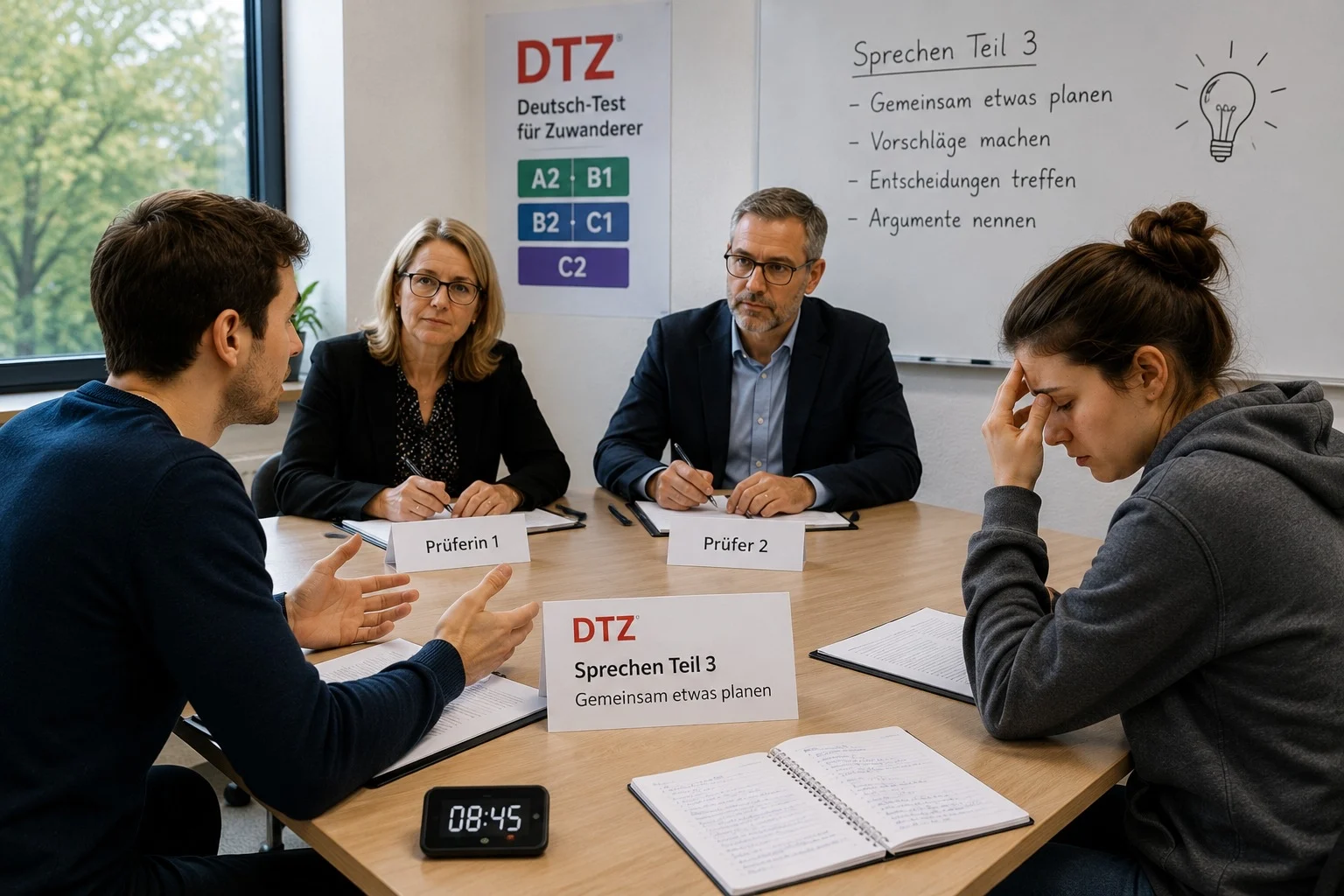
Almost everything. The written exam still lasts 100 minutes. The oral exam with two candidates lasts about 16 minutes. In Speaking, you introduce yourself, talk about a picture and your experiences, and plan something together with your partner. Speaking remains the most important section. Anyone who scores below A2 here receives no certificate at all.
The “Integration Course Certificate” (Zertifikat Integrationskurs) also remains unchanged. To obtain it, you need DTZ B1 and a pass in the “Life in Germany” test (Leben in Deutschland) (BAMF: Final examination). Under Section 9(3) IntTestV, you may retake the DTZ as many times as you wish. Whether a retake is free for you depends on your eligibility. Ask your course provider.
Important: The new rule only applies to the DTZ. telc Deutsch B1 and the Goethe-Zertifikat B1 have their own examination regulations. We explain the differences in the article DTZ or telc: Differences between the exams.
How to prepare now
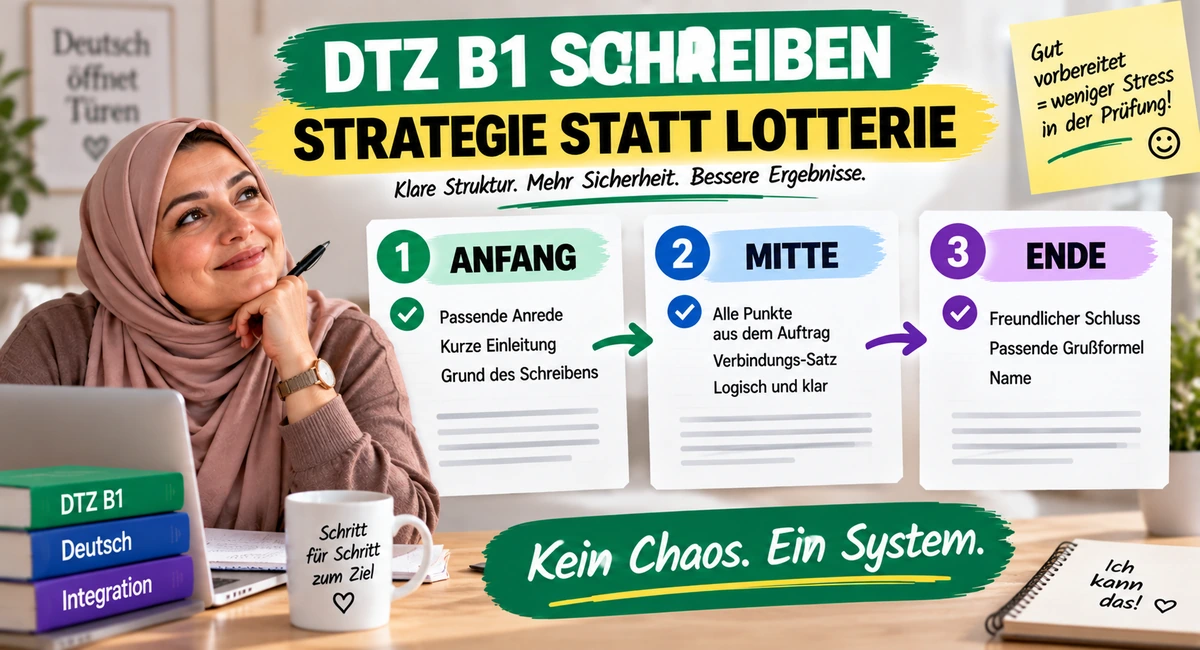
From November, the letter is your safety net. No other section provides so much security with so little effort. Even a short, relevant text can reach the A2 threshold. So make sure to reserve the full 30 minutes for Writing. Our suggestion: During the first three minutes, read both tasks and choose the easier one. Then write one or two keywords for each guiding point in your booklet. From minute seven, write directly on the writing answer sheet. Write two or three sentences for each guiding point. Use the final five minutes to check your work: Have you addressed all four points? Are the greeting and closing appropriate? Is the verb in second position? Practice this procedure with several DTZ B1 tasks under realistic time pressure.
Many people lose points not because their German is poor, but because they plan badly. They see the letter as a “bonus” and hardly practice it. They write everything in the booklet first and then do not have time to copy it. They address only the two easy guiding points. Or they spend too long on a difficult Reading question and leave answers blank at the end. From November, any of these mistakes could cost you B1.
For practice, there are two official DTZ practice tests from g.a.s.t. – free of charge and in the real exam format. For regular training, the online preparation platform BO offers exercises for all sections of the DTZ B1 exam and complete model tests. After registering for free, you can try all exercises for 24 hours.
👉 Take a DTZ B1 model test online 📅 DTZ B1 study plan: Step by step to the exam







There are no comments for this article. Leave your comment