





telc B2 Reading Part 1:
matching headings
Five texts, ten headings, one task: here you will learn exactly how Part 1 is structured, which texts to expect and how to solve the matching step by step.
What is telc B2 Reading Part 1?
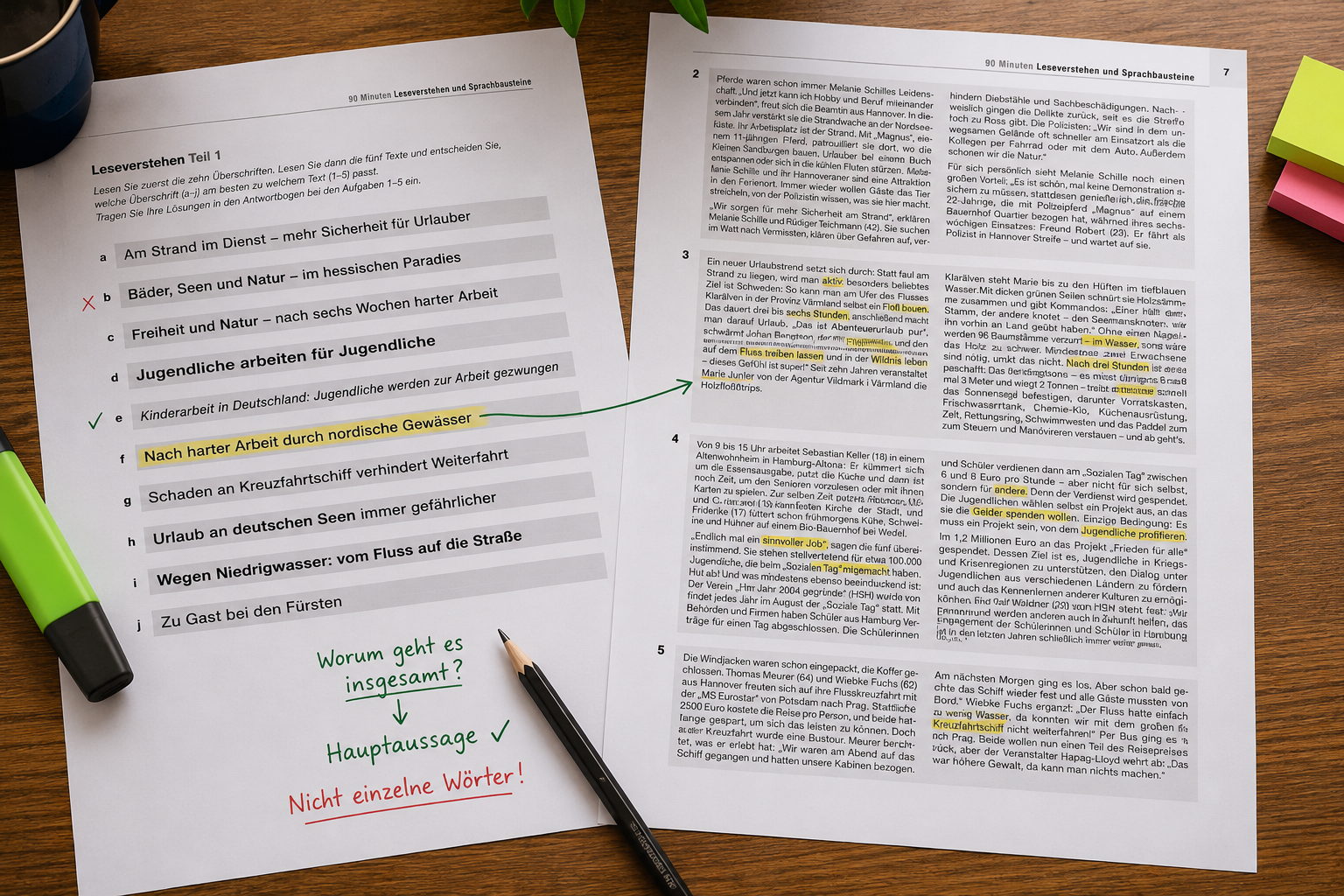
In Part 1 you get 5 short texts and 10 headings. Your task is easy to describe: find the heading that fits best for each text. Five headings are left over at the end.
This task type is called a matching task. You do not write anything yourself and you do not choose from a, b or c as with multiple choice. You connect two lists with each other: texts and headings.
The aim of this part is Globalverstehen (global comprehension). That means: you are meant to show that you recognise the main message of a text — not the details.
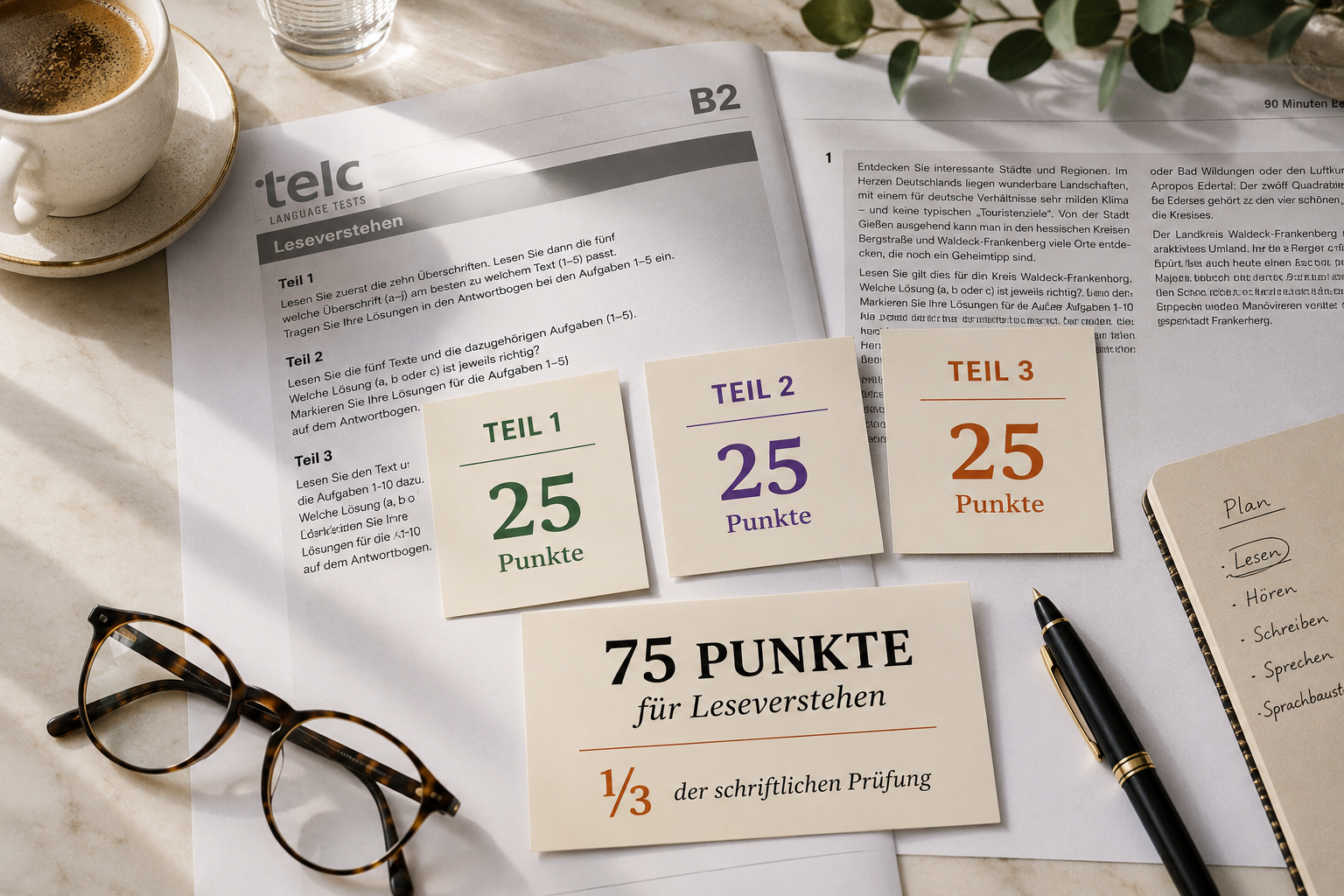
Everything else about points, time and assessment you will find in the overview article on the Reading comprehension subtest.
👉 Exercises: telc B2 Reading Part 1Structure of the task: what you see on the sheet
In the telc handbook, Part 1 is precisely defined as a test specification. These details do not change — they apply to every test set:
| Skill tested | Globalverstehen (global comprehension) |
| Aim | Understanding the main content of short authentic texts |
| Task type | Matching tasks |
| Number of items | five (items 1 to 5) |
| Input text | five authentic texts from two topic areas |
| Items | ten short headings (a to j) |
| Assessment | Answer key, 5 points per item, 25 points in total |
| Recommended time | approx. 15 minutes |
The task instruction
The instruction tells you in which order you should work: first read the ten headings, then the five texts. After that you decide which heading fits best with which text.
Note the word am besten (best). It is not about whether a heading could fit the text. It is about which of all the headings fits best. That is an important difference: sometimes two headings seem possible, but only one is the correct solution.
Each heading can only be used once. If you write the same heading for two texts, at least one of the two answers is automatically wrong. So cross out each heading immediately as soon as you have used it.
This rule has a practical advantage: with each solved text the task becomes easier. For the first text you choose from ten possibilities, for the fifth text from only six.
Which texts come up in Part 1?
The texts in Part 1 are short factual texts in the style of newspaper or magazine articles. Often they are popular-science: they report on a study, a development, a project or an interesting phenomenon.
In the telc handbook it is precisely defined where these texts come from: authentic newspaper reports, magazine articles, short information texts or extracts from brochures. Authentisch (authentic) here means that the texts may be shortened or simplified — but only so far that they still sound genuine to native speakers.
Which topics are selected from?
The topics are not random. In the telc handbook there is a fixed list of 16 topic areas from which all the texts of the exam come:
- Angaben zur eigenen Person (information about oneself)
- Der menschliche Körper, Gesundheit und Körperpflege (the human body, health and personal care)
- Wohnen (living/housing)
- Orte (places)
- Tägliches Leben (daily life)
- Essen und Trinken (food and drink)
- Erziehung, Ausbildung, Lernen (upbringing, education, learning)
- Arbeit und Beruf (work and profession)
- Geschäfte, Handel, Konsum (shops, trade, consumption)
- Dienstleistungen (services)
- Natur und Umwelt (nature and environment)
- Reise und Verkehr (travel and transport)
- Freizeit und Unterhaltung (leisure and entertainment)
- Medien und moderne Informationstechniken (media and modern information technologies)
- Gesellschaft, Staat, Regierung (society, state, government)
- Beziehungen zu anderen Menschen und Kulturen (relationships with other people and cultures)
This list is good news for your preparation: the vocabulary you need is limited and familiar. Specialist knowledge, on the other hand, you do not need — if a text reports on a study, it also explains the study.
Three characteristics you should know
- Each text is independent. Text 1 and text 2 are not parts of a story. They can be read in any order.
- The five texts come from two topic areas. This is not a coincidence, but defined this way in the telc handbook. In one task there can be, for example, three texts about sweets and two texts about thermal baths.
- Each text has exactly one main message. It contains a lot of information, but only one central idea. It is precisely this idea that is in the correct heading.
The second characteristic is particularly useful. If you recognise which topic group a text belongs to, you can immediately rule out several headings. A text about sweets will never get the heading about Roman baths.
How are the headings phrased?
The headings are not sentences from the text. They are written the way titles are written in a newspaper or a magazine: short, compact and often without a verb.
Typical forms are:
| Form | Example |
|---|---|
| Noun phrase without a verb | Süßigkeiten mit langer Tradition (sweets with a long tradition) |
| Title with a colon | Irrtum: Zucker macht nicht glücklich (a mistaken belief: sugar does not make you happy) |
| Contrast or opposition | Essen statt wegwerfen (eat instead of throwing away) |
| Complete short sentence | Radfahren verändert die Städte (cycling is changing the cities) |
This has an important consequence for your work: you cannot find the correct heading by looking for identical words. The heading almost always uses different words than the text. If the text says Bonbons (sweets), the heading might say Süßigkeiten (sweets/confectionery). If the text speaks of Lebensmittelverschwendung (food waste), the heading might say wegwerfen (throw away).
In this task you therefore work with synonyms and paraphrases, not with identical words.
What exactly is Globalverstehen (global comprehension)?
Short answer: Globalverstehen (global comprehension) is the answer to the question Worum geht es hier insgesamt? (what is this about overall?)
The Common European Framework of Reference (CEFR) describes level B2 among other things like this: you can understand the main content of complex texts on concrete and abstract topics. It is exactly this ability that is tested in Part 1 — and nothing beyond it.
A text contains a lot of information: numbers, names, places, examples, quotations. Only one part of it is the main message. Everything else is details that explain or illustrate this main message.
Main message and detail — an example
Imagine a short text:
Immer mehr Menschen in Deutschland fahren mit dem Fahrrad zur Arbeit. In Münster nutzen fast 40 Prozent der Berufstätigen das Rad. Auch in kleineren Städten steigen die Zahlen. Ein Grund sind neue Radwege, ein anderer der Wunsch nach mehr Bewegung im Alltag. Viele Firmen unterstützen ihre Mitarbeiter außerdem mit einem Zuschuss für ein Dienstrad. (More and more people in Germany cycle to work. In Münster almost 40 percent of working people use the bike. In smaller towns too the figures are rising. One reason is new cycle paths, another the wish for more exercise in everyday life. Many companies also support their employees with a subsidy for a company bike.)
Which heading fits best here?
- Das Fahrrad wird zum Verkehrsmittel für den Arbeitsweg (the bicycle is becoming a means of transport for the commute) → This is the main message. The whole text is about it.
- Münster ist die Fahrradstadt Nummer eins (Münster is the number one cycling city) → This is a detail. Münster is only mentioned as one example.
- Firmen zahlen Zuschüsse für Diensträder (companies pay subsidies for company bikes) → This is also only a detail. It is in a single sentence.
All three statements are in the text and all three are correct. Nevertheless, only the first is a fitting heading. A correct piece of information is not yet a main message.
That is the core of Part 1: you distinguish between what the text says as a whole and what it only mentions in passing.
telc expressly recommends global reading for Part 1: read relatively quickly and do not pay too much attention to every single word. Unknown words are therefore completely normal here, even at level B2. If you do not understand a word, read on — the rest of the text usually explains the main message by itself.
In the telc handbook it says expressly: the language in the texts may occasionally exceed level B2 — both in vocabulary and in structures. The headings, on the other hand, always stay at B2 level. So if individual passages in the text seem too hard for you, that is not because of you. It is planned that way. And you do not need these passages for the solution at all: you only have to understand the heading that fits the main message.
Step by step: how you solve the matching
A matching task works differently from multiple choice. With multiple choice you solve each question individually. With a matching task you work on all five tasks at the same time, because each decision influences the next.
This order has proven itself in practice:
- Read all ten headings. You do not have to learn them by heart. You should only get an overview: which topics are there at all?
- Sort the headings into topic groups. Make small marks in the margin, for example A for one topic and B for another. That costs 30 seconds and saves a lot of time later.
- Read text 1 and formulate the main message in your own words. A short thought is enough: Es geht um die Geschichte von Süßigkeiten (this is about the history of sweets). Formulate it yourself first and look at the list afterwards.
- Select the matching topic group. Now you only compare your formulation with the headings of this group, not with all ten.
- Choose the best heading and cross it out. Note down the solution immediately.
- Work on texts 2 to 5 in the same way. The choice becomes smaller with each text.
- Check briefly at the end. Is there a different letter for each text? Are exactly five headings left over?
The most important step is number 3. Anyone who formulates the main message themselves first then searches in a targeted way. Anyone who looks at the list immediately lets themselves be led by the wording of the list.
👉 All exercises for the telc B2 Reading comprehensionYou can download the complete official practice test with a full set of tasks free of charge from the telc page on the Deutsch B2 exam.


There are no comments for this article. Leave your comment