





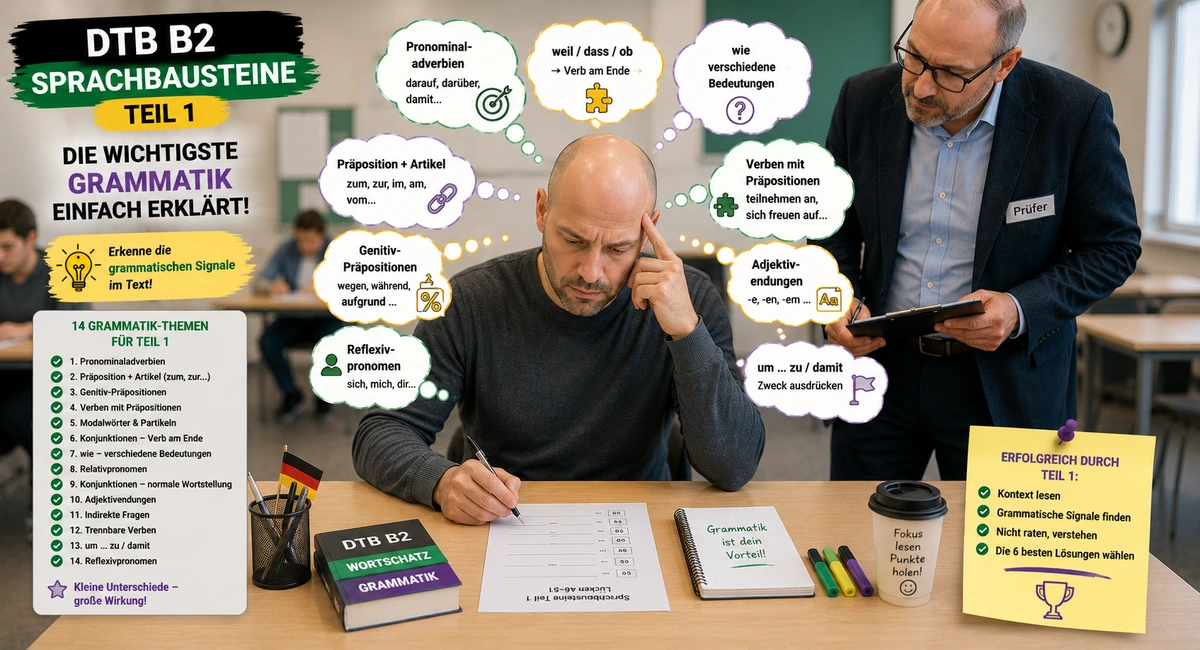
Sprachbausteine Teil 1 — DTB B2:
the most important grammar explained simply
In this article you will find all the important grammar topics for Sprachbausteine Teil 1 of the DTB B2 exam. Simple explanations, many examples, typical traps and clear strategies — ideal for exam preparation.
What is Sprachbausteine Teil 1 in the DTB B2 exam?
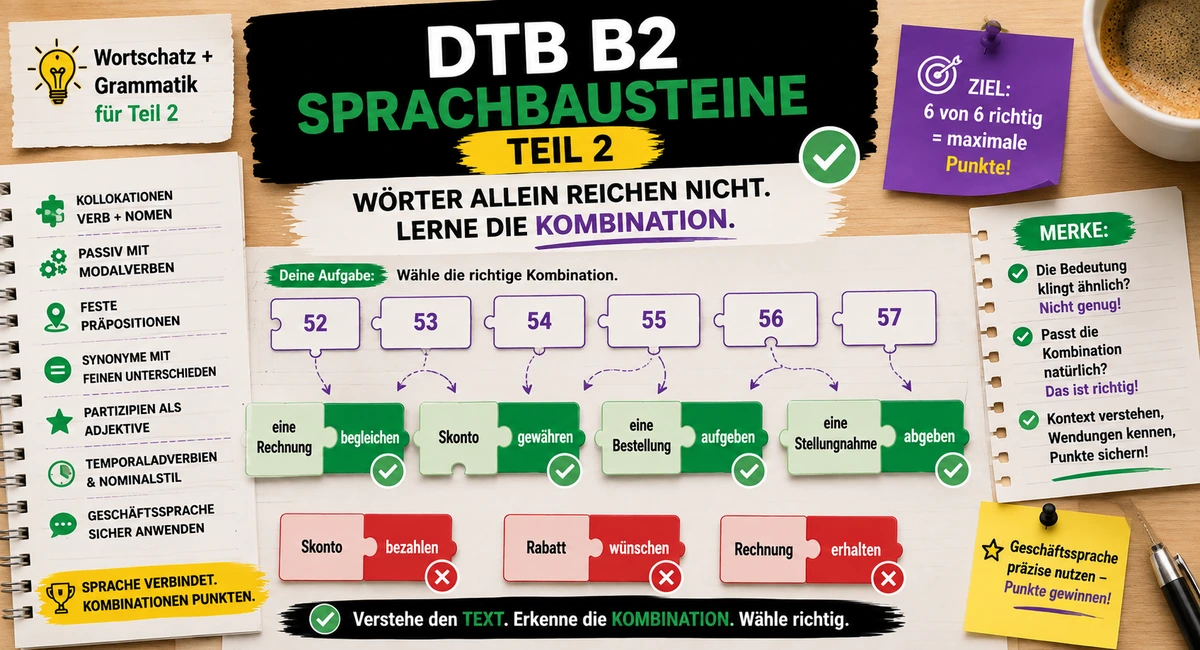
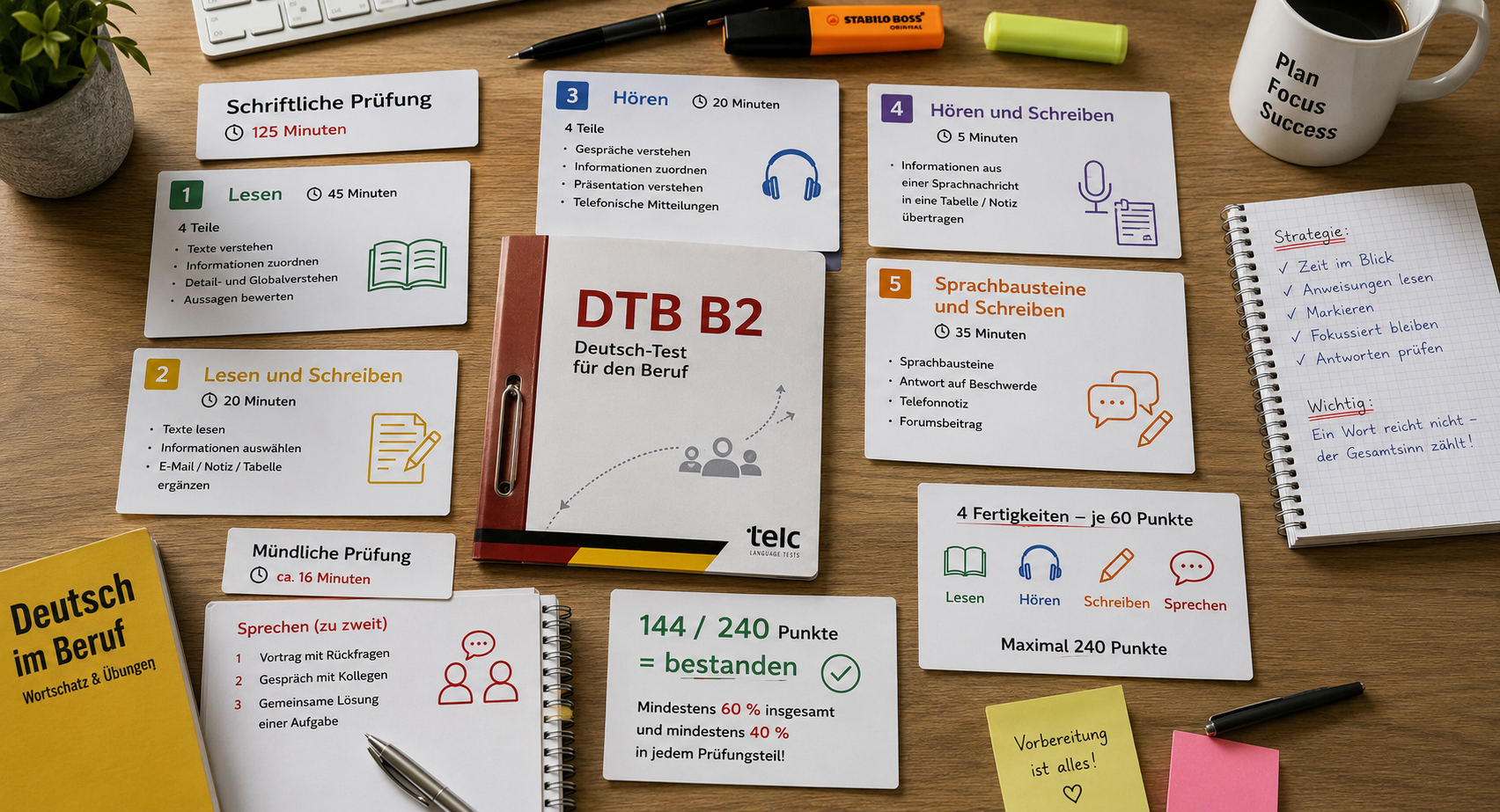
Sprachbausteine Teil 1 is a part of the written exam “Deutsch-Test für den Beruf B2” (DTB B2). In this part there is a text with six gaps. These gaps have the numbers 46, 47, 48, 49, 50 and 51. For each gap there is a word list with 15 options (a to o). You must choose the correct word from the list for each gap.
The text is always a formal email from professional life: a job application, a resignation, a question about an employment contract or another message from the office. In this part of the exam, your grammar is primarily tested. It is therefore important to know the most important grammar rules well.
The word list contains 15 words, but you only need 6 words for the gaps. The other 9 words are “false friends” — they look fitting but are wrong.
In this article I will explain the 14 most important grammar topics to you. We begin with the topic that appears most frequently in the exam.
Pronominal adverbs (darauf, dabei, darüber, hierüber …)
Pronominal adverbs are small words that replace a thing or a thought. They are needed so that the same words do not have to be repeated all the time.
Example: Instead of “Ich freue mich auf das Treffen” one says: “Ich freue mich darauf.”
How are they formed?
The rule is simple:
- Preposition begins with a consonant (e.g. mit, für, bei, von, zu): da + preposition → damit, dafür, dabei, davon, dazu.
- Preposition begins with a vowel (e.g. auf, an, über, aus, in): dar + preposition → darauf, daran, darüber, daraus, darin.
- In formal letters one often uses hier instead of da: hierüber, hiermit, hierauf — the meaning is the same, but the style is more formal.
The most important pronominal adverbs with their meaning
| Word | Meaning | Example sentence |
|---|---|---|
| darauf | darauf warten / sich darauf freuen | Ich freue mich darauf, Sie kennenzulernen. |
| darüber / hierüber | speak about something / be pleased about something | Hierüber freue ich mich sehr. |
| dabei | during this action / in connection with this matter | Ich habe den Vertrag geprüft und dabei Fragen bekommen. |
| davon | about this matter | Sie sprachen davon, dass Sie mir Kleidung geben. |
| dafür | for this matter / for this purpose | Brauchen Sie dafür meine Größe? |
| dahin | until this moment or place | Bis dahin habe ich noch Zeit. |
| damit | with this matter | Ich kann damit gut arbeiten. |
The pronominal adverb always depends on the verb. Every verb has a fixed preposition. If you find the verb, you will also find the correct pronominal adverb.
Typical verbs with preposition
- sich freuen auf (future) → darauf
- sich freuen über (present/past) → darüber / hierüber
- warten auf → darauf
- sprechen von / über → davon / darüber
- sich interessieren für → dafür
- rechnen mit → damit
- bestehen aus → daraus
- denken an → daran
Many learners choose the pronominal adverb according to the logic of their mother tongue. This is wrong! The German preposition always follows the verb, not the logic of another language. Always learn the verb and its preposition together.
Preposition + article combined (zum, zur, im, am, vom …)
Some prepositions merge with the article to form a single word. This happens very frequently in formal German and especially in business letters.
The most important combinations
| Preposition + article | Short form | Example |
|---|---|---|
| zu + dem (masculine/neuter) | zum | zum Arzt, zum Termin, zum Vertrag |
| zu + der (feminine) | zur | zur Arbeit, zur Ausbildung, zur Besprechung |
| in + dem (where?) | im | im Büro, im Nachhinein, im Voraus |
| in + das (where to?) | ins | ins Büro gehen |
| an + dem | am | am Montag, am Arbeitsplatz |
| an + das | ans | ans Telefon gehen |
| von + dem | vom | vom Gesundheitsamt, vom Chef |
| bei + dem | beim | beim Vorstellungsgespräch |
When is the short form obligatory?
- In fixed expressions: zum Beispiel, im Allgemeinen, zur Verfügung, im Voraus, im Nachhinein.
- With days and dates: am Montag, im April, zum 1. März, zum nächstmöglichen Datum.
- With destinations and directions: zum Arzt gehen, zur Arbeit fahren.
In formal emails and business letters the short form is almost always correct. If you are unsure: zum and zur are often the best choice with appointments, dates and training programmes.
zum and zur are different! zum = masculine or neuter (zum Arzt, zum Vertrag). zur = feminine (zur Arbeit, zur Ausbildung). Always check the gender of the noun!
Prepositions with genitive (aufgrund, während, wegen …)
Some prepositions require the genitive (2nd case — whose?) after them. These prepositions are very typical of formal German.
The most important prepositions with genitive
| Preposition | Meaning | Example |
|---|---|---|
| aufgrund | because of something (formal) | Aufgrund meiner Situation ist das schwierig. |
| während | during the time of | Während des Praktikums lernt man viel. |
| wegen | for a reason | Wegen des Wetters bleibe ich zu Hause. |
| trotz | even though something happens | Trotz des Regens arbeite ich im Garten. |
| innerhalb | within this time / within this area | Innerhalb einer Woche antworten wir. |
| außerhalb | outside this area | Außerhalb der Arbeitszeit bin ich nicht erreichbar. |
| statt / anstatt | instead of | Statt eines Briefs schickt er eine E-Mail. |
How to recognise the genitive
After these prepositions there are typical endings:
- Masculine/neuter: des … -s or -es (des Praktikums, des Vertrags, des Chefs).
- Feminine: der (der Woche, der Firma, der Situation).
- Plural: der (der Mitarbeiter, der Kollegen).
- With possessive pronouns: meines, meiner (meines Vaters, meiner Mutter, meiner Situation).
When you see the ending -s/-es on a noun in the sentence, or des / der / meiner / meines, then a preposition with genitive fits.
Verbs with fixed prepositions
Many German verbs have a fixed preposition. This means: the verb and the preposition always belong together. You cannot choose the preposition freely.
Example: One always says sich interessieren für. Not “sich interessieren an” or “sich interessieren über”.
The most important verbs for formal letters
| Verb | Preposition + case | Example |
|---|---|---|
| sich freuen | auf + accusative (future) | Ich freue mich auf den Arbeitsbeginn. |
| sich freuen | über + accusative (present) | Ich freue mich über die Einladung. |
| sich interessieren | für + accusative | Ich interessiere mich für die Abläufe. |
| sich bewerben | um (position) / bei (company) | Ich bewerbe mich um die Stelle bei Ihrer Firma. |
| sich bedanken | bei (person) + für (thing) | Ich bedanke mich bei Ihnen für das Gespräch. |
| rechnen | mit + dative | Kann ich mit dieser Leistung rechnen? |
| warten | auf + accusative | Ich warte auf Ihre Antwort. |
| denken | an + accusative | Ich denke an meine Familie. |
| sprechen | über / von | Wir sprachen über die Arbeitskleidung. |
| sich vorbereiten | auf + accusative | Ich bereite mich auf die Prüfung vor. |
| bestehen | aus + dative | Die Prüfung besteht aus vier Teilen. |
| beginnen | mit + dative | Ich beginne mit einer neuen Tätigkeit. |
Always learn the verb and its preposition as a pair. Write the prepositions in a different colour. That way you will see them immediately.
Modal words and particles (bereits, nämlich, eventuell …)
Modal words and particles are small words that give a sentence a special meaning or tone. They change the basic information only slightly, but they are very important for the meaning.
The most important modal words and their meanings
| Word | Meaning | Example |
|---|---|---|
| bereits / schon | earlier than expected (an event has already taken place) | Ich habe mich bereits informiert. |
| noch | the situation has not yet ended | Ich brauche noch Zeit. |
| nämlich | gives a reason (“the reason is …”) | Ich war nämlich immer gerne hier tätig. |
| eventuell / möglicherweise / vielleicht | not certain, but possible | Brauche ich eventuell ein Attest? |
| bestimmt / sicher / gewiss | I am very certain | Bestimmt überzeuge ich Sie. |
| gerne | with pleasure | Gerne überzeuge ich Sie im Gespräch. |
| ausdrücklich | clearly and explicitly | Ich möchte mich ausdrücklich bedanken. |
| ausführlich | in detail | Ich habe den Vertrag ausführlich geprüft. |
| dennoch / trotzdem | even though it could be otherwise | Kann ich dennoch mit der Leistung rechnen? |
| deshalb / daher | for this reason | Deshalb brauche ich die Termine. |
The word nämlich never stands at the beginning of a sentence. It always comes after the verb, usually in the middle of the sentence.
✅ Correct: Ich war nämlich krank.
❌ Wrong: Nämlich war ich krank.
Read the sentence carefully. Ask yourself: what does the author want to say? Is he certain? Uncertain? Does he want to give a reason? Does he want to show a contrast? This is how you find the correct modal word.
Conjunctions with verb at the end (da, weil, dass, ob, sobald …)
A conjunction connects two sentences. After certain conjunctions the verb goes to the end of the subordinate clause. This group of conjunctions is very important for DTB B2.
Example: Ich komme nicht, weil ich krank bin.
Conjunctions for a reason (why?)
- weil = because. Very common, also in spoken language. Example: Ich komme nicht, weil ich krank bin.
- da = because, but more formal. Very common in business letters! Example: Da mein Mann versetzt wurde, muss die Familie umziehen.
Both words have the same meaning. But: da is more formal and often stands at the beginning of the sentence. weil is more neutral and almost always stands in the middle of the sentence. In the DTB B2 exam you often see da because the letters are formal.
Conjunction for information (what?)
- dass = that. Example: Im Vertrag steht, dass Mitarbeiter umziehen können.
dass (with double s) = conjunction “dass”.
das (with one s) = neuter article or pronoun “das”.
Test: Can you say “dieses” or “welches”? → then das. If it explains something (after “ich glaube/denke/weiß”) → then dass.
Conjunction for a yes/no question
- ob = whether (in an indirect question). Example: Ich möchte wissen, ob es möglich ist.
Time conjunctions
| Word | Meaning | Example |
|---|---|---|
| wenn | when (present/future or something repeated) | Wenn Sie Fragen haben, rufen Sie mich an. |
| als | when (once in the past) | Als ich ankam, war es schon dunkel. |
| sobald | as soon as … | Ich schicke den Vertrag zurück, sobald die Punkte geklärt sind. |
| bis | until a point in time | Ich warte, bis Sie antworten. |
| während | simultaneously | Während ich arbeitete, klingelte das Telefon. |
| nachdem | after an event | Nachdem ich gegessen habe, gehe ich spazieren. |
| bevor | before an event | Bevor ich komme, rufe ich an. |
Further important conjunctions
- obwohl = although: Obwohl es regnet, gehe ich raus.
- falls = in case: Falls Sie etwas brauchen, kontaktieren Sie mich.
- indem = by doing something: Ich lerne Deutsch, indem ich Bücher lese.
- damit = with the aim that (another person): Ich erkläre es, damit du es verstehst.
After all these conjunctions the verb goes to the end of the sentence!
Ich komme nicht, weil ich krank bin.
Ich weiß, dass er heute nicht kommt.
Ich frage, ob es möglich ist.
The word “wie” — many meanings
The word wie is very often the correct answer in the DTB B2 exam. But “wie” has several meanings. You must know every meaning.
Meaning 1: Comparison “so … wie”
- Ich bin so groß wie mein Bruder.
- Er arbeitet wie ein Profi.
- So bald wie möglich.
Meaning 2: “wie” + participle (very important in letters!)
This is the most important meaning for the exam! These are fixed expressions in formal letters.
| Expression | Meaning |
|---|---|
| wie besprochen | as we discussed |
| wie vereinbart | as we agreed |
| wie gewünscht | as you wished |
| wie angekündigt | as previously announced |
| wie erwähnt | as already mentioned |
| wie erwartet | as expected |
| wie geplant | as planned |
Meaning 3: Indirect question “wie”
- Ich möchte wissen, wie die Ausbildung organisiert ist.
- Können Sie mir sagen, wie das funktioniert?
Meaning 4: Direct question
- Wie geht es Ihnen?
- Wie lange dauert das?
When you see an expression such as “… besprochen” or “… vereinbart” or “… geplant” in the text — then the gap is almost always wie!
Relative pronouns (der, die, das, dessen, deren, was)
A relative pronoun connects two sentences and shows what we are referring to. In German there are many forms. For the exam, dessen, deren and was are particularly important.
Table of relative pronouns
| Case | Masculine | Feminine | Neuter | Plural |
|---|---|---|---|---|
| Nominative | der | die | das | die |
| Accusative | den | die | das | die |
| Dative | dem | der | dem | denen |
| Genitive | dessen | deren | dessen | deren |
The difficult forms: dessen and deren
dessen and deren mean “whose”. They show that something belongs to a person or thing.
- dessen → for masculine (der Mann) and neuter (das Kind). Example: Der Kollege, dessen Büro neben mir ist, hilft mir oft.
- deren → for feminine (die Frau) and plural (die Leute). Example: Die Internetseiten, mit deren Hilfe ich lerne, sind nützlich.
Look at the noun before the gap:
- Masculine or neuter (der/das) → dessen
- Feminine or plural (die) → deren
The word “was” as a relative pronoun
The word was is used after: alles, nichts, etwas, vieles, weniges, irgendwas, das (as a pronoun).
- Gibt es irgendwas, was ich vorher besorgen muss?
- Alles, was Sie brauchen, ist in der E-Mail.
- Das, was er sagt, ist wichtig.
Conjunctions without word order change (aber, sondern, sowie …)
These conjunctions connect two equivalent sentences or parts of sentences. After these conjunctions the normal word order remains (subject + verb + …).
The most important conjunctions
| Word | Meaning | Example |
|---|---|---|
| und | and | Ich lese und schreibe. |
| aber | contrast without “nicht” | Ich bin müde, aber ich arbeite weiter. |
| sondern | correction after “nicht” | Ich trinke nicht Kaffee, sondern Tee. |
| oder | one of two options | Kommen Sie heute oder morgen? |
| denn | because (but normal word order!) | Ich komme nicht, denn ich bin krank. |
| sowie | “and also” (formal) | Bestätigen Sie den Erhalt sowie das Datum. |
The difference between “aber” and “sondern”
sondern only comes after a negation (nicht, kein) and means: “not X, but rather Y”.
✅ Correct: Ich arbeite nicht im Hotel, sondern im Restaurant.
✅ Correct: Ich habe keinen Hund, sondern eine Katze.
In all other cases one uses aber.
Pairs of conjunctions
- nicht nur …, sondern auch … — Ich arbeite nicht nur mit Menschen, sondern auch im Büro.
- entweder … oder … — Ich komme entweder heute oder morgen.
- weder … noch … — Ich habe weder Zeit noch Lust.
- zwar …, aber … — Das ist zwar schwer, aber möglich.
Adjective endings and participles as adjectives
Adjectives are words that describe a noun: groß, schön, wichtig, neu. When an adjective stands before a noun, it receives an ending.
The basic rule for endings
The ending depends on two things:
- What stands before the adjective (article)?
- In which case is the noun (nominative, accusative, dative, genitive)?
After the definite article (der, die, das)
The ending is almost always -e or -en.
| Case | Masculine (der) | Feminine (die) | Neuter (das) | Plural (die) |
|---|---|---|---|---|
| Nominative | der gute | die gute | das gute | die guten |
| Accusative | den guten | die gute | das gute | die guten |
| Dative | dem guten | der guten | dem guten | den guten |
After the indefinite article (ein, eine, kein, mein …)
- ein guter Mann (nominative masculine)
- eine gute Frau (nominative/accusative feminine)
- ein gutes Kind (nominative/accusative neuter)
- einen guten Mann (accusative masculine)
Participles as adjectives
A participle is a verb form that can be used like an adjective. There are two participles:
Partizip I (active, “doing”): verb + -end
- anhaltend → die anhaltende Unterstützung (support that continues)
- steigend → die steigenden Preise
- folgend → die folgende Frage
Partizip II (passive, “done”): as in the Perfekt (ge + verb + t/en)
- vereinbart → der vereinbarte Termin
- unterschrieben → der unterschriebene Vertrag
- geplant → die geplante Reise
In the exam you often see word forms such as anhaltende, vorzeitige, geplante. Ask yourself: which article precedes it? What gender does the noun have? After eine + feminine → -e.
Indirect questions (ich möchte wissen, ob/wie …)
An indirect question is a question that is “hidden” inside another sentence. Instead of asking directly, the question is formulated more politely.
Direct: Wie funktioniert das?
Indirect: Ich möchte wissen, wie das funktioniert.
Structure of an indirect question
Introduction + comma + question + verb at the end.
Typical introductions
- Ich möchte gern wissen, …
- Ich möchte nachfragen, …
- Ich bin mir nicht sicher, …
- Können Sie mir sagen, …?
- Teilen Sie mir bitte mit, …
- Ich würde gerne erfahren, …
Which word after the comma?
There are two possibilities:
| Situation | Word | Example |
|---|---|---|
| The answer is yes or no | ob | Ich möchte wissen, ob das möglich ist. |
| The answer is information | wie, wann, wo, was, wer, warum, wie lange, wie viel | Ich möchte wissen, wie die Ausbildung organisiert ist. |
In an indirect question the verb always stands at the end!
✅ Ich frage, wo das Büro ist.
❌ Ich frage, wo ist das Büro.
Separable verbs (zurücksenden, mitteilen, zusagen …)
Many German verbs have two parts: a prefix and the base verb. In a normal sentence the prefix goes to the end.
Example: The verb zurücksenden = zurück + senden.
In the sentence: Ich sende den Vertrag zurück.
Important separable verbs for professional life
| Verb | Meaning | Example sentence |
|---|---|---|
| zurücksenden | send back | Ich sende den Vertrag zurück. |
| zurückrufen | call back | Ich rufe Sie gleich zurück. |
| zusagen | confirm, accept | Sie hat mir das Jobticket zugesagt. |
| absagen | cancel | Ich sage den Termin ab. |
| anbieten | offer, propose | Ich biete Ihnen meine Hilfe an. |
| mitteilen | inform, notify | Ich teile Ihnen die Entscheidung mit. |
| einstellen | hire (staff) | Die Firma stellt neue Mitarbeiter ein. |
| einladen | invite | Sie laden mich zum Gespräch ein. |
| zustehen | be entitled to something | Mir stehen noch vier Urlaubstage zu. |
| aushändigen | hand over, issue | Wir händigen Ihnen das Zeugnis aus. |
Important rule for word order
- Main clause: prefix goes to the end. Ich sende den Vertrag zurück.
- Subordinate clause: everything stays together at the end. Ich hoffe, dass ich den Vertrag schnell zurücksende.
- Perfekt: ge goes in the middle. Ich habe den Vertrag zurückgesendet.
- With “zu”: zu goes in the middle. Ich plane, den Vertrag zurückzusenden.
When you see a verb in the sentence but a short syllable stands at the end (zurück, zu, ab, an, mit, ein, auf), that is a prefix. The gap often needs to contain exactly this prefix.
Purpose clauses: “um … zu” or “damit”?
A purpose clause is a sentence that states a goal. We ask: what for? With what aim? In German there are two forms: um … zu and damit.
Rule: when “um … zu”?
One uses um … zu when the person is the same in both parts of the sentence.
- Ich lerne Deutsch, um in Deutschland zu arbeiten. → I learn and I work.
- Ich mache ein Praktikum, um Erfahrung zu sammeln. → I do and I gather.
Rule: when “damit”?
One uses damit when the persons in the two parts are different.
- Ich erkläre es, damit du es verstehst. → I explain, but you understand.
- Sie schreibt die Nachricht, damit der Chef informiert ist. → She writes, but the boss is informed.
Ask: Is the person the same in both sentences?
- Yes, same person → um … zu
- No, different persons → damit
Similar constructions
- ohne … zu = without an action. Er ging, ohne Tschüss zu sagen.
- statt / anstatt … zu = instead of an action. Statt zu arbeiten, schläft er.
Reflexive pronouns (mich, mir, sich)
A reflexive pronoun is a word that brings the action back to the person. In German this means: the action does not go to another person but to the person themselves.
Example: Ich wasche mein Auto (the car — another object). But: Ich wasche mich (myself).
The forms of reflexive pronouns
| Person | Accusative | Dative |
|---|---|---|
| ich | mich | mir |
| du | dich | dir |
| er / sie / es | sich | sich |
| wir | uns | uns |
| ihr | euch | euch |
| sie / Sie | sich | sich |
Typical reflexive verbs in formal letters
- sich bedanken — Ich bedanke mich für Ihre Antwort.
- sich freuen — Ich freue mich über die Einladung.
- sich interessieren — Ich interessiere mich für die Stelle.
- sich bewerben — Ich bewerbe mich um ein Praktikum.
- sich entscheiden — Ich habe mich entschlossen, zu kündigen.
- sich informieren — Ich habe mich schon informiert.
- sich beschweren — Ich beschwere mich über das Produkt.
- sich vorbereiten — Ich bereite mich auf die Prüfung vor.
Most reflexive verbs use the accusative (mich, dich, sich).
✅ Correct: Ich bedanke mich (accusative).
❌ Wrong: Ich bedanke mir.
Strategy: how to solve Sprachbausteine Teil 1 correctly
Now you know the most important grammar topics. But how do you approach Sprachbausteine B2 Beruf in the exam? Here is the best strategy in 6 steps.
Step by step to success
- Read the whole text first. Try to understand what it is about. Understand the situation and the tone (job application? resignation? question?).
- Look at the verb near the gap. Many verbs have a fixed preposition. The verb often shows which pronominal adverb or which preposition you need.
- Pay attention to punctuation marks. A comma before the gap + verb at the end → this is usually a conjunction (da, dass, ob, weil, obwohl, sobald).
- Look at the noun form. Do you see the ending -s / -es or forms such as des, der, meiner → that is genitive, so a preposition with genitive.
- Recognise fixed expressions. “Wie besprochen”, “zur Verfügung”, “im Voraus”, “hiermit” — these are standard formulations in business letters. Learn these expressions by heart.
- Check at the end. Once you have solved 5 gaps, you can often find the last one by elimination. Cross out the words you have already used from the list.
The 5 most important grammar topics for the exam
If you have little time for studying, concentrate on these five topics:
- Pronominal adverbs (darauf, dabei, hierüber …) — the most important topic!
- Preposition + article (zum, zur, im, am …) + prepositions with genitive.
- Conjunctions with differences (da, weil, dass, ob, sobald, obwohl).
- Modal words (bereits, nämlich, eventuell, bestimmt, ausdrücklich).
- The word “wie” in all its meanings (especially “wie besprochen”).
Practise with real exam tasks. Only by solving many exercises will you develop a feel for the typical sentence structures and the correct answers.



There are no comments for this article. Leave your comment