





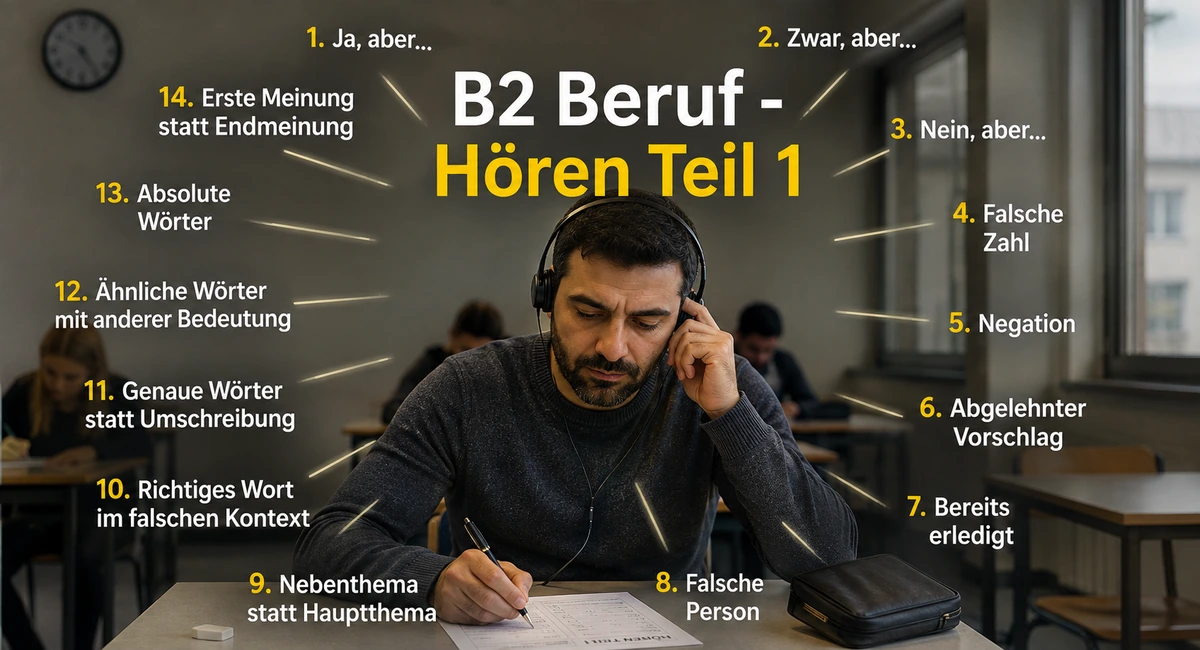
B2 Beruf, Listening, Part 1:
Strategy, Traps and Tips
The structure of this task, 14 typical traps with examples, and practical tips that will help you train your ear for the exam and achieve the maximum score.
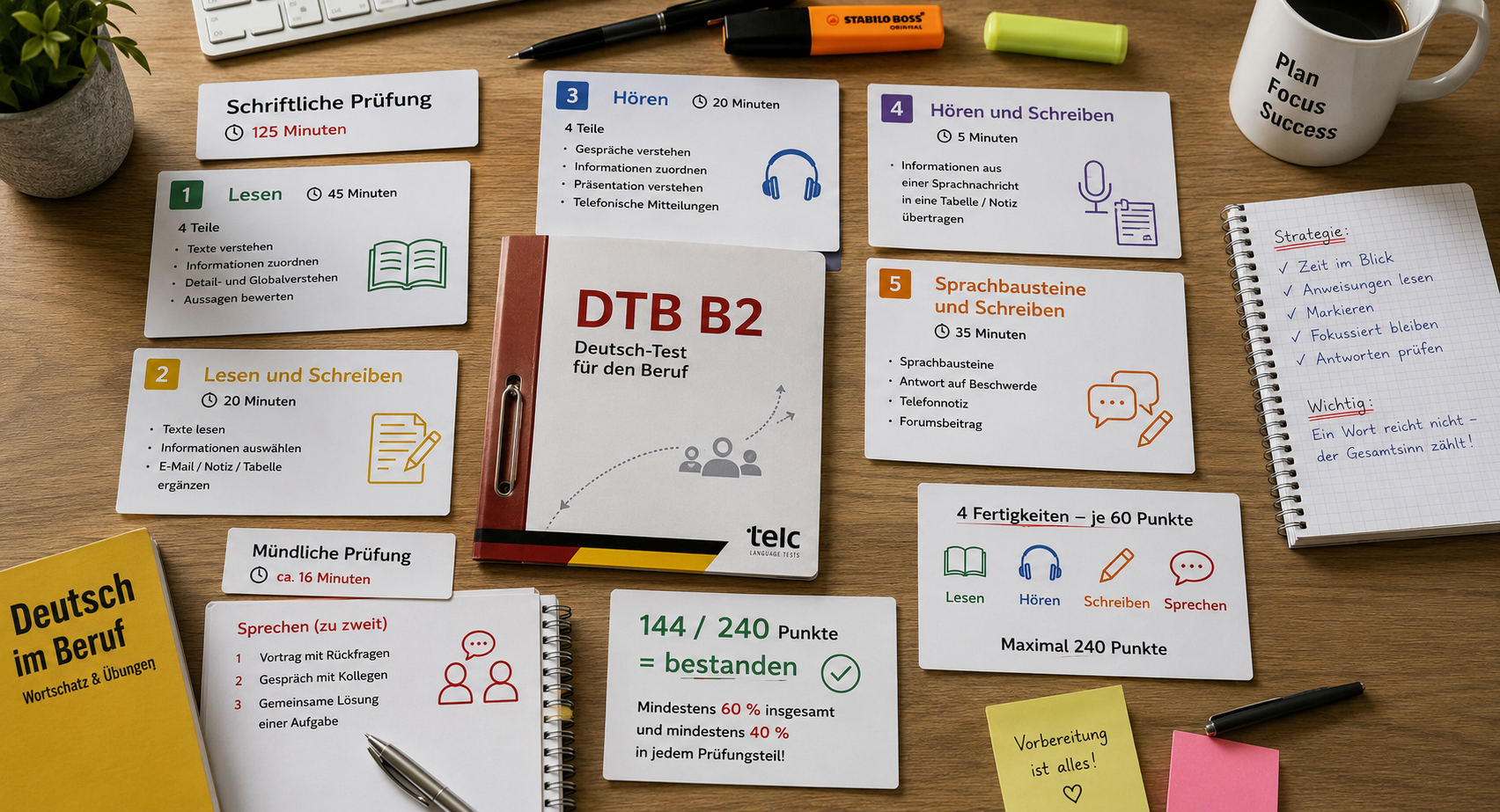
What is Listening, Part 1 in the B2 Beruf Exam
You listen to three recordings: two dialogues between two people and one discussion with three or four speakers. Each recording has two questions: one with the answer options richtig or falsch, and one with three answer options to choose from. In total, you must answer six questions.
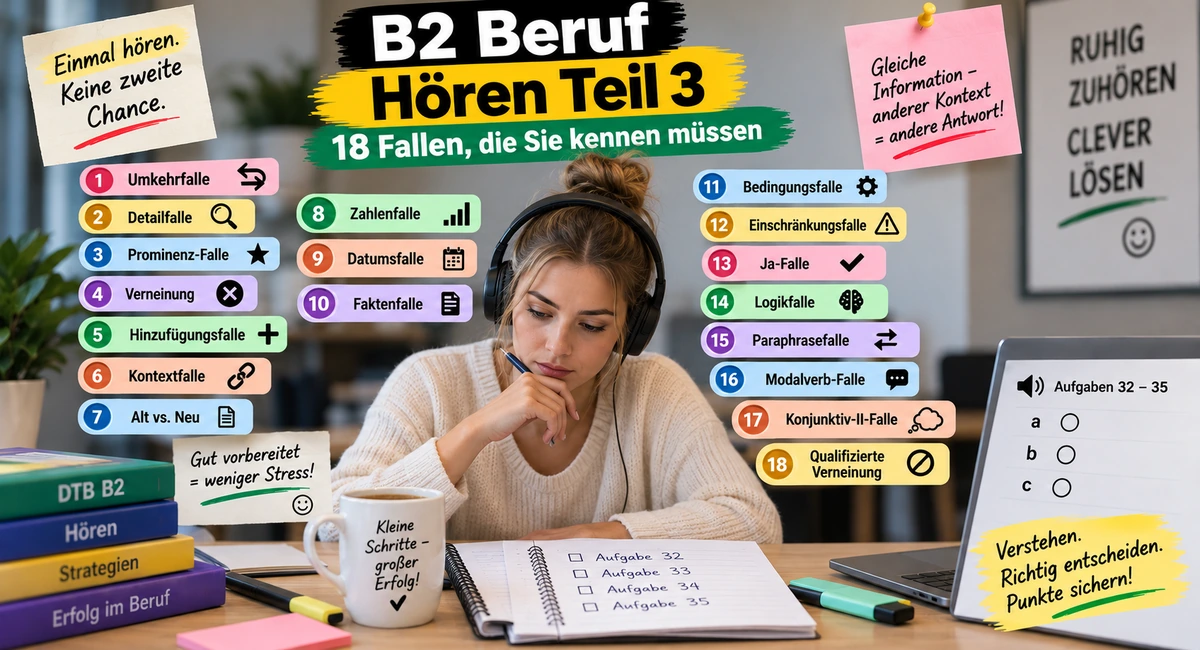
You hear each recording only once. There is no second chance. That is why you must read the questions before listening and know exactly what you are looking for.
What the Conversations Are About
In the recordings, people from the professional world speak with each other. These may include:
- A supervisor speaking with an employee (work schedules, new tasks, safety)
- A supplier speaking with a client (orders, problems, delivery dates)
- A salesperson speaking with a business customer (consultation, offers, prices)
- A discussion between colleagues during a meeting
It is not about conversations with private customers in a shop or restaurant. It is always about communication between business partners or within a company.
What the Examiner Expects
- You understand the main statement of each recording (for the True/False question).
- You understand one specific detail from each recording (for the Multiple-Choice question).
- In the discussion with three or four speakers, you recognize who says what.
- You distinguish between what was really said and what only sounds similar.
The Two Task Types: True/False and Multiple Choice
Task Type 1: True or False
You read a sentence and decide whether it matches the recording or not. This task type checks whether you understood the main statement of the recording — the big picture, not the details.
Task Type 2: Multiple Choice with Three Options
You read a sentence with three possible endings (a, b, c) and choose the correct one. This task type checks one specific detail — a person, a number, a decision, or a task.
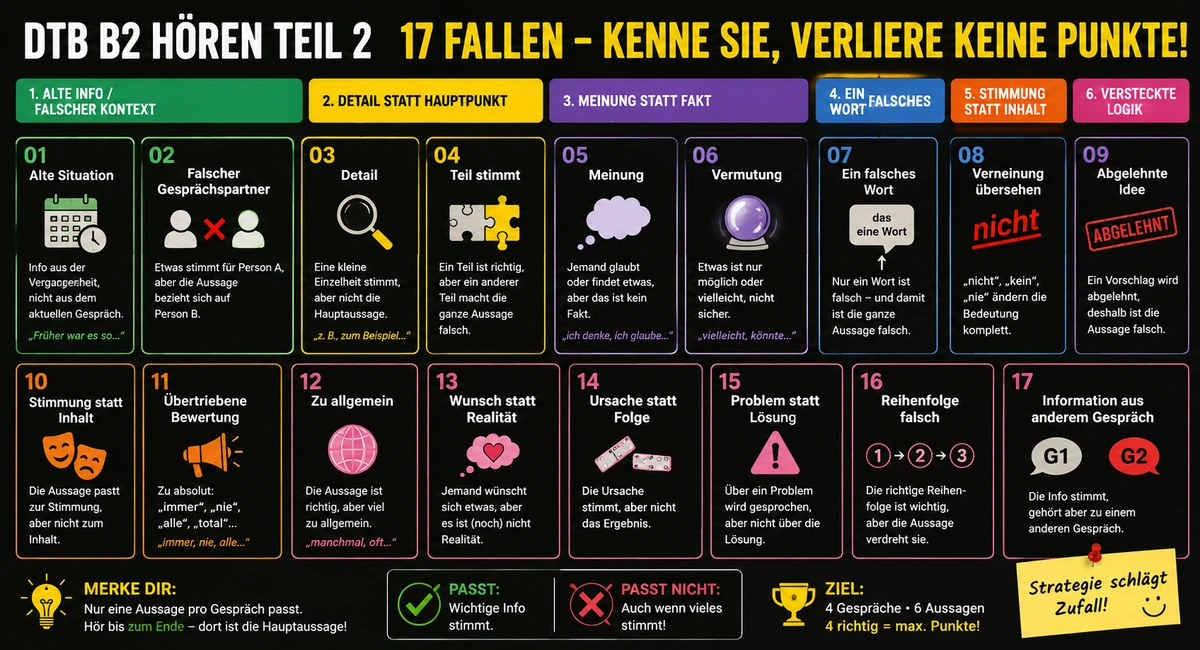
Important: all three options may contain words from the recording. But only one option is correct. The other two are traps.
In Multiple-Choice tasks, the correct answer is usually formulated with different words than in the recording. The wrong answers often repeat the exact words from the recording — but in a different context.
14 Typical Traps with Examples
In Listening Part 1 there are always recurring traps. If you know them, you will not fall for them. One trap is the most important of all — and we begin with it.
In German professional conversations, people almost never say a direct “No.” A direct “No” sounds impolite. Instead, the speaker begins with confirmation — «Ja, stimmt, natürlich, du hast recht» — and then comes to the real answer with «aber, allerdings, jedoch, trotzdem».
The real statement ALWAYS comes after «aber». Whoever only listens to the beginning understands the opposite.
Trap 1: «Ja, aber...» — the Polite No
This is the most important trap in the entire exam. The speaker sounds as if they agree, but in reality says the opposite.
Example 1:
- Question in the test: «Frau Wagner ist mit der neuen Strategie einverstanden.»
- Audio: «Frau Wagner, was halten Sie davon, dass wir die Konferenz nur online machen?»
- Frau Wagner: «Ja, das ist sicher eine moderne Lösung. Allerdings glaube ich, dass uns dann viele persönliche Kontakte verloren gehen.»
- Wrong interpretation: “Ja” at the beginning — therefore agreement.
- Correct interpretation: After «allerdings» comes the real opinion. Answer: falsch.
Example 2:
- Audio: «Können Sie nächste Woche an der Schulung teilnehmen?»
- Answer: «Natürlich würde ich das gern machen. Aber leider habe ich an diesem Tag einen wichtigen Kundentermin.»
- Real statement: The person will not participate in the training.
Typical confirmation words followed by an «aber»:
- Ja, stimmt schon, aber...
- Da haben Sie natürlich recht, aber...
- Klar, das verstehe ich. Allerdings...
- Sicher, das ist eine Möglichkeit. Trotzdem...
- Naja, eigentlich schon. Jedoch...
- Ach komm, das stimmt. Aber...
If the speaker starts with «Ja, stimmt, natürlich, klar, sicher», immediately continue listening — the «aber» will come within the next 5 seconds, and after that comes the real answer.
Trap 2: «Zwar... aber...» — the Predicted No
The small word zwar is a warning signal: the opposite is coming next. The construction «zwar X, aber Y» always means: X is true, but Y is more important and is what finally counts.
Example:
- Audio: «Ich würde zwar gern den Quartalsbericht übernehmen, aber ich habe gerade so viele andere Projekte auf dem Tisch.»
- Real statement: The person will not take over the report.
If you hear the word zwar, it is a red alarm: listen carefully to the next part with aber.
Trap 3: «Nein, aber...» — the Hidden Yes
The opposite of Trap 1. The speaker begins with “No,” but then offers a solution. Here, the real statement at the end is usually positive.
Example:
- Audio: «Können Sie morgen zur Besprechung kommen?»
- Answer: «Morgen leider nicht, da bin ich auf einer Tagung. Aber am Donnerstag würde es klappen.»
- Real statement: The person will come, just on another day.
Trap 4: Wrong Number
The recording mentions a specific number. A wrong option gives a different number.
Example: Audio: «Wir erwarten dieses Quartal 250 neue Kunden.» Wrong option: «Die Firma erwartet 300 neue Kunden.»
Trap 5: Reversing the Negation
The recording says «nicht X». The wrong option simply says «X». A small word like nicht or kein changes the whole meaning.
Example: Audio: «Wir können die Reservierung leider nicht bestätigen.» Wrong option: «Die Reservierung wird bestätigt.»
Trap 6: Rejected Suggestion
In the recording, someone makes a suggestion. Another person rejects the suggestion. The wrong option claims that the suggestion was accepted.
Example: Audio: «Sollen wir das Firmenlogo komplett neu gestalten?» — «Auf keinen Fall, das wäre viel zu teuer und unsere Kunden würden uns nicht mehr erkennen.» Wrong option: «Das Logo wird neu gestaltet.»
Trap 7: Already Completed
In the recording, something has already happened. The wrong option claims that it still has to be done.
Example: Audio: «Den Vertrag habe ich gestern schon unterschrieben und an die Buchhaltung weitergeleitet.» Wrong option: «Der Vertrag muss noch unterschrieben werden.»
Trap 8: Wrong Person
In the recording, Person A does one thing and Person B does something else. The wrong option switches the people.
Example: Audio: «Frau Lang fährt nach Hamburg, Herr König bleibt im Büro und übernimmt die Telefonate.» Wrong option: «Herr König fährt nach Hamburg.»
Trap 9: Side Topic Instead of Main Topic
The recording is mainly about Topic A. Topic B is only briefly mentioned once. The wrong option claims that the conversation is about Topic B.
Example: Main topic of the recording: complaint about loud noises in the office. Side mention: «Übrigens, der neue Kaffeeautomat ist gestern angekommen.» Wrong option: «Die Mitarbeiter sprechen über den neuen Kaffeeautomaten.»
Trap 10: Correct Word in the Wrong Context
Information from the recording is transferred to the wrong situation.
Example: Audio: «Die Sitzung dauert von 14 bis 16 Uhr im Konferenzraum.» Wrong option: «Der Mitarbeiter beginnt seine Schicht um 14 Uhr.» The phrase «14 Uhr» appears, but in the wrong context.
Trap 11: Exact Words versus Paraphrasing
The correct answer usually uses different words than the recording. The wrong answers often repeat the exact words from the recording.
Example: Audio: «Wir suchen jemanden, der gut präsentieren kann.» Correct option: «Die Firma sucht eine Person mit Vortragsfähigkeiten.» (Paraphrase with a synonym!)
Trap 12: Similar Words, Different Meaning
Some German words sound similar but have different meanings.
Example: mieten (to take something and pay for it) is not the same as vermieten (to give something and receive money). Audio: «Wir vermieten unsere freien Räume an externe Firmen.» Wrong option: «Die Firma mietet neue Räume an.»
Trap 13: Absolute Words
If an option contains words like nur, alle, niemand, immer, nie, it is very often wrong. In real professional life, statements are rarely so absolute.
Example: Audio: «Die meisten Teilnehmer waren von dem Vortrag begeistert.» Wrong option: «Alle Teilnehmer waren begeistert.»
Trap 14: First Opinion Instead of Final Opinion
In a conversation, a person sometimes changes their opinion. They first say one thing, then the opposite. The wrong option focuses on the first opinion instead of the final decision.
Example: Audio: «Erst dachte ich, das funktioniert nie. Aber jetzt sehe ich, dass die Idee doch sehr gut ist und wir sie umsetzen sollten.» Wrong option: «Die Person glaubt nicht, dass die Idee funktioniert.» Final opinion: the idea is good.
Strategy and Tips — How to Train Your Ear
Without a strategy, you lose points even if your German is actually good. The following tips show you step by step what you should do before, during, and after each recording, and how to train your ear at home.
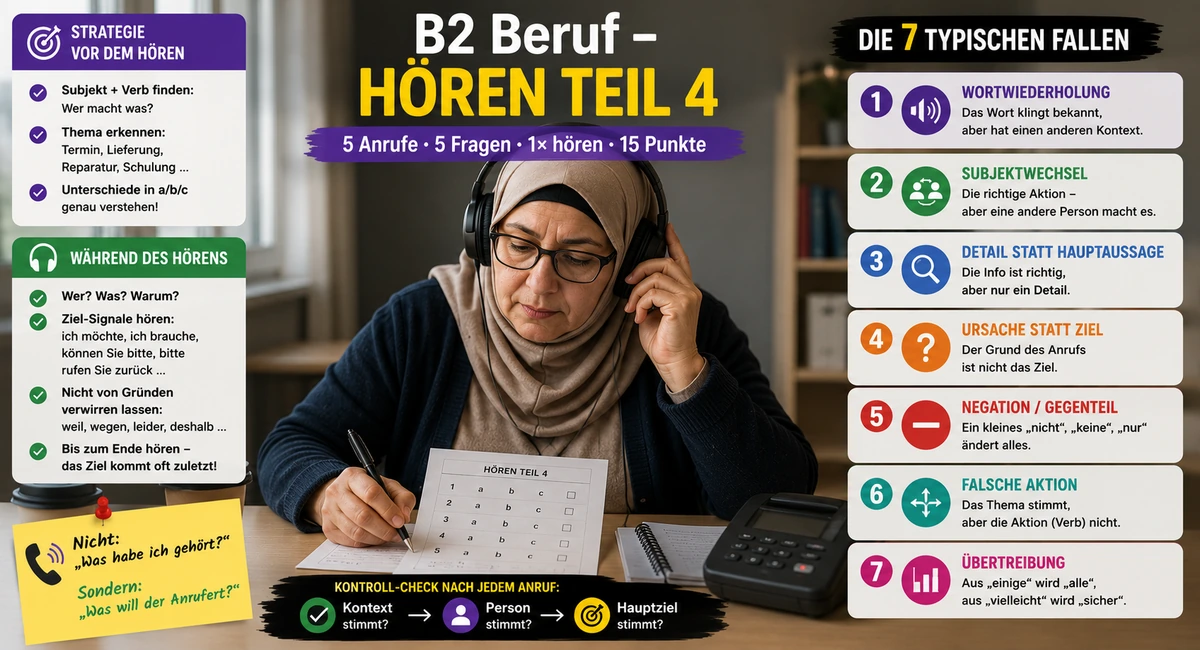
Before the Recording
Tip 1: Read the Questions First, Then Listen
First read both questions for the recording. Also read all three options of the Multiple-Choice question. Only then start listening. Whoever listens without preparation has already lost.
Tip 2: Underline the Subject and Verb in Every Question
In every sentence there are two most important words. If you find these two words, you know exactly what you must pay attention to while listening.
The subject is the person or thing the sentence is about. The question is: Who? or What?
The verb (also called the predicate) is the action or condition. The question is: What happens? or What is being done?
Example: «Die Mitarbeiter müssen die neue Software lernen.»
- Subject: die Mitarbeiter (Who?)
- Verb: müssen lernen (What happens?)
- Object: die neue Software (What are they learning?)
If you underline these two or three words, you know exactly what your ear must search for.
Tip 3: Mark the Small Trap Words
These small words in the questions strongly change the meaning. They are the most important clues for a trap:
- nicht, kein, nie — negation
- nur, alle, immer, niemand — absolute words, often traps
- schon, noch, bereits — time reference: already happened or not yet?
- aber, trotzdem, doch — turning point: opinion changes
If such words appear in a question, underline them. Pay special attention to them while listening.
Tip 4: Compare the Three Multiple-Choice Options
What is the difference between the three options? Sometimes it is only one word, one number, or one day. If you know this difference before listening, you immediately know what to look for.
Example:
- a) The delivery arrives on Monday.
- b) The delivery arrives on Tuesday.
- c) The delivery arrives on Wednesday.
The only difference is the weekday. While listening, you focus only on the weekday.
During the Recording
Tip 5: Listen for the Subject and Verb — or Their Synonyms
You already underlined the subject and the verb of the question before listening (see Tip 2). Now you search in the recording for exactly these two words — or their synonyms. Very often, the speaker does not use the same word but a synonym.
Examples of typical synonyms in the professional world:
- Vorgesetzter = boss, supervisor, manager, department head
- Mitarbeiter = colleagues, employees, staff, team
- ändern = change, adjust, modify, reorganize
- bestellen = order, request, commission
- Problem = difficulty, issue, matter, incident
- klären = discuss, settle, find out, solve
Tip 6: Stay Calm When You Hear Unknown Words
It is normal that you do not understand every word. Nobody understands everything. If a word is difficult, simply continue listening. The next important word will come soon. If you get stuck on one word, you will miss the rest.
Tip 7: Pay Attention to «aber» and Confirmation Words
The word aber is the most important word in Hören Teil 1. When you hear aber, the REAL statement of the speaker comes immediately afterward. Everything before that was politeness.
Especially important: when the speaker starts with confirmation, an «aber» almost always follows. The following words at the beginning of an answer are warning signals:
- Ja, stimmt schon, aber...
- Da haben Sie natürlich recht, aber...
- Klar, sicher, aber...
- Naja, ich verstehe Sie. Trotzdem...
- Zwar X, aber Y — the word «zwar» already announces that an «aber» is coming.
Other turning-point words that you must pay attention to:
- jedoch, allerdings, trotzdem, dennoch — contradiction to the previous statement
- also, deshalb, daher, somit — conclusion, often the important decision
- endlich, schließlich, am Ende — the speaker’s final position
Concrete example: «Ja, das wäre eine moderne Lösung. Aber ich denke, wir sollten lieber das alte System behalten.» The real opinion: against the modern solution.
Tip 8: In Discussions with Multiple Speakers
In conversations with three or four people, the most important thing is: Who says what?
- Listen to the voices: male or female voice, younger or older voice.
- Listen for names: often a name is mentioned at the beginning or end of a statement.
- If someone is silent at first and then starts speaking, this is often a new speaker.
- Write down briefly: «F» for Frau, «M» for Mann, plus the name.
After the Recording
Tip 9: Answer Immediately, Leave Nothing Empty
Answer both questions immediately before the next recording starts. If you are unsure, guess. Do not leave any question empty — that definitely gives zero points. In Multiple-Choice, the chance of guessing correctly is 1 out of 3; in Richtig/Falsch it is 1 out of 2. Use this chance.
Tip 10: If You Are Hesitating Between Two Options
- Avoid the option with absolute words (nur, alle, immer, niemand).
- Avoid the option that repeats the exact words from the recording.
- Choose the option that paraphrases or sounds more general.
- Do not choose the option that sounds too complicated or too detailed.
Preparation at Home — Training Your Ear
Tip 11: Listen to German from the Professional World for 15 Minutes Every Day
You can only train your ear if you regularly listen to German. Focus on content related to the professional world:
- Podcasts about business and work, for example from ARD or Deutsche Welle.
- YouTube channels with business conversations or job interviews.
- German films or series that take place in offices or companies.
Tip 12: Learn Synonyms in Word Groups
Make a list of the most important professional words and their synonyms. Learn them in groups, not individually:
- einstellen — anstellen — beschäftigen — ins Team holen
- kündigen — entlassen — freistellen — verabschieden
- steigen — zunehmen — wachsen — ansteigen
- sinken — abnehmen — fallen — zurückgehen
If you know these word groups, you immediately recognize while listening that it is about the same topic, even if another word is used.
Tip 13: Train Under Stress
In the real B2 Beruf exercises in the exam, you are nervous. Therefore, do not practice only in a quiet atmosphere. For example, let the television run quietly in the background, or practice after a long workday. This way your ear gets used to functioning even under stress.
Tip 14: Practice with a Pen in Your Hand
Even if you work on the computer in the exam: underlining and taking notes on paper is a movement that helps your brain concentrate. Always practice with a pen in your hand, already at home.
Where You Can Practice Hören, Teil 1
You can only master this task confidently through regular practice. You need many different recordings with different speakers, different speaking speeds, and all 14 traps that can appear in the exam. On our platform, you will find exercises exactly in the same format as the real exam — with immediate evaluation and explanation of every question.
👉 Practice B2-Beruf Listening



There are no comments for this article. Leave your comment