





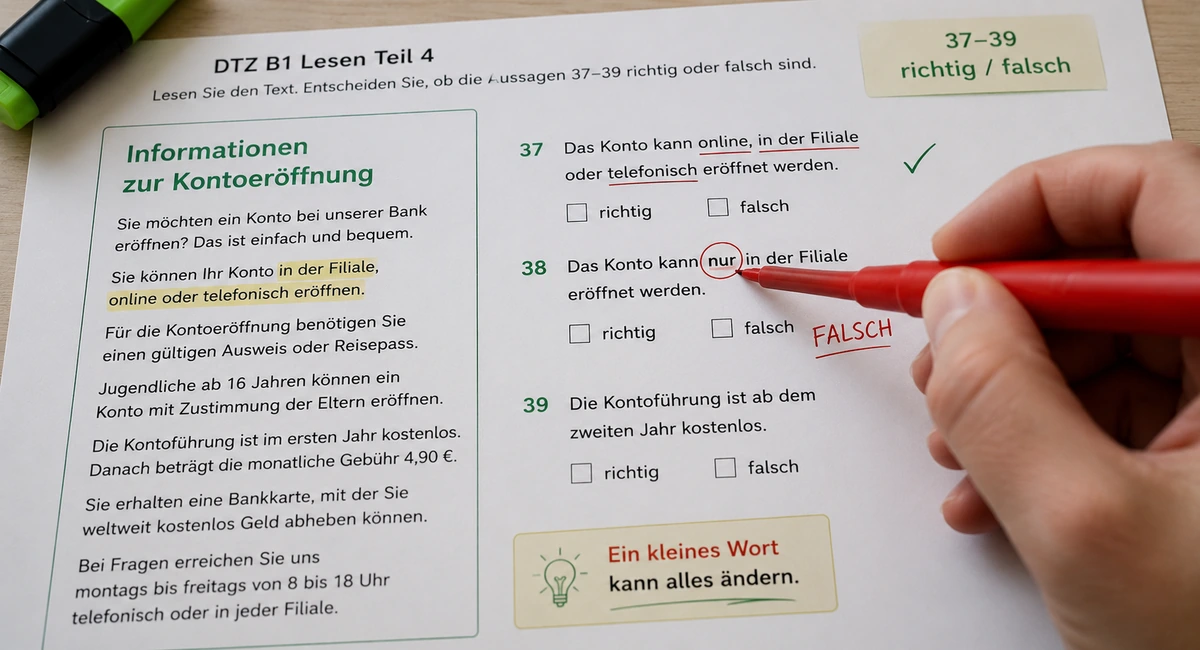
DTZ B1 Lesen Teil 4:
All traps and tricks explained simply
Learn how to recognise all traps in Lesen Teil 4 of the DTZ B1 exam. Simple strategy, clear examples and 11 categories of traps – explained in plain German.
What is Lesen Teil 4 in the DTZ B1 exam?
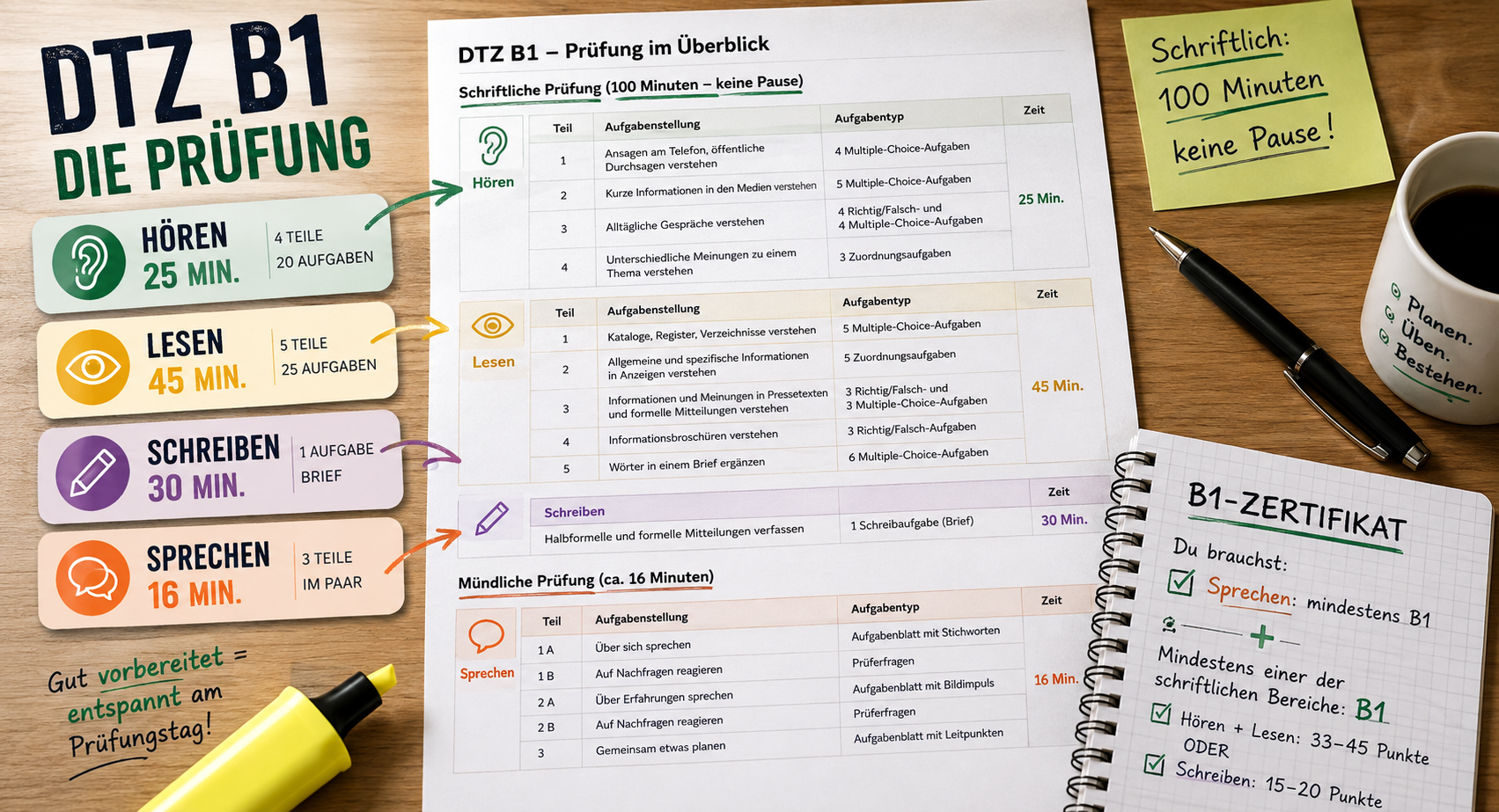
When preparing for the DTZ B1 exam, Lesen Teil 4 is an important section. You read a short informational text. This can be, for example:
- a Hausordnung (house rules),
- a product information sheet (for example for a medicine),
- general terms and conditions (AGB),
- information from a school or a Kindergarten,
- information from a bank,
- information from a Krankenkasse (health insurance),
- safety instructions for a device.
After the text there are three statements (tasks 37, 38 and 39). You must decide: is the statement richtig or falsch? For each correct answer you get one point.
A statement is only richtig if it says exactly what is written in the text. Even one small word can change the answer. If the statement says something different – even just a little bit different – it is falsch.
Many learners think: „That is simple. I read the text and find the answer.“ But the exam builds many traps. You can only see these traps if you read very carefully. In this article we show you all the traps.
👉 Exercises in preparation for DTZ B1 LesenThe right strategy: what do you do first?
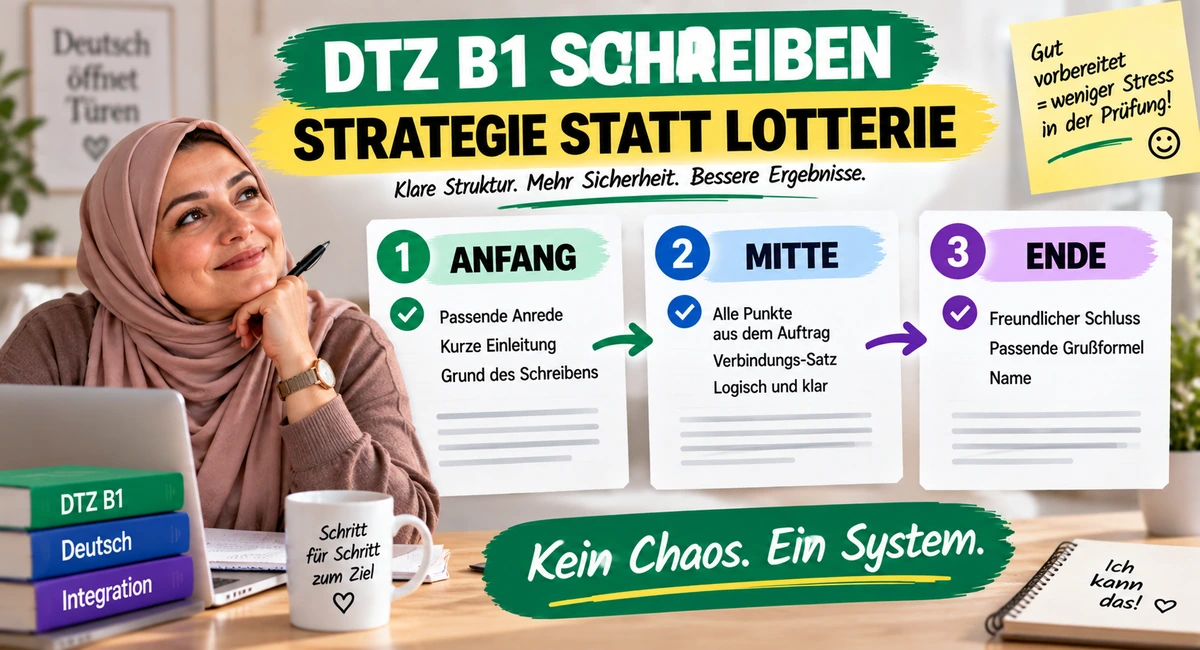
Many learners lose time because they read the whole text first. That is wrong! In the exam you have little time. That is why you need a strategy.
Step 1: Read the three statements first (37, 38, 39)
Read the three statements below the text first. Then you know what you need to look for. You do not read the text without a goal. You have a goal: you are looking for the answer to three concrete questions.
Step 2: Underline the key words in the statements
In every statement there is one or two important words. These words tell you what you need to look for in the text. Underline:
- Numbers (for example: 14 Tage, 5 Jahre, 100 Euro),
- Time expressions (for example: sonntags, in den Ferien, um 9 Uhr),
- People or groups (for example: Kinder, Rentner, Auszubildende),
- Places (for example: in Deutschland, im Garten, im Krankenzimmer),
- small words such as nur, alle, immer, nie, jeder, keine, gesamten.
Step 3: Find the passage in the text
Now look in the text for the passage where the topic is discussed. You do not have to read the whole text. You scan the text and look only for the important passage.
Step 4: Compare word for word
Read the passage in the text and the statement. Compare very carefully. Pay attention to:
- Are the numbers the same?
- Are the time expressions the same?
- Does the text really say alle or only viele?
- Is there a negation (nicht, kein)?
If you are uncertain: read the statement and the text once more. If the statement sounds too „perfect“ or uses absolute words (alle, immer, nur), it is often falsch. Trust only the text, not your gut feeling!
11 categories of traps – all the tricks of the exam
The B1 DTZ exam always uses the same tricks. There are only a few categories of traps. If you know these categories, you can recognise them quickly. Here are all 11 categories with simple examples.
Trap 1: Different number (Zahlenfalle)
This is the simplest trap. The text contains one number. The statement contains a different number. The statement is falsch.
❌ Example:
In the text: „Die Karte ist vier Jahre gültig.“
Statement: „Die Karte ist fünf Jahre gültig.“
Answer: falsch (vier ≠ fünf)
What to do? Underline all numbers in the statement. Look for exactly that number in the text.
Trap 2: Number in the wrong context
This trap is dangerous. The number in the statement also appears in the text. But in the text it refers to something different. The statement uses the correct number, but for the wrong topic.
❌ Example:
In the text: „Sie können die Ware in 14 Tagen zurückschicken. Die Rechnung bezahlen Sie in 30 Tagen.“
Statement: „Sie müssen die Ware in 14 Tagen bezahlen.“
Answer: falsch (14 Tage = return, not payment)
What to do? Do not read only the number. Also read what the number applies to. Numbers are often a trap!
Trap 3: Absolute words (alle, immer, nie, jeder)
Absolute words are very dangerous. When you see these words in a statement, the statement is often falsch. These words say: 100 percent, without exception.
Here are the most important absolute words:
- alle – every person/thing, without exception
- immer – at all times, without exception
- nie – at no time
- jeder – every person, without exception
- keine – nothing at all
- gesamten – the whole time / the whole space
❌ Example:
In the text: „Im letzten Drittel der Schwangerschaft darf das Medikament nicht eingenommen werden.“
Statement: „Während der gesamten Schwangerschaft darf das Medikament nicht eingenommen werden.“
Answer: falsch (only the last third, not the whole pregnancy)
❌ Example:
In the text: „Erwachsene erkranken zweimal im Jahr, Kinder sechsmal.“
Statement: „Alle Rentner zahlen 18 Euro.“
Answer: Look carefully whether the text really speaks of all of them!
Trap 4: The little word „nur“
The word nur is the most important trap in DTZ B1 Lesen Teil 4. It appears very often. Nur means: nothing else, no other option.
If the text mentions several options and the statement says nur, the statement is falsch.
❌ Example:
In the text: „Sie können mit der Karte europaweit kostenlos Geld abheben.“
Statement: „Sie können nur in Deutschland Geld abheben.“
Answer: falsch (Europe is more than Germany)
❌ Example:
In the text: „Sie können das Konto in der Filiale, im Internet oder per Telefon eröffnen.“
Statement: „Man kann das Konto nur in der Filiale eröffnen.“
Answer: falsch (there are three options, not one)
Careful: Sometimes nur is also richtig! That is when the text also says nur. So always compare with the text.
Trap 5: Direct negation (the opposite)
The text says: „That is permitted.“ The statement says: „That is forbidden.“ That is a direct negation. The statement is falsch.
Pay particular attention to these word pairs:
| In the text | In the statement | Result |
|---|---|---|
| kostenlos | muss bezahlen | falsch |
| erlaubt | verboten | falsch |
| möglich | nicht möglich | falsch |
| Rabatt | gleicher Preis | falsch |
| uneingeschränkt möglich | nicht erlaubt | falsch |
Trap 6: General knowledge contradicts the text
Sometimes the text says something that seems unusual. You think: „That cannot be right. In my country it is different.“ But you must believe the text, not your general knowledge!
❌ Example:
In the text: „Sie müssen auch bei Krankheit den vollen Betrag bezahlen.“
Statement: „Wenn ein Kind krank ist, muss man nicht bezahlen.“
Answer: falsch! Logically you would think „If someone is ill, I do not pay“. But this text says something different.
❌ Example:
In the text: „Die aktive Teilnahme am Straßenverkehr ist uneingeschränkt möglich.“
Statement: „Nach den Tabletten darf man nicht selbst Auto fahren.“
Answer: falsch! With many medicines this is forbidden, but this text says: driving is permitted.
Golden rule: Do not trust your general knowledge. Trust only what is in the text!
Trap 7: Information is not in the text
Sometimes the statement says something that is simply not in the text. The statement sounds logical, but this information does not exist in the text. If something is not in the text, the statement is falsch.
❌ Example:
In the text: „Wenn Patienten Speisen von Besuchern bekommen, sollten sie zuerst den Arzt fragen.“
Statement: „Besucher sollen kein warmes Essen mitbringen.“
Answer: falsch! The text says nothing about warm or cold.
❌ Example:
In the text: „Gegen eine Grippe kann man sich impfen lassen.“
Statement: „Gegen Erkältungen helfen besonders Tabletten.“
Answer: falsch! The text says nothing about tablets for colds.
Trap 8: „Automatisch“ vs. „beantragen“
This trap is very common in texts from banks, health insurance companies and authorities. There is an important difference:
- automatisch = without an application, without any action from the customer (for example: The card comes automatically by post.)
- beantragen = the customer must do something, fill in a form, make a phone call
❌ Example:
In the text: „Wir senden Ihnen automatisch eine neue Karte.“
Statement: „Man muss eine neue Karte beantragen.“
Answer: falsch! With automatisch the customer does nothing.
Trap 9: Wrong assignment (colours, groups, types)
The text contains two or more groups, colours or types. The statement mixes them up. Pay particular attention to:
- Colours (gelb / grau / blau)
- Numbers (Raum 1 / Raum 2)
- People (Erwachsene / Kinder)
- Times (vormittags / nachmittags)
❌ Example:
In the text: „Lebensmittelabfälle → gelbe Mülleimer. Papier → graue Mülleimer.“
Statement: „Lebensmittelabfälle können Sie in die grauen Eimer werfen.“
Answer: falsch! Food waste = gelb, not grau.
❌ Example:
In the text: „Erwachsene zweimal im Jahr, Kinder sechsmal.“
Statement: „Erwachsene bekommen öfter eine Erkältung als Kinder.“
Answer: falsch! Children more often, not adults. The numbers are swapped.
Trap 10: „In der Regel“ / „meistens“ is not „immer“
When the text says in der Regel or meistens, that does not mean immer. There are exceptions.
❌ Example:
In the text: „Wir liefern in der Regel in zwei bis fünf Werktagen.“
Statement: „Die Ware wird immer innerhalb von fünf Werktagen geliefert.“
Answer: falsch! In der Regel is not immer.
These words show that it is not always the case:
- in der Regel
- meistens
- normalerweise
- ab und zu
- manchmal
- oft
Trap 11: Recognising synonyms (correct answers)
The correct answer is often not word for word the same as the text. The exam uses synonyms. You must understand that two different words can mean the same thing.
✅ Example of a correct statement:
In the text: „Eine neue Karte erhalten Sie bei einer Adressänderung.“
Statement: „Wenn Sie umziehen, bekommen Sie eine neue Karte.“
Answer: richtig! Umziehen = Adressänderung.
✅ Example of a correct statement:
In the text: „Patienten müssen den Arzt um Erlaubnis fragen.“
Statement: „Patienten dürfen nur mit Zustimmung eines Arztes gehen.“
Answer: richtig! Erlaubnis = Zustimmung.
Learn synonyms! They are the key to correct answers. In the next table you will find the most important synonyms for DTZ B1 Lesen Teil 4.
The most important table: 20 synonyms for DTZ B1 Lesen Teil 4
These 20 synonyms appear very often. Learn them by heart. They help you recognise the correct answers quickly.
| In the text it often says | In the statement it says |
|---|---|
| Adressänderung | umziehen / Umzug |
| Erlaubnis | Zustimmung / einverstanden sein |
| kostenlos | keine Gebühren / nichts bezahlen |
| ohne zusätzliche Kosten | kostet nichts extra |
| ohne Rezept | frei kaufen |
| ab und zu / manchmal | manchmal |
| Nachtisch | Nachspeise / Dessert |
| Erziehungsberechtigte | Eltern |
| Geschirr | Teller |
| Tipps geben | empfehlen |
| verboten | nicht erlaubt / nicht möglich |
| spart Geld | günstiger |
| Höchstnote 1,0 | sehr gute Note |
| mindestens / wenigstens | nicht weniger als |
| höchstens / maximal | nicht mehr als |
| während der Schulzeit | nicht in den Ferien |
| Personalausweis vorlegen | seinen Ausweis zeigen |
| Vertrag kündigen | Vertrag beenden |
| der Kunde ist einverstanden | der Kunde gibt seine Zustimmung |
| uneingeschränkt möglich | ohne Probleme erlaubt |
Write these synonyms on small cards. Learn 5 cards every day. This way you build up your vocabulary quickly and find the correct answers in the exam.
Golden rules to finish
Here are the most important rules in an overview. Read these rules once more before the exam:
Always read the three statements first (37, 38, 39). Only then the text. This saves you time.
Underline numbers, time expressions and small words such as nur, alle, immer, nie.
Compare word for word. Even one small word can change the answer.
Do not trust your general knowledge. Trust only what is written in the text.
The words nur, alle, immer, nie, jeder, gesamten are often a trap. Check carefully whether the text really says that.
The exam only asks about information from the text. If the statement says something new that is not in the text – the statement is falsch.
The correct answer often uses different words from the text. Learn synonyms!
If you are uncertain: „falsch“ is often the correct answer, especially with absolute words such as alle, immer, nur.
With these eight rules and the strategy from step 2, you are well prepared. Practise regularly. Read many texts. The more you practise, the faster you recognise the traps.




There are no comments for this article. Leave your comment