





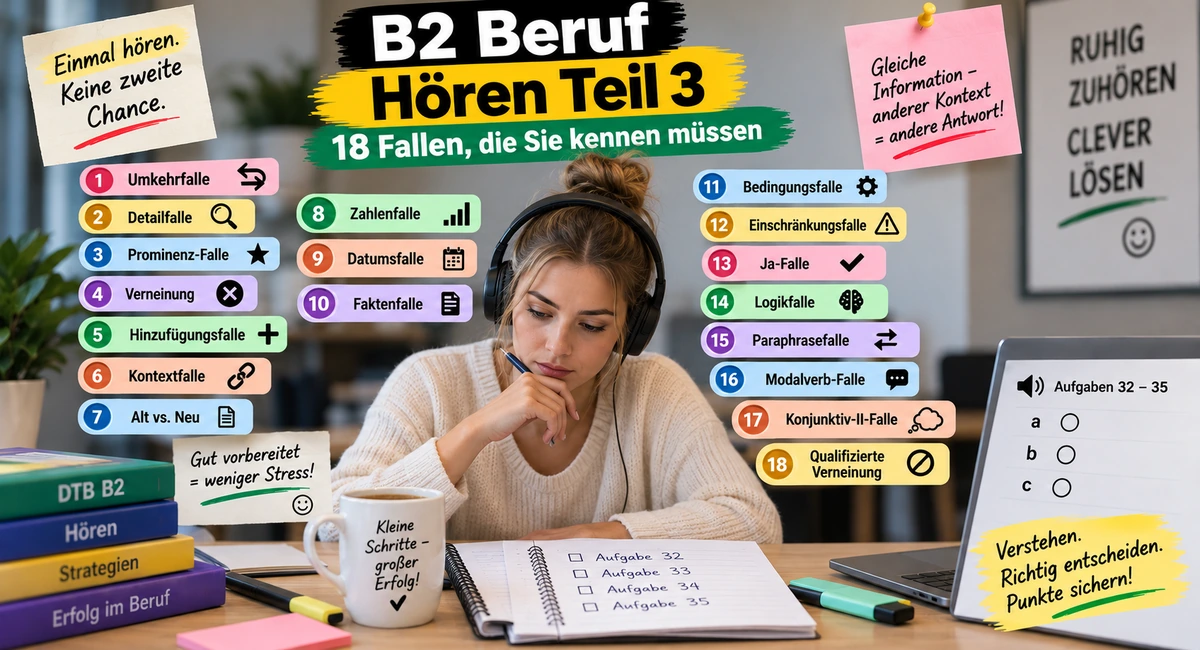
Listening Part 3: 18 traps
you need to know
A complete guide for everyone taking the DTB B2 — all trap types explained in plain language, with concrete examples from real exam tasks.
What is Listening Part 3? — Format and basic principle
Many people prepare for weeks for the Deutsch-Test für den Beruf B2 — and yet they fail precisely at Listening Part 3. Not because their German is poor. Not because they don't understand the text. But because the tasks are designed to mislead the brain.
These traps are not accidental. The examiners build them in deliberately — and they follow a system. Anyone who knows and recognises the 18 trap types has a huge advantage. Anyone who doesn't know them will keep overlooking them — no matter how good their German is.
This article explains all 18 traps in plain language: what happens, why it works, and what you can do about it.
Structure of Listening Part 3
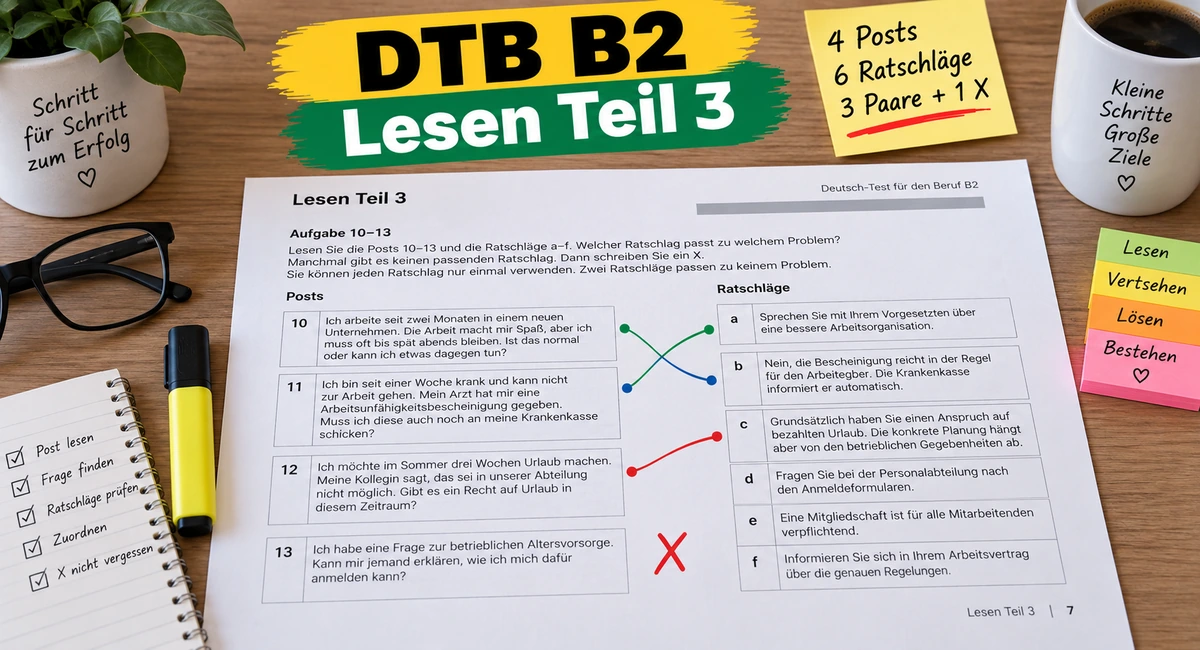
You hear a presentation with interim questions — about a new system, a new branch or a company strategy, for example. The presentation is played only once. You then solve four tasks (items 32–35) in multiple-choice format with three options.
The examiners do not lie. Every wrong answer contains something real from the text — a number, a word, a name, a date. The trap never lies in something invented, but in something shifted, distorted or taken out of context.
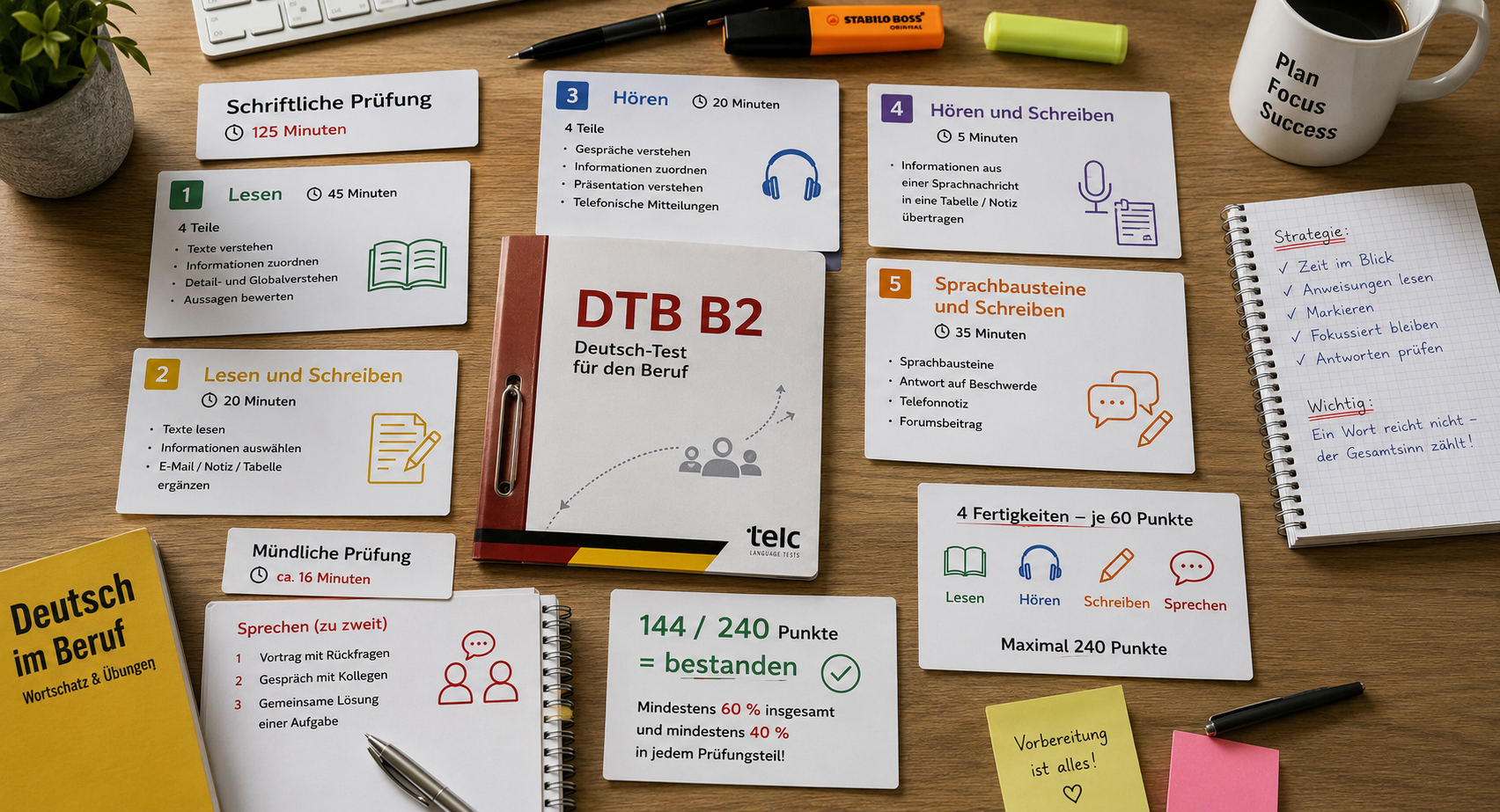
| Exam format overview | |
|---|---|
| Format | Presentation with interim questions |
| Number of items | 4 tasks (32–35) |
| Listening | Once only |
| Answer format | Multiple choice with 3 options |
| Points | 3 points per item |
| Preparation | 1 minute to read |
Content traps (1–7)
These traps play with the content of the text — information is distorted, swapped or simply invented. They are the most common traps and at the same time the easiest to train for.
🔄 1. Reversal trap
This is the most common and most direct trap. The text says something completely clear — and the wrong answer says exactly the opposite. Black becomes white, yes becomes no, more becomes less.
Why do people fall for it? Because when listening quickly, one misses the negation, or the brain registers the familiar words and fills in the rest. Particularly dangerous: when someone in the text expresses a concern — and this then appears as a fact in the answer.
Ask yourself about every answer: if an answer sounds like the opposite of what you heard — that is not a coincidence. Check carefully what the text actually said.
🔍 2. Detail trap
Everything is correct — except for one single word. One person becomes another, one place becomes another, internal becomes external. The answer sounds almost right, but is wrong.
Why do people fall for it? Because the brain perceives the sentence as a whole and overlooks the one wrong detail. You think: "I know this!" — and choose it.
If an answer sounds almost right — look for the one word that is wrong. It is almost always there. It usually involves a person, a place, a direction or an adjective.
🎭 3. Prominence + negation
Something is mentioned in the text very extensively and prominently — but precisely as something that is being dropped or no longer applies. The brain remembers what was mentioned, but forgets the negation that follows.
Why do people fall for it? The more attention something receives, the more strongly it stays in memory. The examiners use this deliberately: they describe something in detail — only to then negate it.
Typical signal words after a long description:
fällt weg
wird nicht übernommen
entfällt
verzichten wir darauf
The more extensively something is described — the more carefully listen to what comes after. The negation is often hidden precisely there.
➕ 4. Addition trap
The answer sounds logical and fits the topic — but simply does not appear in the text. Nobody said that. The brain fills in what it expects.
Why do people fall for it? Our brain is trained to fill gaps. If the conversation is about applications, "interviews are conducted" seems obvious — even if it was never said.
The test is simple: can you name the exact passage in the text? If not, it is an addition trap. Only choose what you actually heard.
🌐 5. Context trap
A word or term from the text appears in the wrong answer — but in a completely different context. The word is real, the context is wrong.
Why do people fall for it? The brain thinks: "I heard this word — so the answer must be correct." But hearing is not the same as understanding.
Don't ask: "Did I hear this word?" — but: "In what context was it used?"
📖 6. Word confusion trap
A familiar word from the text appears in the wrong answer — but it refers to something different or a different person than in the text.
Why do people fall for it? The brain recognises the familiar word and concludes: "That's right!" — without checking what it refers to.
When you recognise a word — stop. Ask yourself: who or what did it refer to in the text?
🔀 7. Old/new confusion trap
The text describes an old and a new system. The wrong answer takes a feature of the old one and attributes it to the new one — or vice versa.
Why do people fall for it? When two versions are described at the same time, it is easy to lose track of which feature belongs to which version.
Always clarify: does this concern the old or the new system? And: whose development is meant?
Numbers & facts — traps (8–10)
Numbers are memorable — but that is precisely what makes them dangerous. The examiners know this and exploit it deliberately. These three traps all revolve around numbers, dates and time indications.
📅 8. Date trap
The text mentions two different dates for two different events. The wrong answer assigns a date to the wrong event.
Why do people fall for it? Numbers stick in the mind — but their context does not. Especially when two dates are mentioned in quick succession, they blur together.
Next to every number, immediately note what it applies to. Not just „20. März" — but „20. März → Entwürfe für Frau Schreiber".
🔢 9. Number trap
A real number from the text appears in the wrong answer — but in a different context or slightly altered. Or two similar numbers are confused.
Why do people fall for it? Numbers are memorable. You remember them — but not always the exact context.
Don't just listen to the number — listen to the whole context. And distinguish carefully: „kostenlos" ≠ „günstig", „sechs Wochen" ≠ „ein Monat".
➗ 10. Calculation trap + modal trap
The text mentions two time periods that could be added together. The wrong answer calculates correctly — but interprets the result as a guarantee, even though it is only a possibility.
Why do people fall for it? Calculating feels safe. If you work out 2+2=4, you believe you have the right answer — and overlook the fact that the result only applies under a certain condition.
These modal words completely change the meaning of a number:
mindestens
höchstens
bis zu
vorerst
zunächst
kann verlängert werden
The number alone is not enough. Always pay attention to the words around it — they show whether it is a fixed statement, a limit or just a possibility.
Logical traps (11–14)
These traps do not play with words or numbers — they play with logic. A "yes" does not mean what it sounds like. A possibility becomes a certainty. The content is correct — but the conclusion is wrong.
⚠ 11. Condition trap
In the text, something is formulated only as a possibility or under a certain condition. The wrong answer turns this into a certain fact.
Why do people fall for it? The brain hears the content — and misses the small signal word that turns it into a condition. „Sollte sich das bewähren" quickly sounds like „das wird sich bewähren".
These signal words often indicate a condition or possibility:
wenn
falls
sollte
wäre denkbar
sofern
könnte
When you hear „wenn", „falls" or „sollte", it is not about a fact. It is about a condition or a possibility.
✂ 12. Restriction trap
A statement in the text is qualified by an „aber", „allerdings" or „jedoch". The wrong answer ignores this qualification and turns the first part into a complete statement.
Why do people fall for it? You hear the first half of the sentence — and decide immediately. The decisive qualification comes afterwards and is missed.
Typical signal words for restrictions:
allerdings
jedoch
aber
nicht für jeden
manchmal
in bestimmten Fällen
When you hear „allerdings", „jedoch" or „aber" — the most important part comes after.
👍 13. Yes-trap
Someone is asked whether something is correct — answers with "yes" — and then explains something completely different. The "yes" sounds like a confirmation, but it is not.
Why do people fall for it? The word "yes" instantly activates agreement in the mind. What comes after is questioned less critically.
Never listen only to the first word. „Ja" alone means nothing — what matters is what is said after it.
📝 14. Paraphrase trap
The correct answer does not sound like a quote from the text — it means the same thing, but in different words. Anyone who only looks for familiar words will overlook it.
Why do people fall for it? Many people focus on individual words when doing listening exercises (B2 Beruf). If the correct answer is formulated differently, it is not recognised.
Pay attention not to individual words, but to the meaning. If the statement is the same but formulated differently, that is the correct answer.
Grammatical traps (15–18)
This is the highest level of difficulty. With grammatical traps, you can understand all the words — and still choose the wrong answer, because you missed the grammatical form. A Konjunktiv II, a modal verb, a tense — that decides everything.
🔧 15. Modal verb trap
The text contains a clear modal verb — „müssen", „dürfen", „können", „sollen". The wrong answer uses a different modal verb and thereby changes the meaning completely.
Why do people fall for it? Modal verbs are small words that are easy to miss when listening. But „muss" and „kann" mean something completely different.
These opposites are particularly dangerous:
verpflichtend ↔ freiwillig
muss ↔ kann
soll ↔ darf
Modal verbs are small words with a big impact. When you hear „verpflichtend" or „muss", note it down — it determines the correct answer.
🌫 16. Konjunktiv II as fact
The text contains Konjunktiv II — „wäre denkbar", „könnte sein", „würde möglich sein". The wrong answer turns this into a fact in the indicative.
Why do people fall for it? The Konjunktiv II is often hard to recognise in spoken German. You hear the content — and overlook the fact that it is only a possibility.
Konjunktiv II means possibility, not fact. Pay attention to „wäre", „könnte", „würde".
🔬 17. Qualified negation
The text says „nicht unbedingt", „nicht immer" or „nicht zwangsläufig". The wrong answer turns this into an absolute statement.
Why do people fall for it? These nuances are hard to hear. „Nicht unbedingt" means: sometimes yes, sometimes no — but the answer often says „immer" or „nie".
Typical signal words:
nicht unbedingt
nicht immer
nicht zwangsläufig
nicht in jedem Fall
„Nicht unbedingt" is not a clear no. Avoid answers with „immer" or „nie".
⏰ 18. Tense trap
The text describes something in a specific tense. The wrong answer uses a different tense and thereby changes the meaning.
Why do people fall for it? Tenses are often missed when listening. But they determine whether something has already happened, is happening now or is planned.
Pay attention to the tense. It shows you whether something has already happened or is happening now.
All 18 traps at a glance
Here all 18 trap types are summarised in an overview table. Save this page or print out the table — it is your personal cheat sheet for exam preparation.
| # | Trap type | Key question when listening |
|---|---|---|
| 1 | Reversal trap | Is the opposite being said? |
| 2 | Detail trap | Which one word is wrong? |
| 3 | Prominence + negation | Is what was mentioned then negated? |
| 4 | Addition trap | Is this really in the text? |
| 5 | Context trap | In what context was this said? |
| 6 | Word confusion trap | Who or what did the word refer to? |
| 7 | Old/new confusion trap | Does this apply to the old or the new? |
| 8 | Date trap | Which date applies to which event? |
| 9 | Number trap | Is the number correct — and its context? |
| 10 | Calculation trap + modal trap | Is the result a fact or a possibility? |
| 11 | Condition trap | Is this a fact or only possible? |
| 12 | Restriction trap | Does a restriction come after „aber"? |
| 13 | Yes-trap | What comes after the „Ja"? |
| 14 | Paraphrase trap | Does it mean the same — just differently? |
| 15 | Modal verb trap | „Muss" or „kann"? |
| 16 | Konjunktiv II as fact | Possibility or certainty? |
| 17 | Qualified negation | „Nicht unbedingt" ≠ „nie" |
| 18 | Tense trap | Is it happening now — or is it already the case? |
🎯 The most important principle of all
The examiners do not lie. Every wrong answer contains something real from the text — a number, a word, a name or a date. The trap never lies in something invented, but in something shifted, distorted or taken out of context.
That is why the most important question is not: „Habe ich dieses Wort gehört?" — but: „Wer hat das gesagt? Über was genau? Und unter welcher Bedingung?"
Anyone who thinks this way recognises the traps — before they snap shut.





There are no comments for this article. Leave your comment