





Speaking Part 2 in telc B1:
structure, assessment and the most common mistakes
Find out how Speaking Part 2 in telc Deutsch B1 is structured, how the examiners assess, which mistakes cost the most points, and with which practical tips you hold a real conversation instead of a monologue.
Structure of Speaking Part 2 – how does this exam part work?
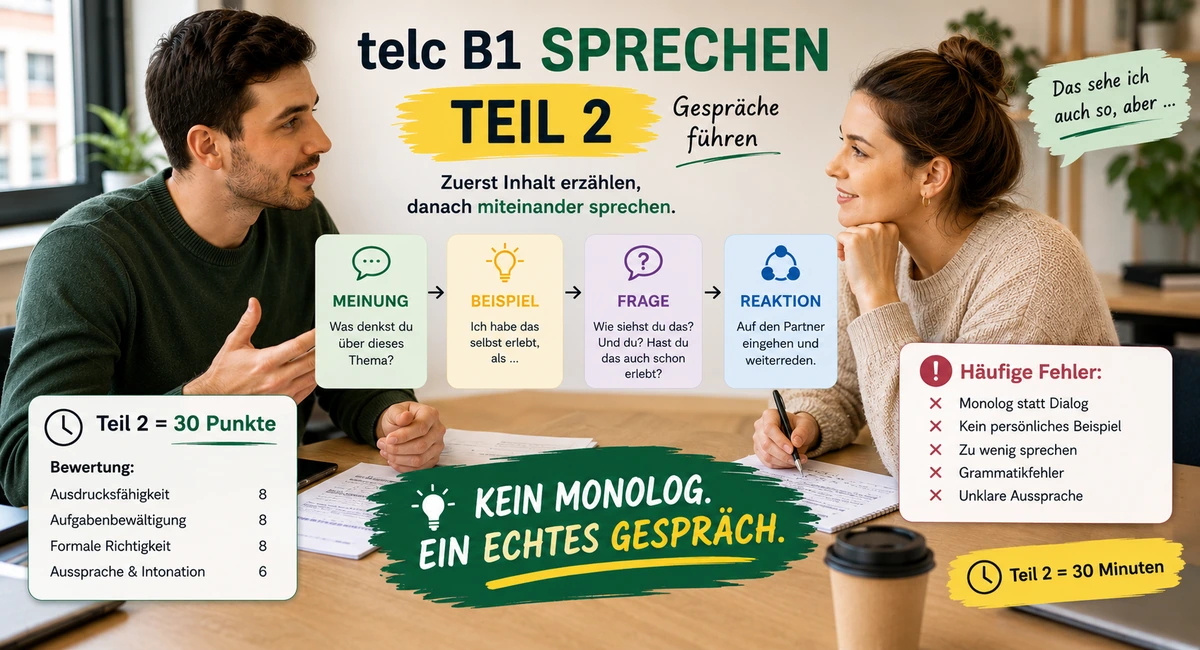
In telc Deutsch B1, Speaking Part 2 is called Über ein Thema sprechen (talking about a topic). You and your conversation partner each receive a short text with a personal opinion on an everyday topic. First you briefly report on your own text, then your partner reports on theirs. After that, you talk about the topic together: you give your opinion, provide an example from your own life, and react to what your partner says.
Important: Speaking Part 2 is not a monologue and not a presentation. It is a real conversation with another person – and that is exactly what is assessed.
Points and weighting
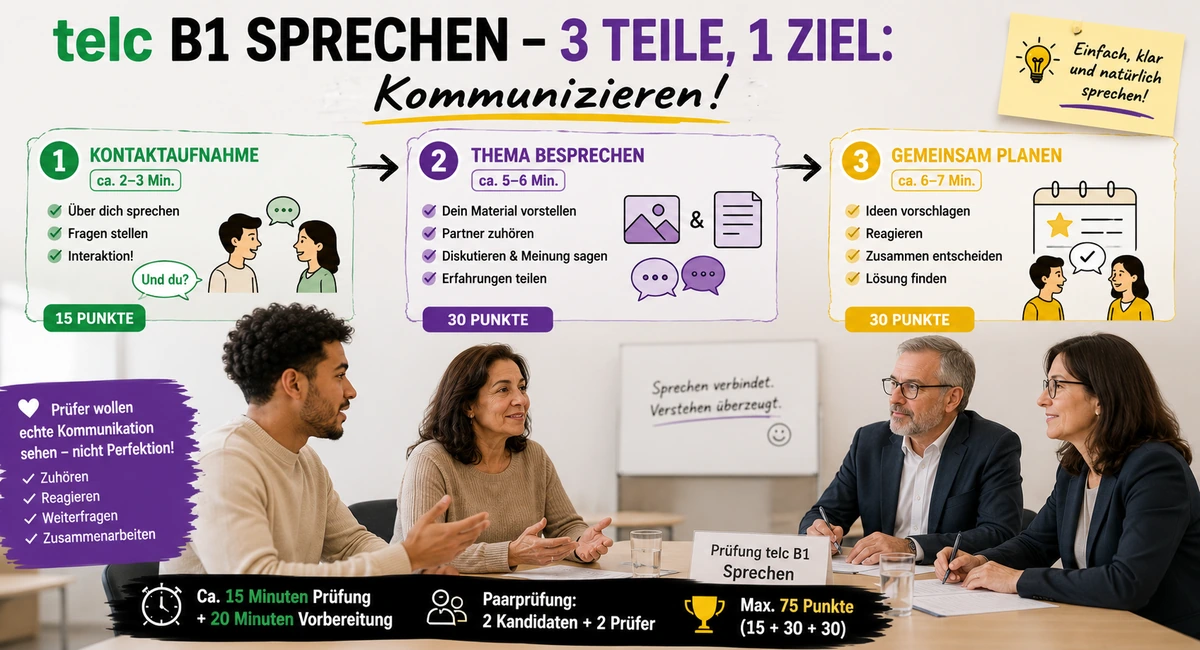
The oral exam consists of three parts. Part 2 and Part 3 each count twice as much as Part 1:
| Exam part | Content | Maximum points |
|---|---|---|
| Part 1 | Kontaktaufnahme (making contact) | 15 points |
| Part 2 | Über ein Thema sprechen (talking about a topic) | 30 points |
| Part 3 | Gemeinsam eine Aufgabe lösen (solving a task together) | 30 points |
In total, 75 points are possible in the oral exam. Part 2 is therefore one of the most important sections – a good reason to train it especially thoroughly.
Assessment criteria – how do the examiners score?
Two trained examiners assess your conversation independently of each other according to four criteria. After the conversation, they compare their evaluations and agree on a joint assessment.
| Criterion | What is assessed? | Maximum points (Part 2) |
|---|---|---|
| I. Ausdrucksfähigkeit (expressive ability) | Vocabulary and how well you can express what you want to say | 8 |
| II. Aufgabenbewältigung (task completion) | Conversation participation, conversation strategies, fluency | 8 |
| III. Formale Richtigkeit (formal accuracy) | Grammar: sentence structure and word forms | 8 |
| IV. Aussprache und Intonation (pronunciation and intonation) | Intelligibility of pronunciation and stress | 6 |
A weak result in one criterion does not automatically mean zero points for the whole conversation. Each criterion is assessed individually and then added up.
What does this mean for your training?
The largest single item is Aufgabenbewältigung (task completion): how actively you take part in the conversation, whether you react, ask follow-up questions and speak fluently. This is exactly where many candidates lose the most points – because they deliver their answer like a prepared monologue instead of really talking with their partner.
Typical mistakes and traps in Speaking Part 2
The following five traps cost the most points in Speaking Part 2. Whoever knows them can work on them in a targeted way.
Trap 1: the monologue instead of a conversation
The most common mistake: the candidate gives their opinion, provides an example – and then simply waits until it is the partner’s turn. There is no reaction to the partner’s statement and no follow-up question. That directly costs points in conversation participation.
Trap 2: opinion without an example
Some candidates say only Ich finde das gut (I think that’s good) or Ich finde das schlecht (I think that’s bad), without giving a personal example. Without an example, the statement seems thin in content, and expressive ability is assessed more weakly.
Trap 3: long pauses and blocks
When a word is missing, many candidates fall completely silent instead of phrasing what was said differently. Long pauses have a negative effect on fluency – a central part of task completion.
Trap 4: grammar mistakes at central points
Not every grammar mistake costs many points. It becomes critical when a mistake really makes understanding harder – for example a wrong tense in your own example or an unclear sentence structure at an important point.
Trap 5: unclear pronunciation of key words
When important words are pronounced so unclearly that the conversation partner has to ask again, this directly affects the criterion pronunciation and intonation.
Speaking Part 2 is not assessed on how perfectly you present a text, but on how naturally you get into a conversation with another person.
Practical tips – how to hold a real conversation
The following five strategies help to turn a prepared text into a lively conversation.
Tip 1: ask politely when you don’t understand something
Asking is allowed and is not assessed negatively – on the contrary, it shows conversation strategy. Use these formulations, for example:
- Entschuldige, ich habe das leider nicht ganz verstanden. Kannst du das bitte noch einmal sagen? (Sorry, unfortunately I didn’t quite understand that. Can you please say it again?)
- Tut mir leid, ich bin heute wegen der Prüfung etwas nervös. Kannst du deine Frage bitte wiederholen? (I’m sorry, I’m a bit nervous today because of the exam. Can you please repeat your question?)
- Entschuldige bitte, ich habe dich akustisch nicht richtig verstanden. Was meinst du genau damit? (Excuse me please, I didn’t hear you properly. What exactly do you mean by that?)
- Kannst du das bitte langsamer sagen? Ich habe es nicht ganz mitbekommen. (Can you please say that more slowly? I didn’t quite catch it.)
- Verzeih, ich war kurz unaufmerksam. Kannst du deine Frage noch einmal wiederholen? (Sorry, I was briefly inattentive. Can you repeat your question again?)
Tip 2: buy time with standard sentences
A short introductory sentence gives you two to three seconds to think without creating a pause:
- Das ist eine gute Frage. (That’s a good question.)
- Das habe ich mir auch schon oft überlegt. (I’ve often thought about that too.)
- Gute Frage, lass mich kurz überlegen. (Good question, let me think for a moment.)
- Das ist ein interessanter Punkt. (That’s an interesting point.)
- Darüber habe ich noch nicht richtig nachgedacht, aber ich versuche es mal. (I haven’t really thought about that yet, but I’ll give it a try.)
Tip 3: keep the conversation going – interim questions
End your own statement as often as possible with a short question to your partner. This automatically creates a conversation instead of a monologue:
- Wie siehst du das? (How do you see it?)
- Findest du das auch? (Do you think so too?)
- Bist du damit einverstanden? (Do you agree with that?)
- Und du, was denkst du darüber? (And you, what do you think about it?)
- Geht es dir genauso? (Do you feel the same way?)
- Siehst du das auch so? (Do you see it that way too?)
- Was ist deine Meinung dazu? (What’s your opinion on it?)
- Hast du das auch schon erlebt? (Have you experienced that too?)
- Kennst du das auch? (Do you know that too?)
- Stimmst du mir zu? (Do you agree with me?)
Tip 4: when the partner says little
Even if the partner is quiet or answers only briefly, your own conversation participation is assessed. So stay active:
- Invite them directly instead of waiting: Und du, wie siehst du das? (And you, how do you see it?)
- Ask concrete yes/no questions instead of open questions that are hard to answer: Hast du das auch schon erlebt? (Have you experienced that too?) or Machst du das auch so? (Do you do it that way too?)
- Use your own example as a bridge and immediately play back with a question: Bei mir war das so … Und bei dir, war das ähnlich? (For me it was like this … And for you, was it similar?)
- After a yes/no answer, ask a simple follow-up question that is easy to answer: Und wo warst du da? (And where were you then?) or Und wann war das? (And when was that?)
- Tolerate a short pause and give the partner two to three seconds before you continue speaking yourself.
Tip 5: train properly with the Online Examiner
Use the Online Examiner in a targeted way to check your conversation participation, not just your grammar. First listen to the example dialogues on the platform and pay attention to how balanced the speaking shares of both people are. Then practise yourself and consciously count how many sentences you speak in a row without reacting to the partner.
👉 To the exercises for Speaking B1 telc


There are no comments for this article. Leave your comment