





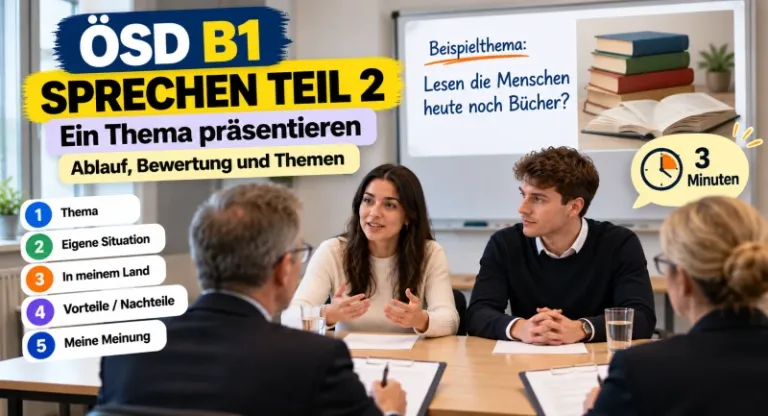
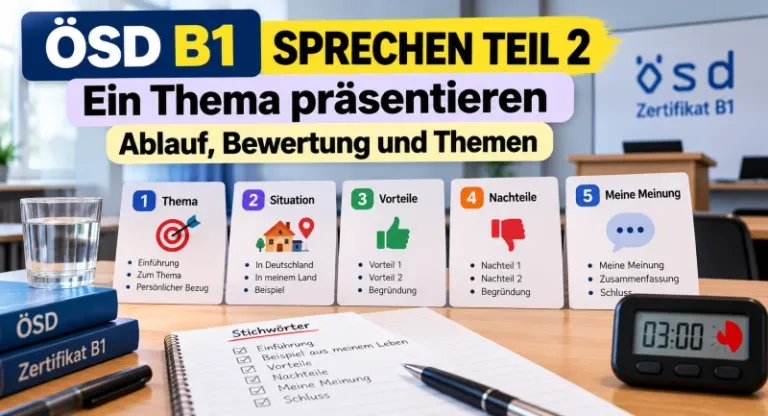
Speaking alone for about three minutes – for many people, this is the most difficult moment of the ÖSD B1 oral exam. With a clear plan, however, the presentation in Speaking Part 2 becomes easier. Here you will find a time plan for the five slides, ready-to-use German phrases for each slide, a formula for expressing the perfect opinion, the most common mistakes, and a complete B1 sample presentation with explanations.
You can read about how Part 2 works, how many points it is worth and which topics are typical in the article “ÖSD B1 Speaking Part 2 ‘Presenting a Topic’: Procedure, Assessment and Topics”. This article focuses on practice: exactly what to say and how to avoid mistakes.
The secret of a good ÖSD B1 presentation: a clear thread
In short: A good presentation is not complicated but clear. Your listeners always know where you are: at the beginning, telling your story, talking about your home country, discussing advantages and disadvantages, or reaching the conclusion. This clear progression is called the central thread of a presentation.
Many exam candidates think, “I need difficult words and long sentences.” That is not true. Simple sentences in a clear order are much more effective than complicated sentences without structure. The five slides already provide the central thread – you only need to follow it.
| ❌ Not like this | ✅ Better like this |
|---|---|
| Jumping back and forth between slides. | Discussing the slides in their exact order. |
| Starting immediately with your opinion. | Introducing the topic and structure first. |
| Saying only “Es ist gut” or “Es ist schlecht”. | Explaining with “weil” and giving an example. |
| Ending the presentation abruptly. | Giving a brief conclusion and thanking the audience. |
Which topic should you choose? The 30-second test
In short: Do not choose the topic that sounds “nicer”. Choose the one for which you can think of a personal story and an example from your home country more quickly.
Read both topics and ask yourself three questions about each. Allow only ten seconds for each answer:
- Experience: Have I experienced something related to this myself – or do I know someone who has?
- Home country: Do I know what the situation is like back home?
- Vocabulary: Do I know enough words about this topic?
The topic with more “yes” answers is your topic. Then stop spending time on the choice and start making notes immediately.
Slide 2 asks for your own situation or an experience. You can therefore also talk about a friend, colleague or family member: “Ich selbst habe keinen Hund, aber mein Nachbar …”.
Time plan: three minutes for five slides
In short: The task sheet says “circa drei Minuten” (about three minutes), while the ÖSD examination regulations specify 3–4 minutes per person. Plan for about three minutes, with a little time in reserve. You only need a short time for slides 1 and 5, and the most time for slide 4.
| Slide | Content | Time | Sentences |
|---|---|---|---|
| 1 | Topic and structure | approx. 20 seconds | 3–4 |
| 2 | Personal experience | approx. 40 seconds | 4–5 |
| 3 | Home country with examples | approx. 40 seconds | 4–5 |
| 4 | Advantages, disadvantages and opinion | approx. 60 seconds | 6–8 |
| 5 | Conclusion and thanks | approx. 20 seconds | 2–3 |
As a guide, three minutes of speaking freely at a calm B1 pace amount to around 300 words. Many candidates tell a very long story on slide 2 and then run out of time for slide 4. Yet slide 4, with its advantages, disadvantages and opinion, is the most important part. So keep your story short: Who? What happened? What did I learn?
Useful phrases for slides 1 to 5
In short: Each slide has set phrases that work with any topic. Memorize two or three for each slide. In the exam, you then only need to fill in the content.
🎯 Slide 1: Introduce the topic
| Useful German phrases | Purpose |
|---|---|
| Liebe Zuhörerinnen und Zuhörer, heute möchte ich über das Thema „…“ sprechen. | Greeting and topic |
| Meine Präsentation hat fünf Teile. | Announce the structure |
| Zuerst erzähle ich von meinen Erfahrungen. Danach spreche ich über mein Heimatland. | State the order |
| Dann nenne ich Vor- und Nachteile und sage meine Meinung. Zum Schluss fasse ich alles kurz zusammen. | Complete the outline |
🎯 Slide 2: “My personal experiences”
| Useful German phrases | Purpose |
|---|---|
| Ich möchte mit einem Erlebnis beginnen. | Opening |
| Letztes Jahr / Vor zwei Monaten ist mir etwas Interessantes passiert. | State when something happened |
| Ich selbst habe damit wenig Erfahrung, aber mein Freund / meine Kollegin … | If you have no experience yourself |
| Seit diesem Tag sehe ich das Thema anders. | Conclude the story |
🎯 Slide 3: “The situation in my home country”
| Useful German phrases | Purpose |
|---|---|
| In meinem Heimatland ist die Situation ein bisschen anders. | Open with a comparison |
| Bei uns ist es normal, dass … | Describe a common practice |
| Zum Beispiel … / Ein typisches Beispiel ist … | Give an example – required on this slide! |
| In großen Städten …, aber auf dem Land … | Show differences |
🎯 Slide 4: “Advantages and Disadvantages & My Opinion”
| Useful German phrases | Purpose |
|---|---|
| Ein großer Vorteil ist, dass … · Außerdem … | Name advantages |
| Es gibt aber auch Nachteile. · Ein weiteres Problem ist, dass … | Name disadvantages |
| Meiner Meinung nach … · Ich finde, dass …, weil … | Opinion with a reason |
| Ich würde zum Beispiel …, weil … | Example supporting your opinion |
🎯 Slide 5: “Conclusion & Thanks”
| Useful German phrases | Purpose |
|---|---|
| Zum Schluss möchte ich sagen: … | Introduce the conclusion |
| Wichtig ist, dass … | Repeat the key message |
| Vielen Dank für Ihre Aufmerksamkeit! | Thank the audience |
| Ich beantworte gern Ihre Fragen. | Transition to Part 3 |
Transition sentences: how to move from slide to slide
In short: A transition sentence tells listeners that you are moving on to the next slide. It holds your presentation together and gives you a second to glance at your notes.
| Transition | Transition sentence in German |
|---|---|
| Slide 1 → 2 | Ich möchte mit meiner eigenen Erfahrung beginnen. |
| Slide 2 → 3 | Jetzt möchte ich über mein Heimatland sprechen. |
| Slide 3 → 4 | Kommen wir nun zu den Vor- und Nachteilen. |
| Advantages → disadvantages | Es gibt aber auch Nachteile. |
| Slide 4 → 5 | Zum Schluss möchte ich sagen: … |
If you get nervous and suddenly do not know what to say next, simply use the next transition sentence. It automatically takes you to the next slide and keeps your presentation moving.
The formula for slide 4: opinion + “weil” + example
In short: On slide 4, you should express your opinion and give examples. The safest formula is: Opinion → reason with “weil” → specific example with “Ich würde zum Beispiel …”.
| Step | Example on the topic “Sollen Kinder ein Musikinstrument lernen?” |
|---|---|
| 1. Two advantages | Ein großer Vorteil ist, dass Kinder Geduld lernen. Außerdem macht Musik Spaß. |
| 2. Two disadvantages | Es gibt aber auch Nachteile. Ein Instrument ist teuer. Außerdem muss man jeden Tag üben. |
| 3. Opinion | Meiner Meinung nach ist Musik für Kinder sehr gut. |
| 4. Example + “weil” | Ich würde zum Beispiel zuerst ein Instrument ausleihen, weil man dann sieht, ob das Kind Lust hat. |
Two advantages, two disadvantages, one clear opinion and one example. With these four building blocks, slide 4 is complete.
12 common mistakes in ÖSD B1 Speaking Part 2
In short: Most points are lost because part of the task is missing or because candidates read aloud instead of speaking freely. These twelve mistakes are easy to avoid.
| Mistake | Better approach |
|---|---|
| ❌ Writing out and reading a complete text | ✅ Writing down only keywords and speaking freely |
| ❌ Only naming the topic on slide 1 | ✅ Also explaining the structure: “Zuerst …, danach …” |
| ❌ Forgetting slide 2 or slide 3 | ✅ Always discussing all five slides in order |
| ❌ Giving no example on slide 3 | ✅ Giving at least one specific example: “Zum Beispiel …” |
| ❌ Mentioning only advantages or only disadvantages | ✅ Presenting both sides, with at least two points for each |
| ❌ Giving an opinion without a reason: “Ich finde das gut.” | ✅ Always explaining it with “weil” |
| ❌ Not giving a clear opinion on the topic question | ✅ Answering the question: yes, no, or “ja, aber …” |
| ❌ Being too brief: finishing after one minute | ✅ Preparing several sentences for every slide |
| ❌ Spending too long on slide 2 | ✅ Keeping the story short and saving time for slide 4 |
| ❌ Simply stopping without a conclusion | ✅ Summarizing briefly and thanking the audience |
| ❌ Using difficult words you cannot pronounce confidently | ✅ Using simple words you know well – pronunciation is assessed |
| ❌ Speaking quietly and looking only at the paper | ✅ Speaking loudly and slowly, and looking at the listeners |
What a good sheet of notes looks like
In short: A good sheet of notes contains only three to five keywords per slide. Write complete sentences in just two places: your opening sentence and your opinion.
Topic: “Lesen die Menschen heute noch Bücher?”
| Slide | Keywords on your sheet of notes |
|---|---|
| 1 | „Liebe Zuhörer… heute: Lesen“ · 5 Teile |
| 2 | früher jeden Abend · Handy · Urlaub ohne Handy · 2 Romane · jetzt 20 Min. |
| 3 | Ältere: Zeitung · Bücher teuer · wenig Bibliotheken · Junge: Apps · Buchmesse |
| 4 | + Wörter, Ideen · + entspannt, Schlaf · – Zeit · – Videos spannender · „Meiner Meinung nach bleibt Lesen wichtig.“ · Kindern vorlesen, weil … |
| 5 | Papier oder E-Reader egal · Hauptsache lesen · Dank |
On slide 4, put a “+” before each advantage and a “–” before each disadvantage. This lets you see in a second whether you have covered both sides.
B1 presentation example: sample text with explanation
In short: This is what a complete ÖSD B1 presentation based on the notes above could sound like. The sample text is about 300 words long, takes around three minutes at a calm pace, and uses only simple sentences.
Topic: “Lesen die Menschen heute noch Bücher?”
Slide 1: Liebe Zuhörerinnen und Zuhörer, heute möchte ich über ein Thema sprechen, das mir sehr am Herzen liegt: Lesen die Menschen heute noch Bücher? Zuerst erzähle ich Ihnen von meinen eigenen Erfahrungen. Danach berichte ich über die Situation in meinem Heimatland. Dann spreche ich über die Vor- und Nachteile und sage meine Meinung. Zum Schluss fasse ich alles kurz zusammen.
Slide 2: Früher habe ich fast jeden Abend ein Buch gelesen. Seit ich ein Smartphone habe, lese ich aber meistens nur noch kurze Texte im Internet. Letzten Sommer habe ich im Urlaub mein Handy zu Hause vergessen. In dieser Woche habe ich zwei Romane gelesen und mich sehr wohlgefühlt. Seitdem lese ich wieder jeden Abend zwanzig Minuten.
Slide 3: Jetzt möchte ich über mein Heimatland sprechen. Bei uns lesen vor allem ältere Menschen, meistens die Zeitung. Bücher sind ziemlich teuer, und es gibt nur wenige Bibliotheken. Junge Leute lesen lieber auf dem Handy, zum Beispiel Nachrichten oder kurze Geschichten in Apps. In der Hauptstadt gibt es aber jedes Jahr eine Buchmesse, und sie ist immer sehr voll.
Slide 4: Kommen wir nun zu den Vor- und Nachteilen. Ein großer Vorteil ist, dass man beim Lesen viele neue Wörter und Ideen lernt. Außerdem entspannt ein Buch am Abend, und man schläft besser als nach dem Bildschirm. Es gibt aber auch Nachteile. Lesen kostet viel Zeit, und viele Menschen haben nach der Arbeit keine Energie mehr. Außerdem finden viele junge Leute Videos spannender als Bücher. Meiner Meinung nach bleibt Lesen sehr wichtig. Ich würde zum Beispiel kleinen Kindern jeden Abend vorlesen, weil sie so früh Freude an Büchern bekommen.
Slide 5: Zum Schluss möchte ich sagen: Es ist egal, ob man auf Papier oder auf einem E-Reader liest. Wichtig ist, dass wir uns jeden Tag ein bisschen Zeit für Bücher nehmen. Vielen Dank für Ihre Aufmerksamkeit! Ich beantworte gern Ihre Fragen.
| What happens in the presentation | Why this is good |
|---|---|
| Slide 1 names the topic and all five parts. | ✅ Listeners know the central thread. |
| Slide 2 tells a short, specific story with a time and an outcome. | ✅ Personal, but not too long. |
| Slide 3 compares older and younger people and gives examples. | ✅ Examples as required. |
| Slide 4: two advantages, two disadvantages, an opinion and an example with “weil”. | ✅ The formula is complete. |
| Transition sentences between slides | ✅ Clear structure, no awkward pauses. |
| Slide 5 with key message and thanks | ✅ A clear ending and a good transition to Part 3. |
After the presentation: answering questions well
In short: After your presentation, you receive feedback and questions in Part 3. Prepare for these while making your notes: What question might someone ask about your story or your opinion?
| Situation | How you can respond in German |
|---|---|
| Someone praises your presentation. | Vielen Dank, das freut mich sehr! |
| You do not fully understand the question. | Entschuldigung, können Sie die Frage bitte noch einmal sagen? |
| You need a moment to think. | Das ist eine gute Frage. Ich denke, … |
| The question relates to your story. | Ja, genau. Wie ich schon erzählt habe, … |
| You are not sure of the answer. | Das weiß ich leider nicht genau, aber ich glaube, … |
Possible questions include “Warum ist das in Ihrem Heimatland so?”, “Was würden Sie anders machen?” and “Wie ist das bei Ihnen in der Familie?”. During preparation, briefly think of an answer to each of these three questions.
FAQ – strategies for the ÖSD B1 presentation
Deutsch-Vorbereitung is an independent learning resource and has no affiliation with the Austrian German Language Diploma (ÖSD). “ÖSD” is a trademark of the Österreichisches Sprachdiplom Deutsch. All information about the task is based on official ÖSD publications, especially the ÖSD Zertifikat B1 sample examination – Speaking and the ZB1 examination regulations (version 10/2023) (as of October 2026). More information is available on the official ÖSD Zertifikat B1 page. The time plan, strategies and useful phrases are recommendations from Deutsch-Vorbereitung. The current examination regulations and the information provided by your examination centre are always authoritative.




There are no comments for this article. Leave your comment