





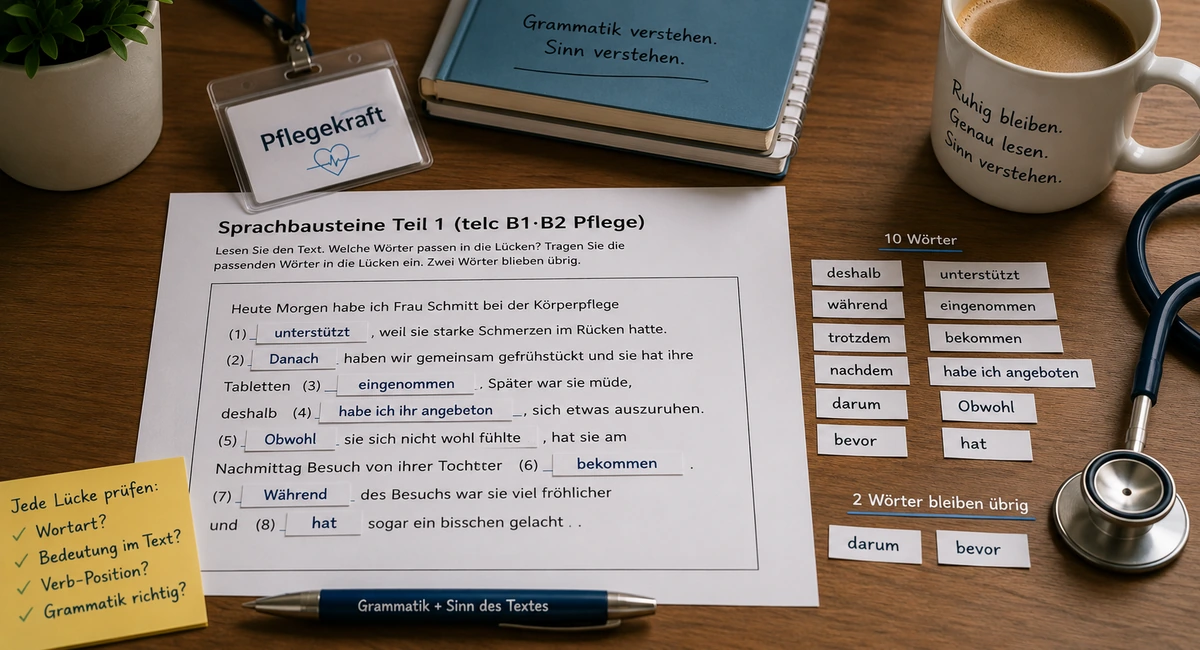
Sprachbausteine Teil 1 (telc B1·B2 Pflege):
Understanding grammar and training correctly
Sprachbausteine Teil 1 looks difficult, but with the right method it can be learned well. Here you will find out what is tested, which grammar you really need, what traps there are — and above all, how to practise correctly from the very beginning.
What is Sprachbausteine Teil 1? Format, requirements and points
Sprachbausteine is part of the written section of the telc Deutsch B1·B2 Pflege exam and is completed together with Lesen. Unlike Leseverstehen, the focus here is not on the content of a text but on language structures — that is, grammar and vocabulary. The section has two parts: Teil 1 covers grammar, Teil 2 covers specialist vocabulary. Because telc B1·B2 Pflege is a scaled exam, it covers both levels B1 and B2 simultaneously.
This is what Teil 1 looks like in practice: you read a short text from everyday nursing life, very often a report. Eight words are missing from the text. Below it there is a list of ten words. For each gap you choose a suitable word from this list. Important: of the ten words, only eight fit. Two words are surplus and do not belong in any gap. What is primarily tested are connecting words (Konnektoren), Präpositionen, Adverbien and the prefixes of separable verbs.
| Feature | Sprachbausteine Teil 1 |
|---|---|
| Task type | Matching: one word per gap from a shared list |
| Number of gaps | 8 |
| Words to choose from | 10 (one list) |
| Distraktoren | 2 words do not fit any gap |
| Focus | Grammar and text cohesion |
| Structures tested | Konnektoren, Präpositionen, Adverbien, prefixes of separable verbs |
| Points | 8 (one point per correctly solved gap) |
| Assessment | Together with Hören and Lesen, Dual-Level B1/B2 |
Hören, Lesen and Sprachbausteine are evaluated together. One point is awarded for each correctly solved task. Teil 1 therefore brings up to 8 points. There is no separate pass threshold just for Sprachbausteine B1-B2 Pflege — what matters is the overall result in the written section. Every point counts, so targeted practice is worthwhile.
There is one thing you should know from the very beginning: Teil 1 is not a pure grammar test. Very often several words from the list fit grammatically into the gap, but only one word fits the meaning of the text. You therefore need two things: solid grammar and a feel for text cohesion — that is, for temporal and causal relationships between sentences. That is exactly what we train in this article.
👉 Exercises for telc B1·B2 PflegeThe typical traps, tricks and mistakes — with examples
The task is deliberately built with traps. If you know the following patterns, you will no longer fall into them. Each trap comes with a small example.
- Grammar instead of logic (the most important trap). Example: Die Tochter ___ der Pflegedienst betreuen sie. Both und and oder fit grammatically. But only und is correct because both are caring for her together — not one or the other. Always check the logic first.
- Konjunktion versus Adverb. Both can express reason and consequence, but the sentence structure is different. weil sends the verb to the end: ..., weil sie unsicher ist. deshalb comes first, then the verb: Deshalb ist sie unsicher. Confusing these two leads to a wrongly built sentence.
- Reason versus contrast. deshalb (consequence) and trotzdem (contrast) both stand at the beginning of the sentence but mean the opposite. Ask yourself: does this express a consequence or a contradiction?
- Time versus reason. seitdem (since that point in time) and deshalb (therefore) can be confused when the sentence would allow both. Only context helps here.
- Sequence of events. vor versus nach, bevor versus nachdem: what came first, what came later? Example: Vor dem Sturz konnte sie noch allein gehen. The word noch shows: it is about the time before.
- da-Komposita. dadurch, darunter, dafür, davor, daneben, dazu look similar but mean different things. Sie ist abhängig. Darunter leidet sie. Here only darunter fits, not dazu.
- Relativpronomen. die (Nominativ plural), der (singular masculine) and denen (Dativ plural) are confused. Example: Medikamente, die ihr helfen. The medicines are the subject in the plural, so die.
- Komparativ trap. When the text is full of comparisons (öfter, mehr als), a second Komparativ like größer is distracting — it does not have a gap at all.
- Passive: tense and number. wurde (one person, past) versus wurden (several) versus wird (present). Example: Die Bewohnerin wurde aufgenommen. — one person, past, so wurde.
- Postposition. gegenüber stands after the pronoun: ihr gegenüber, not gegenüber ihr.
- Adjective ending. After an article the adjective takes an ending (die langjährige Kollegin); with sein it stays without an ending (Sie war sehr unsicher).
- Fixed verb-Präposition combinations. Many verbs have a fixed Präposition: informieren über, leiden unter, sich Sorgen machen um, etwas als ... empfinden. These must be known by heart.
- Quantoren trap. allen (= all) and keinen (= none) look similar but reverse the meaning.
- The two surplus words are deliberately plausible. Never choose by gut feeling — check every gap individually.
In Teil 1, it is often not grammar alone that decides but the logical connection in the text. For every gap ask first: is this about time, a reason, a consequence or a contrast? And only then: does the word also fit grammatically in the sentence?
Grammar explained simply: everything you need to know
Here are all the grammar topics that really appear in Teil 1 — briefly explained, with a clear example and a tip on how to recognise the correct word.
1. Konnektoren — the most important topic
Konnektoren are words that connect sentences and show HOW two pieces of information are related. Most gaps in Teil 1 are Konnektoren. There are three groups, and the difference lies in the sentence structure.
Group A — coordinating Konjunktionen: und, oder, aber, sondern, denn. They connect two equal sentences; afterwards the normal word order remains (subject, then verb). und = together, oder = choice, aber/sondern = contrast (sondern only after a negation: keine normale Folge, sondern eine Krankheit), denn = reason.
Group B — subordinating Konjunktionen: weil, da, dass, nachdem, bevor, seitdem, während, sobald. They introduce a subordinate clause. Key feature: the verb moves to the end of the clause. Example: Sie braucht Hilfe, weil sie nicht gehen kann. Temporal: nachdem (first A, then B), bevor (before), seitdem (since that point in time).
Group C — Konjunktionaladverbien: deshalb, deswegen, daher, dadurch, trotzdem, dennoch, allerdings, jedoch, dann, danach, anschließend, zunächst, bisher, inzwischen. They often stand at the beginning of the sentence; immediately after them comes the verb (inversion). Example: Sie übt täglich. Deshalb geht es ihr besser.
Look at the verb. If the verb is at the end of the clause, you need a subordinating Konjunktion (weil, da, nachdem, seitdem). If the verb comes immediately after the gap in second position, you need an Adverb (deshalb, trotzdem, dann). This is how you distinguish weil from deshalb, even though both relate to reason and consequence.
2. Präpositionen
Präpositionen are small words before a noun or pronoun. Temporal and causal Präpositionen are particularly important.
- Temporal (with Dativ): vor, nach, seit, bei, in. Example: vor dem Sturz (in the time before), nach der Operation (afterwards), seit drei Wochen (from a point in time until now).
- Special form beim (= bei + dem) comes before a capitalised verb and means during: beim Eingießen, beim Spazierengehen.
- Causal (with Genitiv): aufgrund, wegen. Example: aufgrund der Operation = because of the operation.
- Fixed phrases must be learnt by heart: im Rahmen + Genitiv (= within the context of), bei jemandem liegt ... vor.
- Watch out for the postposition: gegenüber stands after the pronoun: ihr gegenüber.
3. Pronominaladverbien (da + Präposition)
These are words such as dadurch, darunter, dafür, davor, dazu, dahin. They replace Präposition + das/es when talking about a thing (instead of unter das one says darunter). They usually refer to something mentioned earlier in the text. Examples: Sie ist abhängig. Darunter leidet sie. · Sie wird umgelagert. Dadurch sinkt der Druck. · bis dahin = until that point in time. Tip: read carefully what the word is pointing to and which meaning fits — the forms look very similar.
4. Relativpronomen
A Relativpronomen (der, die, das, denen ...) introduces a relative clause and replaces a noun. It depends on two things: first on the reference word (Genus and Numerus), second on its function in the subordinate clause (Kasus). Example: Medikamente, die ihr helfen — the reference word is plural, in the subordinate clause it is the subject, so Nominativ plural: die. The trap denen (Dativ plural) only fits when a Dativ is needed.
5. Verb forms and fixed verb-Präposition combinations
- Partizip II in Perfekt: with haben/sein + Partizip at the end. Sie hat den Brief beantwortet.
- Vorgangspassiv: wurde/wurden + Partizip II. Sie wurde aufgenommen. Pay attention to tense and number.
- Separable verbs: the prefix stands at the end of the sentence. Sie nimmt die Tabletten ein. In Perfekt and in subordinate clauses it joins again.
- Fixed verb-Präposition combinations: certain verbs require a fixed Präposition — learn them like vocabulary: informieren über, leiden unter/an, sich Sorgen machen um, etwas als ... empfinden.
- Fixed phrase: zur Verfügung stellen → Partizip gestellt.
6. Articles, Kasus and adjective endings
- Kasus after the verb: benötigen and brauchen require the Akkusativ. Sie benötigt einen Rollstuhl (masculine → einen).
- Adjective ending after the article: die langjährige Kollegin, zu einer deutlichen Reduktion.
- Predicative adjective (with sein) stays without an ending: Sie war sehr unsicher.
7. Quantoren and Komparativ
- Quantoren such as manche, alle, kein, viele, einige say how many. Trap: allen and keinen look similar but mean the opposite.
- Komparativ always goes with als: öfter als zweimal.
- Gradpartikel zu before an adjective = excess: eine zu hohe Trinkmenge (more than is good).
8. Word order
This rule helps with almost every Konnektor gap. In the main clause the verb stands in second position. If there is already a word at the front (e.g. Deshalb), the verb comes immediately after it (inversion): Deshalb braucht sie Hilfe. In the subordinate clause the verb stands at the end: ..., weil sie Hilfe braucht.
How to solve the task — and how to train correctly from the very beginning
This part is the most important. Those who practise with the right method from the very start make fewer mistakes later and work faster. It goes in two steps: first you learn how to think through every gap, then you learn how to train correctly.
A. How to think through every gap — four questions
For every gap ask yourself four questions, always in this order:
- What kind of word is missing here? A connecting word, a Präposition, a verb form, an article or an adjective? Look carefully at what comes before and after the gap.
- What relationship should the word express? Time, reason, consequence, contrast or addition? Read the sentence before and the sentence after.
- Where is the verb? At the end of the clause → you need a Konjunktion (subordinate clause). Immediately after the gap in second position → you need an Adverb. This question decides between words with similar meanings.
- Does the word fit grammatically? Do number, gender, case and ending match? Does the whole sentence sound logical?
The sentence with the gap: Frau Berg ist beim Gehen sehr unsicher. ___ benötigt sie einen Rollator.
Three words to choose from: weil, deshalb, trotzdem. Which one is correct? We work through the four questions one by one.
Question 1 — What kind of word is missing here?
Let us look at what surrounds the gap. Before the gap a complete sentence ends: Frau Berg ist beim Gehen sehr unsicher. After the gap a new sentence begins: ... benötigt sie einen Rollator. The missing word stands exactly between two sentences and connects them. We therefore need a connecting word. All three words (weil, deshalb, trotzdem) are connecting words — up to this point all three still fit.
Question 2 — What relationship should the word express?
Now we think about how the two sentences relate to each other in terms of content. Sentence 1 (she is unsteady) is the reason. Sentence 2 (she needs a Rollator) is the consequence. It is therefore about reason and consequence. This eliminates trotzdem, because trotzdem shows a contrast (it would mean: even though she is unsteady, she does NOT need a Rollator — that is illogical). weil and deshalb remain.
Question 3 — Where is the verb?
Now the sentence structure decides between weil and deshalb. Both relate to reason and consequence, but they build the sentence differently. Let us look at the verb after the gap: benötigt stands directly after the gap in second position. Rule: if the verb stands immediately after the connecting word in second position, we need an Adverb, i.e. deshalb. The Konjunktion weil would send the verb to the end of the sentence (..., weil sie einen Rollator benötigt). Here the verb is in second position — so deshalb and not weil.
Question 4 — Does everything fit together?
Let us insert deshalb and read the whole sentence: Deshalb benötigt sie einen Rollator. Subject (sie) and verb (benötigt) match, the sentence structure is correct (Adverb at the front, verb in second position) and the logic is correct (reason leads to consequence). Solution: deshalb.
How we eliminated the words step by step: Question 2 eliminates trotzdem (wrong meaning), Question 3 eliminates weil (wrong sentence structure), deshalb remains.
B. How to train correctly from the very beginning
It is not the quantity of tasks that makes the difference, but HOW you practise. These habits build the skill step by step:
- Always read the explanation, not just the result. After every task check not only right or wrong, but read WHY the solution is correct. Only then do you understand the pattern and can apply it yourself next time.
- Build your own Konnektoren table. Sort the connecting words by their function: time, reason, consequence, contrast, addition. This way you immediately see which words are competitors (e.g. deshalb and trotzdem) and how they differ.
- Collect da-Komposita and fixed verb-Präposition combinations. Write a list such as darunter leiden, sich Sorgen machen um, informieren über and learn them like vocabulary. These combinations come up again and again.
- Correct mistakes by hand. After a mistake, write the whole correct sentence out by hand once. This sticks much better than simply marking the right answer.
- Pattern first, then speed. Practise at first without time pressure, working consciously through the four questions. Only once the method is secure should you practise with a time limit as in the real exam.
- Read real reports. Read admission reports, progress reports and incident records. This gives you a feel for the typical sentence connections that keep coming up in Teil 1.
- Do the Distraktoren check at the end. After solving, exactly two words must remain. If more or fewer are left, you have made a mistake somewhere — and you should check your assignments again.
Solve the gaps you are sure about first and cross those words off the list. The difficult gaps will then become easier because fewer words remain. At the end leave no gap empty: if you are uncertain, assign the remaining words so that the sentence sounds as logical as possible.


There are no comments for this article. Leave your comment