





B1 ÖSD Writing Part 3:
topics, universal sentences and set phrases
The most important topics for Writing Part 3 in the ÖSD certificate B1, plus universal sentences and set phrases that you can use for every formal email.
Overview: what is this article for?
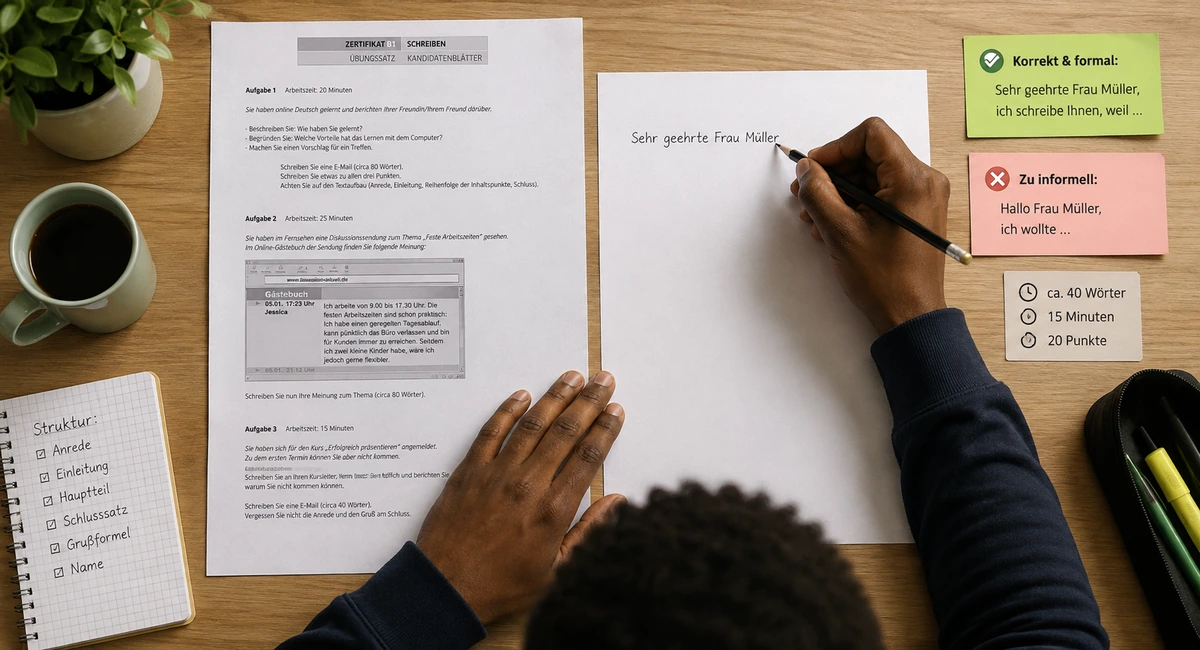
In Writing Part 3 you write a short, formal email of about 40 words. The topics are always practical and come from everyday life, work or training. If you know the topics and the most important sentences, you save a lot of time in the exam.
In this article you find the typical topics plus universal sentences and set phrases. These sentences almost always fit. You only have to change the name, the reason or the appointment.
Learn two or three fixed sentences by heart for each language action. This way you have a good start immediately in the exam and make fewer mistakes.
The most important topics in Writing Part 3
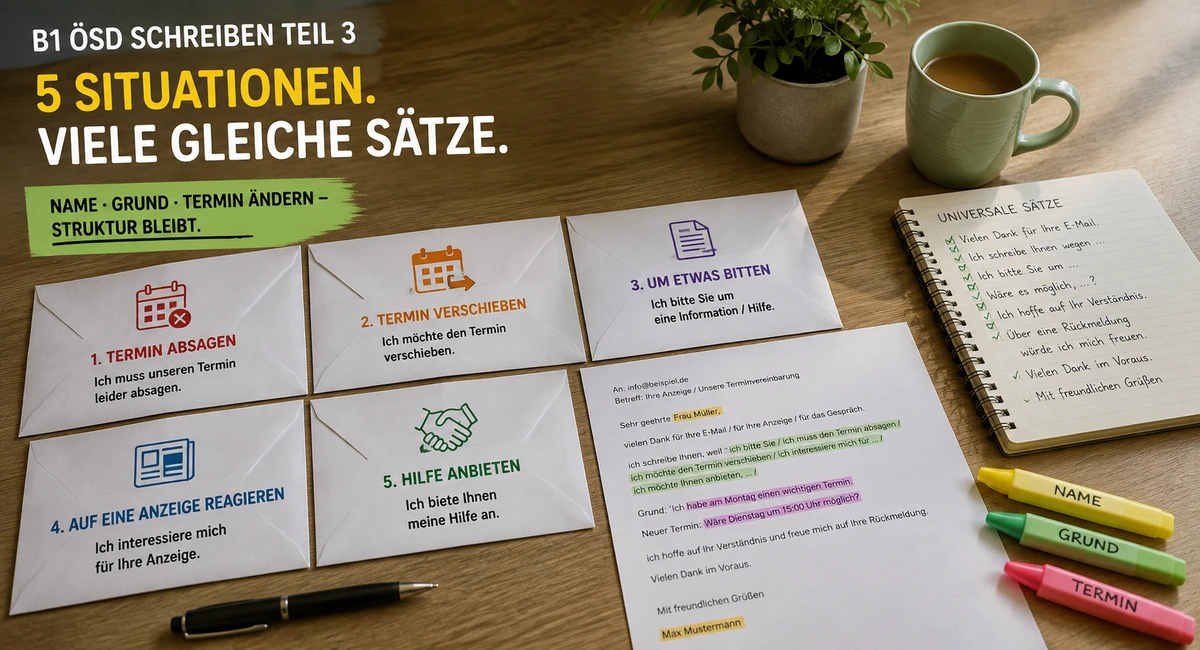
The topics in Part 3 repeat often. Usually it is about one of these five situations:
| Topic | Example |
|---|---|
| Cancelling an appointment | you cannot come to a meeting or course |
| Postponing an appointment | you would like to move a meeting to another day |
| Asking for something | you need information, documents or a certificate |
| Responding to an advertisement | you are interested in a flat, a car or a job |
| Offering help | you would like to help at a celebration or a project |
If you practise these five situations, you are prepared for almost any task.
👉 All exercises for the ÖSD B1 examUniversal sentences for salutation and introduction
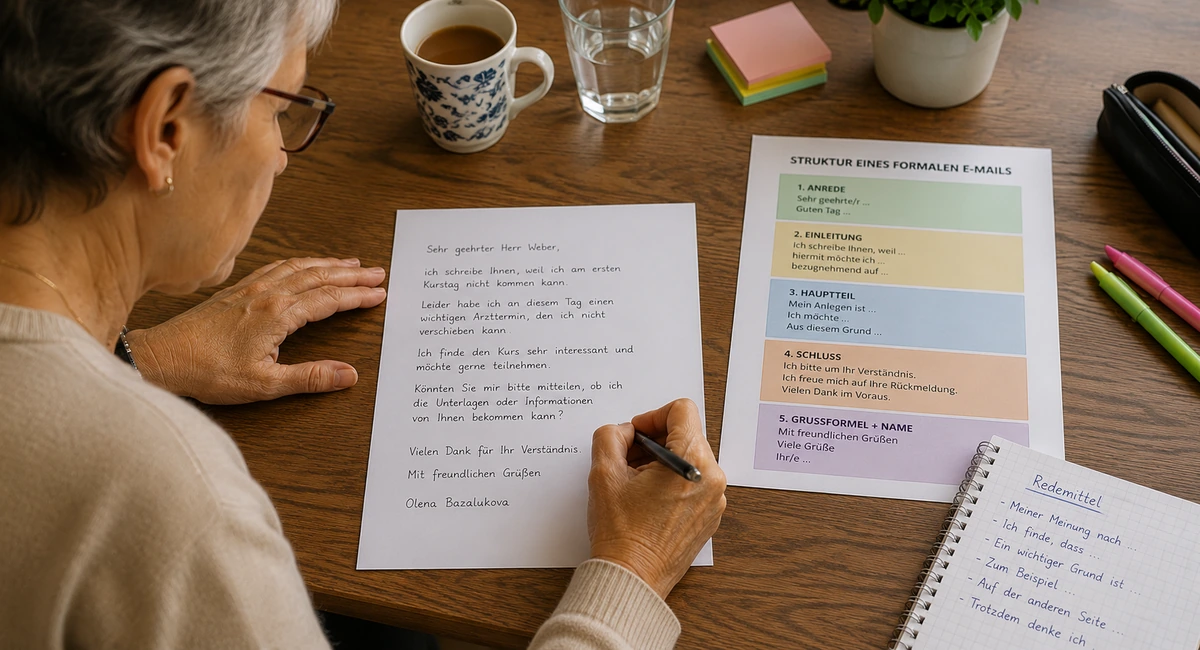
Every email in Part 3 begins with a formal salutation. After that comes a short introductory sentence.
Anrede (salutation)
- Sehr geehrte Frau [Name],
- Sehr geehrter Herr [Name],
- Sehr geehrte Damen und Herren, (if you do not know the name)
Einleitung (introduction)
- vielen Dank für Ihre Einladung.
- vielen Dank für Ihre E-Mail.
- ich schreibe Ihnen wegen [Thema].
- mit großem Interesse habe ich Ihre Anzeige gelesen.
After the salutation comes a comma. You write the first word after it in lower case, for example: Sehr geehrte Frau Müller, vielen Dank …
Set phrases: sich entschuldigen und einen Termin absagen (apologising and cancelling an appointment)
This is the most frequent situation in Part 3. These sentences help you:
Apologising
- Leider muss ich mich entschuldigen, da ich …
- Es tut mir leid, aber leider kann ich nicht kommen.
- Leider kann ich an diesem Tag nicht teilnehmen.
Stating the reason
- An diesem Tag muss ich arbeiten.
- Ich bin an diesem Tag krank.
- Ich bin im Urlaub und nicht in der Stadt.
Apologising again
- Das tut mir sehr leid.
- Ich hoffe auf Ihr Verständnis.
Set phrases: einen Termin verschieben und vorschlagen (postponing and suggesting an appointment)
Sometimes you should not only cancel, but also suggest a new appointment.
Postponing
- Leider muss ich unseren Termin verschieben.
- Können wir den Termin bitte auf einen anderen Tag legen?
Suggesting a new appointment
- Hätten Sie vielleicht am nächsten Montag Zeit?
- Würde Ihnen der Mittwoch um 15 Uhr passen?
- Wäre ein Termin in der nächsten Woche möglich?
With Hätten Sie and Würde Ihnen your suggestion sounds especially polite. This form makes a good impression in the exam.
Set phrases: um etwas bitten (asking for something)
Often you should ask for a piece of information, a document or help.
Asking politely
- Könnten Sie mir bitte sagen, …?
- Könnten Sie mir bitte mehr Informationen schicken?
- Ich möchte Sie um eine Bescheinigung bitten.
Saying thank you (at the end)
- Vielen Dank im Voraus.
- Über eine baldige Antwort würde ich mich sehr freuen.
Set phrases: auf eine Anzeige oder einen Aushang reagieren (responding to an advertisement or a notice)
With this topic you show interest, ask a question and say how you can be reached.
Showing interest
- Mit großem Interesse habe ich Ihre Anzeige gelesen.
- Auf Ihrem Aushang habe ich gelesen, dass …
- Diese Stelle / Wohnung interessiert mich sehr.
Asking a question
- Ist die Wohnung noch frei?
- Könnten Sie mir bitte den Preis nennen?
Giving your availability
- Sie erreichen mich jederzeit unter [Telefonnummer].
- Sie können mich per E-Mail oder telefonisch erreichen.
Write your phone number or email only if the task requires it. For a cancellation you do not need this information.
Set phrases: Hilfe oder Mitarbeit anbieten (offering help or participation)
With this topic you kindly offer your help.
Offering help
- Sehr gerne möchte ich Ihnen helfen.
- Gerne möchte ich bei dem Fest mithelfen.
- Ich würde Sie gerne unterstützen.
Asking a question about the help
- Können Sie mir bitte sagen, wobei Sie Hilfe brauchen?
- An welchen Tagen brauchen Sie Unterstützung?
Universal closing sentences and closings
A good closing sentence fits the topic. After that comes the closing and your name.
Closing sentences by topic
- Cancellation → Ich hoffe auf Ihr Verständnis.
- Appointment suggestion → Über eine kurze Rückmeldung würde ich mich freuen.
- Request → Vielen Dank im Voraus.
Grußformel (closing)
- Mit freundlichen Grüßen
- Freundliche Grüße
Name (name)
Your first and family name, for example Maria Sanchez.
A complete model letter with universal sentences
This is what an email looks like when you use only universal sentences. The task: you cannot come to a consultation appointment.
Sehr geehrte Frau Lindner,
vielen Dank für die Einladung zu unserem Termin. Leider muss ich mich entschuldigen, da ich an diesem Tag arbeiten muss. Hätten Sie vielleicht nächste Woche Zeit? Über eine kurze Rückmeldung würde ich mich freuen.
Mit freundlichen Grüßen
Maria Sanchez
You can see: salutation, introduction, apology, reason, appointment suggestion, closing sentence and closing. All parts are universal and also fit other topics.




There are no comments for this article. Leave your comment