





Goethe B1 Listening Part 4 at a glance: a radio discussion with three speakers, 8 “Who says what?” questions, two listenings, and 8 out of 30 points. Plus: an overview of the entire Goethe B1 Listening exam and how many points you need to pass – with links to official Goethe-Institut sources.
What Is Goethe B1 Listening Part 4?
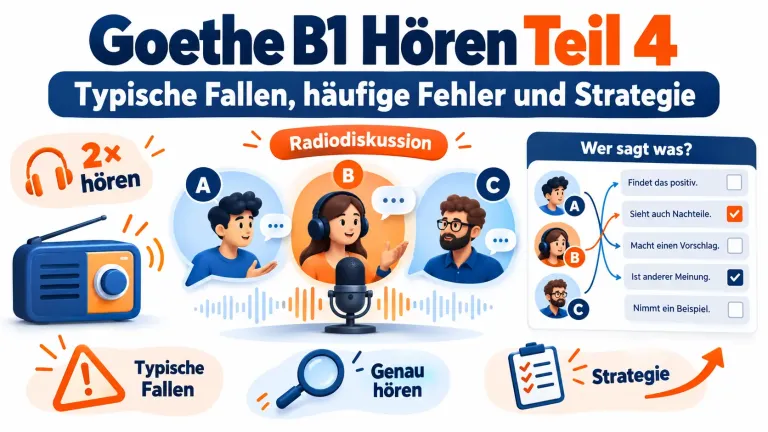
In short: Goethe B1 Listening Part 4 consists of a radio discussion. A male or female host talks with two guests about a topic related to public life. You match 8 statements to the three speakers and listen to the discussion twice.
Part 4 is the final section of the Listening module in the Goethe-Zertifikat B1 exam. The Goethe-Institut describes its purpose as testing whether candidates can identify different opinions. So the task is not about recognizing a particular number or time, but about answering the question: Which speaker expresses which idea?
Goethe B1 Listening Exam Overview: All Four Parts
The Listening module consists of four parts with a total of 30 questions. Part 4 is the longest section and contains the most questions. Along with Part 1, it is the only section in which the audio recording is played twice.
| Part | Audio Text | Listenings | Questions | Duration | Points |
|---|---|---|---|---|---|
| Part 1 | 5 short recordings: announcements, voicemail messages, short news reports | 2× each | 10 (True/False + a/b/c) | approx. 10 min. | 10 |
| Part 2 | Presentation or guided tour | 1× | 5 (a/b/c) | approx. 5 min. | 5 |
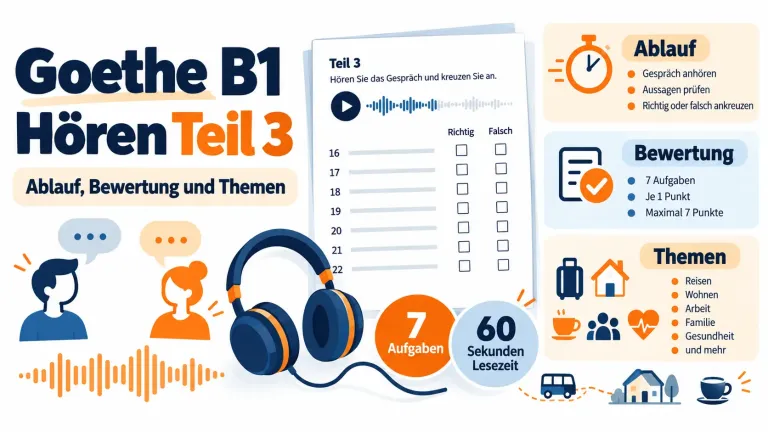
| Part 3 | Everyday conversation | 1× | 7 (True/False) | approx. 8 min. | 7 |
| Part 4 | Radio discussion with three speakers | 2× | 8 (match statements to speakers) | approx. 12 min. | 8 |
The entire Listening module takes approximately 40 minutes: 35 minutes of listening and 5 minutes to transfer your answers to the answer sheet.
Source: Goethe-Institut, “Tips and Tricks for Exam Preparation – Goethe-Zertifikat B1, Listening” (PDF, in German).
Listening Part 4: Step-by-Step Procedure
In short: Listen to the instructions, read the questions for 60 seconds, listen to the discussion twice, and select a, b, or c. At the end of the module, transfer your answers to the answer sheet.
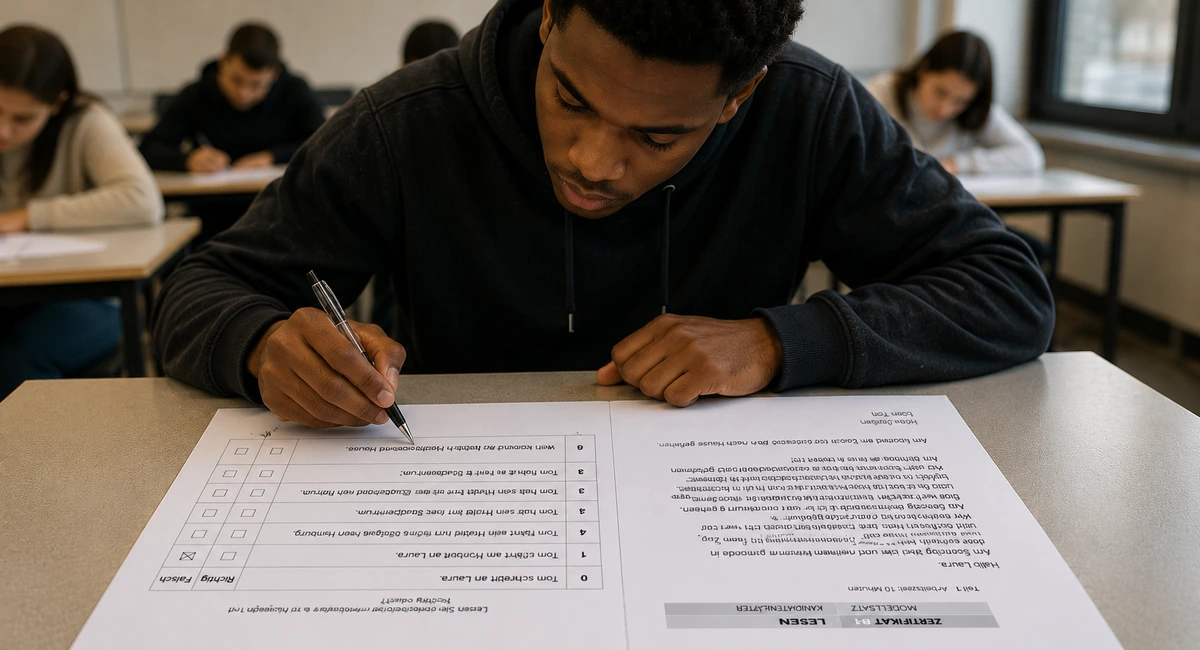
What the Question Sheet Looks Like
- Introductory sentence: It gives the name of the radio programme, the topic, and the three speakers, usually including their professions or roles. For example: “The host of the radio programme … discusses the topic … with the teacher … and the professor …”.
- Three columns: The names of the three speakers appear above answer options a, b, and c. In practice tests, the host usually comes first, followed by the two guests.
- Example 0: A statement with the correct answer already marked shows how the task works.
- Statements 23 to 30: Eight short sentences. Each statement belongs to exactly one speaker.
The Individual Steps
- Instructions: You will hear instructions along these lines: “You will now hear a discussion. You will hear the discussion twice. Complete eight questions. Match the statements to the speakers: Who says what? Now read statements 23 to 30. You have 60 seconds to do this.”
- Reading time: 60 seconds to read the example and the eight statements.
- First listening: You listen to the entire discussion.
- Second listening: You listen to the discussion a second time.
- Transferring answers: After Part 4, the listening section ends. You then have 5 minutes to transfer your answers from all four parts to the answer sheet.
“It is important that, in the Listening module, the order of the items always follows the order of the audio text.” This means that the information for question 23 appears before the information for question 24, question 24 before question 25, and so on (Goethe-Institut, Tips and Tricks for B1 Listening).
| Feature | Listening Part 4 |
|---|---|
| Text type | Radio discussion programme |
| Speakers | Male/female host + two guests |
| Question type | Match statements to speakers (“Who says what?”) |
| Reading time | 60 seconds |
| Listenings | Twice |
| Questions | 8 (Nos. 23–30) + Example 0 |
| Duration | approx. 12 minutes |
Scoring: How Many Points Do You Need to Pass Goethe B1 Listening?
In short: Each correct answer in Part 4 earns 1 point. Part 4 therefore accounts for a maximum of 8 out of 30 points in the Listening module – equivalent to approximately 27 out of 100 result points. You pass the Listening module with at least 60 points.
How the Points Are Calculated
- Each question is worth 1 point (correct) or 0 points (incorrect or unanswered).
- The Listening module contains 30 questions, so the maximum raw score is 30 points.
- These points are multiplied by 3.33 and rounded, resulting in a maximum of 100 result points.
- You pass the module if you achieve at least 60 points, or 60%.
| Correct Answers in the Listening Module | Result Points (approx.) | Result |
|---|---|---|
| 30 | 100 | ✅ Passed |
| 24 | 80 | ✅ Passed |
| 18 | 60 | ✅ Passed (minimum required) |
| 17 | 57 | ❌ Failed |
How Much Does Part 4 Count?
| Correct Answers in Part 4 | Result Points (approx.) | Share of the 60 Points Needed to Pass |
|---|---|---|
| 8 out of 8 | 27 | Almost half |
| 6 out of 8 | 20 | One third |
| 4 out of 8 | 13 | Just over one fifth |
The Goethe-Zertifikat B1 consists of four modules: Reading, Listening, Writing, and Speaking. The modules can be taken individually or in combination. Each module is assessed separately. Therefore, a strong result in Reading cannot compensate for a weak result in Listening.
Source: Goethe-Institut, Examination Administration Regulations for the Goethe-Zertifikat B1 (PDF, in German). The result points shown in the tables are rounded.
Topics and Speakers in Listening Part 4
In short: Listening Part 4 covers topics related to public life and everyday adult experiences. The discussion usually focuses on a question that people may have different opinions about – for example, “Should children start learning a foreign language at an early age?” or “Is it worth doing a year of voluntary social service?”
Typical Topic Areas
| Topic Area | Example Topics |
|---|---|
| Family and relationships | Friendship, long-distance relationships, gifts, homework |
| Media and technology | Mobile phones, mobile phones in the classroom |
| Health and nutrition | Organic food, childhood obesity, sports |
| Education and work | Foreign languages for children, voluntary social service year, studying abroad |
| Housing and the environment | Living in the city or countryside, a new shopping centre |
| Consumer habits and money | Online shopping, credit cards, advertising |
Who Takes Part in the Discussion in Listening Part 4?
In addition to the male or female host, there are two guests in the studio. Typical guest combinations include:
- Expert + person with practical experience: a language researcher and a parent representative, a professor and a teacher;
- Two people from different professions: a social worker and a journalist;
- Representatives of different interests: a managing director and a childcare educator.
The guests do not always have opposing opinions. Sometimes one is clearly in favour and the other is against. In other cases, both have similar views but emphasise different aspects of the topic.
The Goethe-Institut does not publish a fixed list of topics for Listening Part 4. This overview is based on the official Goethe-Zertifikat B1 Practice Test for Adults (PDF), practice tests published by educational publishers, and reports from exam candidates. Any topic related to everyday life or public affairs may appear in the exam.
FAQ – Goethe B1 Listening Part 4
Deutsch-Vorbereitung is an independent learning platform and is not affiliated with the Goethe-Institut. “Goethe-Zertifikat” and “Goethe-Institut” are trademarks of the Goethe-Institut e. V. All information about the examination procedure and scoring is based on official publications by the Goethe-Institut (as of October 2026). The current examination regulations and the information provided by your examination centre are always authoritative.


There are no comments for this article. Leave your comment