





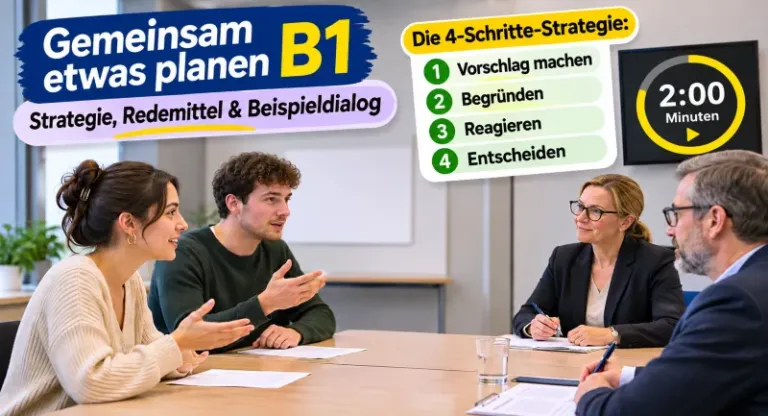
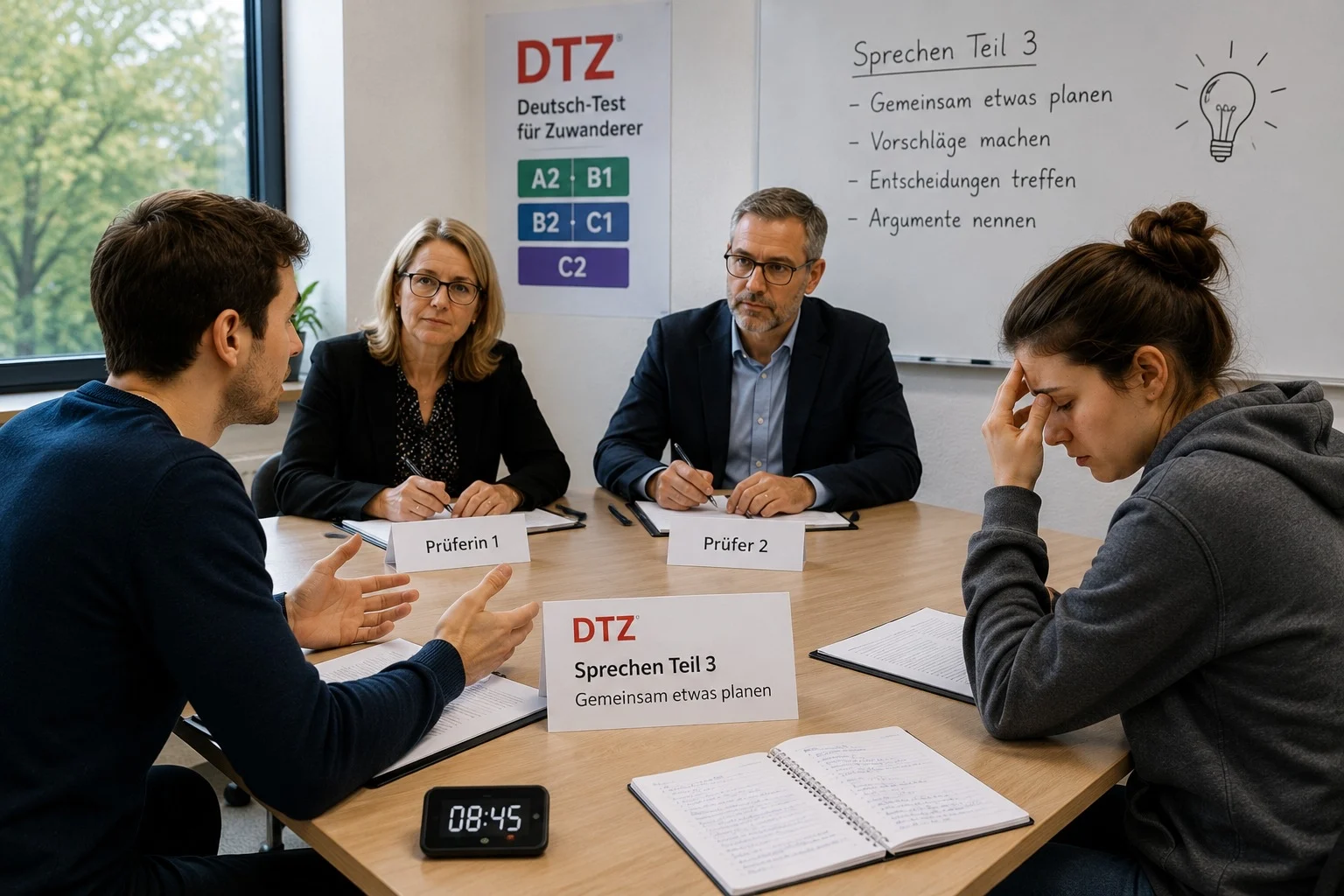
For “Gemeinsam etwas planen”, you do not need any special vocabulary. Instead, you need a clear structure in mind: for each prompt, ask a question, make a suggestion, respond and make a decision. Here you will find this 4-step strategy, useful phrases for every topic, a complete sample dialogue and the common mistakes that can cost you points.
Why “Ja, gute Idee” is not enough
Many candidates say almost nothing but phrases such as “Gute Frage!”, “Ja, gute Idee!” or “Ja, okay.” during the exam. This is rarely because their German is not good enough. Under stress, your brain first looks for something familiar and safe. If you do not know what to say next, only the simplest sentences come to mind. With a clear structure in your head, the sentences come back.
“Ja, gute Idee.” is grammatically correct. Nevertheless, the sentence contributes very little: it contains no suggestion, gives no reason and does not move the conversation forward. You earn points by contributing something new to the planning process and giving your partner an opportunity to respond.
You can read about how the task works in DTZ, telc, Goethe, ÖIF and ÖSD, and exactly what the examiners assess, in the article Gemeinsam etwas planen B1: Procedure, Assessment and Topics. This article focuses on how to manage the conversation yourself.
The 4-step strategy: Ask, suggest, respond, decide
For each prompt, repeat the same four steps, working from top to bottom. Using the official DTZ task “Wanderung mit dem Deutschkurs” as an example, one complete sequence looks like this:
- ❓ Ask a question: Was können wir besichtigen?
- 💡 Make a suggestion and give a reason: Ich schlage vor, eine Burg zu besichtigen, weil es dort viel Geschichte gibt.
- 👂 Respond and give a reason: Oh, das ist eine tolle Idee, weil ich Burgen sehr interessant finde.
- ✅ Make a decision: Prima, so machen wir es. Wir besichtigen eine Burg.
Then move straight on to the next prompt. This way, both partners take turns speaking, both contribute ideas, every idea has a reason and each prompt ends with a decision.
Step 1: Turn every prompt into a question
If there is a question word on the task sheet, add “können wir” after it and put the verb in its infinitive form at the end. You do not need to change the verb:
- “Wohin?” → Wohin können wir wandern?
- “Wann?” → Wann können wir uns treffen?
- “Was besichtigen?” → Was können wir besichtigen?
If there is only a word without a question word, such as “Übernachten?” or “Essen?”, start directly with “Können wir”. This allows you to ask a question and make a suggestion at the same time: Können wir im Hotel übernachten? · Können wir ein Picknick machen? International words such as Hotel, Picknick, Restaurant or Pizza are particularly useful because your partner will understand them immediately.
Your own question for “…”
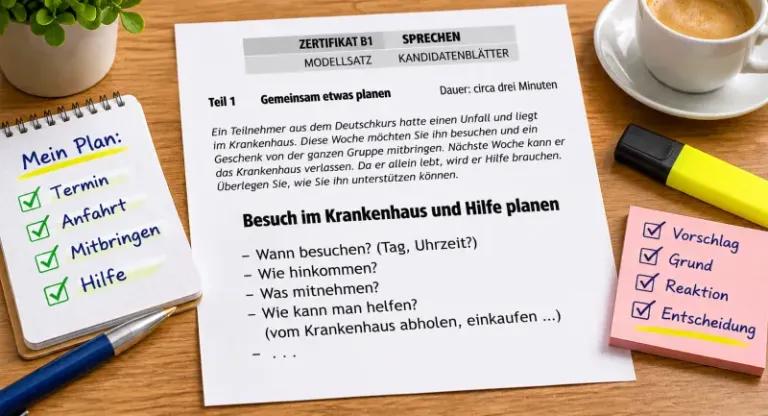
The three dots at the bottom of the task sheet are an invitation to add your own point to the plan. Three questions work for almost any topic, whether it is a hike, a party or a move:
- Wer bezahlt das eigentlich?
- Wer macht was?
- Was machen wir, wenn einer von uns krank wird?
Even if there are no dots on the task sheet, asking your own question shows that you are actively involved in planning. Leave a little time for this at the end.
Say no at least once
A conversation in which both people always agree does not sound like a real negotiation. That is why you should politely say no at least once, always give a reason and immediately suggest a new idea. Saying no without offering another idea brings the planning process to a stop.
At the end: Give a short summary
Once you have discussed all the prompts, one of you summarises the plan. Start with “Also” and mention only the decisions, without giving reasons or introducing new ideas. For the hiking trip, it could sound like this:
Also, ich fasse kurz zusammen: Wir wandern am Samstag mit dem ganzen Deutschkurs in den Bergen und besichtigen eine Burg. Zum Essen machen wir ein Picknick, wir übernachten im Hotel, jeder bezahlt selbst, und alles besprechen wir in unserer WhatsApp-Gruppe.
Your partner gives a short response, for example Genau, das ist unser Plan! If time is almost up, one sentence is enough: Also, dann machen wir es so.
🎬 Video lesson: The 4-step strategy for “Gemeinsam etwas planen” explained step by stepUseful phrases for “Gemeinsam etwas planen” B1
Vocabulary is assessed in all exams. Therefore, do not always use the same sentence. Instead, alternate between different expressions. The following useful phrases work for every topic.
| Purpose | Useful phrases |
|---|---|
| Making a suggestion | Mein Vorschlag ist, eine WhatsApp-Gruppe zu machen, um alles zu besprechen. · Ich schlage vor, allen eine E-Mail mit unseren Ideen zu schicken. · Wir könnten Ivan und Nina fragen, ob sie uns helfen. · Was hältst du davon, eine Liste zu schreiben? |
| Giving a reason | …, weil ich an diesem Tag frei habe. · …, weil das nicht so teuer ist. · …, weil es dann schneller geht. · Alternative with “denn”: Wir fahren mit dem Auto, denn dann geht es schneller. |
| Agreeing | Das klingt wirklich gut! · Da hast du völlig recht! · Oh, das ist eine tolle Idee! · Damit bin ich einverstanden. |
| Politely disagreeing | Das ist eine gute Idee, aber das geht leider nicht, weil … · Das finde ich nicht so gut, weil … · Ich bin leider dagegen, weil … |
| Making a counterproposal | Ich schlage … vor, weil … · Ich habe eine andere Idee. Wir könnten …, weil … · Ich finde … besser, weil … |
| Responding to a rejection | Kein Problem, das verstehe ich gut. … passt mir auch. |
| Making a decision | Gut, dann machen wir das so. · Super, dann ist das abgemacht. · Prima, so machen wir es. · Alles klar, das ist ein guter Plan. |
| Summarising | Also, unser Plan ist fertig. · Also, ich fasse kurz zusammen. · Also, dann machen wir es so. |
Two grammatical details that sound like B1-level German: After “weil”, the verb goes at the end (weil das nicht so teuer ist), while after “denn”, the verb stays in second position (denn dann geht es schneller). And in sentences such as Mein Vorschlag ist, … zu machen, “zu” comes directly before the infinitive.
Follow-up questions: Pass the conversation back to your partner
By asking a short question at the end of your contribution, your partner immediately knows that it is their turn. While your partner answers, you have time to prepare your next sentence.
- Was meinst du?
- Was denkst du?
- Passt dir das?
- Ist das okay für dich?
- Bist du einverstanden?
- Ist das für dich in Ordnung?
- Hast du eine Idee?
- Hast du eine andere Idee?
- Wie findest du das?
- Sollen wir das so machen?
Expressive phrases: Gain time without pausing
Fixed phrases come to mind almost automatically, even under stress. While you are saying one of these phrases, your brain is already searching for the actual answer.
- Das tut mir wirklich leid.
- Ich freue mich schon sehr darauf!
- Super, das ist wirklich praktisch!
- Das ist eine wunderbare Idee!
- Das finde ich wirklich schade.
- Gute Frage, darüber habe ich auch schon nachgedacht.
- Das ist sehr nett von dir.
- Daran habe ich gar nicht gedacht!
- Da hast du recht, das ist ein wichtiger Punkt.
Express a feeling + make a suggestion with “weil” + ask a follow-up question. For example: Gute Frage, darüber habe ich auch schon nachgedacht. Ich schlage vor, einen Transporter zu mieten, weil es dann schneller geht. Was meinst du?
Sample dialogue: Planning a move together
Situation: Someone has found a new room and will be moving soon. A friend is helping, and together they plan the move.
Prompts: When and where? · How to transport everything? · Who will help? · Food and drinks for the helpers? · …
A: Ich habe endlich ein neues Zimmer gefunden, ich freue mich riesig!
B: Wow, herzlichen Glückwunsch! Dann planen wir jetzt den Umzug. Wann und wo können wir anfangen?
A: Mein Vorschlag ist, am Samstag um neun Uhr bei meiner alten Wohnung anzufangen, weil ich an diesem Tag frei habe. Passt dir das?
B: Das ist eine gute Idee, aber das geht leider nicht, weil ich am Samstag arbeiten muss. Ich habe eine andere Idee: Wir könnten am Freitag ab 14 Uhr anfangen.
A: Kein Problem, das verstehe ich gut. Freitag ab 14 Uhr passt mir auch. Dann machen wir das so.
B: Und wie transportieren wir die Möbel?
A: Gute Frage, darüber habe ich auch schon nachgedacht. Ich schlage vor, einen kleinen Transporter zu mieten, weil wir mit dem Auto viele Male fahren müssten. Was meinst du?
B: Super, das ist wirklich praktisch! Am Bahnhof kann man einen Transporter mieten. Ich fahre, weil ich schon oft einen Transporter gefahren bin.
A: Das ist sehr nett von dir, denn ich habe keinen Führerschein. Wer kann uns noch helfen?
B: Ich schlage vor, dass ich meinen Bruder frage, weil er stark ist und gern hilft. Hast du noch eine Idee?
A: Ja, ich frage Nina aus unserem Deutschkurs.
B: Das ist eine sehr gute Lösung, mit vier Leuten geht alles viel schneller. Was machen wir mit Essen und Getränken für die Helfer?
A: Ich finde Pizza am besten, weil nach dem Umzug niemand Lust zum Kochen hat. Ist das okay für dich?
B: Ja, das ist sehr vernünftig, auf die Pizza freue ich mich schon! Was machst du eigentlich mit deinen alten Möbeln?
A: Das alte Sofa ist für das neue Zimmer zu groß. Ich verkaufe es online.
B: Prima, so machen wir es.
A: Also, ich fasse kurz zusammen: Wir ziehen am Freitag ab 14 Uhr um, mieten einen Transporter am Bahnhof, und du fährst. Dein Bruder und Nina helfen, danach gibt es Pizza, und das Sofa verkaufe ich online.
B: Genau, das ist unser Plan!
What earns points in this dialogue
| Part of the dialogue | Element of the strategy |
|---|---|
| “ich freue mich riesig” · “herzlichen Glückwunsch” | Expressing feelings at the beginning makes the conversation sound real and lively. |
| Saturday → Friday from 2 p.m. | Disagreeing with a reason, making a counterproposal and reaching an immediate decision: genuine negotiation. |
| “Gute Frage, darüber habe ich auch schon nachgedacht.” | Gaining time without creating a pause. |
| “Ich fahre” · “ich frage Nina” | Dividing responsibilities: It is clear who will do what. |
| “Was machst du eigentlich mit deinen alten Möbeln?” | Adding your own question for the three dots. |
| “Passt dir das?” · “Was meinst du?” · “Ist das okay für dich?” | Follow-up questions: Both people speak approximately the same amount. |
| “Also, ich fasse kurz zusammen …” | A clear ending that includes all the decisions. |
Common mistakes during the conversation
These mistakes result from how you behave during the conversation. Each one can be replaced with a specific, better habit.
- ❌ Giving a monologue instead of having a dialogue. Person A reads out their notes for one minute, followed by Person B. Both speak a lot, but it is not a conversation. ✅ Better: Say three or four sentences, then ask a follow-up question, just like in ping-pong.
- ❌ Only saying yes. “Ja, gute Idee.” – “Ja, okay.” – “Ja, gerne.” This means only your partner is doing the planning. ✅ Better: Agree and immediately add an idea of your own.
- ❌ Reading from the task sheet or notes. If you write down complete sentences and read them aloud, you are no longer speaking to your partner but to the paper. ✅ Better: Write down only keywords and look your partner in the eye.
- ❌ Not listening. If you are already planning your own sentence while your partner is answering, your response may not address their idea. ✅ Better: Respond to your partner's idea first, then make your own suggestion.
- ❌ Discussing without reaching a decision. Saturday or Sunday? In the end, nobody knows. ✅ Better: Finish each point with a decision and briefly repeat it: Super, dann ist das abgemacht. Wir wandern am Samstag.
- ❌ Spending too much time on one point. If you discuss one prompt for too long, you will not have enough time for the remaining points. ✅ Better: Make a decision and immediately ask the next question.
- ❌ Always using the same sentence. Saying “Ich schlage vor …” five times shows a limited range of vocabulary. ✅ Better: Alternate between the expressions in the useful phrases table.
- ❌ Not letting your partner speak. If you do all the planning alone, you are not demonstrating the ability to plan together. ✅ Better: Actively involve your partner, for example with Hast du eine andere Idee?
You can read in detail about what to do if your partner hardly speaks in the article How to Pass the A2–B1 DTZ Dialogue with a Weaker Partner.
How to practise “Gemeinsam etwas planen”
Reading and listening alone are not enough for this task. Your brain remembers sentences best when you have to say them yourself and recall them from memory. In learning research, this is known as the testing effect. And if you have already experienced the situation of “speaking with a stranger under time pressure” many times, you will enter the exam feeling much calmer. The following sequence has proven effective:
- 🎧 Listen: Listen to a sample dialogue several times, more slowly if necessary. You can also do this while travelling, on the bus or while cooking.
- ✍ Write things down: Write new words and sentences in a notebook without trying to memorise them yet. Writing helps your brain remember the words more easily.
- 🗣 Repeat aloud: Listen again, follow the text and repeat each sentence aloud after a pause.
- 🤖 Practise with the AI assistant: Go through the task without an audience, as often as you like. The timer shows whether you can cover all the prompts within the time limit.
- 👥 Practise with real people: Make plans with other learners who are also preparing for their exams, without a camera, using only your voice. This way, the exam situation will no longer feel unfamiliar.
Topic lists for “Gemeinsam etwas planen” by exam:
- DTZ B1 Speaking: Topics for “Gemeinsam etwas planen”
- telc Deutsch B1 Speaking: Topics for “Gemeinsam etwas planen”
- Goethe-Zertifikat B1 Speaking: Topics for “Gemeinsam etwas planen”
- ÖIF B1 Speaking: Topics for “Gemeinsam etwas planen”
- ÖSD Zertifikat B1 Speaking: Topics for “Gemeinsam etwas planen”



There are no comments for this article. Leave your comment