





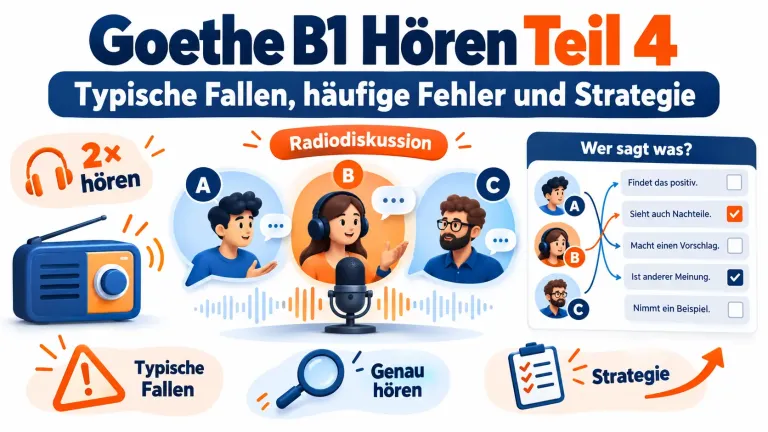
Why is Goethe B1 Listening Part 4 so difficult? Because the correct answer is often subtle, while the distraction is obvious. Here you will learn about the typical traps in the “Who says what?” task, the most common mistakes learners make, and a strategy to help you solve the radio discussion task confidently – including two Goethe B1 listening exercises with answers.
We explain how Listening Part 4 works, how it is scored, and which topics may appear in the article “Goethe B1 Listening Part 4: Format, Scoring and Topics”. This article builds on that information.
The Basic Principle: Subtle Answers, Obvious Distractions
In short: In Listening Part 4, the correct information is usually inconspicuous – at the end of an answer, after “aber”, or hidden in a short story. At the same time, there is often something much more noticeable that leads you to the wrong person.
The task tests whether you can recognize opinions. That is why the listening texts are designed so that superficial listening is not enough. If you only listen for familiar words, you will often choose the wrong person. If you understand what a person actually means, you will find the correct answer.
| The correct answer is often … | The distraction is often … |
|---|---|
| expressed using different words | a word from the statement used by another person |
| at the end of a long answer | a funny or dramatic story at the beginning |
| after “aber”, “trotzdem”, “allerdings” | something the person admits beforehand |
| expressed in the speaker's own words | a quick “Genau!” or “Das stimmt” from another person |
How Statements Are Rephrased
In short: The statements on the question sheet summarize what a person means. The words used in the audio recording are almost always different. If you know the typical types of rephrasing, you will recognize the correct answer more quickly.
| Type of Rephrasing | In the Audio Recording | In the Statement |
|---|---|---|
| Synonym / idiomatic expression | „An so einem Wochenende kracht es bei uns.“ | Wenn man sich trifft, gibt es oft Streit. |
| Examples → general concept | „Ich übersetze mit einer App, fotografiere die Lieferung, rechne Preise um.“ | Ein Smartphone kann für viele verschiedene Aufgaben hilfreich sein. |
| Metaphor / comparison | „Mein Büro steckt in der Hosentasche.“ | Arbeitszeit und Freizeit kann man nicht klar trennen. |
| Negation → positive statement | „Ich möchte nicht für jedes Brot zehn Kilometer fahren.“ | Es ist wichtig, alles für den Alltag in der Nähe zu haben. |
| Subjunctive → factual statement | „Ohne Handy wäre diese Freundschaft längst eingeschlafen.“ | Durch die neuen Medien bleibt man leichter in Kontakt. |
| Personal story → general rule | „Mein Bruder braucht für die App zehn Sekunden, meine Mutter ruft ihn an.“ | Bei digitalen Geräten kennen sich Kinder oft besser aus als ihre Eltern. |
| Opposite meaning | „Ein moderner Betrieb muss mit der Zeit gehen.“ | Ein Handyverbot ist altmodisch. |
If you hear exactly the same word as in the statement, check particularly carefully. That is often precisely where the trap lies.
The 8 Typical Traps in Listening Part 4
In short: The traps in Listening Part 4 tend to repeat themselves. Once you know them, you can recognize them even when the discussion is about a completely new topic.
Trap 1: The Word from the Statement Is Used by the Wrong Person
The statement is „Wenn man sich trifft, gibt es oft Streit.“ However, the word „streiten“ is used by the guest who says there is no arguing: „Bei uns hat keiner Lust, sich zu streiten.“ The correct person says: „Da kracht es bei uns.“
Trap 2: First Admit Something, Then Contradict It (“zwar … aber”)
Many speakers begin by acknowledging something: „Das Leben in der Stadt hat zwar viele Vorteile, aber …“ Their actual opinion comes after „aber“. If you select an answer after hearing only the first part of the sentence, you will get it wrong.
Trap 3: Agreement Is Not an Independent Statement
One person simply says „Genau!“ or „Das stimmt leider“ and then talks about something else. The correct answer is the person who expressed the idea themselves – not the person who merely agreed.
Trap 4: The Moderator Is Forgotten
The moderator can also be the correct answer. This is often the case when the moderator:
- mentions a fact or an example from everyday life;
- expresses a personal opinion before asking a question;
- describes a personal experience;
- says „Viele Leute meinen …“ or summarizes a survey – even then, the moderator is the speaker.
Trap 5: Almost the Same Idea – but a Different Group or Reason
The moderator says: „Bei Kindern zeigt ein Geschenk vor allem, dass man sie lieb hat.“ Shortly afterward, a guest says about adults: „So eine kleine Sendung hält Menschen zusammen.“ The statement „Geschenke sind wichtig für soziale Kontakte“ belongs to the guest. Always check: Who is the person talking about? What reason do they give?
Trap 6: The Story Says “Yes”, but the Conclusion Says “No”
A person enthusiastically describes how wonderful something was – but reaches the opposite conclusion at the end: „Mein Neffe hat begeistert erzählt … Aber ich glaube, für viele sind diese Monate einfach verlorene Monate.“ What matters is the conclusion, not the story.
Trap 7: The Funny Story Distracts You
A white lie („Oh, die ist ja wunderschön!“), a joke, or a dramatic anecdote is striking and easy to remember. The correct answer often appears only in the final sentence afterward – frequently after „Ich denke“, „Ich glaube“ or „Ich finde“.
Trap 8: Categorizing the Guests as “For” or “Against”
Even a guest who generally supports something may sometimes make a critical comment – for example: „Ehrlich gesagt gibt es auch Dinge, die mich ärgern.“ And the guests do not always have opposing views. You must examine each statement individually.
Common Mistakes Learners Make
In short: Most mistakes happen because learners focus on individual words instead of meanings, or choose the person whose words stand out the most.
| Mistake | Why It Happens | What to Do Instead |
|---|---|---|
| ❌ Choosing the person who uses the same word | The same word is often used by several people or with the opposite meaning. | ✅ Focus on the meaning: Does the person really mean exactly that? |
| ❌ Choosing the person who speaks about the topic last | A reaction or contradiction often follows the correct answer. | ✅ Check who first expressed the idea in their own words. |
| ❌ Never choosing the moderator | Learners assume that the moderator only asks questions. | ✅ Remember the moderator when you hear facts, personal experiences, or „Viele meinen …“. |
| ❌ Selecting an answer after the first half of a sentence | The actual opinion appears only after „aber“ or at the end. | ✅ Listen until the person has finished speaking. |
| ❌ Guessing based on someone's role (“the professor is against it”) | Even people who oppose something sometimes make positive comments. | ✅ Examine each statement individually. |
| ❌ Trying to answer everything during the first listening | Learners get stuck on one question and miss the following ones. | ✅ During the first listening, mark only answers you are sure about. |
| ❌ Leaving questions unanswered | Uncertainty at the end of the task. | ✅ Always choose an answer – leaving it blank definitely earns no points. |
Strategy for Goethe B1 Listening Part 4: Listen Twice, Match Correctly
In short: Understand the statements before listening, become familiar with the voices during the first listening, check your answers during the second listening, and transfer everything carefully at the end.
🎯 Phase 1: Reading Time
- Read the names in the introductory sentence and remember which speakers are women and which are men. Goethe-Institut also recommends this approach.
- Mark the key word in each statement: „nur“, „nicht immer“, „oft“, „Kinder“, „schnell“.
- Briefly consider how the statement could be expressed differently – this will help you recognize rephrasing in the audio recording.
🎧 Phase 2: First Listening
- Become familiar with the three voices. Not every answer begins with a name – some guests simply interrupt.
- Mark only answers you are sure about.
- Missed a question? Move on. The next question will come later in the discussion.
🔁 Phase 3: Second Listening
- Answer the remaining questions.
- Check each answer using three questions: Who actually says it? Who is the person talking about? Does the opinion come after „aber“?
- When listening to long stories, wait until the final sentence.
📝 Phase 4: Transferring Answers
- Carefully transfer your answers to the answer sheet – line by line.
- Do not leave any questions unanswered.
Signal Words: Here Comes the Answer
In short: Certain words indicate that the speaker is about to express their actual opinion. Others show that someone is merely agreeing or acknowledging a point.
| Signal | Examples | What It Means for the Answer |
|---|---|---|
| Contrast | aber, trotzdem, allerdings, dabei | ✅ The actual opinion is coming now. |
| Personal conclusion | Ich glaube …, Ich denke …, Ich finde …, Da finde ich einfach … | ✅ Often the final sentence contains the answer. |
| Additional thought | Und überhaupt …, Außerdem … | ✅ Often introduces a new, important point. |
| Other people's opinions | Viele meinen …, Wenn man Leute fragt … | ⚠ Counts for the person who says it – often the moderator. |
| Concession | zwar, Ich gebe zu …, Klar, …, Das stimmt, … | ⚠ Not necessarily the actual opinion yet – wait for „aber“. |
| Agreement | Genau!, Das stimmt leider., Das glaube ich Ihnen sofort. | ❌ Agreement alone is not the answer. |
Goethe B1 Listening Exercises: Two Examples from Radio Discussions with Answers
In short: Here is how to apply the strategy to a short excerpt.
Example 1: „Bio-Obst wird schnell schlecht.“
Erzieherin: „Ja, und ehrlich gesagt gibt es auch Dinge, die mich ärgern. Die Äpfel und Bananen vom Öko-Hof sehen am Montag wunderschön aus, und am Mittwoch haben sie schon braune Stellen.“
- Trap: The preschool teacher generally supports organic food – so you would not expect her to criticize it (Trap 8).
- Rephrasing: „Äpfel und Bananen vom Öko-Hof“ = Bio-Obst, „am Mittwoch schon braune Stellen“ = schnell schlecht.
- Answer: the preschool teacher.
Example 2: „Es gibt Orte, an denen das Telefonieren verboten ist.“
Moderatorin: „Mir ist neulich im Krankenhaus etwas Peinliches passiert: Die Krankenschwester hat ganz streng auf das Schild mit dem durchgestrichenen Handy gezeigt. So ein Schild hängt ja auch an jeder Tankstelle.“
Gast: „Ich finde, im Kino sollten die Geräte genauso draußen bleiben wie im Krankenhaus.“
- Trap: The guest also talks about the hospital – but wants a ban in additional places. That is a different statement.
- Rephrasing: „Schild mit dem durchgestrichenen Handy“ = verboten, „Krankenhaus, Tankstelle“ = Orte.
- Answer: the female moderator – she describes a personal experience (Trap 4).
FAQ – Traps and Strategies in Listening Part 4
Deutsch-Vorbereitung is an independent learning platform and is not affiliated with Goethe-Institut. “Goethe-Zertifikat” and “Goethe-Institut” are trademarks of Goethe-Institut e. V. All information about the exam format and scoring is based on official publications by Goethe-Institut (as of October 2026). The current examination regulations and information provided by your examination center are always authoritative.


There are no comments for this article. Leave your comment