





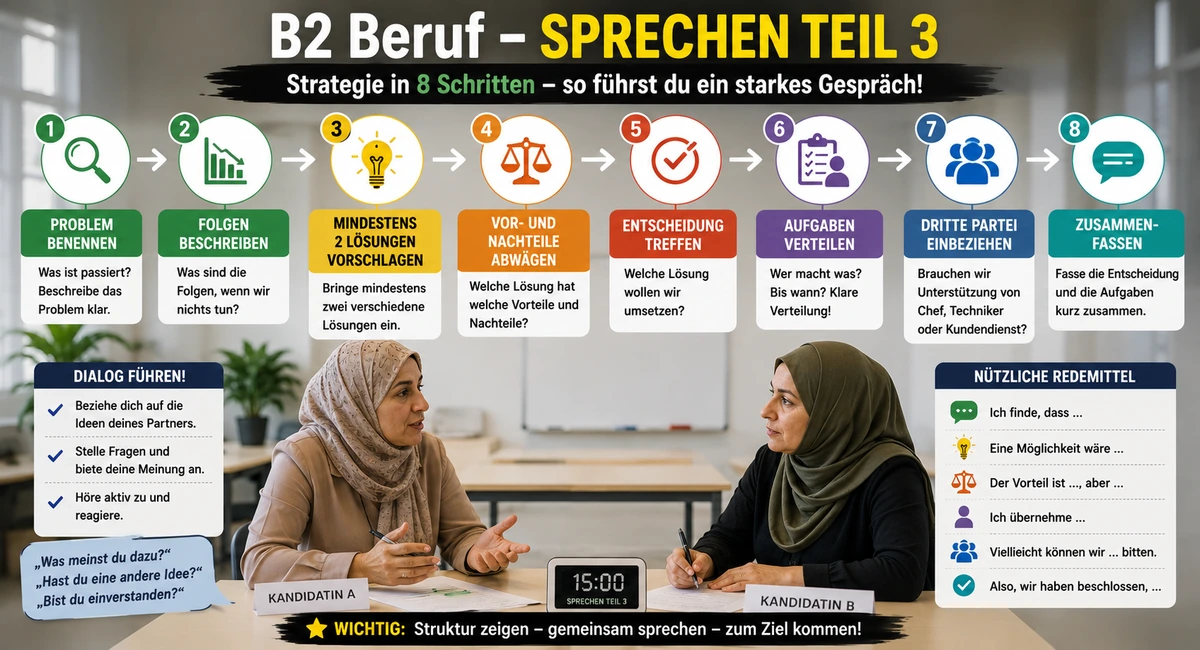
B2 Beruf, Sprechen, Teil 3:
Strategy in 8 steps and set phrases
Universal strategy in 8 steps, ready-made set phrases and training with the AI examiner for confident completion of Teil 3 of the B2 Beruf oral exam.
What is Sprechen Teil 3 in the B2 Beruf exam
Teil 3 of the oral B2 Beruf exam is the last block of the Sprechen test. You and your partner receive a task card. On this card there is a situation with a problem at work and some keywords as guidance. Your task: to discuss the problem together and find a solution jointly.
The most common mistake is that candidates jump straight to the solution and skip important intermediate steps. In reality the examiner expects a structured dialogue from you in eight steps with active interaction with the partner. Only in this way can the examiner properly assess your B2 language level.
What is the Situierung?
The Situierung is the brief description of the task on the exam card. It tells you which situation you and your partner should discuss, who you are in that situation and what problem there is. Read the Situierung carefully and note the most important information: the problem, the location, the people involved.
Below the Situierung there are keywords or W-questions. These keywords are not just for decoration. They show you which aspects you absolutely must address in the dialogue. If, for example, the word Termin appears on the card, then the topic of time or deadline must come up in the dialogue.
Format and task
You speak with your partner about a problem at work. The official task is: innerbetriebliches Problem lösen, Strategie entwickeln — to solve a problem at work and develop a strategy. You have no preparation time before Teil 3. That is why it is so important to practise the eight-step strategy thoroughly beforehand.
Register and style
This is very important information: the register in Teil 3 is informal. You are speaking with a colleague, so use «Du». No formal phrases like «Sehr geehrte Frau Müller». The vocabulary is general and professional, but without specialist technical terms.
What the examiner assesses — four official criteria
Each of your utterances is assessed according to four criteria. These criteria are aligned with the scales of the Common European Framework of Reference (CEFR):
- Kommunikative Aufgabenbewältigung — how well you complete the task: appropriate register, flexibility and fluency in speaking.
- Aussprache und Intonation — how clearly and naturally you speak.
- Formale Richtigkeit — grammar, correct word choice and the ability to correct your own mistakes.
- Spektrum sprachlicher Mittel — how varied your vocabulary and structures are.
| Parameter | Description |
|---|---|
| Format | Dialogue between two candidates |
| Topic | Problem at work between colleagues |
| Register | Informal («Du») |
| Preparation time before the exam | Not provided |
| Assessment criteria | 4 (Aufgabenbewältigung, Aussprache, Richtigkeit, Spektrum) |
| Guidance on the card | Situierung + keywords or W-questions |
Strategy in 8 steps: what to say and in what order
The universal structure of the Teil 3 dialogue consists of eight steps. Each step has its own function and its own set of phrases. If you go through all eight steps and pass the floor to your partner along the way, your result for the Kommunikative Aufgabenbewältigung criterion will be high.
The universal structure of a mini-block
Each step is a small block consisting of four parts. This structure repeats from step 2 to step 8. This keeps the dialogue fluent and natural:
- Answer to the partner's question. You react to what your partner has just said or asked.
- Universal transition. A short sentence that fits almost any topic, for example: Das ist eine wichtige Frage! or Du hast recht!
- 2—3 sentences on the current step. Here you bring in the new content: consequences, suggestions, arguments, decision and so on.
- Your own question to the partner. You take a question from the card or ask your own question, thus passing the floor to your partner.
Universal transition phrases that always fit:
- Das ist eine wichtige Frage!
- Das ist eine gute Frage!
- Du hast recht.
- Stimmt!
- Genau, das sehe ich auch so.
- Da bin ich ganz deiner Meinung.
- Daran habe ich auch gedacht.
- Das ist wirklich ein Problem.
- Ja, das ist mir auch aufgefallen.
Step 1 is the beginning of the dialogue. Here you are not yet answering a question. You open the conversation with the phrase Hast du gehört, dass …? and a brief description of the problem from the Situierung.
Step 1 — Naming the problem
Begin the conversation with a brief description of the problem from the Situierung. Speak the way you would speak with a colleague during a break. This step is short: one to two sentences plus a question to the partner.
Example mini-block (Speaker A):
«Hast du gehört, dass der Drucker schon seit drei Tagen kaputt ist? Mir ist aufgefallen, dass sich niemand darum kümmert. Was meinst du dazu?»
Set phrases for Step 1:
- Hast du gehört, dass …?
- Du, ich muss mit dir über etwas reden …
- Hast du auch mitbekommen, dass …?
- Mir ist aufgefallen, dass …
- Wir haben hier ein Problem mit …
- Ich finde, wir müssen mal über … sprechen.
Step 2 — Describing the consequences
Directly after the problem you show why the problem matters. This step is a marker for the B2 level: you can think ahead. Name at least one consequence, better two.
Example mini-block (Speaker B):
«Ja, das habe ich auch bemerkt. Das ist wirklich ein Problem! Wenn das so weitergeht, können wir wichtige Dokumente nicht drucken und unsere Arbeit leidet. Hast du eine Idee, was passieren könnte?»
Set phrases for Step 2:
- Wenn wir nichts machen, dann …
- Das könnte dazu führen, dass …
- Sonst riskieren wir, dass …
- Auf Dauer wird das …
- Das hat zur Folge, dass …
- Wenn das so weitergeht, …
Step 3 — Making proposals for solutions
Suggest at least two solutions. Not just one! Without alternatives there is nothing to discuss, and the next step falls away. At the end pass the floor to your partner.
Example mini-block (Speaker A):
«Du hast recht, das könnte teuer werden. Eine Möglichkeit wäre, den Techniker anzurufen. Eine andere Möglichkeit wäre, einen neuen Drucker zu kaufen. Was hältst du davon?»
Set phrases for Step 3:
- Eine Möglichkeit wäre, …
- Wir könnten zum Beispiel …
- Was hältst du davon, wenn wir …?
- Vielleicht sollten wir …
- Ein Vorschlag von mir wäre …
- Hast du auch eine Idee?
Step 4 — Weighing up advantages and disadvantages
This is the central step for the examiner. Here you demonstrate argumentation: every solution has advantages and disadvantages. You do not have to list everything — one argument for and one against per option is sufficient.
Example mini-block (Speaker B):
«Stimmt, beide Ideen sind gut. Den Techniker zu rufen wäre billiger, aber dauert vielleicht lange. Einen neuen Drucker zu kaufen wäre schneller, aber teurer. Was denkst du, was besser ist?»
Set phrases for Step 4:
- Der Vorteil daran ist, dass …
- Allerdings hätte das auch einen Nachteil: …
- Auf der einen Seite …, auf der anderen Seite …
- Das klingt gut, aber …
- Da bin ich mir nicht so sicher, weil …
- Das spricht dafür, aber dagegen spricht …
Step 5 — Making a decision
After the discussion comes a clear decision. Do not leave the decision open. One of the options must win, and you both agree.
Example mini-block (Speaker A):
«Da bin ich deiner Meinung. Ich finde, wir sollten zuerst den Techniker anrufen. Wenn er nicht hilft, kaufen wir einen neuen Drucker. Bist du einverstanden?»
Set phrases for Step 5:
- Okay, ich finde, wir sollten …
- Dann machen wir es so: …
- Lass uns … machen.
- Einigen wir uns darauf, dass …
- Gut, dann bleibt es dabei: …
- Also entscheiden wir uns für …
Step 6 — Dividing up tasks
A decision without a division of tasks is not a real decision. Who does what? Who does it by when? This step is short but necessary.
Example mini-block (Speaker B):
«Ja, einverstanden! Dann übernehme ich den Anruf beim Techniker. Kannst du in der Zwischenzeit alle Kollegen informieren? Wann sollen wir das machen?»
Set phrases for Step 6:
- Übernimmst du …, und ich kümmere mich um …?
- Wer macht was?
- Ich übernehme …, wenn du … machst.
- Können wir das so aufteilen: …?
- Ich kümmere mich um …, du machst …
- Wer ist dafür zuständig?
Step 7 — Involving a third party (if necessary)
If the problem is too large for the two of you, name a third person who can help. According to the official exam programme there are three possible people: der oder die Vorgesetzte (the manager), der Techniker and der Kundendienst. This step is not always obligatory, but in a serious situation it brings additional points.
Example mini-block (Speaker A):
«Gute Aufteilung! Sollten wir vielleicht auch die Chefin informieren? Sie sollte wissen, dass wir den Techniker rufen. Was meinst du, ist das nötig?»
Set phrases for Step 7:
- Sollten wir das vielleicht mit dem Chef besprechen?
- Ich würde vorschlagen, den Techniker anzurufen.
- Vielleicht müssen wir den Kundendienst informieren.
- Das übersteigt unsere Möglichkeiten — wir sollten … fragen.
- Da brauchen wir Unterstützung von …
- Können wir das selbst lösen oder müssen wir die Chefin einbeziehen?
Step 8 — Summary
End the dialogue with a brief summary. Repeat the most important points: the decision, the tasks, the third party. This shows the examiner that you have kept the whole conversation in your head. This step is a marker for a well-structured B2 level.
Example mini-block (Speaker B):
«Ja, das ist eine gute Idee. Also fassen wir zusammen: Du rufst den Techniker an, ich informiere die Kollegen, und wir sagen der Chefin Bescheid. Wenn der Techniker nicht hilft, kaufen wir einen neuen Drucker. Klingt das gut?»
Set phrases for Step 8:
- Also, fassen wir kurz zusammen: …
- Zum Schluss: wir haben uns darauf geeinigt, dass …
- Gut, dann ist alles klar: …
- Lass mich noch mal zusammenfassen: …
- Damit haben wir die Sache geklärt: …
- Okay, dann steht es: ich mache …, du machst …
| Step | Function | Minimum per step |
|---|---|---|
| 1. Name the problem | Open the topic with «Hast du gehört, dass …?» | 1—2 sentences + question |
| 2. Describe consequences | Show why the problem matters | 1—2 consequences |
| 3. Proposals for solutions | Create space for discussion | At least 2 proposals |
| 4. Advantages and disadvantages | Demonstrate argumentation | 1 argument per proposal |
| 5. Make a decision | Choose the proposal | 1 clear statement |
| 6. Divide up tasks | Move from plan to action | 2 statements (who does what) |
| 7. Third party | Plan for outside help | 1 proposal |
| 8. Summary | Briefly repeat the plan | 2—3 sentences |
Tactics: what to say after what and how
Remember the sequence as a short formula: Problem → Consequences → 2 proposals → Advantages and disadvantages → Decision → Divide up tasks → (Third party) → Summary. This formula is universal and fits every topic in Teil 3.
It is better to go through all eight steps slowly than to rush through three steps quickly. The examiner assesses the structure of the dialogue, not the number of words per minute.
Passing the floor to the partner
Do not give a monologue. Teil 3 is a dialogue, not a presentation. After each step pass the floor to your partner with short questions: Was meinst du dazu? Hast du eine andere Idee? Wie siehst du das? Bist du auch dieser Meinung?
If your partner makes a suggestion, do not ignore it. Pick it up: Das ist eine gute Idee, aber … / Stimmt, das könnte funktionieren / Genau, daran habe ich auch gedacht.
Using the keywords from the card
The keywords on the card are markers for topics the examiner wants to hear. Mentally distribute the keywords across the eight steps of your strategy. This ensures that no topic is missing.
What you must not skip under any circumstances
- Step 2 (Consequences) — a marker for the B2 level. Without this step the dialogue sounds like B1.
- Step 4 (Advantages and disadvantages) — here you demonstrate argumentation. The second B2 marker.
- Step 6 (Division of tasks) — without this step the decision remains only theory.
- Step 8 (Summary) — shows that you have kept the whole conversation in your head.
Speak with «Du». The register in Teil 3 is informal. No «Sie» and no formal phrases like «Sehr geehrte Frau Kollegin». This is not a letter, but a conversation at work.
Training with the AI examiner (online examiner)
The biggest difficulty with Teil 3 is that you cannot practise without a partner. At home you can learn all the set phrases by heart, but in a real dialogue you forget half of them under stress. That is why we developed the AI examiner — an artificial examiner who acts as your dialogue partner and at the same time assesses your language according to the official criteria.
The AI examiner is not ChatGPT and not a general AI assistant. The AI examiner is specifically trained for the B2 Beruf exam format and knows all the requirements of the exam: the 4 assessment criteria, the informal register, the obligatory steps of the structure and the current topics. This is a specialised tool that we have developed for your preparation.
9 advantages of training with the AI examiner
- ✅ Immediate feedback on each of the 4 official criteria: Kommunikative Aufgabenbewältigung, Aussprache und Intonation, Formale Richtigkeit, Spektrum sprachlicher Mittel.
- ✅ Specific comments on your answer — the AI examiner does not invent deductions but shows the exact point in your language.
- ✅ Training of the 8-step structure: the AI examiner sees which step you have skipped and draws your attention to it.
- ✅ Access around the clock — practise whenever it suits you, without a timetable and without a partner.
- ✅ Unlimited number of attempts — unlike in lessons, making mistakes is not a problem.
- ✅ Anonymity — nobody except the AI examiner hears you. This reduces stress and you speak more freely.
- ✅ Accurate simulation of the real exam — the AI examiner knows the real requirements of telc and BAMF, not just general ideas about B2 level.
- ✅ Alternative set phrases — the AI examiner suggests how you can say the same thing more powerfully or more elegantly.
- ✅ Analysis of pronunciation and intonation — a criterion that cannot be trained alone without a recording.
How the training works
On the training page you choose a topic, read the Situierung and the keywords, and then record your answer orally. The AI examiner assesses your language immediately and gives you detailed feedback with specific recommendations. You can repeat the task as many times as you wish until you feel confident.
All current topics for Teil 3
On our platform you will find a complete catalogue of current topics for Teil 3 B2 Beruf. Each topic is structured according to the official format: Situierung and keywords. The topics cover all four obligatory areas: working with customers and guests, short-term problems, third party and long-term strategic tasks.
We recommend training step by step: first read the eight-step strategy, then choose the first topic and do a dialogue with the AI examiner. After 5—7 different topics the structure becomes automatic — and in the real exam you no longer need to think about what to say.
👉 To all exercises for the B2 Beruf exam



There are no comments for this article. Leave your comment