





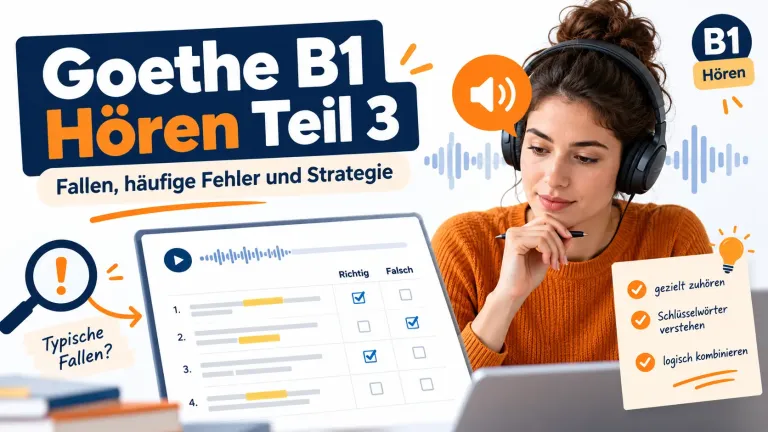
"True or False?" sounds simple – and yet many learners lose valuable points in Goethe B1 Listening Part 3. The reason: You hear the conversation only once, and the statements are deliberately worded so that first impressions can be misleading. Here you will learn how the statements are constructed, which ten common traps appear again and again, and get practical B1 listening tips – including two B1 listening exercises with answers explained step by step.
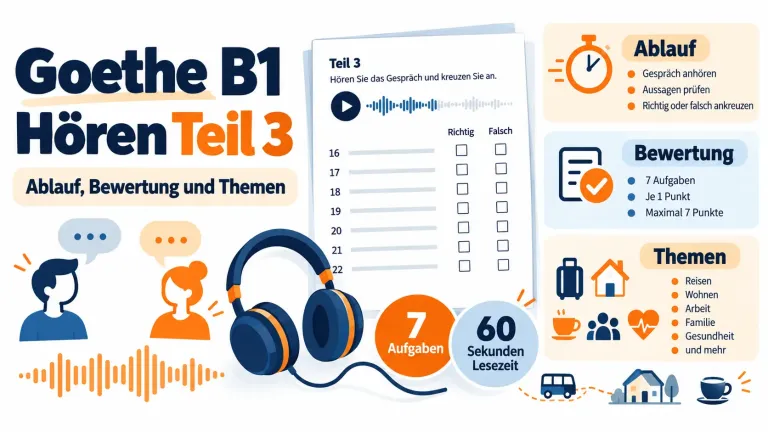
To learn how Part 3 is structured, how many points it is worth, and which conversation topics are typical, read the article "Goethe B1 Listening Part 3: Procedure, Scoring and Topics". This article takes you to the next level: understanding the tricks used in the tasks.
Why Part 3 costs so many points
In short: The crucial information is often mentioned casually during the conversation and expressed in different words. In contrast, information presented loudly, humorously, or in great detail often leads to the wrong answer. And because you hear the conversation only once, there is no second chance.
Many learners rely on their intuition in Part 3: If someone speaks enthusiastically, they must have enjoyed it; if someone uses a word from the statement, that must confirm it. The tasks are designed to exploit exactly this intuition. Conversations are structured so that a person initially seems to be saying one thing and only later – often casually – explains what actually happened.
| What you hear first | What comes later – and actually matters |
|---|---|
| "Ja, genau!" – quick agreement | a correction: "… aber das war erst am Sonntag." |
| a plan: "Eigentlich wollte ich mit dem Zug fahren." | what actually happened: "Mein Onkel hat mich dann mitgenommen." |
| a long, lively story | a short sentence at the end containing the actual information |
| the word used in the statement | the same information – but referring to a different person |
How the statements are constructed
In short: A false statement is almost always created by changing just one detail. A true statement almost always expresses the same information using different words. Knowing both patterns helps you listen more effectively.
❌ How a "False" statement is created: one detail is changed
| What is changed | In the conversation | Statement on the question sheet |
|---|---|---|
| the person | "Meine Schwester hat am Strand geschlafen, ich lieber im Hotel." | Sie hat am Strand geschlafen. |
| the object | "25 Euro hat der Eintritt gekostet, die Pizza danach nur acht." | Die Pizza hat 25 Euro gekostet. |
| the time | "Das war im letzten Jahr so. Diesmal helfen mir die Nachbarn." | Sie organisiert alles allein. |
| the reason | "Geld hätte ich genug – mir fehlt einfach die Zeit." | Er verreist nicht, weil er kein Geld hat. |
| the place | "Gesperrt war nur die Altstadt." | Die ganze Stadt war autofrei. |
| the quantity | "Viele Spiele waren für Kinder." | Alle Spiele waren für Kinder. |
A statement is false if the conversation says something different. But it is also false if the information is not mentioned anywhere in the conversation. Do not add information based on your own reasoning: Only what the speakers actually say counts.
✅ How a "True" statement is created: the same information, different words
| Type of paraphrasing | In the conversation | Statement on the question sheet |
|---|---|---|
| number converted | "ein halbes Jahr" | sechs Monate |
| time converted | "Um halb eins haben sie noch gespielt." | Das Fest ging bis nach Mitternacht. |
| behavior → feeling | "Ich habe schon nachgeschaut, was dasselbe Hotel im März kostet." | Ihr hat die Reise gefallen. |
| details → general term | "Gitarre gespielt, mit seiner Band" | Er tritt als Musiker auf. |
| colloquial language → neutral wording | "Da hat wirklich alles gestimmt." | Das Essen war hervorragend. |
If you hear almost exactly the same words as in the statement, be careful: Often just one small detail has been changed. If, however, you hear completely different words with the same meaning, the statement is often true.
The 10 most common traps in Listening Part 3
In short: The topics change, but the tricks remain the same. You will encounter these ten traps in almost every conversation.
Trap 1: Plan or reality?
"Eigentlich wollte ich mit der Bahn fahren, ich hatte sogar schon ein Ticket." The person then explains what actually happened. Words such as eigentlich, wollte, and hatte vor indicate that something was only planned.
Trap 2: The correct information – but about the wrong person
Conversations often mention people who are not actually present: a brother, a colleague, or a neighbor. The statement matches the information perfectly – except that it refers to someone else. Always check: Who is being discussed?
Trap 3: Numbers and times that need to be converted
"Vierzehn Tage" instead of "zwei Wochen", "halb eins" instead of "nach Mitternacht", "nächste Woche ist schon die vierte" instead of "seit drei Wochen". Several numbers are often mentioned in the conversation – but only one is relevant to the statement.
Trap 4: "alle", "immer", "überall"
The statement makes a generalization, but the conversation does not. Someone who cycles "jeden Tag" may still take the bus when it rains. A single counterexample makes the statement false.
Trap 5: First "Yes", then the correction
The second speaker makes an assumption, and the first initially responds in agreement: "Ja, genau, das dachte ich auch!" Only afterward do they explain what actually happened. What matters is not the beginning of the answer but the end.
Trap 6: Konjunktiv II – it did not happen
"Da hätte ich gern mitgemacht", "Ich wäre fast hingefallen", "Es hätte gereicht". The Konjunktiv II expresses a wish or a possibility, not something that actually happened.
Trap 7: A habit or what happened this time?
"Normalerweise fahre ich sonntags zu meinen Eltern. Aber diesmal kommen sie zu mir." The statement asks about this particular occasion – the usual habit is just a distraction.
Trap 8: The wrong reason
The event itself is correct, but the reason is different: The festival was postponed – not because of the rain, but because another festival was taking place on the same day. Pay attention to weil, deshalb, and wegen.
Trap 9: The other speaker's assumption
The person asking the question often suggests a possible answer: "Das war bestimmt teuer, oder?" This assumption is not a fact. Listen to what the other person actually says in response.
Trap 10: Lots of enthusiasm, little relevant information
Someone talks enthusiastically at length about a trainer, a concert, or a hotel. The enthusiasm is obvious – but the important qualification is mentioned quietly: "… allerdings war er nur zwei Tage da, und wir waren zu zwölft."
Typical mistakes in True-or-False listening tasks
In short: Most points are lost because learners decide too early, look for identical words, or draw their own conclusions.
| Mistake | Why it happens | What to do instead |
|---|---|---|
| ❌ Marking "True" as soon as you hear the first matching word | The word often appears in a different context or refers to another person. | ✅ Listen to the entire sentence and check whether the meaning matches. |
| ❌ Deciding based on the beginning of an answer | The answer often begins with agreement and only introduces a correction later. | ✅ Pay attention to aber, eigentlich, dabei, and the end of the answer. |
| ❌ Drawing logical conclusions | "Er hat die Bank angerufen, also hat die Bank geholfen." The text does not actually say that. | ✅ Only count what is explicitly stated. If the information is missing, the statement is false. |
| ❌ Choosing "False" only when something is contradicted | Some learners think that something not mentioned could still be true. | ✅ Not mentioned = False. |
| ❌ Getting stuck on a missed question | You keep thinking about it and miss the next two statements. | ✅ Make a quick guess, add a question mark, and immediately continue listening. |
| ❌ Hoping for a particular ratio of True and False answers | "I have already marked False four times, so the next answer must be True." | ✅ Decide each question independently. |
| ❌ Leaving answer fields blank at the end | Uncertainty when transferring answers. | ✅ Always choose an answer – there are no penalty points. |
B1 listening tips: 60 seconds to read, one listening, confident decisions
In short: The reading time is your most important tool. If you know within 60 seconds which detail matters in each statement, you can listen specifically for that information during the conversation.
⏱ Before listening: make use of the reading time
- Read the introductory sentence: Where are the people? Who is speaking? Are they two women, two men, or a man and a woman? This will help you recognize their voices more quickly.
- In each statement, mark the one detail that might have been changed: the person, the number, the reason, "alle", or "jeden Tag".
- If you still have time, briefly consider how the statement could be expressed differently.
🎧 While listening: step by step
- Focus on only two statements at a time: the current one and the next one. This way, you will not miss the transition.
- When listening to an answer, wait until the final sentence before choosing an option.
- Once the relevant part of the conversation has passed, decide immediately. Do not think back – the conversation continues.
- Not sure? Mark your answer lightly and put a question mark next to it.
📝 After listening: transfer your answers carefully
- At the end of the module, transfer all your answers to the answer sheet – make sure questions 16 to 22 are entered in exactly the correct rows.
- For answers marked with a question mark, keep your first choice unless you have a clear reason to change it.
- Do not leave any fields blank.
Small words with a big impact
In short: In Part 3, seemingly insignificant words often determine whether a statement is True or False. When you hear one of these words, listen especially carefully.
| Signal word | Example | What it means |
|---|---|---|
| eigentlich, wollte, hatte vor | "Eigentlich wollte ich mitkommen …" | ⚠ Only a plan – what actually happened comes next. |
| diesmal, dieses Jahr, heute | "Diesmal kommen meine Eltern zu mir." | ✅ This is where the information you need appears. |
| normalerweise, sonst, wie immer | "Normalerweise fahre ich zu ihnen." | ⚠ A habit – not necessarily what happened this time. |
| aber, dabei, allerdings | "Dabei waren wir nur zwei Wochen dort." | ✅ A correction is coming. |
| erst, schon, noch | "Siebzehn wird er erst im März." | ✅ Check the time and sequence carefully. |
| nur, fast, viele, kaum | "Fast alle Plätze waren leer." | ⚠ Compare this with "alle" or "immer" in the statement. |
| hätte, wäre, würde | "Ich hätte gern an Deck geschlafen." | ❌ A wish or possibility – it did not happen. |
| bestimmt, sicher, oder? | "Das war bestimmt teuer, oder?" | ⚠ Just an assumption – wait for the answer. |
B1 listening exercises with answers: two dialogues explained step by step
In short: Here is how to apply the strategy to a short excerpt.
Example 1: "Mira ist mit dem Auto nach Hamburg gefahren."
Jakob: "Und? Bist du mit deinem neuen Auto nach Hamburg gefahren?"
Mira: "Ja, das war der Plan! Ich hatte es sogar extra waschen lassen. Aber am Freitag ging plötzlich die Batterie kaputt. Zum Glück gab es noch einen Platz im Fernbus – sieben Stunden, aber mit WLAN."
- Trap: Mira initially answers with "Ja" (Trap 5) and talks about a plan (Trap 1).
- Signal words: "das war der Plan", "aber".
- Answer: False – she traveled by long-distance bus.
Example 2: "Herr Wolf wartet länger als eine Stunde auf den Arzt."
Frau Lenz: "Sie warten bestimmt auch schon ewig, oder? Ich sitze hier seit neun."
Herr Wolf: "Ach, ich kenne das, letztes Mal waren es fast zwei Stunden! Heute bin ich erst um Viertel nach zehn gekommen, und jetzt ist es halb zwölf."
- Trap: Frau Lenz makes an assumption (Trap 9). "Fast zwei Stunden" refers to the previous visit (Trap 7).
- Calculation: From 10:15 to 11:30 is one hour and 15 minutes (Trap 3).
- Answer: True – he has been waiting for more than an hour today.
FAQ – Mistakes and strategies in Listening Part 3
Deutsch-Vorbereitung is an independent learning platform and is not affiliated with the Goethe-Institut. "Goethe-Zertifikat" and "Goethe-Institut" are trademarks of Goethe-Institut e. V. All information about the exam procedure and scoring is based on official Goethe-Institut publications (as of October 2026). The current examination regulations and the information provided by your examination center are always authoritative.


There are no comments for this article. Leave your comment