





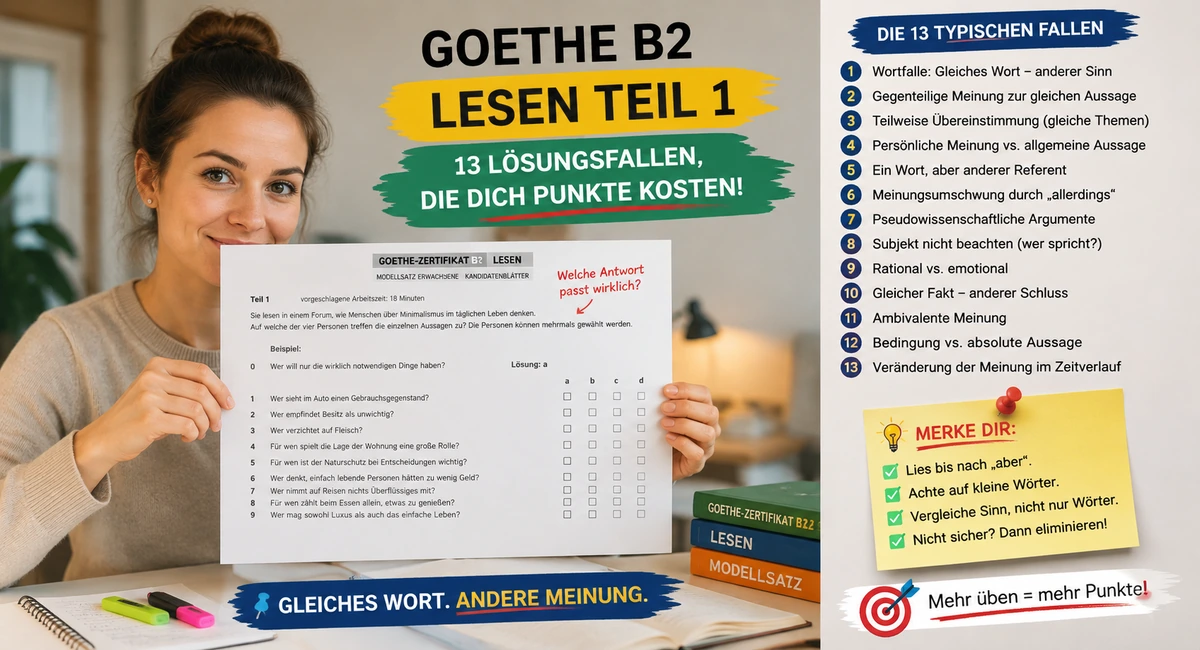
Reading Part 1:
All the traps at a glance
13 recurring trap types from official Goethe B2 exam sets — with real examples, so that in the exam you no longer fall for the typical tricks. 🎯
Why Reading Part 1 is so tricky
Reading Part 1 looks harmless: four short opinion texts, nine simple who-questions, 18 minutes. That is exactly the trap. The task authors at the Goethe-Institut almost never build the distractors (Distraktoren) through obvious contrasts, but through fine, partial overlaps: same topic, different focus; same word, different sense; same behaviour, different motive.
After analysing numerous official exam sets, 13 recurring trap types can be identified that keep appearing in new disguises — regardless of the topic of the text. Once you have internalised this mechanism, you recognise it again in every new forum text.
Almost every trap works only if you do not read a sentence to the end or confuse behaviour with motive, theory with practice, or feeling with opinion. The solution almost always comes after an aber (but), allerdings (however), jedoch (yet) or a zwar … aber (admittedly … but).
The 13 trap types in detail
Each of the following trap types has been worked out from real exam sets and our own original exercises. The examples come from different topic areas, to show that the mechanism always stays the same — only the topic changes.
1. Word trap
A signal word from the question appears in the text — but is relativised or revoked in the next sentence.
Sina: Ich habe mir vorgenommen, das Handy nur zu festen Zeiten zu nutzen, aber wenn ich abends müde bin, greife ich dann doch wieder danach. (I resolved to use my phone only at fixed times, but when I am tired in the evening I reach for it again after all.) — resolution and relapse in the same sentence.
2. Polarity — same topic, opposite position
Two people comment on the same topic, but hold exactly opposite standpoints.
Maren complains about extra costs — Philipp says: Dank der Konkurrenz sind die Langstreckenflüge preisgünstiger geworden. (Thanks to the competition, long-haul flights have become cheaper.) Same topic (price), opposite conclusion.
3. Thematic partial overlap
A person touches the asked topic only in passing, without explicitly holding the specific position asked about.
Question: Wer ist mit dem Lehrpersonal sehr zufrieden? (Who is very satisfied with the teaching staff?) — Cordula does mention professors, but delivers a split assessment (die eine Hälfte … die andere … / one half … the other …), no unqualified satisfaction.
4. Indirect vs. explicit
The question requires a personal, explicit statement — one text delivers only an impersonal generalisation (man sollte … / one should …) instead of an I-statement.
Lukas: Man sollte sich genau überlegen, wie viel Verantwortung man übernehmen möchte (One should consider carefully how much responsibility one wants to take on — advice to others) vs. Elena: Habe ich mir genau überlegt … (I considered it carefully … — her own, actually carried-out action).
5. Same keyword, different referent
The same word appears with two people, but refers to completely different things.
Georg: Es ist eine tolle Atmosphäre, da es hier nur so von Studenten wimmelt (It is a great atmosphere, because the place is teeming with students — lots of bustle) vs. Martina: So gut wie keine überfüllten Hörsäle (Practically no overcrowded lecture halls — little bustle) — both mean gute Atmosphäre (good atmosphere), but the exact opposite.
6. Self-contradiction — risk formula (6a) and however-reversal (6b)
6a: A person weakens their own statement themselves (bisher nichts passiert, aber man weiß ja nie / nothing has happened so far, but you never know), yet keeps the original position.
6b: A reason mentioned first, sounding logical, is explicitly devalued by allerdings (however); the true reason follows afterwards.
Elena: Weil das Land bekannt ist. Allerdings war das gar nicht der eigentliche Grund: Meine beste Freundin hat mir die Familie direkt empfohlen. (Because the country is well known. However, that was not the actual reason at all: my best friend recommended the family to me directly.)
7. Pseudo-scientific bait
A sentence with wissenschaftlich belegt/erwiesen (scientifically proven) sounds well-founded and distracts — but often answers a different question than it seems to at first glance.
Christine: Es ist wissenschaftlich erwiesen, dass Wachstumshormone ausgeschüttet werden … (It is scientifically proven that growth hormones are released …) — sounds well-founded, but only justifies her own questionable sleep method, not a universally valid fact.
8. Subject swap — actor vs. addressee, critic vs. perpetrator, theory vs. practice
Two people talk about the same action, but from swapped roles: one criticises the behaviour, the other actually shows it; or one explains the theory, the other applies it in practice.
Nico is annoyed when people copy from him — Alex only says that he himself would never copy. Same topic (copying), different role in the process.
9. Cognitive vs. emotional evaluation
Two people reject the same phenomenon — one rationally/on principle (unverantwortlich / irresponsible), the other emotionally (Angst / fear, unheimlich / eerie).
Simon: Ich finde es unverantwortlich … (I find it irresponsible … — principle) vs. Elena: Diese Vorstellung ist mir unheimlich … erschreckend … (This idea is eerie to me … frightening … — feeling) — same topic, different evaluation category.
10. Same external fact, opposite conclusion
Both people acknowledge the same external fact, but draw opposite practical conclusions from it. The dispute is not about the fact, but about its interpretation.
Both commentators acknowledge the decline in serious accidents in Austria — one sees in it proof for a limit, the other attributes it to the expansion of the road network.
11. Ambivalence within one person
One and the same person expresses, in the same passage, both a negative and a positive evaluation of the same aspect — often in a Paar-Konfiguration (pairing configuration; first/second provider, then/now).
Walter describes a first, disappointing acoustician and a second, excellent one — two questions (gut beraten / well advised, unzufrieden / dissatisfied) target different parts of the same text.
12. Conditional vs. unconditional agreement
Two people seem similarly approving/disapproving of a topic — one entirely without reservation, the other only under clearly stated conditions.
Antonia: Ich habe überhaupt nichts dagegen, egal wann (I have no objection at all, no matter when — unconditional) vs. Justus, who shows agreement only when a procedural rule is observed (conditional).
13. Opinion change over time
A person openly admits to having held exactly the opposite — often professional — position earlier. Whoever does not read as far as the früher … heute … (earlier … today …) assigns the wrong time level.
Helmut, a doctor: Früher habe ich selbst Vorträge für die großen Pharmakonzerne gehalten … Heute bin ich der Meinung, dass es nicht vertretbar ist, Medikamente zu verschreiben … (Earlier I myself gave talks for the big pharmaceutical companies … Today I am of the opinion that it is not justifiable to prescribe medications …)
Two special construction principles
The mirror trap (combination of type 1 + 2)
The strongest variant of the word trap: the same keyword appears with two people in exactly opposite modality — one person was prepared for an event, but it did not occur (hypothesis without fact); the other was unaware, but the event actually occurred (fact without expectation).
Florian: Auf eine Ablehnung war ich also gefasst (So I was braced for a rejection — but got none) — Jenny: Leider wurde mein Antrag abgelehnt (Unfortunately my application was rejected — she had not prepared for it). The same principle repeated with Kündigung (dismissal), Heimweh (homesickness), Streit (argument) and Entzündung (inflammation) in further exercises.
Double function of a text fragment
One and the same sentence or passage provides the answer to two different questions in the same task set — a construction principle that occurs at least once in almost every official exam set.
Maren’s statement about the large suitcase simultaneously answers the question about the großes Gepäckstück (large piece of luggage) and reappears as evidence in a second question — in the original marked twice.
Overview table — all the traps at a glance
| No. | Trap type | Key question for recognising it |
|---|---|---|
| 1 | Word trap | Is the signal word relativised in the next sentence? |
| 2 | Polarity | Does another person say the opposite about the same topic? |
| 3 | Topic overlap | Is the topic only touched on, without holding the position asked about? |
| 4 | Indirect vs. explicit | Is it a personal statement (ich / I) or a generalisation (man / one)? |
| 5 | Same word, different referent | Does the word really refer to the same thing for both people? |
| 6a / 6b | Self-contradiction / however-reversal | After the first statement, does an aber/allerdings come that tips it over? |
| 7 | Pseudo-scientific bait | Does the scientific-sounding sentence really answer this question? |
| 8 | Subject swap | Is the person actor/perpetrator or only critic/theorist of the same action? |
| 9 | Cognitive vs. emotional | Does the person argue rationally or with emotional words? |
| 10 | Same fact, different conclusion | Do both agree on the fact, but not on the interpretation? |
| 11 | Ambivalence within one person | Does the sought statement refer to the first or second part of the passage? |
| 12 | Conditional vs. unconditional agreement | Does the agreement hold without reservation or only under conditions? |
| 13 | Opinion change over time | Is there an früher … heute … (earlier … today …) in the text? |
Vocabulary radar: signal words that announce a trap
| Signal word | What usually follows |
|---|---|
| aber / allerdings / jedoch (but / however / yet) | Relativisation — the actual, correct answer often stands here (type 1, 6b) |
| zwar … aber (admittedly … but) | Contradiction in the same sentence (type 4, 6b) |
| man sollte / man muss (one should / one must) | Impersonal generalisation, not an I-statement (type 4) |
| es ist wissenschaftlich belegt/erwiesen (it is scientifically proven) | Bait — check exactly which question it really answers (type 7) |
| man weiß ja nie (you never know) | Self-contradiction, original position still remains valid (type 6a) |
| früher … heute / mittlerweile (earlier … today / by now) | Temporal development, often with a change of opinion (type 13) |
| eigentlich / ehrlich gesagt (actually / to be honest) | Announces the unvarnished, often surprising true position |
5-step strategy for the exam
- Read the questions first (2 min.): underline the core verb/noun and consider which trap type is probably lurking here.
- Read the texts in order: next to each text, note in keywords who stands for what.
- On similarity: read the whole sentence to the end. Never stop at a matching keyword — always check the subordinate clause after aber (but).
- Check role instead of topic: does the person act themselves, or only talk about others / in general?
- Elimination procedure: first cross out people who do not mention the topic at all — then compare specifically between the remaining similar candidates.


There are no comments for this article. Leave your comment