





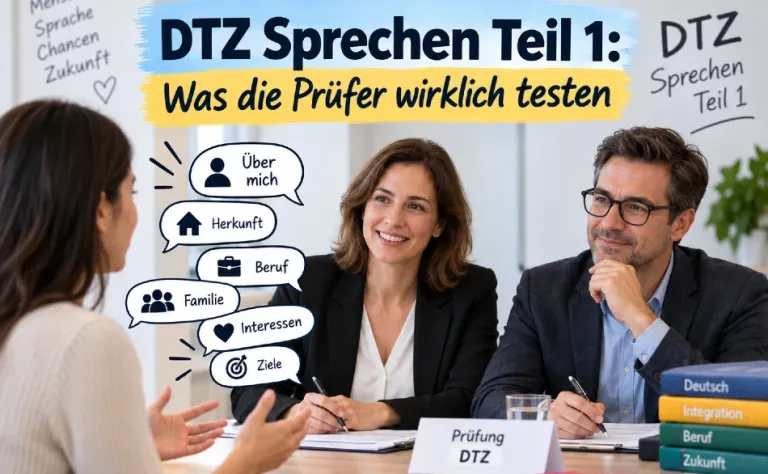
In Part 1, “Über sich sprechen”, there are no wrong answers. Nevertheless, the task has 7 hidden rules. They can be found in the examiners’ script and in the assessment criteria. If you know these rules, you will understand what is really happening during the first few minutes of the oral DTZ exam.
The short answer: Part 1 tests your conversation skills, not your personal details
In Part 1 of the oral DTZ exam, the examiners are not checking facts. Your name, where you live and your profession are already on the registration form. The examiners are testing something else: Can you connect this information in German? And can you respond spontaneously to a question? These are exactly the two things that appear in the official assessment criteria for Parts 1A and 1B.
This means that Part 1 has no distractors like the Reading or Listening sections. There is no wrong answer. But the task has rules that are not written on the task sheet. They can be found in the examiners’ script, the examination handbook and the wording of the assessment criteria. In this article, you will learn these 7 rules – with the official source for each rule.
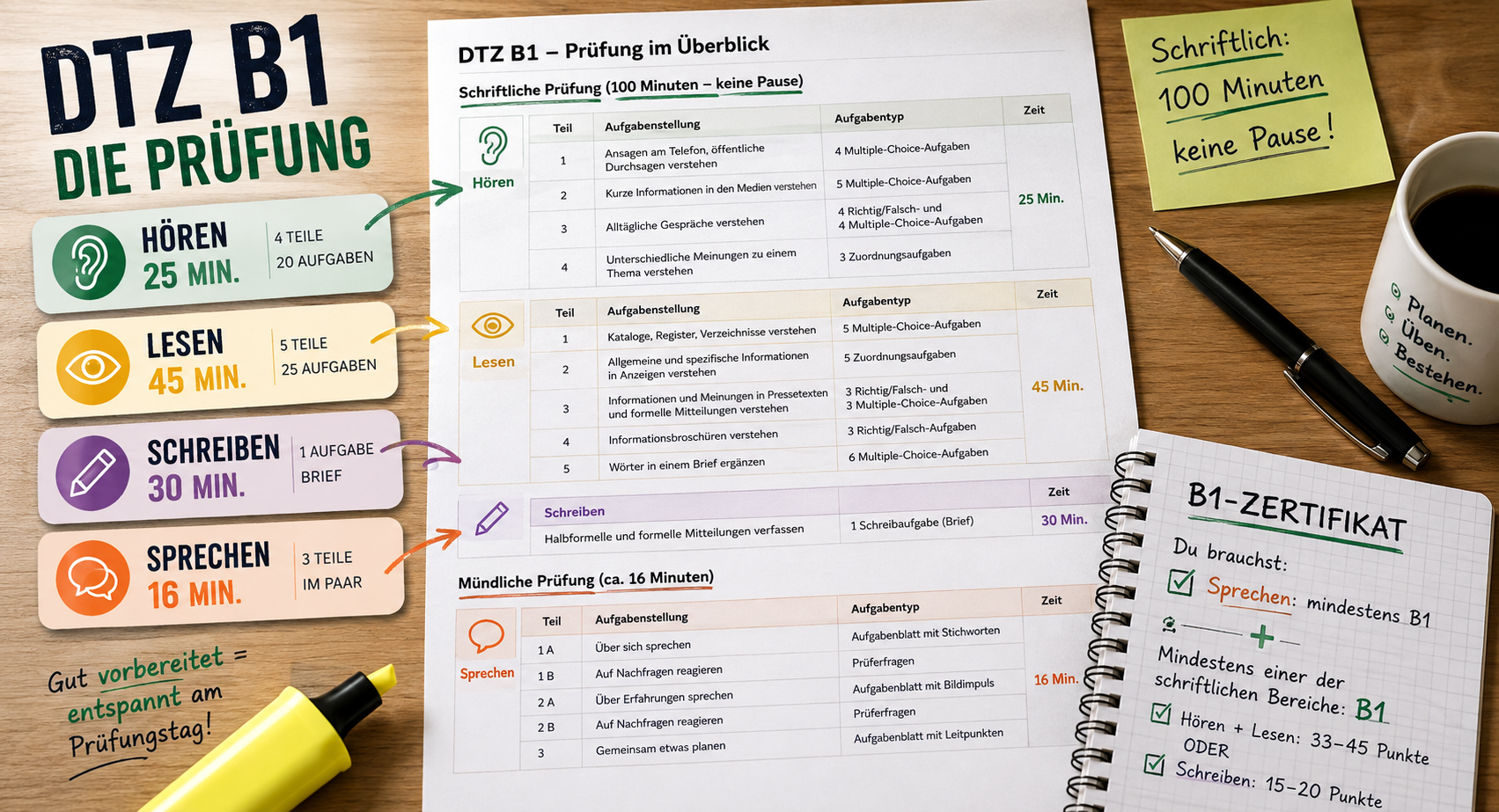
The sources are: the DTZ-Übungssatz 1 from g.a.s.t. (PDF), which contains the procedure for examiners (pages 28–32) and the assessment criteria (pages 44–46), the page “Der DTZ auf einen Blick” and the official DTZ-Prüfungshandbuch (BAMF, PDF), which g.a.s.t. refers to in its FAQ. Last updated: 11.09.2026.
You can find the procedure for Part 1 and the scoring tables in our article about the structure and assessment of Part 1. Here, we focus only on the rules behind it.
👉 Practice DTZ Speaking Part 1 “Über mich”Rule 1: The questions come from a catalogue – and you influence them
The questions in Part 1B are not spontaneous. The examiners have a catalogue of standard questions. For Part 1B, the examination handbook refers to “Prüferfragen aus Katalog”. In Übungssatz 1 (page 30), g.a.s.t. gives examples: questions about your profession, your children and the languages you speak.
The hidden rule behind this is that the examiner chooses a question from the catalogue that matches your introduction. The official procedure says that the examiner “knüpft an das Gesagte an”. This means that you influence the questions yourself. If you talk about your children in 1A, you may get a question about your children in 1B. If you talk about your work in your home country, you may get a question about your work.
In 1A, you can introduce topics that you feel comfortable and confident talking about. A sentence such as “Ich habe in meiner Heimat als Koch gearbeitet” is an invitation for the question “Was haben Sie da genau gemacht?”. If you do not mention a particular topic, the examiner will usually not ask about it.
Rule 2: Part 1B is a test of spontaneous speaking
Why does Part 1B exist at all? The answer can be found directly in the assessment criteria (Übungssatz 1, page 45). For Part 1B, they state:
- B1: Kann auf Fragen relativ spontan und ausführlich antworten.
- A2: Kann auf Fragen knapp und/oder nur teilweise verständlich antworten.
- A1: Kann mit einzelnen Wörtern oder auswendig gelernten Wendungen antworten.
The word “spontan” appears only at B1. The phrase “auswendig gelernt” appears only at A1. This is not a coincidence. The task is designed this way: You can prepare Part 1A. You cannot completely prepare Part 1B because the question depends on your introduction. This is exactly where the examiners can see the difference between a prepared text and a real conversation.
The hidden rule: The examiners do not expect you to speak perfectly in 1B. They expect you to react. An answer with a small mistake but with an example and a reason fits “spontan und ausführlich”. A perfect answer consisting of only three words fits “knapp”.
Rule 3: Short answer = more questions
The examination handbook states that after the introduction, the examiner asks “eine bzw. bei kurzen Antworten zwei bis drei weiterführende Fragen”. The aim is for each person to speak for approximately one minute in 1A and approximately one minute in 1B.
The hidden rule: The number of questions is a signal. One question means that your introduction was long enough. Three questions mean that your introduction or your answers were short, so the examiner is filling the available time. This is not a punishment. The examiner’s task is to give you two minutes to speak. They are not taking time away from you – they are giving you time.
Übungssatz 1 (page 30) also states that if a person “ins Stocken kommt oder die Vorstellung abbricht”, the examiner provides prompts. Examples in the script include: “Was machen Sie beruflich? Haben Sie Kinder? Was machen Ihre Kinder?”. This is also help, not a test.
The assessment for 1B does not depend on the number of questions. The examiner does not assess: “I had to ask three questions.” They assess: “How did the person answer the questions – spontaneously and in detail, or briefly?”
Rule 4: “Das habe ich nicht verstanden” is part of the script, not a judgment
In the official procedure (Übungssatz 1, page 30), the following sentence is given as an example of a transition to Part 1B: “Sie haben etwas über Ihren Beruf gesagt. Das habe ich nicht genau verstanden.” Many participants hear this sentence and think: I spoke badly. That is not true. The sentence is a standard prompt. It is already in the script before you even enter the room.
The hidden rule: This sentence is a second chance. You can give the same information again – using different words, speaking more slowly or adding an example. The examiners assess what you do with this second chance.
There is another rule in the examination handbook: The examiner speaks clearly and distinctly and keeps vocabulary and grammar at B1 level. If there are comprehension problems, the examiner should provide “weitere Erklärungen”. So you are allowed to ask: “Können Sie die Frage bitte wiederholen?” This is allowed and completely normal.
The A1 criteria state that the person depends on things being repeated more slowly. Asking for clarification once is not a problem. But if you need every question to be repeated twice, this fits the A1 description. The examiner is happy to help – but the criteria also look at how often you need this help.
Rule 5: Part 1 determines which questions you get in Part 2
This is the most important hidden rule. The language criteria – pronunciation, fluency, accuracy and vocabulary – are not assessed separately for each part, but for the entire conversation from Part 1 to Part 3. This is stated in Übungssatz 1 (page 44). For Part 2, there are also two lists of questions: “Prüfungsfragen Stufe A2” and “Prüfungsfragen Stufe B1” (Übungssatz 1, pages 34–35).
The examiners therefore have to decide early: Which list should I use? This decision is made in Part 1. The examination handbook says this directly: The questions in Part 2 “sollen dem vorgefundenen sprachlichen Niveau A2 oder B1 angepasst werden”. “Vorgefunden” means the level that the examiner has heard from you up to that point.
The hidden rule: Part 1 accounts for only 10 of the 100 content points. But Part 1 is where the examiners form their initial impression of your level. If you speak in connected sentences and provide details in Part 1, you may receive the B1 questions in Part 2 – giving you the opportunity to demonstrate B1. If you speak briefly in Part 1, you may receive the A2 questions instead. With A2 questions, it is more difficult to give detailed answers because the questions are simpler and more closed.
| What the examiner hears in Part 1 | What the examiner chooses for Part 2 | Example of a question in Part 2 |
|---|---|---|
| Short sentences, little connection | Liste A2 | Was haben Sie schon im Internet gekauft? |
| Connected sentences, details, reasons | Liste B1 | Welche Erfahrungen haben Sie mit dem Einkaufen im Internet gemacht? Was sind die Vor- und Nachteile? |
The sample questions come from Übungssatz 1 (page 34). They show the difference: The A2 question can be answered with one word. The B1 question requires experience, an opinion and a comparison.
Rule 6: Completeness is not a criterion – connection is
Many participants think: I have to mention all 6 prompts, otherwise something is missing. Look closely at the criteria for Part 1A (Übungssatz 1, page 45). There is no mention of “all prompts”. Instead, it says:
- B1: Kann sich vorstellen und dabei auch detailliertere Informationen vortragen.
- A2: Kann sich vorstellen und dabei knappere, allgemeine Informationen geben.
- A1: Kann sich vorstellen und dabei Informationen unverbunden vortragen.
The hidden rule: The examiners assess two things – detail and connection. Not the number of prompts. An introduction with five prompts and plenty of detail can be B1. An introduction with all six prompts but no connection can be A1. The examination handbook also says that the prompts “müssen nicht nacheinander abgearbeitet werden”. The sheet is an aid, not a checklist.
That is why the examiners do not assess whether you left out “Familie”. They assess whether what you said is connected: with “weil”, “seit”, “aber”, “dann” or with an example.
Rule 7: The silent examiner assesses you – and friendly words are not feedback
There are two examiners in the room during the oral DTZ exam. One speaks with you. The second says almost nothing, listens and writes. The examination handbook calls these roles “Interlokutor” (the conversation partner) and “Assessor” (the assessor). Both assess you – but only one speaks.
The first hidden rule here: The silent examiner is not being unfriendly or bored. Their job is to focus solely on the assessment. The handbook says that the examiners “halten sich grundsätzlich zurück”. You can calmly speak to the silent examiner as well – but do not expect a reaction.
The second hidden rule: At the end of each part, the examiner says something friendly. The script (Übungssatz 1, page 31), for example, says: “Vielen Dank, das war informativ.” This is not feedback. Übungssatz 1 clearly states: “Hinweise auf das Prüfungsergebnis dürfen nicht gegeben werden.” So a friendly comment is not a sign that you have B1. A neutral comment is not a sign that you have A2. The assessment takes place only after the exam, once you have left the room.
Do not look for signals in the examiners’ facial expressions during the exam. There are none. The only information that matters is in the assessment criteria: details, connection and spontaneous answers. You can focus on these – everything else is part of the script.





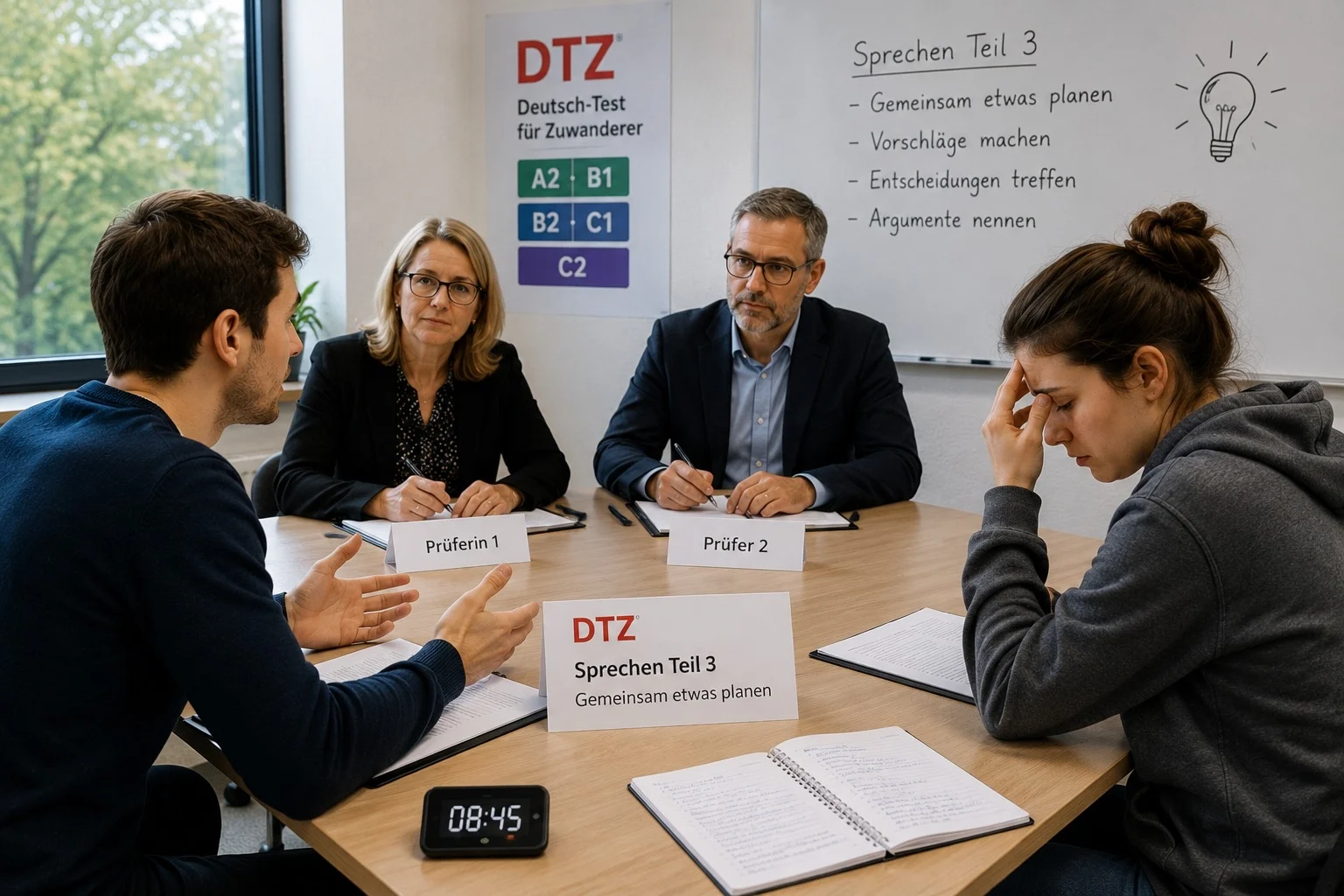
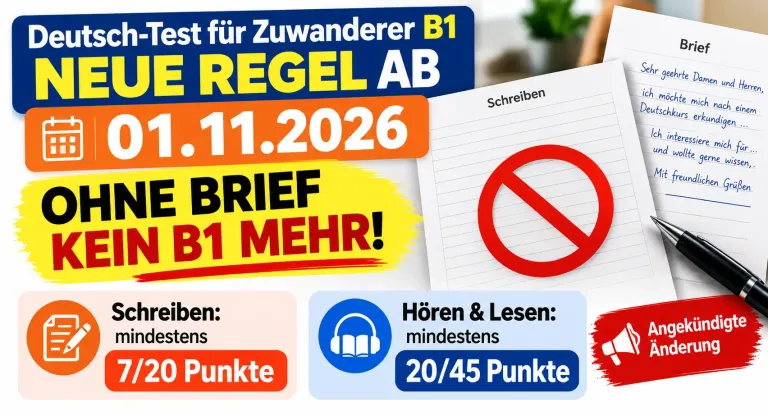
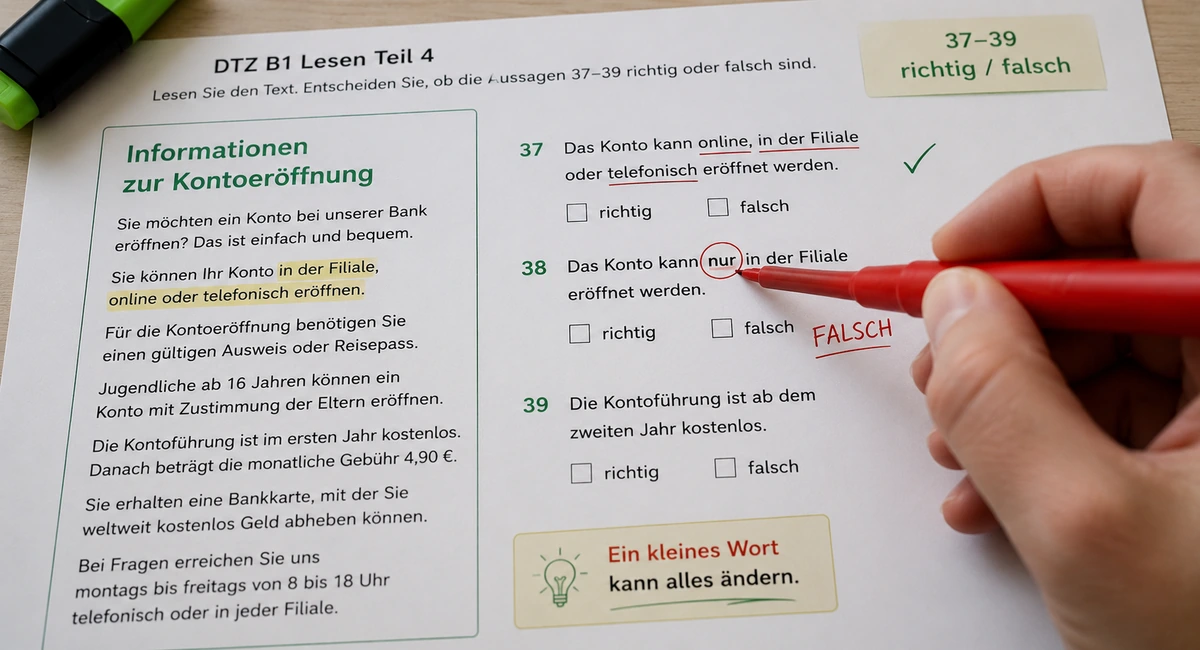



There are no comments for this article. Leave your comment