





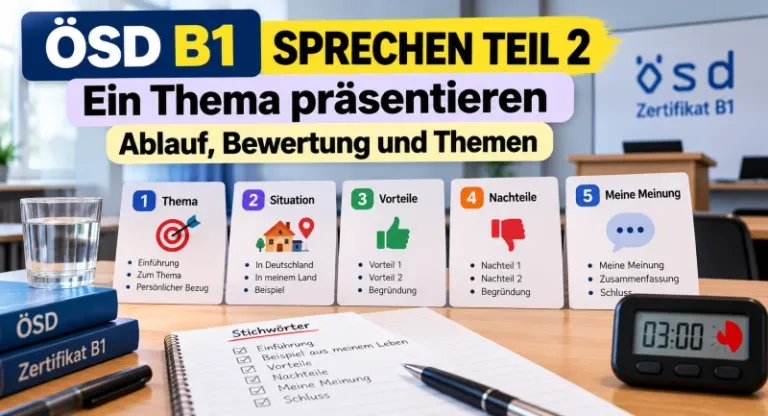
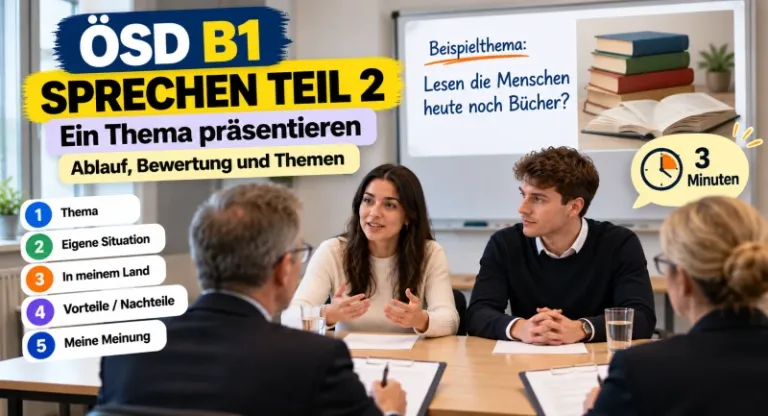
In the ÖSD B1 oral exam, Speaking Part 2, you give a short presentation on an everyday topic – for example, “Brauchen Kinder Mobiltelefone?”. You choose one of two topics and speak freely for about three minutes, following five slides. Here you will learn how the ÖSD B1 presentation works, how many points it is worth and which topics are typical – based on official ÖSD documents and applicable to examination centres around the world.
What is ÖSD B1 Speaking Part 2 “Presenting a Topic”?
In brief: ÖSD B1 Speaking Part 2 is a short presentation. You choose one of two topics, follow five slides and speak on your own for about three minutes. You introduce the topic, talk about yourself and your home country, describe advantages and disadvantages, and give your opinion.
“Presenting a Topic” is the second part of the oral examination for the ÖSD Certificate B1 (ZB1). Unlike in Part 1, here you do not speak with your partner but rather to your audience. The examiners and your partner listen. This is similar to a real-life situation: you tell other people about a topic you have prepared well.
The ÖSD Certificate B1 is taken at examination centres around the world – from Austria to Asia, Africa and the Americas. The task is the same everywhere. Anyone familiar with the five-slide format can present any topic.
The ZB1 examination was jointly developed by ÖSD, the Goethe-Institut and the University of Fribourg (Switzerland). That is why many learners also know this task as the “Goethe B1 presentation”. However, ÖSD rules and documents always apply to ZB1 Speaking Part 2, and this article is based on them.
You present a current topic to your audience. You are given five slides. The instructions are on the left, and there is space for your notes on the right.
Source: ÖSD, ÖSD Certificate B1 sample examination – Speaking (PDF).
Part 2 of the Speaking module: time and points
In brief: Part 2 lasts about 3–4 minutes per person and is worth 40 out of 100 points. This makes the presentation the most important part of the oral examination.
| At a glance | ÖSD B1 Speaking Part 2 |
|---|---|
| Task | Presenting a topic |
| Format | Monologue – you speak on your own |
| Topics | 2 topics to choose from; you select 1 |
| Structure | 5 slides with instructions |
| Duration | “approximately three minutes” (task sheet), 3–4 minutes per person (examination regulations) |
| Preparation | 15 minutes for all three parts, individually |
| Notes | allowed, keywords only |
| Points | 40 out of 100 |
You need 60 points to pass the entire Speaking module. Part 2 alone is worth 40 points. A well-prepared presentation is therefore your most important step towards passing.
Source: ÖSD, ZB1 examination regulations, version 10/2023 (PDF).
The procedure: from choosing a topic to the final sentence
In brief: During preparation time, you choose one of two topics and make notes. After Part 1, both candidates give their presentations one after the other. While you speak, your partner and the examiners listen.
- Receive the task sheets: During preparation, you have all the tasks in front of you – including the two topics for Part 2.
- Choose a topic: You choose Topic 1 or Topic 2. Your partner makes their own choice – sometimes the same topic, sometimes the other one.
- Make notes: There is space for keywords beside each slide. You also receive stamped paper.
- Part 1: First, you plan something together with your partner.
- Part 2: The moderator briefly explains the task. Then one person presents, followed by the other.
- Part 3: After each presentation, there is feedback and there are questions.
You may use your keyword notes during the examination. However, the task sheet also says that you should speak freelyduring the examination. So glance briefly at your keywords and then speak to your audience.
Individual examination: presentation without a partner
In exceptional cases, an individual examination is held. In that case, only one person gives a presentation. The structure is exactly the same, and preparation time remains 15 minutes.
The five slides: how the task is structured
In brief: Every ÖSD B1 presentation has five slides in the same order: introduce the topic, describe personal experience, explain the situation in your home country, discuss advantages and disadvantages and give your opinion, then conclude and thank the audience. Only the topic changes.
| Slide | Title on the slide (sample examination) | What you do | Example on the topic “Brauchen Kinder Mobiltelefone?” |
|---|---|---|---|
| 1 | the topic as a question, e.g. “Brauchen Kinder Mobiltelefone?” | Introduce the topic and explain the content and structure | Ich spreche heute über …. Zuerst …, danach … |
| 2 | „Meine persönlichen Erfahrungen“ | Describe your own situation or an experience | Mein Neffe hat seit einem Jahr ein Handy … |
| 3 | „Die Situation in meinem Heimatland“ | Describe the situation in your home country and give examples | In meinem Heimatland haben viele Kinder schon mit acht Jahren … |
| 4 | „Vor- und Nachteile & Meine Meinung“ | Mention advantages and disadvantages, express your opinion and give examples | Ein Vorteil ist die Sicherheit. Ein Nachteil ist … Meiner Meinung nach … |
| 5 | „Abschluss & Dank“ | End the presentation and thank the audience | Zum Schluss möchte ich sagen … Vielen Dank für Ihre Aufmerksamkeit! |
In the sample examination, the title of Slide 3 may also be adapted to the topic, for example “Die Rolle von Handys in meinem Heimatland”. Slide 1 contains a short quotation from everyday life, such as something a child says to their parents. It illustrates what the topic is about. In the sample examination, the topic itself is a yes-or-no question, such as “Sehen Kinder zu viel fern?”.
The article “ÖSD B1 Presentation: Useful Phrases for All 5 Slides, Common Mistakes and Strategies”shows how to fill each slide with suitable sentences and how much time to spend on each slide.
👉 Practise ÖSD B1 Speaking with sample textsAssessment: 40 points for a presentation
In brief: You can earn up to 40 out of 100 points for the presentation – more than for any other part of the Speaking module. Pronunciation is assessed as well: in Part 2, you speak on your own for the longest time, so your pronunciation is especially noticeable here.
The general rules are the same throughout the module: two examiners, fixed point values and an audio recording of the examination. These are explained in the article “ÖSD B1 Speaking Part 1: Procedure, Assessment and Topics” . Here we focus only on what matters for the presentation.
What your presentation must demonstrate
ÖSD provides the detailed assessment criteria, including all levels, only to licensed examiners. However, the task sheet and examination regulations explain what is required in Part 2:
| What is expected | Source |
|---|---|
| Introduce the topic and explain the structure | Task sheet, examination regulations |
| Describe a personal situation or experience | Task sheet |
| Describe the situation in your home country, with examples | Task sheet, examination regulations |
| Describe advantages and disadvantages, give your own opinion and provide examples | Task sheet, examination regulations |
| Conclude the presentation and thank the audience | Task sheet, examination regulations |
| Speak freely | Task sheet |
Source: ÖSD, ZB1 examination regulations, version 10/2023 (PDF).
ÖSD B1 presentation topics: the main areas
In brief: The topics in ÖSD B1 Speaking Part 2 come from everyday adult life: family and children, media, work and learning, health, the environment, shopping and housing. The topic is almost always a question with reasonable arguments both for and against it.
| Topic area | Presentation examples |
|---|---|
| Family and children | Brauchen Kinder Mobiltelefone? · Sehen Kinder zu viel fern? · Sollen Kinder in den Kindergarten gehen? · Brauchen Familien ein gemeinsames Abendessen? · Sollen alle in der Familie im Haushalt helfen? |
| Media and the internet | Benutzen wir unser Handy zu viel? · Sind soziale Netzwerke wie Facebook nützlich? · Kann man Informationen im Internet glauben? · Sind Computerspiele nur Zeitverschwendung? |
| Work and learning | Ist Arbeit wichtig? · Sollte man immer seinen Traumberuf wählen? · Ist eine Ausbildung eine gute Chance? · Sollte jeder Fremdsprachen lernen? · Lohnt es sich, im Ausland zu lernen? |
| Health and sport | Ist Fastfood wirklich so schlecht? · Sollte jeder regelmäßig Sport treiben? · Ist Schulsport langweilig? · Sollte Rauchen in der Öffentlichkeit verboten sein? |
| Environment and transport | Sollen Autos in der Innenstadt verboten werden? · Sind öffentliche Verkehrsmittel besser als das Auto? · Sollen alle Menschen ihren Müll trennen? |
| Shopping and money | Soll man im Internet einkaufen? · Ist Mode wichtig? · Soll man gebrauchte Kleidung kaufen? · Braucht man heute eine Kreditkarte? |
| Housing and living together | Leben auf dem Land oder in der Stadt? · WG oder eigene Wohnung – was ist besser? · Ist Kontakt mit Nachbarn heute noch wichtig? · Im Ausland leben – ja oder nein? |
ÖSD does not publish a list of all examination topics. This overview is based on the official ÖSD Certificate B1 sample examination for adults and on reports from candidates in many countries. A new topic may also appear in the examination – but with the five-slide structure, you can handle any of them.
Parts 2 and 3: what happens after the presentation
In brief: Part 3 begins immediately after your presentation. Your partner and the second examiner give you feedback and ask questions about your topic. You respond to them.
Part 3 lasts about 1–2 minutes per person and is worth 16 points. For your presentation, this means you should talk about things you can also answer questions about. If you tell a genuine story in Part 2, answering questions in Part 3 will be easier.
| Who? | What happens in Part 3? |
|---|---|
| Your partner | gives feedback on your presentation and asks a question |
| the second examiner | also gives feedback and asks a question |
| You | respond to the feedback and answer the questions |
Comparing Part 1 and Part 2
In brief: In Part 1, you speak with your partner; in Part 2, you speak on your own to the audience. Part 1 is a dialogue using the informal German “du”; Part 2 is a short speech using the formal German “Sie”.
| Part 1: Planning Something Together | Part 2: Presenting a Topic | |
|---|---|---|
| Format | Dialogue | Monologue |
| Form of address | “du” when speaking to your partner | “Sie” when addressing the audience |
| Content | plan something and make decisions | experience, home country, advantages and disadvantages, opinion |
| Structure | 4 points + “– …” | 5 slides |
| Choice | no choice | 1 of 2 topics |
| Points | 28 | 40 |
Read everything about the dialogue in Part 1 in the article “ÖSD B1 Speaking Part 1 ‘Planning Something Together’: Procedure, Assessment and Topics”.
FAQ – ÖSD B1 Speaking Part 2
Deutsch-Vorbereitung is an independent learning resource and is not affiliated with the Austrian Language Diploma in German (ÖSD). “ÖSD” is a trademark of the Austrian Language Diploma in German. All information on the procedure and assessment is based on official ÖSD publications, in particular the examination regulations for the ÖSD Certificate B1 (version 10/2023), the ÖSD examination rules (effective from 1 August 2026) and the ÖSD Certificate B1 sample examination – Speaking (as of October 2026). The current examination rules and information provided by your examination centre are always authoritative.




There are no comments for this article. Leave your comment