





Written B1 Exam (DTZ): Structure, Lines, Betreff and Typical Mistakes
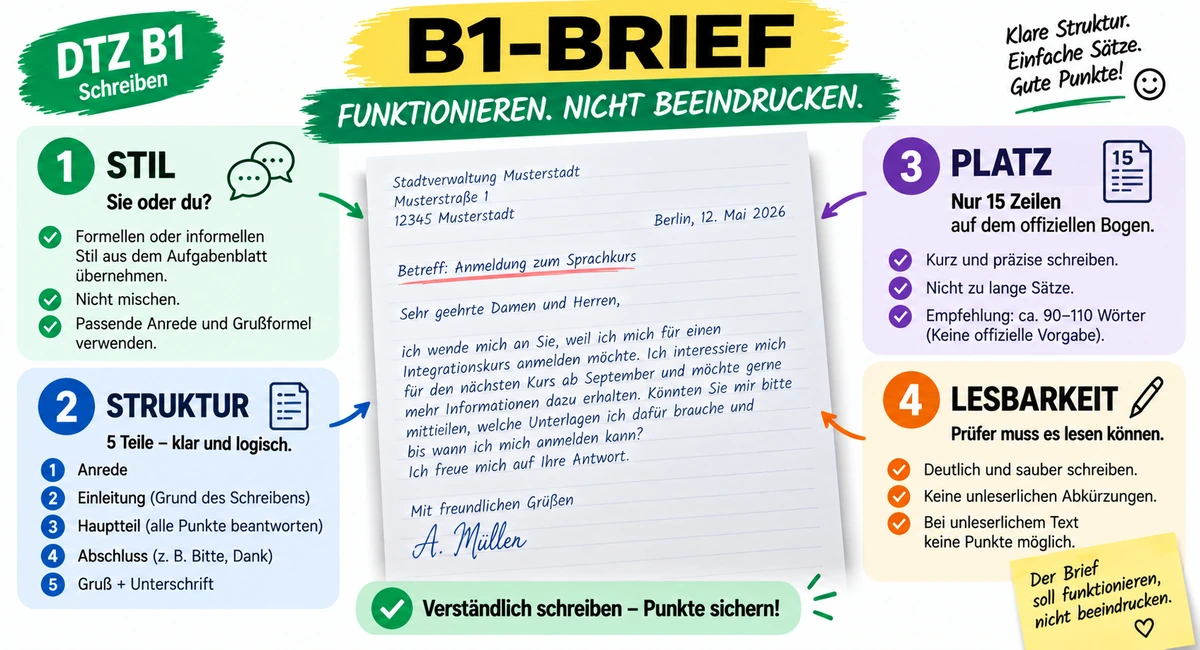
The B1-level letter is one of the most underestimated parts of the DTZ writing exam.
Many people consider it “easy” until they encounter the real exam sheets, the limited number of lines, and the strict assessment criteria.
In this article, we will analyze:
- what the functional structure of a B1 letter looks like,
- why the Betreff is important even if it is not explicitly required,
- why legible handwriting is not a minor detail,
- and how to fit into the 15 lines of the exam sheet without losing points.
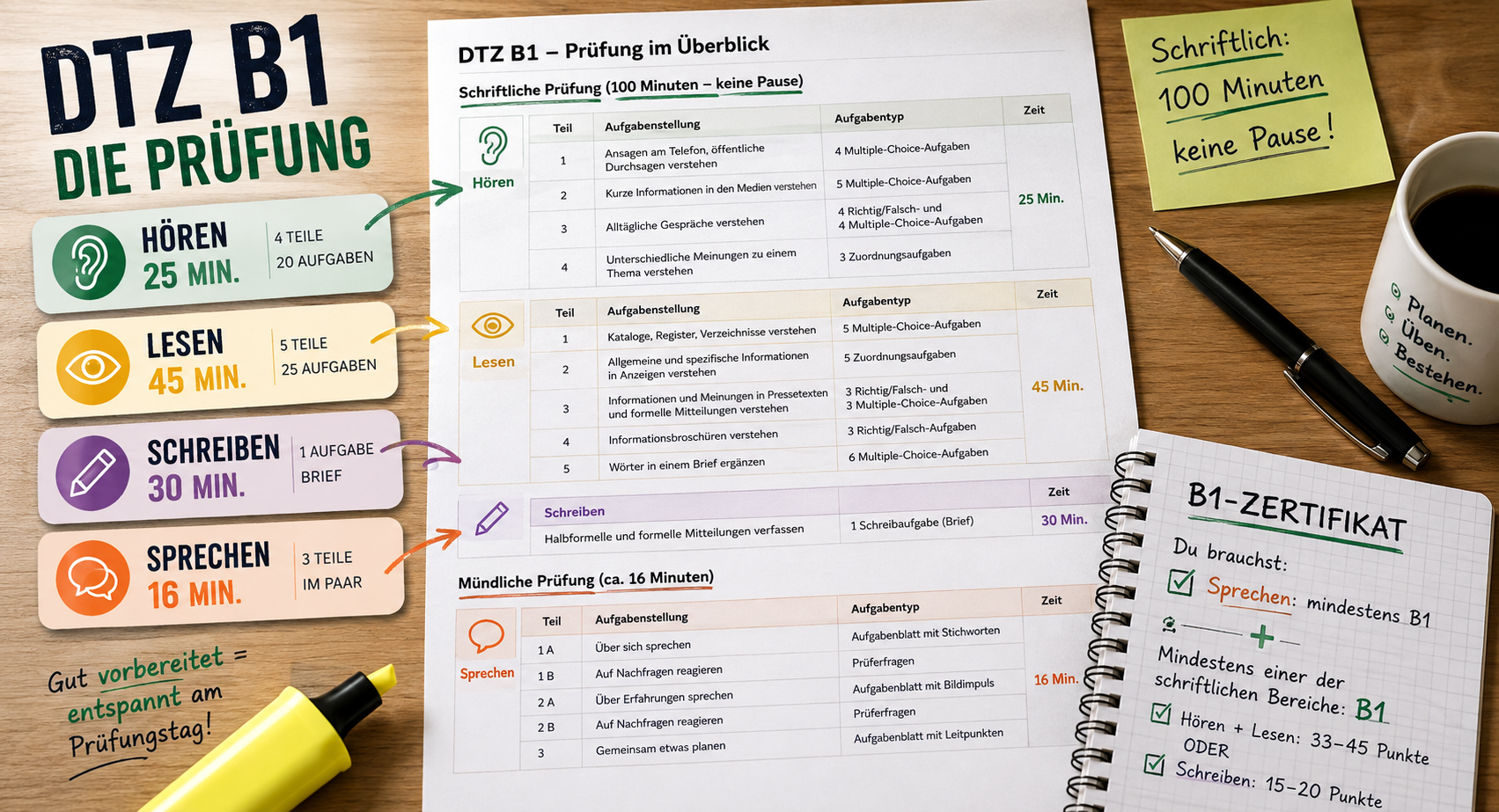
What is actually assessed in a B1 letter (DTZ)
In the written part of the DTZ (Deutsch-Test für Zuwanderer), the examiner does not assess style or the “beauty” of the text.
What is assessed is whether the candidate can:
- understand the task,
- logically cover all required points,
- use language at B1 level,
- present the letter in a clear and expected form.
In other words: the letter has to work, not impress.
Formal and informal style: this is where mistakes begin
One of the most common reasons for losing points is choosing the wrong style.
The style of the letter is always specified in the task and is not a matter of personal preference.
Formal letter
Used when writing to:
- organizations,
- landlords,
- official institutions,
- employers.
Typical features:
- the Sie form,
- a neutral, polite tone,
- no emotions and no colloquial expressions,
- a clear, predictable structure.
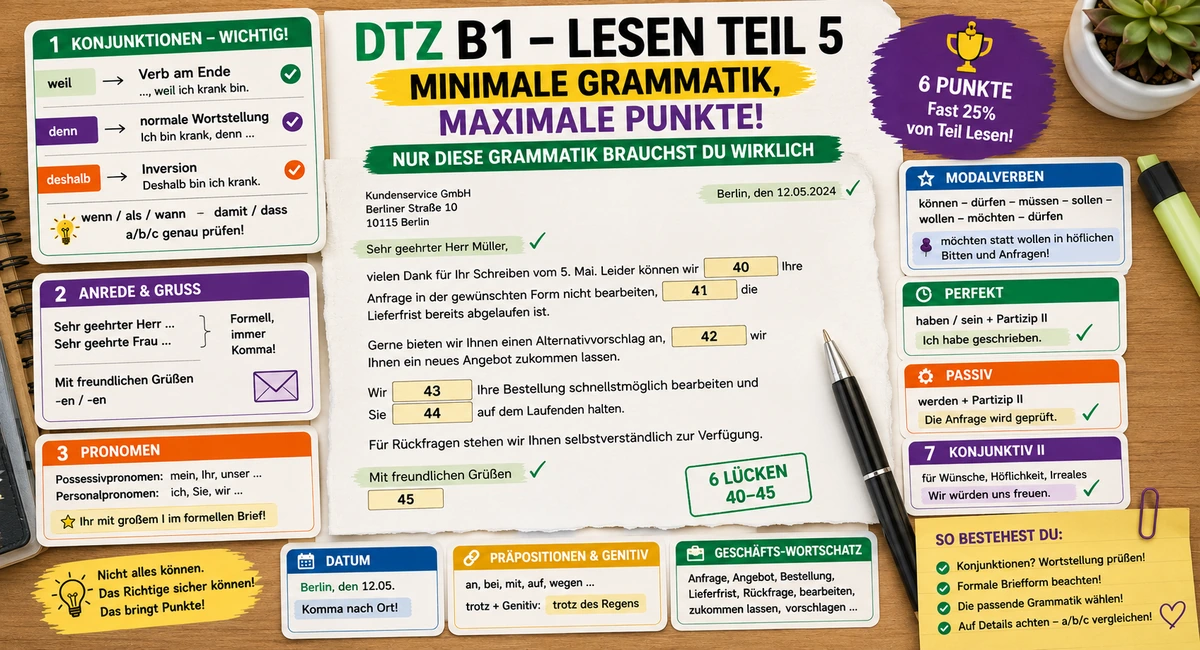
Typical greetings in a formal letter:
- Sehr geehrte Damen und Herren,
- Sehr geehrte Frau Müller,
- Sehr geehrter Herr Schneider,
- (the greeting always ends with a comma; the text starts on a new line with a lowercase letter)
Typical closing formulas:
- Mit freundlichen Grüßen
- Vielen Dank im Voraus und mit freundlichen Grüßen
A formal letter must be correct and functional, without personal comments or emotional evaluations.
Informal letter
Used when writing to:
- friends,
- acquaintances,
- family members.
Typical features:
- the du form,
- a personal but structured style,
- simple and clear wording.
Typical greetings in an informal letter:
- Liebe Maria,
- Lieber Paul,
- Hallo Anna,
Typical closing formulas:
- Viele Grüße
- Liebe Grüße
- Bis bald
- Herzliche Grüße
Even in an informal letter, it is important to:
- maintain the structure,
- not mix styles,
- not turn the letter into a chat.
The structure of a B1 letter: without it, the text is hard to read
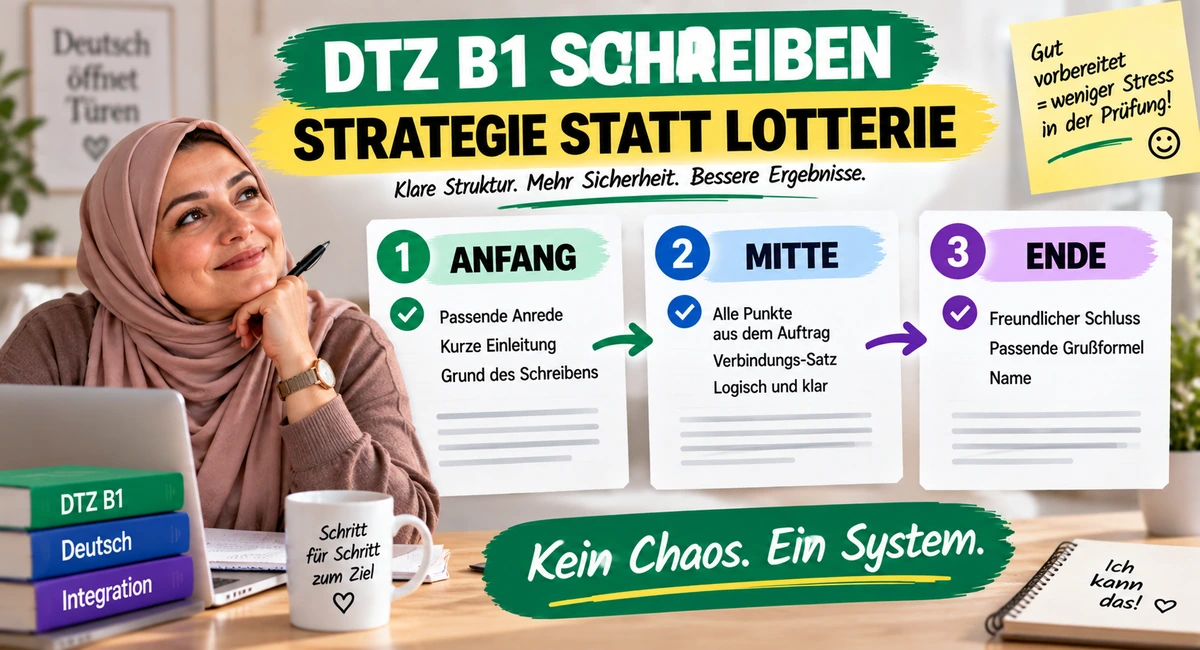
Regardless of the topic, a B1-level letter must have a clear, recognizable structure:
1️⃣ Greeting
2️⃣ Introduction – why you are writing
3️⃣ Main part – all points of the task
4️⃣ Closing
5️⃣ Signature
This is exactly the logic the examiner expects.
If the structure “slips,” the text becomes harder to assess – and that is always a risk.
Betreff: why I recommend using it
Formally, in the B1 DTZ tasks, it is not always stated that a Betreff must be written.
However, I consciously recommend including it.
Why?
- In real life, every letter starts with a subject.
- The Betreff immediately shows the examiner what the letter is about.
- It promotes proper writing culture, not just passing the exam.
A short, neutral Betreff:
- takes up little space,
- does not interfere with the structure,
- makes the letter more professional.
👉 It is not a mandatory element, but a reasonable practice that I recommend to my students.
15 lines in the exam: the main limiting factor
On the official DTZ writing exam sheet, only 15 lines are provided.
This means that the candidate must be able to:
- cover all points of the task,
- maintain the structure of the letter,
- stay within the line limit,
- write legibly enough.
What is especially important here:
- not writing overly long sentences,
- not getting stuck on a single point,
- knowing in advance how much space each part of the letter requires.
👉 A B1 DTZ letter means writing concisely and to the point.
Handwriting matters (yes, really)
This is often underestimated, but in practice it is very important.
The examiner:
- reads hundreds of papers,
- does not decipher illegible words,
- only assesses what can be clearly read.
If a word cannot be read, it effectively does not exist for the assessment.
Therefore:
- the handwriting must be legible,
- the letters must be distinguishable,
- the lines must not “stick together.”
👉 This is not about calligraphy, but about readability.
Length of the letter: without myths and extremes
In the DTZ exam, no fixed word count is specified. The official documents speak of a sufficiently developed text that allows the examiner to assess task completion.
In practice, a text of about 90–110 words is considered optimal because:
- all points can be clearly covered,
- grammar is easier to control,
- it fits well into 15 lines.
This is a methodological recommendation, not a formal requirement.
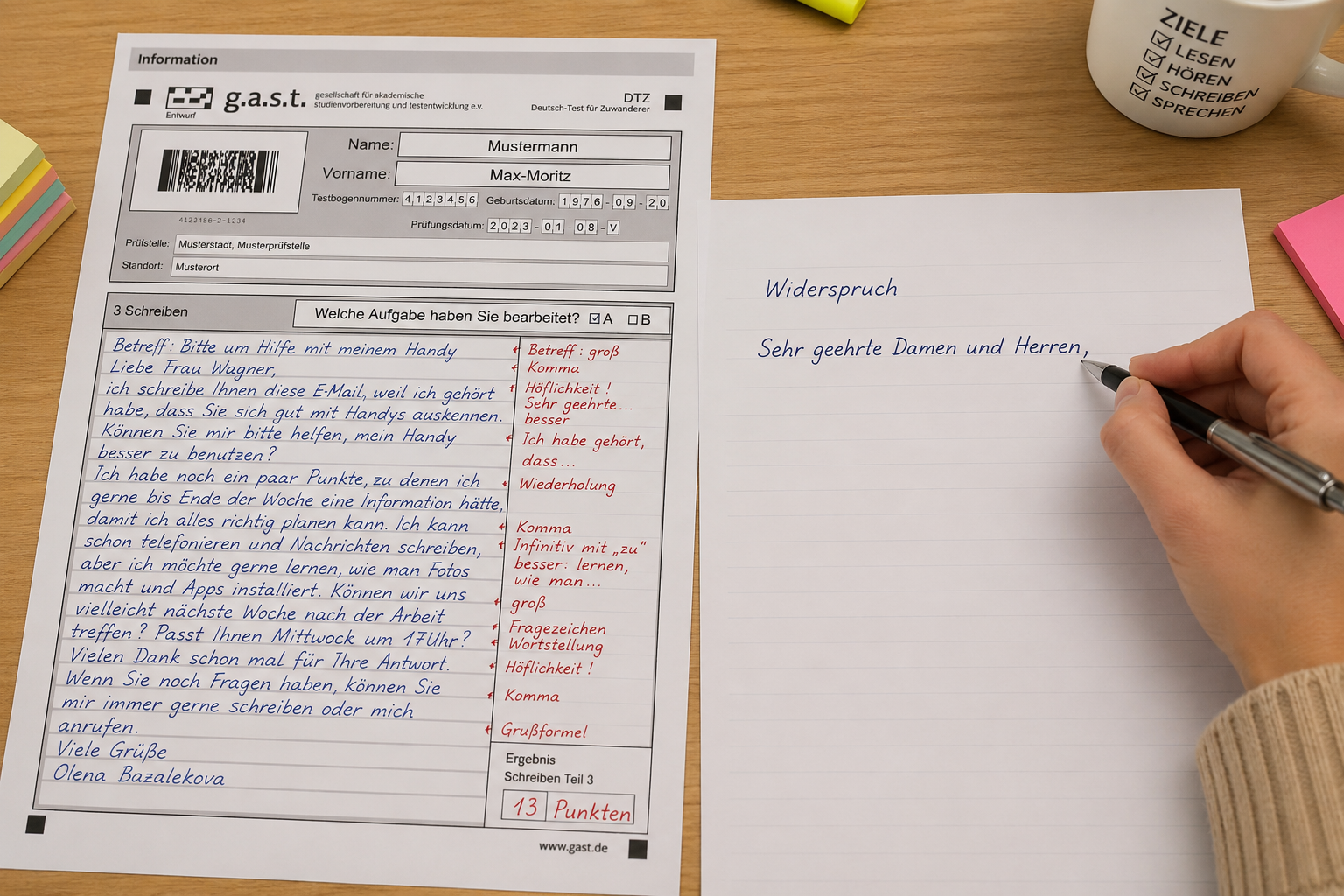
Typical mistakes that cost points
Most often, problems arise due to:
- missing points from the task,
- lack of structure,
- wrong style (du / Sie),
- a text that is too short,
- illegible handwriting.
The good news:
👉 all of these mistakes can be avoided if you understand the mechanics of the exam.
Video analysis of a B1 letter
If you want to see how all of this looks in a real example, I recommend this video lesson:
🎥 How to write a B1 letter (DTZ) step by step
The video explains in detail:
- how to read the task correctly,
- how to distribute the text across the lines,
- how to keep the structure and stay within the given limits.
Official sources
The information in this article is based on official materials:
Bundesamt für Migration und Flüchtlinge (BAMF) — commissioning body of the DTZ exam – https://www.bamf.de/
Used sources include:
- official handbooks,
- assessment criteria for the written part,
- practical experience in correcting exam papers.
Conclusion
A B1 letter does not mean “writing something somehow,” but rather the ability to:
- work within clear limits,
- follow a given form,
- write clearly and to the point.
This is exactly what is required in the DTZ exam.





There are no comments for this article. Leave your comment