





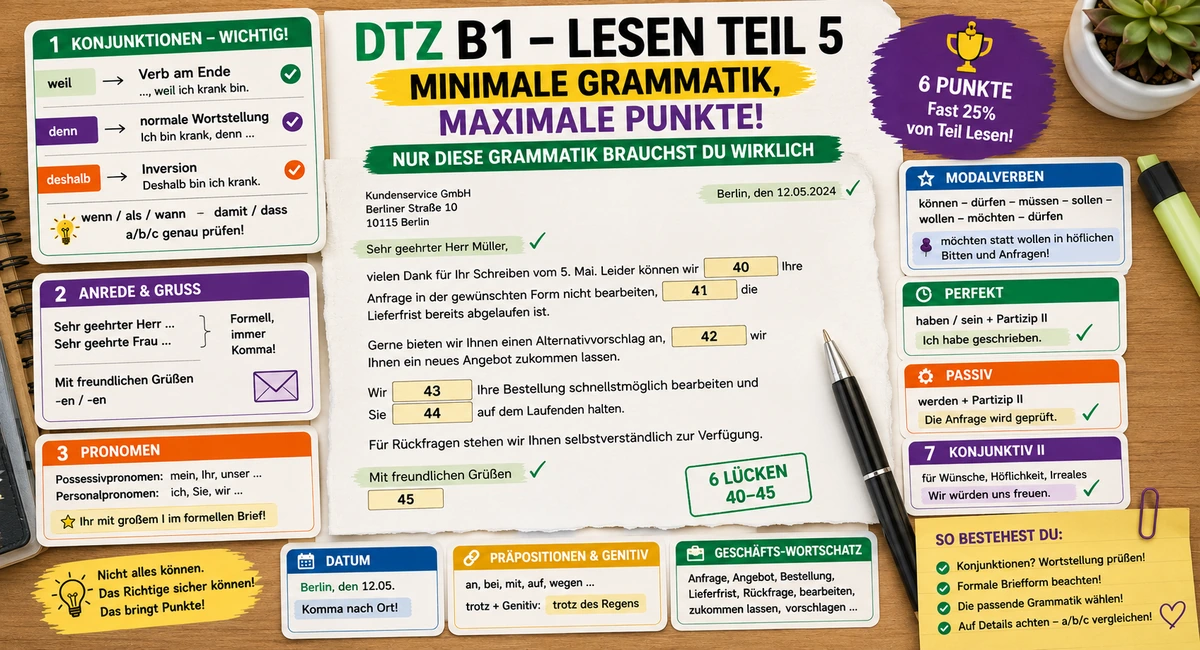
Minimum necessary grammar:
How to pass B1 in the DTZ
In Lesen Teil 5 of the DTZ exam, grammar is primarily tested. Here you will learn all the important rules for B1 — explained simply, with many examples from formal letters.
Why is grammar so important for Lesen Teil 5?
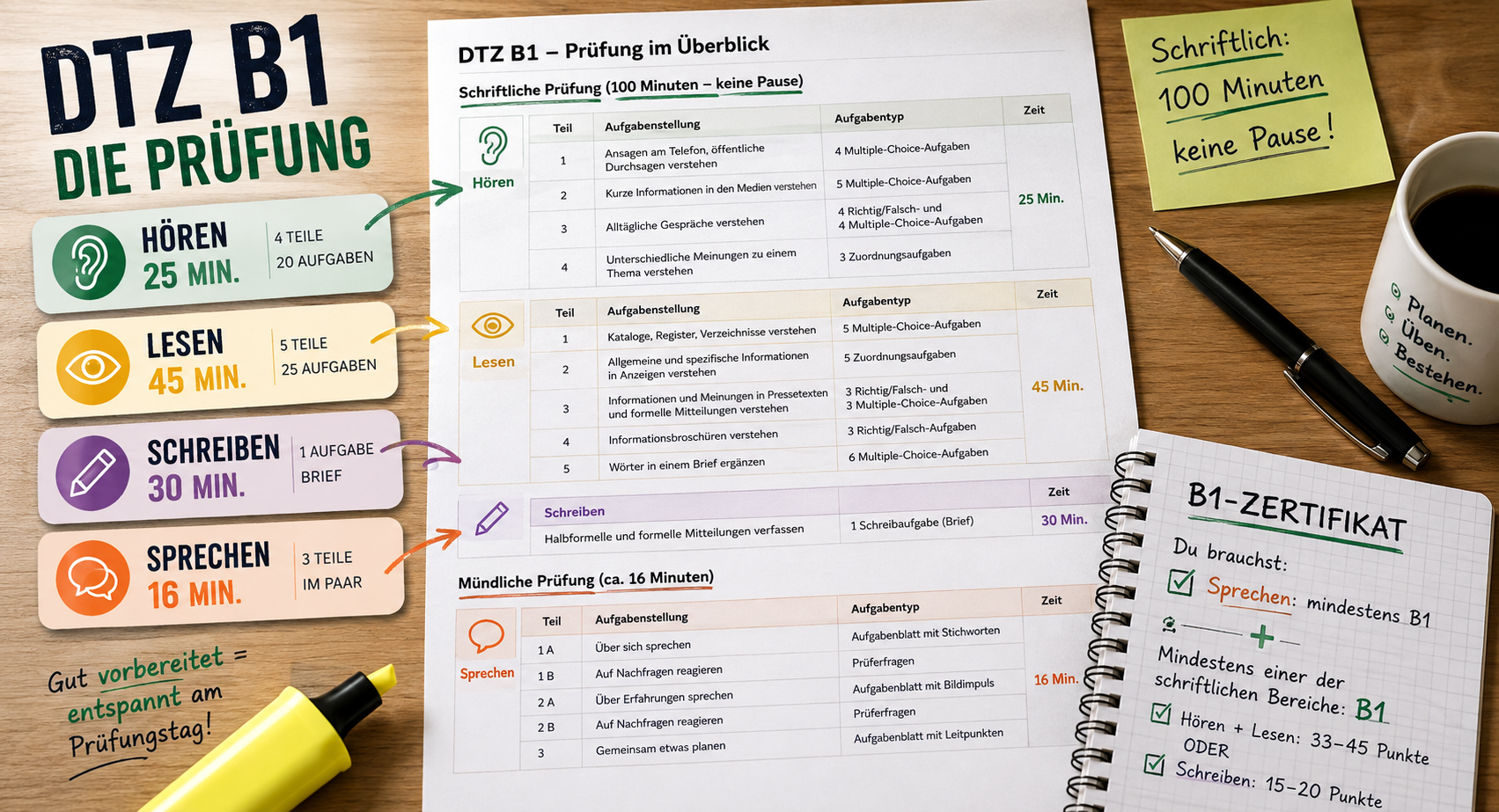
In the DTZ exam, the Lesen section has five parts. The last part is Lesen Teil 5. Here there is a formal letter with six gaps. For each gap there are three answers (a, b, c). You must choose the correct answer.
This part tests primarily your grammar. If your grammar is not strong, you will lose many points here. This can lower your overall result from B1 to A2.
Lesen Teil 5 has 6 tasks (numbers 40–45). Each task gives 1 point. That is 6 points out of 25 in the Lesen section. That is almost a quarter of the entire Lesen section!
Which grammar topics are tested?
These are the most important grammatical topics needed to solve the tasks:
- Conjunctions (connecting sentences) — in almost every task!
- Salutation and closing formulas (Sehr geehrte... / Mit freundlichen Grüßen)
- Possessive pronouns (mein, Ihr, unser...)
- Personal pronouns (ich, Sie, Ihnen...)
- Modal verbs (können, müssen, möchten...)
- Konjunktiv II (würde, wäre, könnte)
- Perfekt and passive (haben/sein + Partizip; werden + Partizip)
- Date in letters (Berlin, den 12.05.)
- Prepositions and genitive
- Vocabulary in the business letter
Conjunctions — the most important topic
Conjunctions connect two sentences. In Lesen Teil 5 they are the most important topic. More than half of the tasks test conjunctions! There are three types of conjunctions. The most important thing: each type has a different word order.
Type 1: Main clause conjunctions (normal word order)
These conjunctions connect two main clauses. The word order remains normal: subject + verb + rest.
| Conjunction | Example from a formal letter |
|---|---|
| und | Ich habe zwei Kinder, und sie wollen ein eigenes Zimmer. |
| aber | Zuerst hat alles funktioniert, aber jetzt kann ich nicht telefonieren. |
| oder | Sie können mich anrufen oder schicken Sie eine E-Mail. |
| denn | Ich brauche den Tisch, denn meine Tochter muss viel arbeiten. |
| sondern | Ich arbeite nicht in der Bäckerei, sondern im Supermarkt. |
The conjunction sondern only appears after nicht or kein. The formula is: nicht A, sondern B.
Type 2: Subordinate clause conjunctions (verb goes to the end!)
After these conjunctions the verb goes to the end of the sentence. This is the most important rule!
| Conjunction | Function | Example |
|---|---|---|
| weil | Reason | Ich kann nicht kommen, weil ich Deutschkurs habe. |
| dass | Content | Ich hoffe, dass Sie zufrieden sind. |
| damit | Goal / purpose | Bitte melden Sie sich, damit wir das Problem lösen können. |
| wenn | Condition or repetition | Wenn Sie die Rechnung nicht zahlen, müssen wir handeln. |
| als | One event in the past | Als ich das Geschirr in den Schrank gestellt habe, ist der Schrank gefallen. |
| obwohl | Contrast | Ich habe nichts bekommen, obwohl die Lieferzeit nur 2 Wochen sein sollte. |
| bevor | Before (time) | Bevor ich bestelle, habe ich eine Frage. |
| sobald | Immediately after | Ich gebe Ihnen den Schlüssel, sobald ich zu Hause bin. |
| sodass | Result / consequence | Hat die Wohnung einen Garten, sodass meine Kinder spielen können? |
| während | Simultaneous | Vielleicht haben Sie es vergessen, während Sie viel Arbeit hatten? |
| da | Reason (formal) | Da ich kein Auto habe, kann ich nicht abholen. |
| ob | Indirect yes/no question | Können Sie sagen, ob das möglich ist? |
Type 3: Conjunctional adverbs (inversion!)
These are not true conjunctions but adverbs. After these words comes first the verb, then the subject (inversion).
| Adverb | Function | Example |
|---|---|---|
| deshalb / darum / deswegen | Consequence, result | Unsere Kinder wollen ein eigenes Zimmer. Deshalb brauchen wir eine größere Wohnung. |
| trotzdem | Contrast | Ich hatte wenig Zeit. Trotzdem bin ich gekommen. |
| außerdem | Additional information | Die Zimmer waren klein. Außerdem hatten wir kein warmes Wasser. |
| dann | Temporal consequence | Zahlen Sie bitte. Dann müssen wir nichts weiter tun. |
| sonst | Negative consequence | Zahlen Sie schnell, sonst müssen wir Gebühren berechnen. |
Typical mistakes and confusions
All three express a reason. But the word order is different:
- Ich komme nicht, weil ich krank bin. → Verb at the end
- Ich komme nicht, denn ich bin krank. → Normal (subject + verb)
- Ich bin krank. Deshalb komme ich nicht. → Inversion (verb + subject)
- wenn = condition or repetition (every time when)
- als = one event in the past
- wann = direct or indirect question
Example: Können Sie sagen, wann Sie liefern werden? — this is an indirect question.
- damit = goal / purpose. Ich schreibe, damit Sie informiert sind.
- dass = content / fact. Ich hoffe, dass Sie zufrieden sind.
Tip: Can you say "um zu"? → damit. It is information without a goal? → dass.
Salutation and closing formulas in the letter
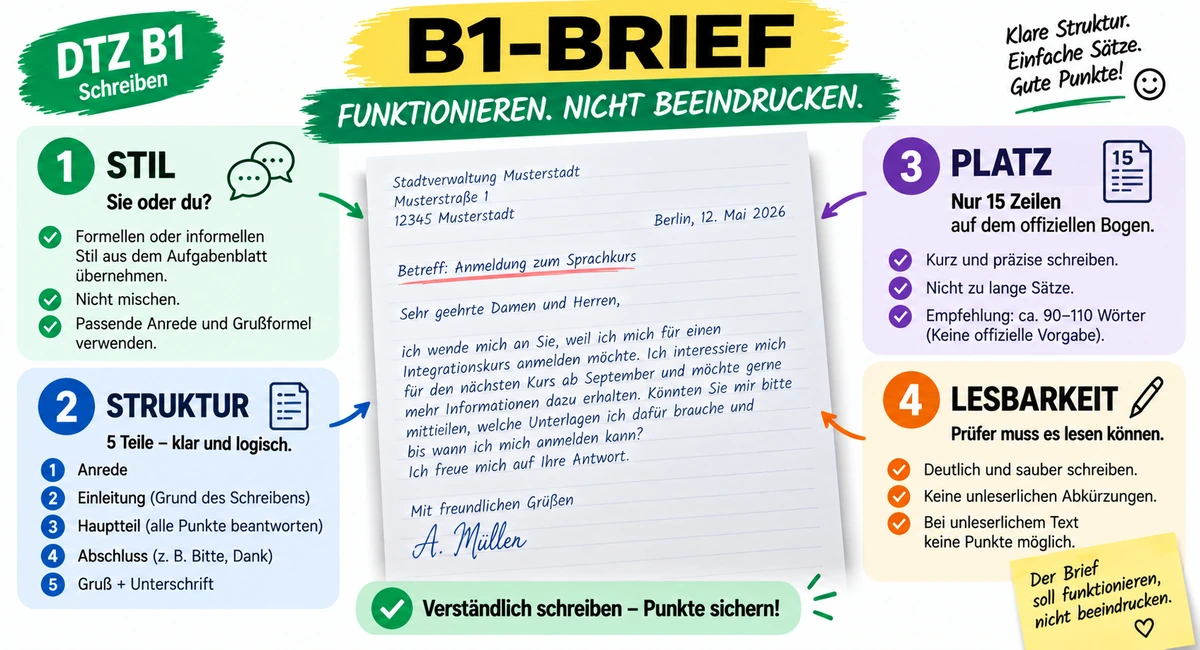
Every formal letter begins with a salutation and ends with a closing formula. In Lesen Teil 5, a word in the salutation or closing formula is almost always tested. This is easy — if you know the rules!
Salutation at the beginning of the letter
You only need to know two endings of the word geehrt-:
- -er — when you write to a man (because "Herr" is masculine)
- -e — in all other cases
| To whom? | Salutation |
|---|---|
| Unknown persons (many) | Sehr geehrte Damen und Herren, |
| A woman | Sehr geehrte Frau Müller, |
| A man | Sehr geehrter Herr Müller, |
A man (Herr) → -er. Everything else (Frau, Damen, plural) → -e.
The variant geehrten is never correct in the salutation! This is a trap. At the beginning of the letter there are only two correct forms: geehrte (Frau, Damen) and geehrter (Herr).
Salutation with "Liebe/Lieber" (semi-formal)
For neighbours, acquaintances or friends. The rule is the same:
- Lieber Herr Müller,
- Liebe Frau Schmidt,
- Liebe Eltern,
- Lieber Frank,
- Liebe Anna,
Closing formulas at the end of the letter
There is a very simple rule to remember here. You only need to look at the word "Mit"!
If there is "Mit" → both endings are -en. If there is no "Mit" → both endings are -e.
| Closing formula | Endings | Memory aid |
|---|---|---|
| Herzliche Grüße | -e ... -e | No "Mit" → both -e |
| Liebe Grüße | -e ... -e | No "Mit" → both -e |
| Mit freundlichen Grüßen | -en ... -en | With "Mit" → both -en |
| Mit herzlichen Grüßen | -en ... -en | With "Mit" → both -en |
| Mit besten Grüßen | -en ... -en | With "Mit" → both -en |
Pronouns: possessive pronouns and personal pronouns
Possessive pronouns (mein, dein, Ihr...)
Possessive pronouns show who something belongs to. Here are the basic forms:
| Person | Possessive pronoun |
|---|---|
| ich | mein |
| du | dein |
| er / es | sein |
| sie (one woman) | ihr |
| wir | unser |
| ihr (friends, several people) | euer / eure |
| sie (several people) | ihr |
| Sie (formal) | Ihr (always capitalised!) |
Endings like the article "ein"
Possessive pronouns take the same endings as the article ein/eine/ein:
| Case | Masculine | Feminine | Neuter | Plural |
|---|---|---|---|---|
| Nominative | mein | meine | mein | meine |
| Accusative | meinen | meine | mein | meine |
| Dative | meinem | meiner | meinem | meinen |
Typical examples from formal letters
- Wir sind auf Ihre Anzeige gestoßen. — feminine accusative.
- Wir liefern an unsere Adresse. — feminine accusative.
- Der Monteur muss in meine Wohnung. — feminine accusative.
- Die Heizung wird in unserem Haus repariert. — neuter dative.
- Ich freue mich sehr für euch. — "ihr" in the accusative.
Three words look almost the same but mean different things:
- Ihr / Ihre (always capitalised!) = formal, directed at the reader
- ihr / ihre (lower case) = belonging to a woman or to several people
- ihr (lower case) = personal pronoun (e.g. for friends: "Kommt ihr?")
Tip: In a business letter one almost always writes Sie (formal). That is why the possessive pronoun Ihr is also written with a capital letter!
Personal pronouns
| Person | Nominative | Accusative | Dative |
|---|---|---|---|
| 1st person singular | ich | mich | mir |
| 2nd person singular (informal) | du | dich | dir |
| 3rd person singular (m) | er | ihn | ihm |
| 3rd person singular (f) | sie | sie | ihr |
| 1st person plural | wir | uns | uns |
| 2nd person plural (informal) | ihr | euch | euch |
| 3rd person plural | sie | sie | ihnen |
| Polite form (formal) | Sie | Sie | Ihnen |
Ihnen (capitalised) = polite form. ihnen (lower case) = to several people (3rd person plural).
Example: Wir senden Ihnen die Unterlagen zurück.
- dich — to one person informally (accusative)
- euch — to several people informally (e.g. friends, children)
- Sie — formal, to one or several people
Example: Ich freue mich sehr für euch. (Letter to a couple who are friends.)
Verbs: modal verbs, Perfekt, passive, Konjunktiv II
Modal verbs — the 6 most important verbs
| Modal verb | Function | Example |
|---|---|---|
| können | Possibility or ability | Ich kann schwimmen. |
| müssen | Necessity (internal or objective) | Ich muss arbeiten. |
| sollen | Task from another person | Der Chef sagt, ich soll kommen. |
| dürfen | Permission | Darf ich hier parken? |
| wollen | Strong wish | Ich will Kaffee. (sounds direct!) |
| möchten | Polite request | Ich möchte Kaffee. (polite) |
In a formal letter always use möchten, not wollen! Möchten is polite. Wollen sounds like a command.
Typical examples from formal letters
- Wir möchten uns für Ihren Einkauf bedanken.
- Sie können uns gerne anrufen.
- Meine Tochter muss viele Hausaufgaben machen.
Perfekt — haben or sein?
The Perfekt is formed with haben or sein + Partizip II. When do you use which auxiliary verb?
- Movement (from point A to point B): gehen, fahren, kommen, fliegen, umziehen → Ich bin umgezogen.
- Change of state: aufstehen, einschlafen → Ich bin aufgestanden.
- Three special verbs: sein, bleiben, werden → Ich bin zu Hause gewesen.
kaufen, machen, bestellen, lesen, arbeiten ... Ich habe gekauft / gemacht / bestellt.
Typical examples from formal letters
- Vor vier Wochen habe ich einen Schreibtisch bestellt.
- Am 20.4. haben wir ein Sofa bestellt.
- Ich bin gerade umgezogen. — movement!
- Wir haben Urlaub in Ihrem Hotel gemacht.
Passive — werden + Partizip II
The passive is used when you do not say who does something, but what happens.
| Tense | Auxiliary verb | Example |
|---|---|---|
| Present passive | wird / werden | Die Heizung wird repariert. |
| Past passive | wurde / wurden | Die Heizung wurde repariert. |
Typical examples from formal letters
- Morgen wird die Heizung in unserem Haus repariert.
- Kinder wurden nach ihrem Namen gefragt.
When you see a form of werden (wird, werden, wurde, wurden) in the sentence and at the end a verb ending in -t or -en — that is the passive!
Konjunktiv II — speaking politely and expressing wishes
Konjunktiv II is the form for polite requests and unfulfillable wishes.
| Infinitive | Konjunktiv II |
|---|---|
| sein | wäre |
| haben | hätte |
| werden | würde |
| können | könnte |
| mögen | möchte |
For all other verbs one uses the formula: würde + infinitive.
- würde kommen
- würde arbeiten
- würde schreiben
Typical examples from formal letters
- Über Ihre Antwort würden wir uns freuen.
- Ich würde so gern kommen, aber ich habe Urlaub.
- Es wäre toll, wenn Sie den Monteur in meine Wohnung lassen könnten!
- Gerne würde ich als Verkäuferin arbeiten.
You must learn these formulas by heart:
- Ich würde gern ...
- Wir würden uns freuen, wenn ...
- Es wäre toll / schön, wenn ...
- Über Ihre Antwort würden wir uns freuen.
Minor topics: date, genitive, adjective endings, prepositions
Date in the letter — always "den"
At the beginning of a letter the date is written. The correct form always uses den:
- Berlin, den 12. September 2020
- Mainz, den 12.05.
- München, den 14.02.20
In the letterhead you always write: [City], den [date]. Never dem or des!
Genitive
The genitive answers the question "whose?". In Lesen Teil 5 it appears in two cases:
Case 1: After the prepositions während, wegen, trotz, innerhalb.
- während des ganzen Wochenendes
- innerhalb der nächsten 4 Tage
Case 2: Possession:
| Standard form | Genitive | Example |
|---|---|---|
| der Monat | des Monats | am 15. des Monats |
| das Jahr | des Jahres | ab Heft 6 dieses Jahres |
| die Woche | der Woche | am Ende der Woche |
For masculine and neuter nouns, add -s or -es to the word. For feminine nouns there is only der (no ending on the word).
Adjective endings: only 3 positions important
The full table is long, but for Lesen Teil 5 you only need three rules:
- Salutation: Sehr geehrter Herr / Sehr geehrte Frau / Sehr geehrte Damen und Herren
- Closing formula: With "Mit" → -en, without "Mit" → -e
- Days and months in the past or future: letzten Samstag, nächsten Monat, kommenden Montag
Prepositions — tip for the exam
In Lesen Teil 5 these prepositions are the most important:
| Preposition | Function | Example |
|---|---|---|
| aus | Origin (where from?) | Wir kommen aus Ägypten. |
| in | Place (where?) | Ich lebe in Deutschland. |
| nach | Direction (where to? without article) | Ich fahre nach Berlin. |
| bis | End point in time | Sie haben bis heute nicht bezahlt. |
| seit | Starting point (ongoing) | Seit zwei Wochen funktioniert es nicht. |
| ab | Starting point in the future | Ab Montag arbeite ich neu. |
| als | In the role of | Ich möchte als Verkäuferin arbeiten. |
Look at the article after the gap — it shows the case:
- dem / der / den (plural) → dative → prepositions: in, auf, bei, zu, mit, von, seit, nach, aus
- den / die / das → accusative → prepositions: für, gegen, ohne, durch, um
- des / der (fem.) → genitive → prepositions: während, wegen, trotz, innerhalb
Vocabulary in the business letter
Some words look similar but mean something different. Here are the most important pairs.
erreichen / rufen / telefonieren
| Verb | When? |
|---|---|
| erreichen | You call and someone answers. |
| rufen | Call out loudly or call a taxi / ambulance. |
| telefonieren | Have a phone conversation in general. |
Correct in the letter: Sie können mich telefonisch unter 030/434241 erreichen.
bringen / holen / verkaufen
| Verb | Direction | Example |
|---|---|---|
| bringen | there (someone carries it there) | Können Sie den Schrank zu mir bringen? |
| holen | back from there (I take it with me) | Ich hole den Schrank. |
| verkaufen | for money | Ich verkaufe das Auto. |
senden / schreiben / holen
- senden — send formally (e.g. by post): Wir senden Ihnen die Unterlagen zurück.
- schreiben — compose a text, letter or email
- holen — take something with you (go somewhere)
bekommen / behalten / liefern
| Verb | Who acts? |
|---|---|
| bekommen | I receive something (someone gives it to me). |
| behalten | I keep it, I do not give it back. |
| liefern | The seller or courier delivers the goods. |
bekommen does not mean "to become"! Many learners confuse these:
- Ich bekomme ein Geschenk. (= someone gives me something)
- Ich werde Lehrer. (= I change my profession)
einverstanden / glücklich / zufrieden
- einverstanden — one accepts a proposal: Meine Eltern sind damit einverstanden.
- zufrieden — one is pleased with the result: Ich bin mit dem Service zufrieden.
- glücklich — strong positive emotion
geärgert / gefreut / gut erholt
- sich geärgert haben — in a complaint: Wir haben uns sehr geärgert.
- sich gefreut haben — in a thank you or invitation
- sich gut erholt haben — after a holiday or weekend
Anschrift / Abschrift / Überschrift
| Word | Meaning | Memory aid |
|---|---|---|
| Anschrift | Postal address | an whom? → where you write to |
| Abschrift | Copy of a document | ab from the original → copy |
| Überschrift | Title of a text | über the text → title |
Example in the letter: Bitte prüfen Sie Ihre Anschrift.
Betreff / Argument / Auskunft
- Betreff — subject of the letter: Betreff: Warnung vor SMS-Betrug
- Argument — a reason in a discussion
- Auskunft — information (e.g. at the station, at reception)
Antwort / Bitte / Frage
- Antwort — response to a question
- Bitte — polite request
- Frage — something one would like an answer to
Standard formula in the letter: Über Ihre Antwort würden wir uns freuen. — learn by heart!
Termin / Datum / Tipp
- Termin — an agreed time (e.g. at the doctor's, in a business)
- Datum — a day in the calendar
- Tipp — a helpful piece of advice
Example: Können Sie mir für Samstag einen Termin geben?



There are no comments for this article. Leave your comment