






17 Small Word Tricks:
Lexical Traps
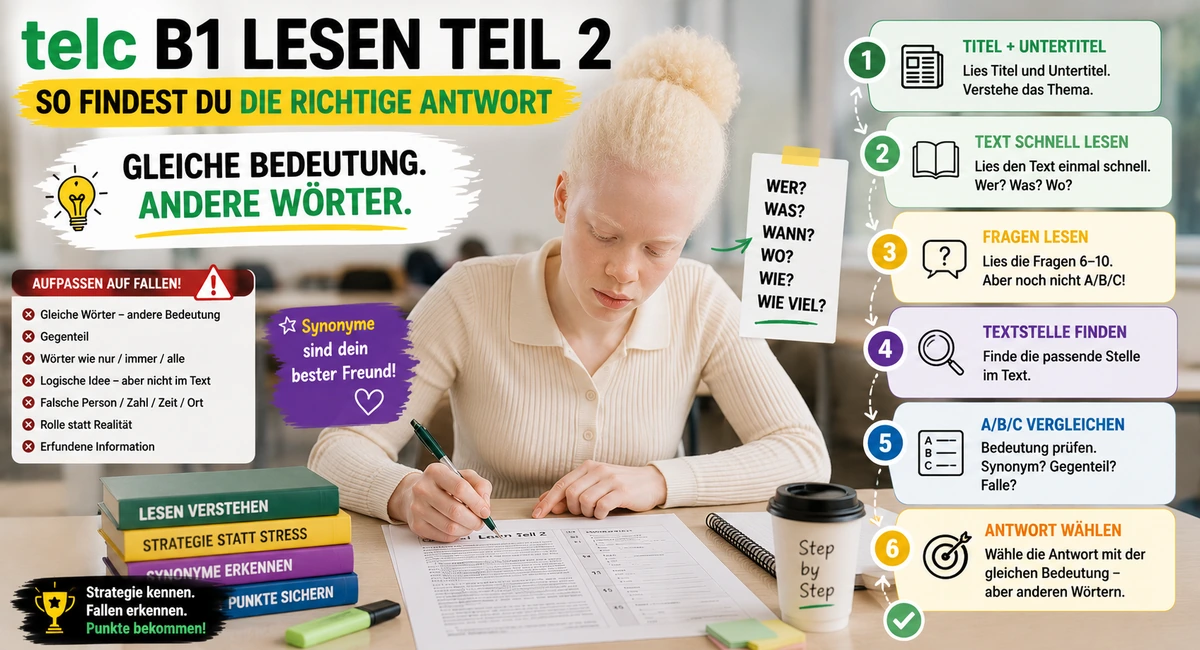
17 small words and constructions that are crucial for the exam. Learn the difference between similar words and find the correct answer faster.
Why are small words so important?
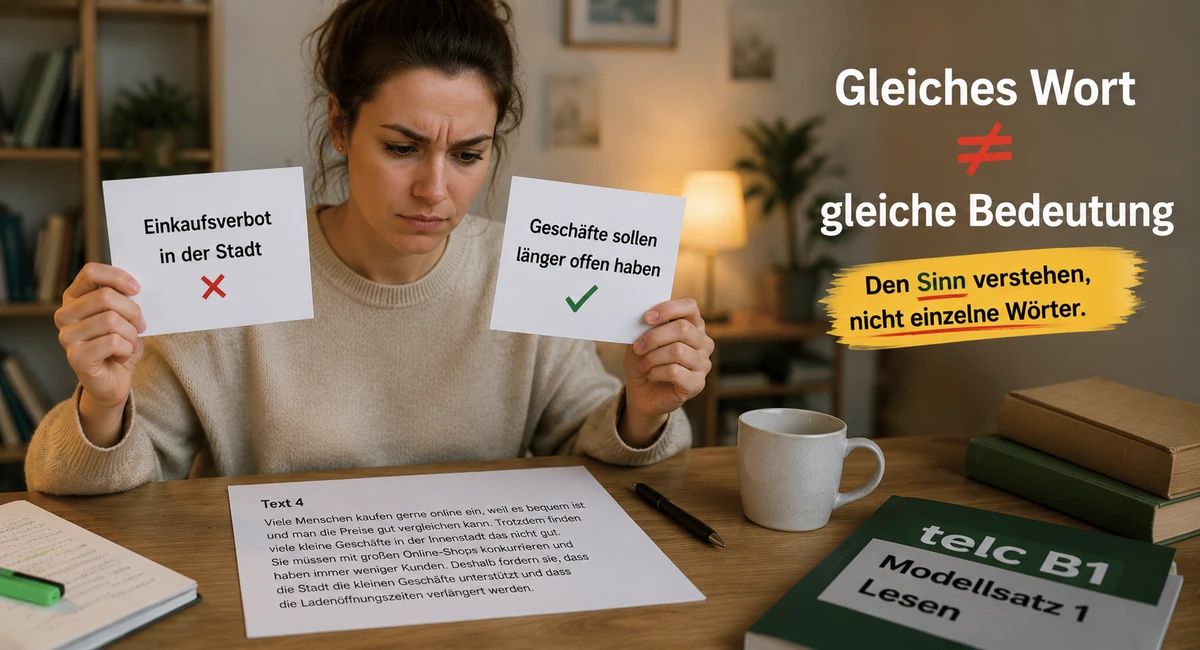
In telc B1 Reading Part 2, you have to read very carefully. Sometimes a single word changes the entire meaning. For example: Er kann lernen (He can study) and Er muss lernen (He must study). Both sentences have almost the same words, but the meaning is completely different!
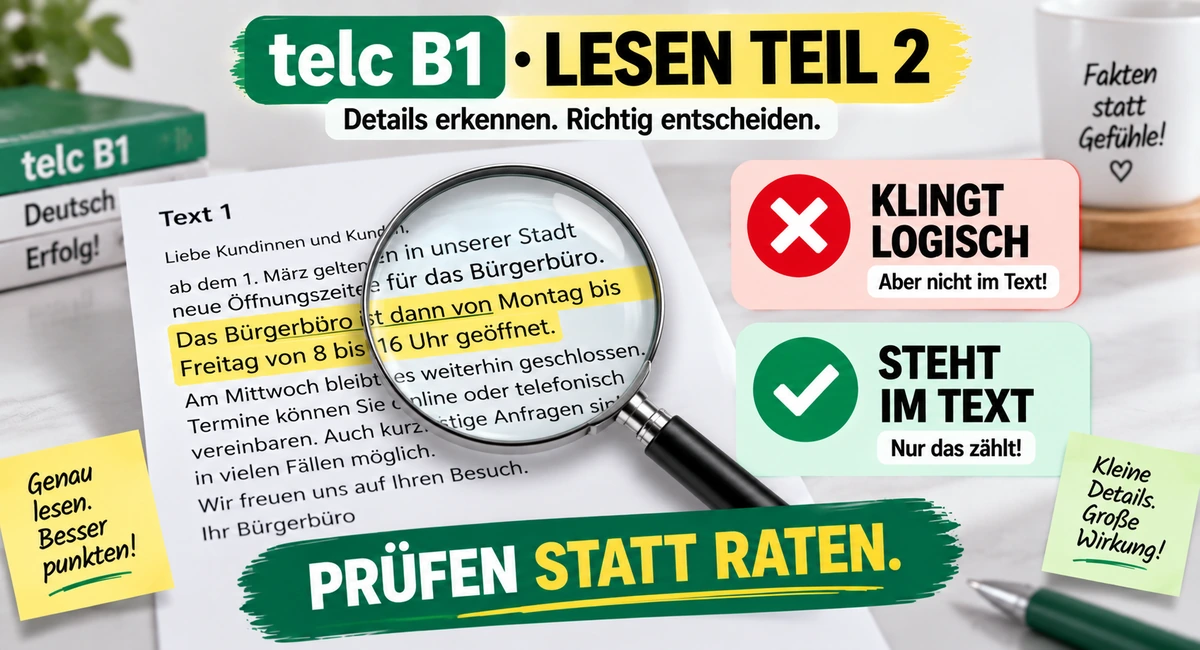
The exam is clever. It uses these small differences to set traps. If you don't know the difference, you'll pick the wrong answer. If you do know the difference, you'll easily find the correct one.
In this article, you will learn 17 small word tricks. Each trick is a pair of similar words or constructions that mean something else. Knowing these 17 tricks will help you make significantly fewer mistakes in the exam.
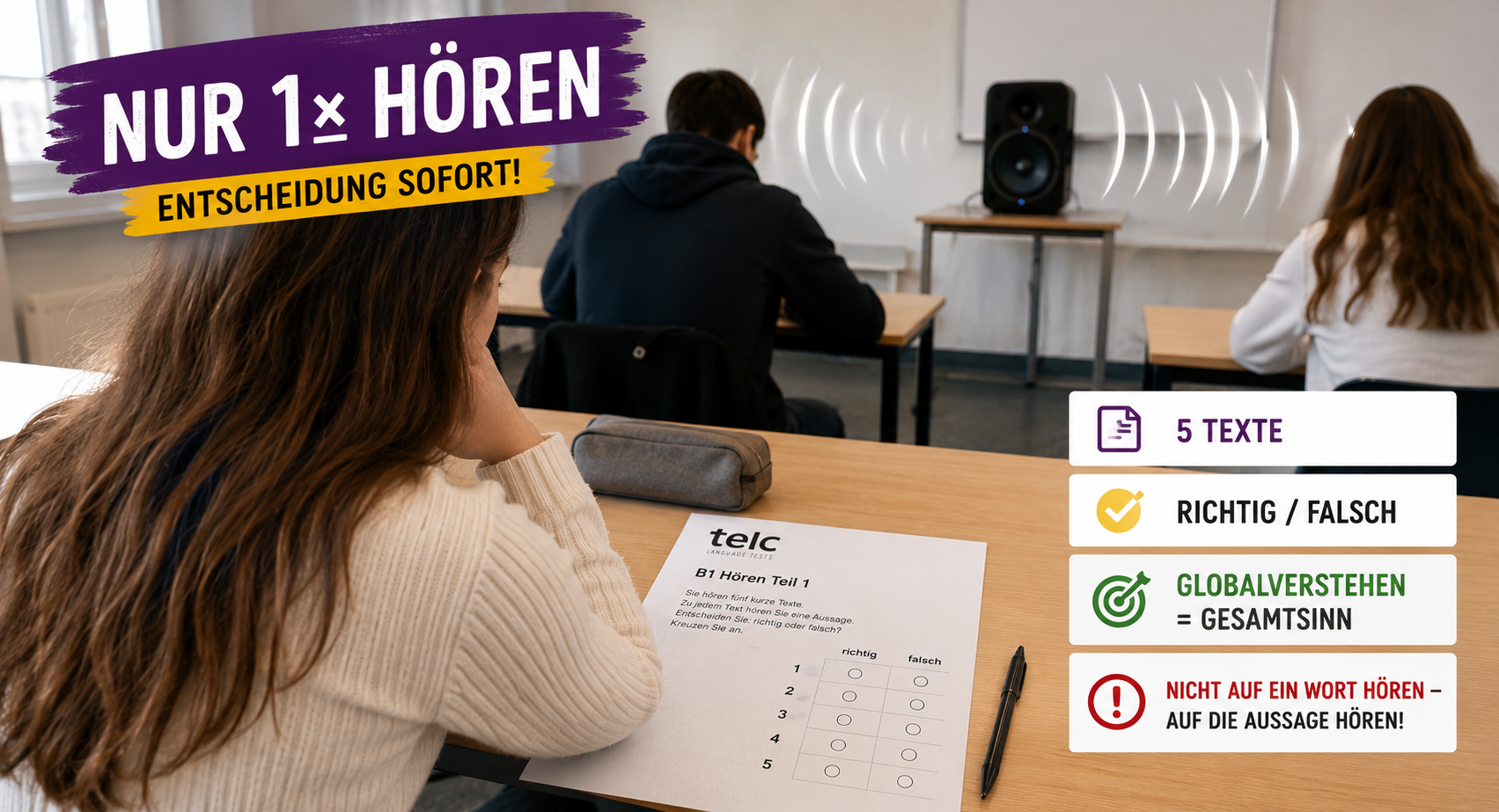
The telc B1 exam tests whether you understand every word precisely. Read slowly. Pay attention to every small word. This is how you spot the trap and choose the right answer.
Tricks 1–4: Verbs with different meanings
Some verbs look similar but mean very different things. Here are the most important pairs.
Trick 1: abbrechen is not the same as durchfallen
Abbrechen means: to quit or stop before finishing. For example: A student "abgebrochen" his A-levels. This means he didn't finish them. Maybe he was sick, or maybe he didn't want to continue. But he did not fail the exam yet.
Durchfallen means: to take the exam and fail. The student completed all tests, but the points were not enough.
If the text says: Niemand ist durchgefallen, nur ein Schüler hat abgebrochen, it means everyone who finished passed. The one who quit didn't fail — he just stopped.
Trick 2: filmreif is not the same as einen Film machen
Filmreif is an adjective. It means: as beautiful or exciting as in a movie. For example: eine filmreife Show — that's a fantastic show, almost like in the cinema.
Einen Film machen means: to film with a camera. This is a real action with real equipment.
If the text says filmreife Show, it doesn't mean someone made a movie. It just means the show was very impressive.
traumhaft = very beautiful (not: having a dream). märchenhaft = wonderful (not: telling a fairy tale). eiskalt = very cold (not: made of ice).
Trick 3: mitsingen is not the same as Sänger sein
Mitsingen means: to join in singing once. For example: The technician "mitgesungen" during the last song. It was a one-time thing, brief, at the end.
Sänger sein means: that is their role; they do it all the time.
A person doing something once doesn't make it their role! Watch for time indicators: once, sometimes, briefly, at the end — these are signals for a one-time event.
Trick 4: helfen is not the same as verantwortlich sein
If someone helps (hilft), they are an assistant. But they are not the boss. The boss is the one primarily responsible (Hauptverantwortliche).
There can be many people in the text. Read closely: Who is the boss? Who is just helping? If the text says Tobias ist der Hauptverantwortliche and an answer says Martin ist der Hauptverantwortliche — that's wrong! Martin is only helping.
Tricks 5–8: Mood and Reality (What actually happens)
Sometimes the text mentions something that didn't actually happen. It's just a wish or an idea. But a wrong answer might turn it into reality. Watch out for these constructions!
Trick 5: hätte gesehen is not the same as hat gesehen
Ich hätte mehr Leute sehen wollen (I would have liked to see more people) — this is Konjunktiv II. It means: I wanted to see more people, but I didn't see them. It was just a wish that wasn't fulfilled.
Ich habe mehr Leute gesehen (I saw more people) — this is the past tense. I actually saw them.
If the examiner Mira says: Ich hätte gern mehr Leute am Schalter gesehen — it means she didn't see them. A wrong answer might say: Mira durfte am Schalter arbeiten. That's wrong! She just wanted to see people; she didn't work there.
Look for these words: hätte, wäre, würde, könnte, sollte, müsste, möchte. These words indicate: It's just a wish or an idea, not reality.
Trick 6: kann lernen is not the same as muss lernen
These small modal verbs change the meaning completely:
- kann = is possible / able to (You can study if you want)
- muss = is mandatory (You must study, you have no choice)
- darf = is allowed (You are permitted to study)
- soll = is recommended (You should study, it's good for you)
If the text says: Schüler können Sonderaufgaben machen, it means they have the opportunity. But if the answer says: Schüler müssen Sonderaufgaben machen, it's wrong. they don't have to; they just can!
Trick 7: würde verschlingen is not the same as verschlingt
Eine eigene Wohnung würde mehr als die Hälfte meines Lohnes verschlingen. (An apartment of my own would swallow more than half my wages). This is Konjunktiv II. Lukas doesn't have his own apartment. He's just thinking: If I had one, it would be too expensive. It's a hypothetical idea.
A wrong answer could say: Eine Wohnung verschlingt seinen ganzen Lohn. That's wrong — he doesn't even have the apartment!
Trick 8: gilt als übertrieben is not the same as passiert wirklich
Etwas gilt als übertrieben means: people think it's too much. It doesn't mean it actually happens!
For example: In Deutschland findet man eine Anzeige übertrieben. This means: In Germany, nobody really files a police report for this. The idea is considered "too much," so nobody does it.
A wrong answer could say: In Deutschland wird man bestraft. That's wrong! If filing a report is considered "over the top," there is no punishment.
Tricks 9–12: Quantities and Frequency (How often? How much?)
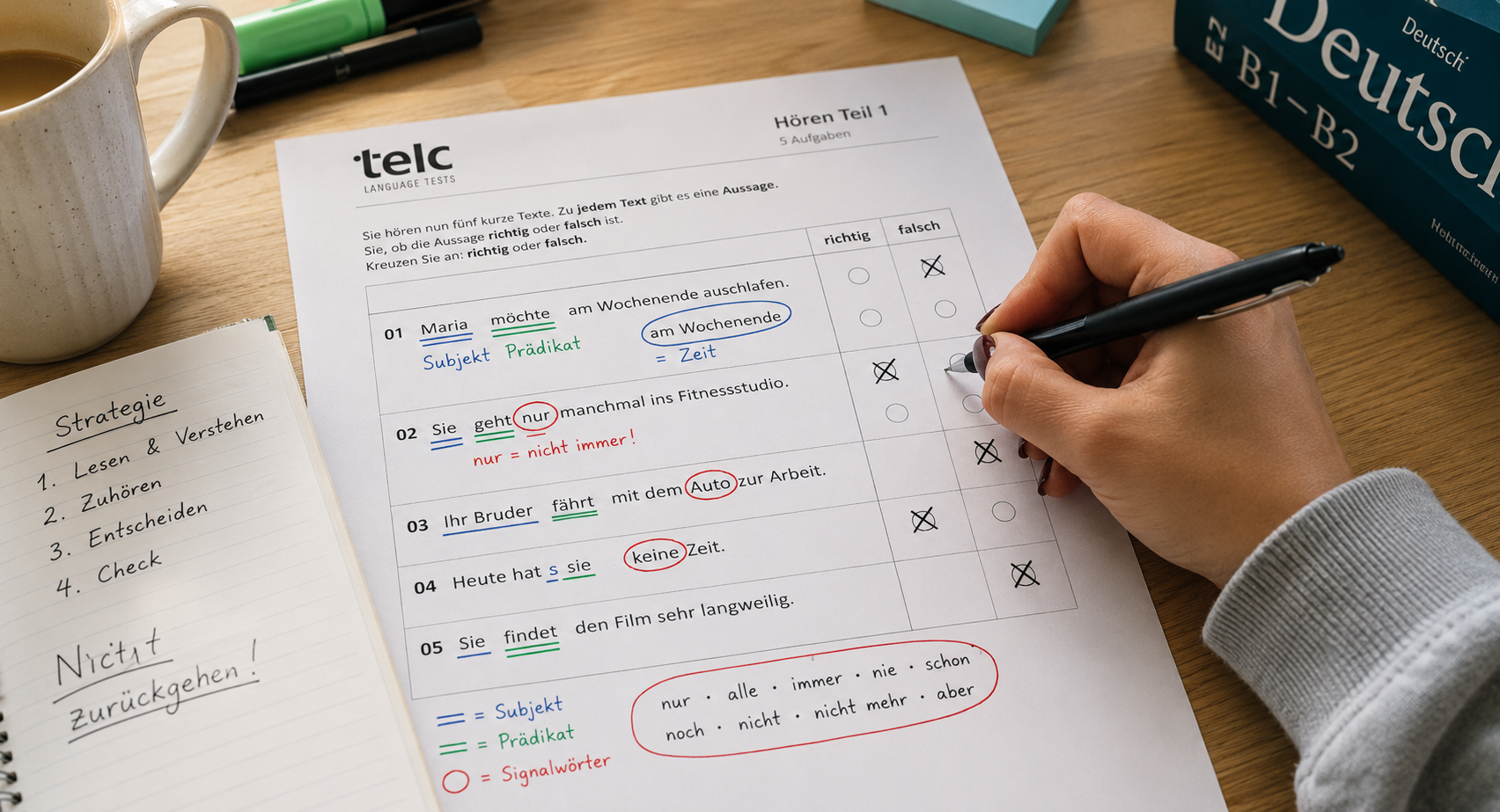
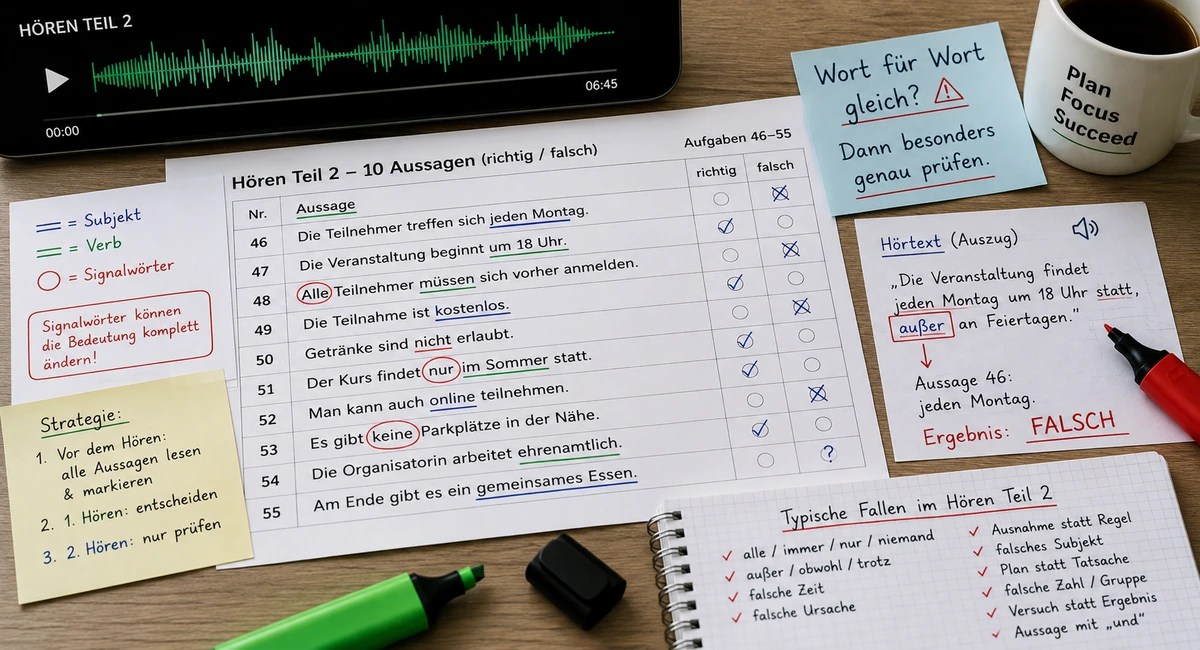
Small words like alle, viele, kaum, oft are very dangerous. They change the scope of the sentence completely.
Trick 9: mehrere is not the same as alle
Mehrere Faktoren means: two, three, four, or five factors. But not all of them!
Alle Faktoren means: 100 percent. There are no others.
If the text says: Mehrere Faktoren spielen eine Rolle, and a wrong answer says: Alle Faktoren spielen eine Rolle, it's a trap!
| Word | Meaning | How much? |
|---|---|---|
| alle | 100 percent | Very much/Everyone |
| die meisten | more than half | Most |
| viele | a large amount | Many |
| einige / mehrere | two, three, four... | Some / Several |
| wenige | not many | Few |
| keine | 0 percent | None |
Trick 10: wahrscheinlich is not the same as sicher
Wahrscheinlich means: maybe yes, maybe no. The person isn't certain.
Sicher or bestimmt means: the person has already decided.
If Inka says: Wahrscheinlich wird es Jura werden, it means she is thinking about law, but hasn't decided. If Alexander says: Ich habe mich für Jura entschieden, it means he is certain.
Inka and Alexander are not the same! Inka is considering it; Alexander has already committed.
Trick 11: kaum is not the same as niemand
Kaum jemand means: hardly anyone, but a few people still do. It is not 0 percent!
Niemand means: 0 percent. Truly not a single person.
If the text says: Kaum jemand macht einen Vorwurf — it means a few people might, but very few. A wrong answer says: Niemand macht einen Vorwurf. That's not quite right.
Trick 12: nicht so eng wie is not the same as sehr eng
Die Kontakte sind nicht mehr so eng wie früher. This means: today the contacts are less close than before. This is negative information.
Die Kontakte sind sehr eng. This means: today the contacts are very close. This is positive information.
Pay attention to the word nicht! It turns the positive "very close" into a negative "less close."
When you read nicht so in a text, pay close attention. It's often a comparison with the past: less now than before. A wrong answer often claims the opposite: very much now.
Tricks 13–15: Imagery and Comparisons
Sometimes the text uses idioms or metaphors. You must understand: Is it meant literally or figuratively?
Trick 13: spielt eine Rolle has two meanings
First meaning: spielt eine Rolle = is important. For example: Hier spielen mehrere Faktoren eine Rolle. This means several factors are important. No one is actually "acting."
Second meaning: spielt eine Rolle = in theater or film. For example: Maria spielt die Rolle einer Polizistin. This means Maria is an actress playing a police officer in a play.
Be careful! If the text uses the idiom to mean "is important," don't pick an answer about acting or theater.
Trick 14: die Zeit vergeht is not the same as die Zeit ist kürzer
Die Zeit vergeht im Flug (Time flies) is an idiom. It means: one feels like time is passing quickly. But it isn't actually shorter!
If a mother says: Im Spielzimmer vergeht die Wartezeit schnell — it means the child isn't bored, so time feels short. But the waiting time is objectively just as long as it would be without the playroom!
A wrong answer says: Die Wartezeit ist kürzer als auf anderen Flughäfen. That's wrong! The time isn't objectively shorter; it just feels that way.
Trick 15: gemütlich is not the same as groß
Gemütlich means: cozy, warm, quiet, and often small. Like a living room with a sofa.
Groß means: big, lots of space, many people, a large area.
These two are almost opposites! A small, "gemütlich" town is not a "groß" city.
In the text, Christopher says: Bayreuth soll schön gemütlich sein. A wrong answer says: Bayreuth ist schön groß. That's wrong! Gemütlich implies it's rather small and cozy, not big.
Tricks 16–17: Recommendation or Obligation?
Sometimes the text says: That is good. But that doesn't mean it's mandatory. Watch for these tricks!
Trick 16: empfehlen is not the same as vorschreiben
Empfehlen means: to recommend. It's a good idea, but you don't have to do it.
Vorschreiben or verlangen means: to prescribe or demand. You must do it; you have no choice.
If the text says: Berater empfehlen, Miete zu zahlen, it's just a tip. A wrong answer says: Die Eltern verlangen Miete. That's wrong! The advisor recommends it, but the parents aren't demanding it.
Trick 17: sich freuen auf is not the same as sich freuen über
These two small prepositions (auf and über) make a big difference in time!
- sich freuen auf = looking forward to something in the future.
- sich freuen über = being happy about something that is already here/happened.
Example: If Inka says: Ich freue mich auf mein Studium — it means university hasn't started yet. She just finished school and is waiting for it to begin.
Summary – All 17 Tricks at a glance
| No. | What the text says | What it does not mean |
|---|---|---|
| 1 | abbrechen (quit) | not: durchfallen (fail) |
| 2 | filmreif (very good) | not: einen Film machen (filming) |
| 3 | mitsingen (join in) | not: Sänger sein (is a singer) |
| 4 | helfen (to help) | not: Chef sein (is the boss) |
| 5 | hätte gesehen (wish) | not: hat gesehen (did see) |
| 6 | kann (possible) | not: muss (mandatory) |
| 7 | würde verschlingen (idea) | not: verschlingt (reality) |
| 8 | gilt als übertrieben (opinion) | not: passiert wirklich (really happens) |
| 9 | mehrere (several, 2-5) | not: alle (all, 100%) |
| 10 | wahrscheinlich (probably) | not: sicher (certain/decided) |
| 11 | kaum jemand (hardly anyone) | not: niemand (no one, 0%) |
| 12 | nicht so eng (less close) | not: sehr eng (very close) |
| 13 | spielt eine Rolle (is important) | not: im Theater spielen (acting) |
| 14 | Zeit vergeht im Flug (feeling) | not: Zeit ist kürzer (shorter time) |
| 15 | gemütlich (cozy, small) | not: groß (big) |
| 16 | empfehlen (recommend) | not: vorschreiben (demand) |
| 17 | freuen auf (future) | not: freuen über (present/past) |




There are no comments for this article. Leave your comment