





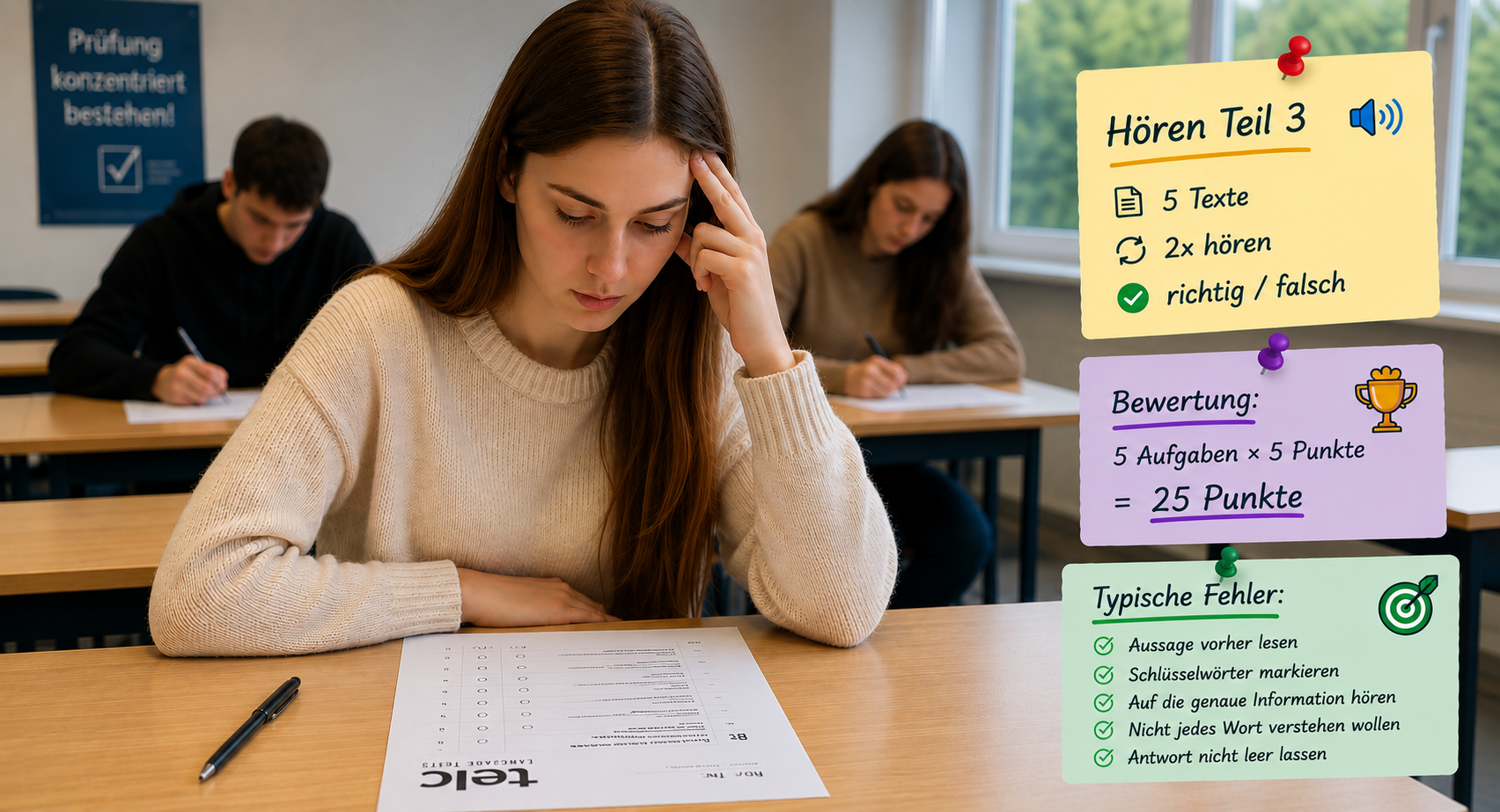
Listening Part 3:
structure, assessment and typical mistakes
Before you start training Listening Part 3, find out exactly about the structure, the assessment and the typical mistakes in this part of the exam.
What is Listening Part 3?
Listening Part 3 is the last part of the listening section in telc Deutsch B1. Here you train selective listening. That means: you do not have to understand every detail in the text. You are looking for one single, concrete piece of information.
In Listening Part 3 you hear five short texts from typical everyday situations. For example:
- an announcement at the station or on the train;
- an announcement in the supermarket or in a department store;
- a weather report on the radio;
- a message on the phone (answering machine);
- an advertisement on the radio.
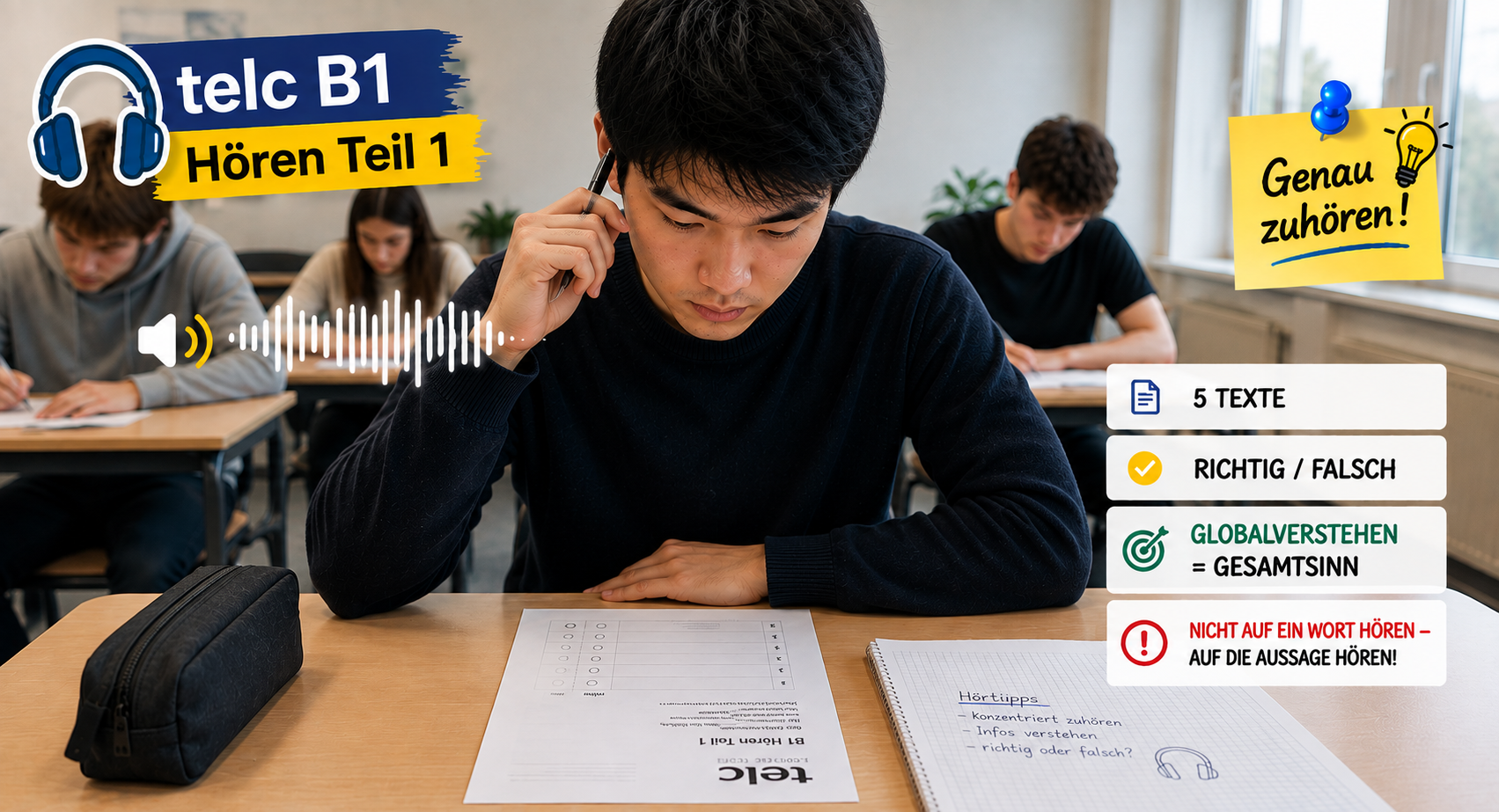
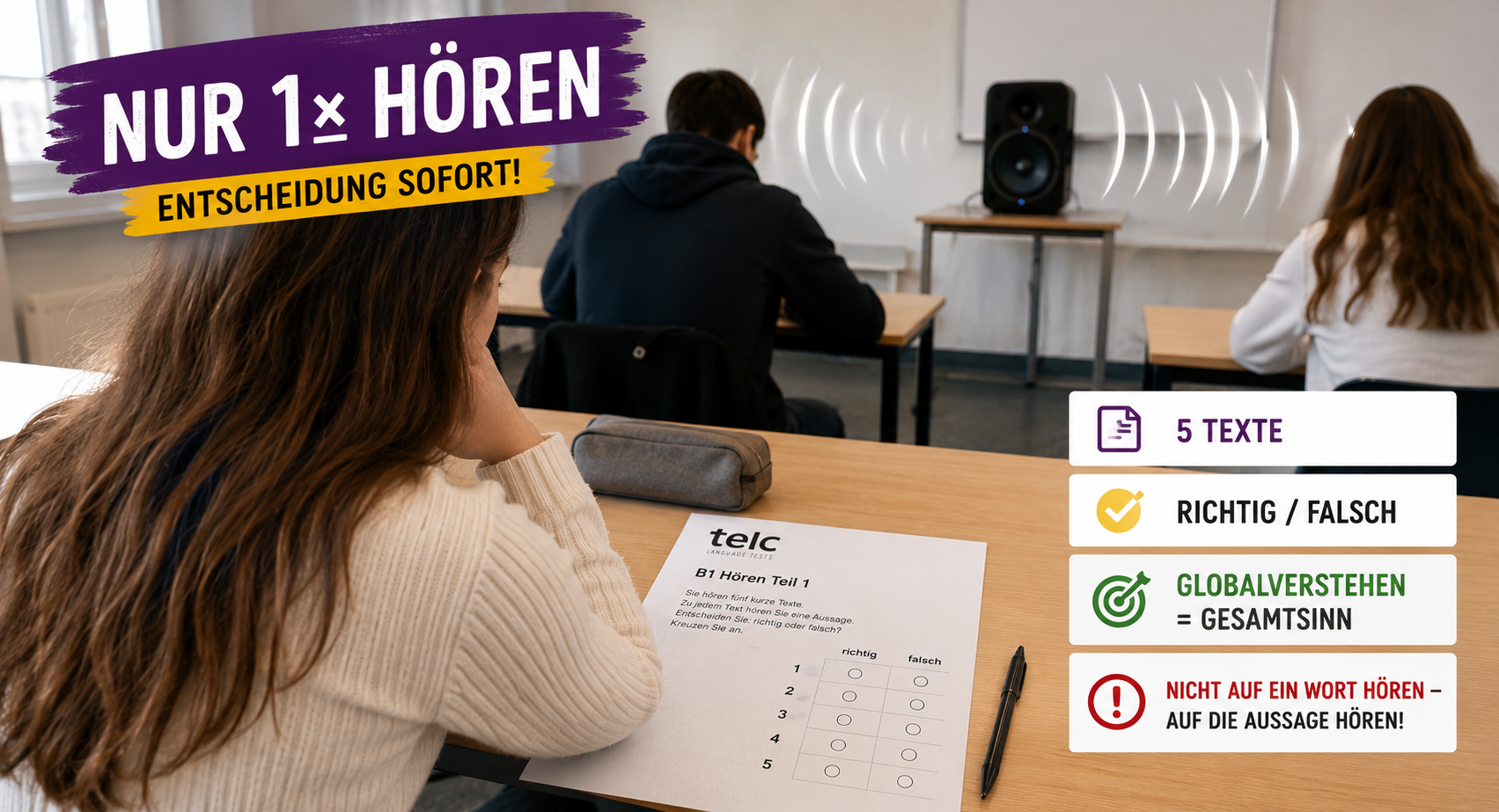
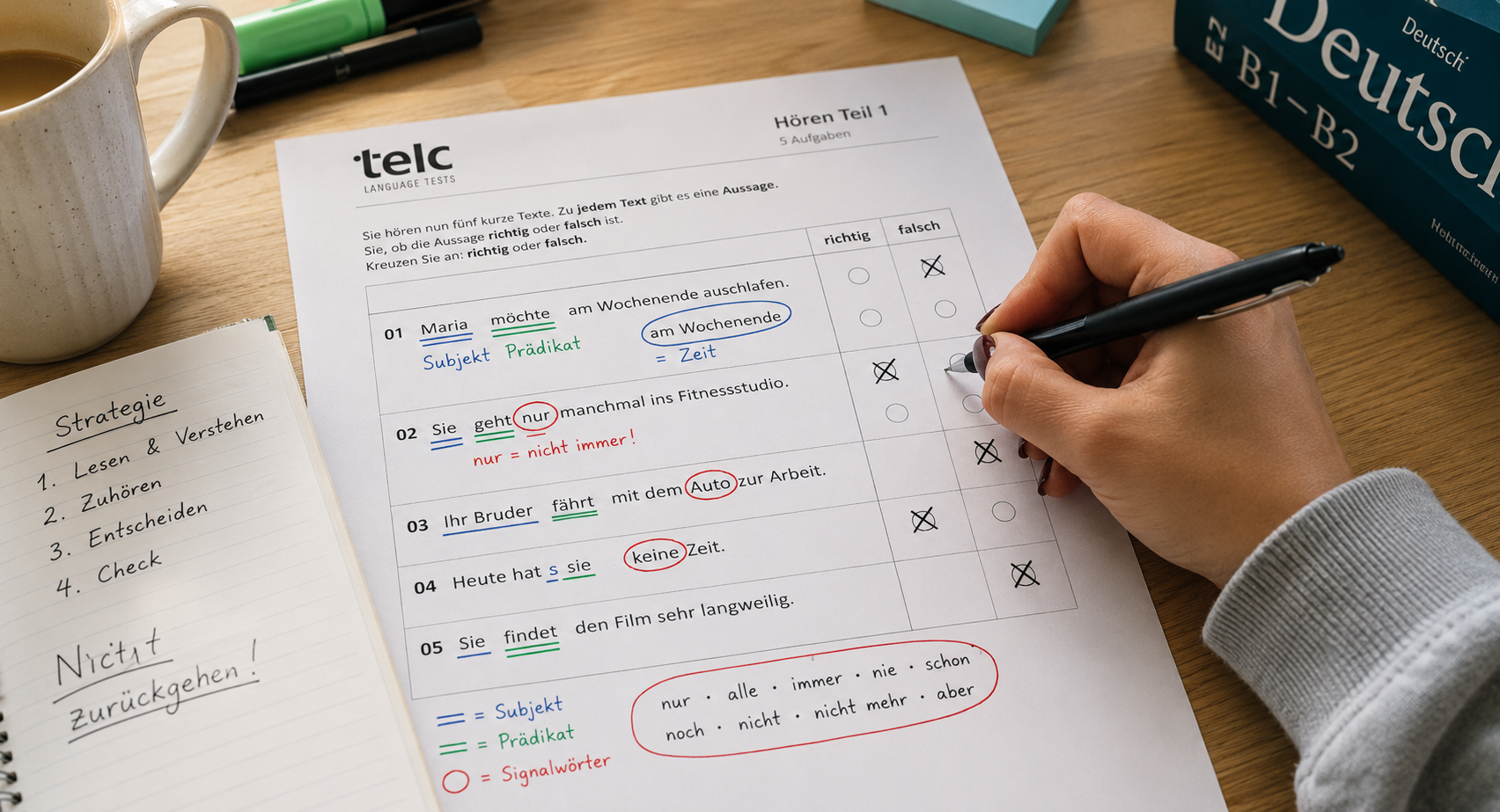
These situations are what make Listening Part 3 special: Part 1 tests Globalverstehen (global comprehension, the main information in a text), Part 2 tests Detailverstehen (detailed comprehension) in a longer dialogue. Part 3 tests whether you can identify one concrete piece of information in a short, practical text.
Before each of the five texts you hear a short introductory sentence. For example: Sie sind im Supermarkt und hören folgende Durchsage. (You are in the supermarket and hear the following announcement.) This sentence gives you the context: where are you? What kind of text is coming now?
The structure of the task
The structure of Listening Part 3 is identical in every exam. If you know this structure exactly, you already have clear orientation before the first listening.
- There are five items (with telc normally numbered from 56 to 60).
- Each item consists of one short text and one statement.
- You hear each text twice.
- You have to analyse: is the information in the statement identical with the information in the text? Then the statement is true (+). Is the information different? Then the statement is false (−).
- For each item there is only one correct solution.
Before each text you have a few seconds to read the statement. Then comes the first playing of the text, after that a short pause, and then you hear the text once more – in the same version. Only after that does the next text begin.
| Element | Information |
|---|---|
| Number of texts | 5 |
| Number of statements | 5 (one per text) |
| How often do you hear each text? | Twice |
| Answer format | true (+) or false (−) |
| Type of texts | short, practical everyday texts (public announcement, in-store announcement, phone message, radio advert) |
How is Listening Part 3 assessed?
Listening Part 3 has 5 items. Each correct answer gives 5 points. The maximum is therefore 25 points for this part of the exam.
| Part of the exam | Number of items | Points per item | Points in total |
|---|---|---|---|
| Listening Part 1 | 5 | 5 | 25 |
| Listening Part 2 | 10 | 2.5 | 25 |
| Listening Part 3 | 5 | 5 | 25 |
The complete listening section (Parts 1, 2 and 3 together) therefore gives 75 points. That is a quarter of the 300 points in total that are possible in the written and oral exam.
With only 5 items, every single item in Listening Part 3 has the same value as an item in Listening Part 1. So stay maximally concentrated on each of the five texts – even though this is the last part of the listening section and you may already be tired.
Typical mistakes candidates make
These mistakes have no connection with a difficult text. They happen because of your own method – and that is exactly why you can eliminate them quite easily with a little practice.
Mistake 1: not reading the statement before listening
Some candidates listen to the text first and only read the statement afterwards. That is a big problem: you then have no orientation as to which information is relevant. Always read the statement before the text starts.
Mistake 2: not marking the important words
If you read the statement without marking the central words, you quickly lose focus while listening. In the few seconds before the listening, mark the elements that could be relevant for the solution – for example names, numbers, places, times.
Mistake 3: ignoring the introductory sentence
The introductory sentence before each text gives you the context of the situation. Whoever ignores this sentence loses seconds getting their bearings and then often does not understand the beginning of the actual text correctly.
Mistake 4: wanting to translate every single word
Some candidates try to translate every word into their own language while listening. That costs too much time, and you lose the relevant information. Concentrate on the sense of the sentence, not on every single word.
Mistake 5: blocking at an unknown word
If a word in the text is unknown, some candidates block mentally and lose the rest of the sentence as a result. An unknown word is not a problem – simply keep listening as normal.
Mistake 6: starting completely from scratch at the second listening
The second listening has the function of a check, not of a complete restart. Whoever completely forgets their first decision at the second listening and guesses again makes the task unnecessarily more complicated.
Mistake 7: leaving a box empty
An empty box on the answer sheet automatically counts as wrong. So always mark a solution, even when you are unsure. With true/false the chance with a guess is 50 to 50 – that is better than no answer.
Mistake 8: investing too much time in one item
When you are unsure: decide quickly and move on to the next item. Whoever analyses for too long misses the introductory sentence or even the start of the next text.
If you respect these eight points, you have already done half the work towards a good score.
Sometimes you get stuck on an item and find no clear solution – that is normal, it happens to every candidate. In that moment, analyse the statement once more briefly with the strategy you have learned: which words did you mark? What did you hear in the text, even if it was not entirely clear?
If you are still unsure after that: simply guess. With true/false there are only two options – so your chance is 50 to 50. That is always better than an empty box, because an empty box is automatically wrong and gives you 0 chances. So mark a solution in any case and move on to the next item.





There are no comments for this article. Leave your comment