






Lesen Teil 2:
How to recognise all traps
This task is like a little detective story. Every advertisement has a secret. One fits the situation. Others look like they fit, but they are traps. If you find the traps, you get your points. It is that simple – and that difficult.
What is Lesen Teil 2 about?
In Lesen Teil 2 you see 5 situations (numbers 26 to 30) and 8 advertisements (letters a to h). In each situation a person is looking for something: a flat, a job, a course, insurance. Your task is to find the correct advertisement for each situation.
For each correct answer you get one point. A total of 5 points is possible.
✓ Each advertisement fits only one situation.
✓ An advertisement may not be used twice.
✓ One situation fits NO advertisement – here you write an X.
✓ At the end several advertisements are left over. That is correct.
This is your detective work: you are not only looking for the correct advertisement. You must also recognise the wrong advertisements. These wrong advertisements are called Distraktoren. They look correct – but they are wrong. We will look at exactly these traps step by step.
👉 Here you will find B1 DTZ Lesen exercises to practiseWhat are Distraktoren?
A Distraktor is an advertisement that looks almost correct. But something small is wrong. Perhaps a number. Perhaps a word. Perhaps a date. The examiners write these advertisements specifically like this. They want to see: do you really read carefully?
Situation: Eine Familie sucht einen Urlaub: zwei Erwachsene und zwei Kinder (5 und 9 Jahre alt). Budget: bis 600 Euro pro Woche für die ganze Familie.
Anzeige: Familienhotel, 600 Euro pro Woche für 2 Erwachsene und 2 Kinder. Kinder bis 9 Jahre wohnen kostenlos bei den Eltern.
At first glance everything fits: family, price, two children. But read carefully: „bis 9 Jahre“ means 8 years or younger. The older child is already 9 years old – and no longer fits into this group. Such a small thing – only one year difference – makes the whole advertisement wrong. That is a typical Distraktor.
In a typical DTZ task there are 8 advertisements. You only need 4 of them (one situation gets the X). The other 4 advertisements are left over. These are the Distraktoren.
A Distraktor is never completely wrong. It is always almost correct. Only one small detail does not fit. You must find exactly this detail.
What do you read first?
Many exam candidates make a mistake: they start immediately with the advertisements. They read the first advertisement, then the second, then the third. Later they have read all the advertisements – but they no longer know what the people are looking for. They have to read everything again. This costs a lot of time.
Read the situations first, not the advertisements. The situations are short. You understand them quickly. Only then do you search in the advertisements.
Underline the important words
Take a pen and underline three things in each situation:
- WHO is looking for something? (Vater, Tochter, Frau, Sohn, Freundin ...)
- WHAT is the person looking for? (Wohnung, Job, Kurs, Versicherung ...)
- HOW / WHERE / WHEN? (günstig, in Berlin, am Wochenende ...)
Example: „Eine Mutter sucht für ihren zweijährigen Sohn Gesellschaft.“
| Question | Answer |
|---|---|
| WHO? | eine Mutter für ihren Sohn |
| WHAT? | Gesellschaft (= andere Kinder zum Spielen) |
| HOW / WHERE? | der Sohn ist 2 Jahre alt |
Now you know exactly: a play group for children aged 2. With this clear picture in your head you go to the advertisements.
The correct method step by step
If you have a clear method, you work faster and make fewer mistakes. This is how you proceed:
Step 1: Read and underline the situations
Read all situations. Underline WHO, WHAT, HOW/WHERE/WHEN. This takes approximately 2 minutes.
Step 2: Skim the advertisements quickly
You do not need to understand every word. Just look: what is the main topic? The heading in bold type helps you a great deal. It almost always says everything important.
Step 3: First exclude, then select
This is the most important trick. Do not look for the correct answer immediately. First cross out all the advertisements that definitely do not fit. Then only 2 or 3 candidates remain. You choose from these.
Step 4: Check all conditions
If you find a suitable advertisement, check once more: does the age fit? Does the price fit? Does the time fit? An advertisement only fits if ALL the conditions from the situation match. One single wrong detail is enough – and the advertisement is not correct.
Step 5: Solve difficult tasks at the end
If a situation is difficult, skip ahead. Solve the easy tasks first. At the end you come back. Then fewer advertisements are left – and the solution becomes easier.
Step 6: Do not forget the X
One situation must receive an X at the end. If you have found an advertisement for every situation, something is wrong. Look again. One answer is certainly wrong.
The 12 most important traps – overview
When preparing for the B1 DTZ exam, similar types of traps can be observed again and again. We have compiled them for you – a total of 12 typical types. Once you know these traps, you will spot them immediately. Here is the list:
| No. | Trap | What is the problem? |
|---|---|---|
| 1 | Falsche Rolle | The advertisement searches instead of offering |
| 2 | Falsches Alter | The age does not match |
| 3 | Falsche Zeit | Day, time or duration does not match |
| 4 | Falscher Preis | Too expensive, or additional costs |
| 5 | Falsches Ziel | kaufen, mieten, reparieren – not the same thing |
| 6 | Gleiches Wort | Word fits, but the meaning is different |
| 7 | Falsche Voraussetzungen | Führerschein, qualification, experience is missing |
| 8 | Neu oder gebraucht | Person wants new, advertisement offers used |
| 9 | Wichtiges Adjektiv | ruhig, laut, hell, dunkel makes the decision |
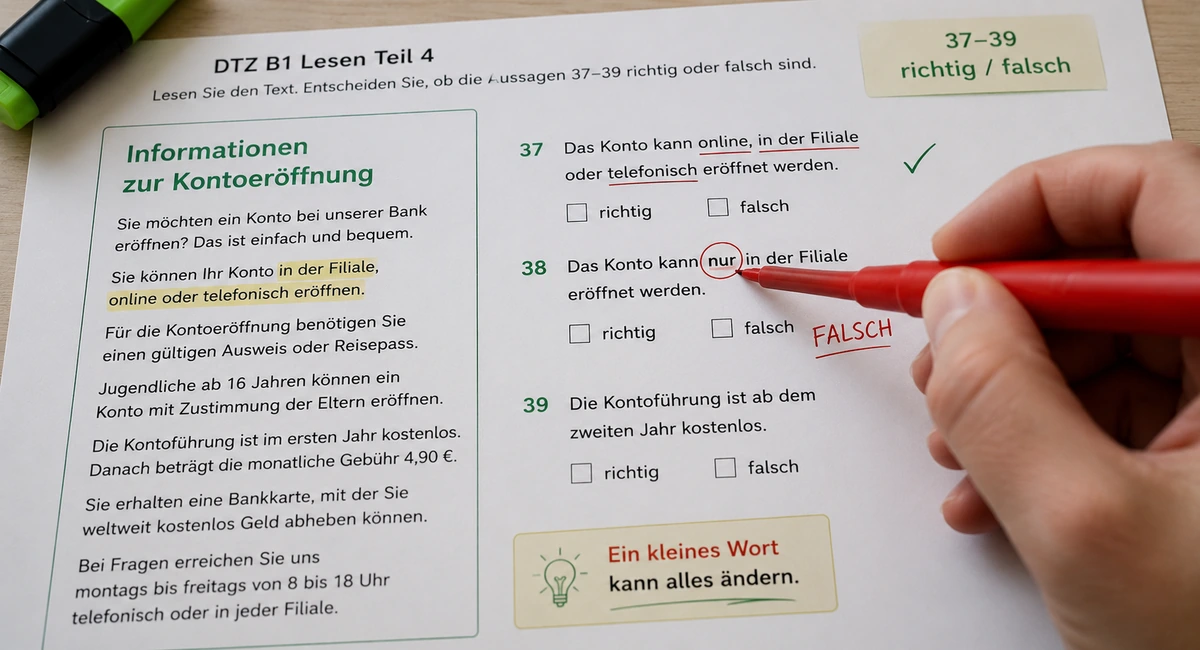
| 10 | Verneinung | A „nicht“ or „kein“ reverses the meaning |
| 11 | Ohne klares Ziel | Advertisement does not say what the person needs |
| 12 | Spezialfilter | Special requirement (language, pet, specialisation) |
On the following pages we explain each trap. With examples for illustration. This way you learn what they look like and how to recognise them.
Trap 1: Falsche Rolle
This trap is the most common. It appears in almost every test. The problem is always the same: in the situation a person is looking for something. In the advertisement another person is looking for the same thing. Both are looking – and nobody is offering anything.
Situation: Sie suchen einen Babysitter für Samstag.
Anzeige: „Babysitter gesucht! Wir brauchen jemanden für unsere Kinder Mo–Fr.“
Problem: Beide suchen einen Babysitter. Die Anzeige bietet keinen an.
Pay attention to certain words in the advertisement: Wir suchen, gesucht, Wir brauchen, Bewerbung, Stellenangebot, Nachmieter. If these words appear there, the advertisement is a search, not an offer.
There is also another form: a private person writes themselves. For example a 17-year-old pupil looking for an apprenticeship. Or an intern looking for a flat. Here too someone is looking – and offering nothing.
Who writes the advertisement? A company that offers something? Or a person who is looking for something themselves?
Trap 2: Falsches Alter
Many advertisements have an age limit. For example a course only for children aged 8 to 16. Or an account only for young people up to 25 years old. If the person in the situation is outside this limit, the advertisement does not fit.
Situation: Ihr Bekannter ist 28 Jahre alt und sucht ein Girokonto.
Anzeige: Kostenloses Girokonto für Auszubildende bis 25 Jahre.
Problem: Der Bekannte ist zu alt. Das Konto ist nur bis 25 Jahre.
Important words for age
| Word | Meaning |
|---|---|
| ab 5 Jahre | 5 years and older |
| bis 25 Jahre | 25 years and younger |
| zwischen 16 und 25 | from 16 to 25 years |
| mindestens 18 | 18 years or older |
Always check the limit carefully. A child of 5 years fits „ab 5 Jahre“, but not „ab 6 Jahre“. Only one year difference – and the advertisement is wrong.
Trap 3: Falsche Zeit
Sometimes almost everything is correct: the topic, the location, the price. Only the time is wrong. „Zeit“ means three things: Tag, Uhrzeit and Dauer. Let us look at all three.
Day of the week
Situation: Sie suchen Arbeit am Wochenende.
Anzeige: Aushilfe gesucht, Mo–Fr 15 bis 18 Uhr.
Problem: Samstag und Sonntag sind in dieser Anzeige nicht möglich.
Time of day
Situation: Sie möchten morgens arbeiten.
Anzeige: Reinigungskräfte gesucht für die Abendstunden.
Problem: „Morgens“ und „Abendstunden“ sind das Gegenteil.
You should know these words:
- vormittags / morgens – from 6 to 12 o’clock
- nachmittags – from 12 to 18 o’clock
- abends – from 18 to 22 o’clock
- Werktage – Monday to Friday
- Wochenende – Saturday and Sunday
Duration
A person needs a flat for 3 months because they are doing an internship. An advertisement offers a flat for a limited period, „Mietdauer 5 Tage bis 4 Wochen“. 4 weeks are approximately 1 month. But the person needs 3 months. The advertisement does not fit.
Trap 4: Falscher Preis
Money is always a topic. If a budget appears in the situation (for example „bis 1000 Euro“ or „günstig“), you must check the price in the advertisement carefully.
Rent plus additional costs
This is a particularly important trap with flat advertisements. Look carefully: are the additional costs already included in the price or do they come on top?
Situation: Sie suchen eine Wohnung bis 1100 Euro für Miete UND Nebenkosten.
Anzeige A: Wohnung 1100 Euro ohne Nebenkosten. ✓ passt
Anzeige E: Wohnung 1100 Euro plus Nebenkosten. ✗ zu teuer
Important words for price
- günstig / preiswert / billig – little money
- kostenlos / gratis / umsonst – 0 Euro
- inklusive (inkl.) – already included in the price
- plus / zzgl. – on top, extra
Free and not free
Situation: Sie möchten sich KOSTENLOS über den Schulabschluss informieren.
Anzeige: Kurs zur Vorbereitung auf den Schulabschluss. 4 Mal pro Woche, 195 Euro.
Problem: Der Kurs kostet Geld. Die Person sucht aber eine kostenlose Information.
Trap 5: Falsches Ziel
In this trap the topic is correct, but the action is not. The most important word here is the verb. A person wants to mieten something. The advertisement offers something to kaufen. The topic is the same, but the action is different. The advertisement does not fit.
Situation: Eine Frau möchte nach Indien reisen.
Anzeige: Vortrag über Indien – das Land der Gegensätze.
Problem: Die Anzeige ist ein Vortrag, kein Reisebüro. Die Frau kann dort keine Reise buchen.
Typical examples of wrong actions
| Person wants to ... | ... but advertisement offers |
|---|---|
| mieten | kaufen |
| reparieren lassen | verkaufen |
| etwas lernen | einen Lehrer suchen |
| eine Ausbildung machen | einen Job für ausgebildete Personen |
| buchen (eine Reise) | einen Vortrag über das Reiseland |
| sich informieren | einen Kurs machen |
| selbst helfen | einen Profi engagieren |
The verb is often more important than the noun. Always pay attention to: kaufen, mieten, lernen, suchen, helfen, reparieren, machen, buchen, informieren.
Trap 6: Gleiches Wort, andere Bedeutung
Sometimes exactly the same word appears in the advertisement as in the situation. Many exam candidates immediately think: „That fits!“ But be careful. The same word can have a completely different meaning.
For example: the word „Maler“ can be a profession. But it can also be a family name. The word „Fahrlehrer“ can be someone who teaches. But it can also be someone who wants to learn this profession first.
Situation: Ein Bewerber sucht einen Job als Gartenpfleger.
Anzeige: Autohaus Gartner GmbH – Wir suchen Autoverkäufer.
Problem: „Gartner“ ist hier ein Firmenname, kein Beruf.
Situation: Sie möchten den Führerschein machen.
Anzeige: Werden Sie Fahrlehrer! Ausbildung in der Fahrschule.
Problem: Die Fahrschule sucht keine Führerschein-Schüler. Sie bildet Fahrlehrer aus.
Situation: Sie suchen eine Haftpflichtversicherung für Ihren Hund.
Anzeige: Günstige Haftpflichtversicherung für Familien mit Kindern.
Problem: Die Versicherung ist nicht für Hunde, sondern für Kinder.
Always read the whole sentence, not just one word. The same word is no proof of the correct answer.
Trap 7: Falsche Voraussetzungen
Some advertisements require certain things from the person. These are called Voraussetzungen. For example a driving licence, a school leaving certificate or work experience. If the person in the situation does not have these things, they cannot use the advertisement.
Typical Voraussetzungen
- Führerschein – car, lorry or other category
- Eigenes Auto – not just a driving licence, also the vehicle itself
- Schulabschluss – Hauptschule, Realschule or Abitur
- Berufserfahrung – often stated in years
- Computerkenntnisse – Windows, Word, Internet
- Sprachen – for example Deutsch C1 or Englisch
- Mindestalter – often 18 years
Situation: Sie suchen einen Nebenjob. Sie haben keinen Führerschein.
Anzeige: Kurierfahrer gesucht. Wichtig: Führerschein und eigenes Auto.
Problem: Ohne Führerschein können Sie diesen Job nicht machen.
Situation: Sie haben einen guten Schulabschluss und möchten Altenpfleger werden.
Anzeige: Pflegekraft gesucht. Voraussetzung: examinierter Altenpfleger.
Problem: Die Person will erst Altenpfleger werden. Die Anzeige sucht jemanden, der schon Altenpfleger ist.
Trap 8: Neu oder gebraucht
One single word decides everything here: neu or gebraucht. Both words are short, but they make a big difference. Always read carefully what it says in the advertisement.
| Word | Meaning |
|---|---|
| neu | never used before, from the shop |
| gebraucht | already used once, second hand |
| neuwertig | almost new, but already used |
| Haushaltsauflösung | old things from a flat – always used |
Situation: Sie suchen einen günstigen NEUEN Kühlschrank.
Anzeige: Haushaltsauflösung – Kühlschrank günstig zu verkaufen.
Problem: Bei einer Haushaltsauflösung sind alle Sachen gebraucht, nicht neu.
Trap 9: Das wichtige Adjektiv
An adjective is a small word. But it can change the whole answer. Ruhig or laut? Hell or dunkel? Klein or groß? If an adjective appears in the situation, you must check carefully whether the advertisement fits.
Situation: Eine Studentin sucht eine kleine, ruhige Wohnung.
Anzeige A: 1-Zimmer-Apartment mitten im Zentrum, Kneipen und Restaurants direkt nebenan. ✗
Anzeige B: 1-Zimmer-Wohnung, wenig Verkehr, neben einem Park, ruhig gelegen. ✓
Problem in A: Kneipen direkt nebenan bedeutet laut. Das ist das Gegenteil von ruhig.
Important adjectives and their synonyms
| Adjective in the situation | Synonyms in the advertisement |
|---|---|
| ruhig | wenig Verkehr, leise, neben Park, in ruhiger Lage |
| hell, viel Licht | sonnig, Südseite, große Fenster |
| klein | 1-Zimmer, 30–50 m², Single-Wohnung |
| groß | 4-Zimmer, 100 m²+, für Familie |
| günstig | preiswert, Schnäppchen, niedriger Preis |
| flexibel | Arbeitszeit selbst bestimmen, frei einteilen |
If an adjective appears in the situation, it is like a filter. You must find a matching synonym in the advertisement. If the advertisement says the opposite, it is a trap.
Trap 10: Die Verneinung
A small word such as nicht, kein or leider can completely reverse the meaning of an advertisement. Anyone who reads quickly often does not see these words. But exactly these words decide whether the advertisement fits or not.
Situation: Ihre Bekannte hat einen großen Hund und sucht eine passende Wohnung.
Anzeige: Schöne 3-Zimmer-Wohnung – nur kleine Haustiere erlaubt.
Problem: At first glance this looks fine – pets are allowed! But the small word nur is a negation here. Nur kleine Tiere – and nothing else. A large dog does not fit.
Situation: Sie suchen einen Babysitter für Samstag.
Anzeige: Ich passe gerne auf Kinder auf, ausschließlich an Werktagen ab 16 Uhr.
Problem: The small word ausschließlich is a negation here: ausschließlich Werktage = Montag bis Freitag – and nothing else. Saturday does not fit.
These words you must see
- nicht – makes the opposite
- kein / keine – none of it
- leider – often connected with „nicht“
- außer – everything except that
- nur – nothing else
- ohne – something is missing
- ausschließlich – only that, nothing else
If an advertisement looks almost perfect, read it again slowly. Look for these small words. They often appear at the end of a sentence.
Trap 11: Advertisement without a clear goal
In this trap the advertisement talks about the correct topic. It mentions the right words. But it does not say what the person actually needs. Exactly this absence makes the advertisement wrong.
Situation: Sie möchten für Ihr Telefon weniger zahlen als bisher.
Anzeige A: Billiger telefonieren? Die Verbindung ist zu teuer? Wir haben die besten Preise! ✓
Anzeige G: Eine Leitung – drei Möglichkeiten: TV, Telefon und Internet via Kabel. ✗
Problem: Anzeige G talks about the phone, but says nothing about prices or cheaper calls.
Always ask yourself: what is the most important word in the situation? Then check: is that in the advertisement? If not, it does not fit.
Situation: Sie suchen einen gebrauchten Schreibtisch.
Anzeige A: Haushaltsauflösung – Gasherd, Kühlschrank, Küchenstühle, Wohnzimmermöbel, Stehlampen, Regale.
Anzeige H: Möbelmarkt – gebrauchte Möbel für Küche, Wohnzimmer, Schlafzimmer und Arbeitszimmer.
Problem in A: Many pieces of furniture are in the list, but no Schreibtisch. Anzeige H mentions the Arbeitszimmer – that is where desks are.
It is not enough that the advertisement talks about the correct topic. It must also mention the exact detail that the person is looking for.
Trap 12: The special filter
Sometimes the situation has a very particular requirement. For example a doctor who speaks a certain language. Or insurance specifically for dogs. This particular requirement is like a filter. Only one advertisement passes through this filter – or none at all.
Situation: Ein Patient ist krank und sucht einen Arzt, der seine Sprache spricht.
Anzeige (richtig): Gesundheitsprojekt – wir haben eine Liste von Ärzten mit Fremdsprachenkenntnissen.
What is special here? Not just any doctor – a doctor who speaks the patient’s native language.
Situation: Ihre Bekannte sucht einen Kinderarzt für ihre kleine Tochter.
Anzeige A: Arztpraxis im Stadtzentrum – Hausarzt und Sportmedizin. ✗
Anzeige B: Neueröffnung Kinderarztpraxis Dr. Schmidt. ✓
Problem in A: A medical practice – but not for children.
Typical special filters
- Sprache – doctor with foreign language skills
- Spezialisierung – Kinderarzt, Augenarzt, Zahnarzt
- Spezielle Zielgruppe – only for women, only for seniors, only for migrants
- Versicherung für Tiere – not every insurance covers dogs
- Eltern und Kinder zusammen – not just a course for children
- Geschwisterbetreuung – special help for older siblings
If the situation mentions a special detail, that is the most important filter. Look for exactly this detail in the advertisement.
Paraphrases: Different words, same meaning
A paraphrase is an important thing. It means: you say something with different words, but the meaning stays the same. For example „Handy“ is a paraphrase of „Mobiltelefon“. „Sonnig“ is a paraphrase of „viel Licht“.
In Lesen Teil 2 you will almost always find paraphrases. The correct advertisement almost never uses exactly the same words as the situation. Anyone who only looks for the same word often does not find the answer.
Be careful with the same words
This is important: if a word from the situation appears exactly the same in an advertisement, you must be careful. This is often a trap (see Trap 6). The correct answer usually contains a synonym, not a direct word.
Paraphrases for verbs
It is particularly often not the nouns that are paraphrased, but the verbs (actions). You should know these pairs:
| In the situation | In the advertisement |
|---|---|
| zusammenbauen | Aufbau, Montage, montieren |
| nach Hause bringen | Lieferung, liefern, frei Haus |
| helfen | unterstützen, beraten, Hilfe anbieten |
| reparieren | instand setzen, in Ordnung bringen |
| ausbilden | Ausbildung anbieten, Lehrlinge |
| aufpassen (auf Kinder) | betreuen, Betreuung, Babysitter |
| weniger zahlen | günstigste Preise, billiger, Schnäppchen |
| sich informieren | Beratung, Informationsabend, Fragen beantworten |
Do not look for the same word. Look for the same meaning. Lieferung is the same as nach Hause bringen. Sonnig is the same as viel Licht.
The X – do not forget it
Many exam candidates think: I must find an advertisement for every situation. That is not correct. In every Lesen Teil 2 task there is exactly one situation that does not fit any advertisement. For this situation you write an X.
The X is not an empty answer. It is a correct answer. It earns you a point.
If you forget the X, you lose a point. If you cannot find a matching advertisement for a situation, that is not a mistake. Perhaps exactly this situation is the X situation.
How do you recognise the X?
You have checked all the advertisements. None fits 100 percent. You are in doubt. Then do not try to make an advertisement „half fitting“. If nothing really fits, the answer is: X.
Typical examples of X situations
- A person is looking for someone to repair a sofa. But all advertisements are selling furniture. → X
- A person is looking for a Spanish teacher for work. All language advertisements are only for holidays. → X
- A 28-year-old is looking for a current account with a free debit card. The only suitable account is only up to 25 years. → X
- A person is looking for a Maler. No advertisement offers this profession. → X
Self-check at the end
Check at the end:
- Have I used 4 different letters and once X? ✓
- Are 4 advertisements unused? ✓
- Have I not used any advertisement twice? ✓
The 7 most important rules
Now we summarise everything. These 7 rules are the most important things from the whole article. Learn them by heart. They will help you in every DTZ exam.
Rule 1: Read the situations first
Always read all situations first, not the advertisements. Underline WHO, WHAT, WHEN/WHERE/HOW. Only then do you go to the advertisements.
Rule 2: All conditions must match
An advertisement only fits if all the conditions from the situation match. If the situation has three conditions (for example profession, city, time), all three must fit in the advertisement. One single wrong detail makes the advertisement wrong.
Rule 3: The verb is more important than the noun
Not only the topic counts. The action must also be correct. „Indien“ alone is not enough – it must also be „reisen“ or „buchen“, not just „informieren“.
Rule 4: Synonyms instead of the same words
Do not look for the same word, but for the same meaning. If a word is exactly the same, this can be a warning signal. Always check the whole sentence.
Rule 5: With two similar advertisements – find the difference
Sometimes two advertisements seem to fit the same situation. That is not possible. One is correct, one is a trap. Look for the small difference: perhaps in the age, the price, the time, an adjective.
Rule 6: First exclude, then select
Cross out first the advertisements that definitely do not fit. Then only a few candidates remain. You choose from these.
Rule 7: X is a correct answer
If nothing fits, that is not a mistake. One situation must get X. Do not try to force an answer.
Situations first. Check all conditions. Note the verb. Look for synonyms. Find differences. Exclude, then select. Do not forget X.
How much time do you have?
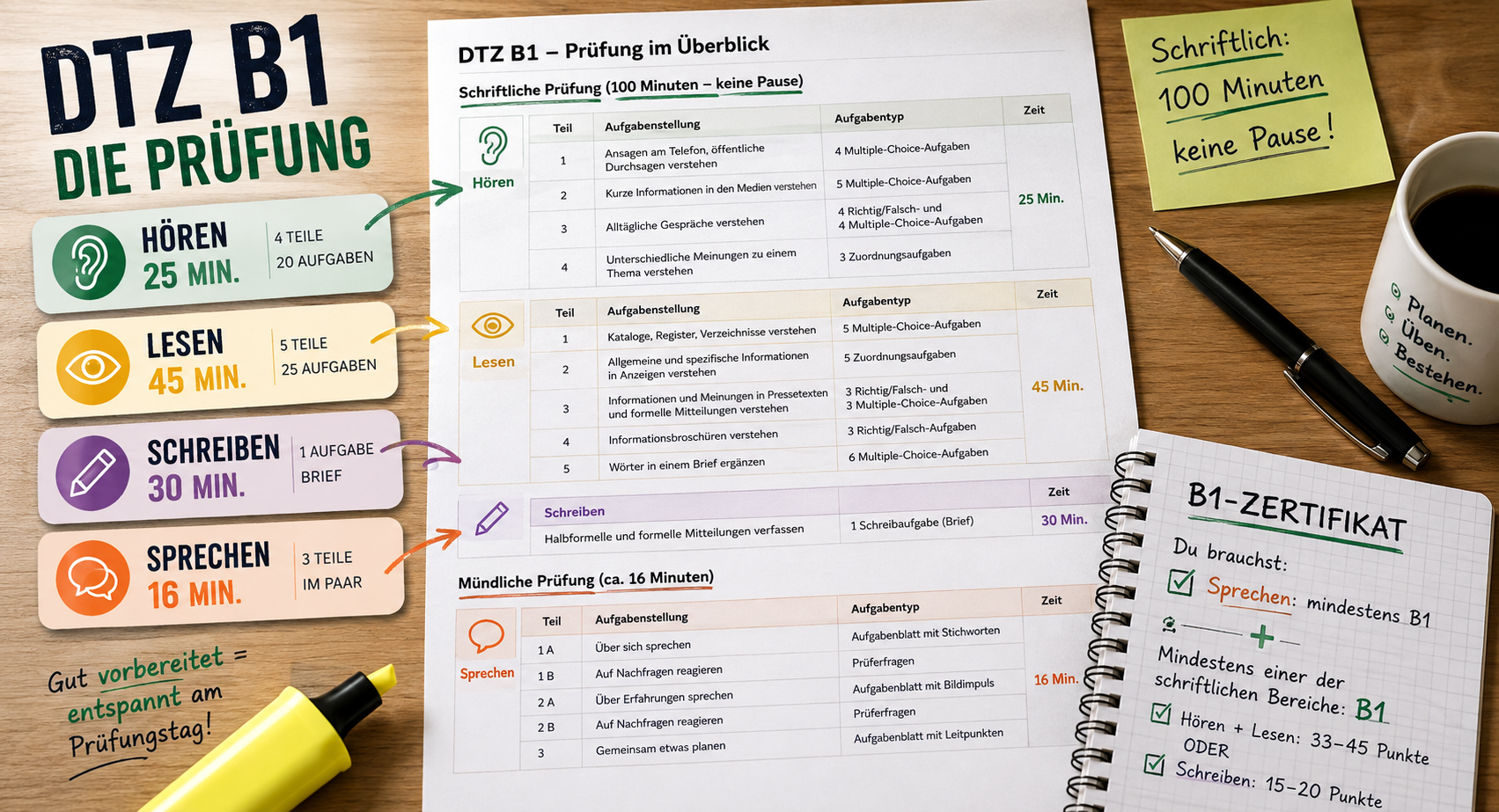
For the entire exam section Lesen you have 45 minutes. There are 5 parts with 25 tasks. For Lesen Teil 2 you need approximately 8 to 10 minutes. With a clear plan in your head you can manage this well.
| Step | Time |
|---|---|
| Read situations and underline | 1–2 minutes |
| Skim advertisements quickly | 2–3 minutes |
| Match situation and advertisement | 4–5 minutes |
| Check and mark X | 1 minute |
Mark your answers on the answer sheet immediately, not at the end. At the end of the exam section Lesen there is a STOP sign. You are then no longer allowed to write.
Important synonyms to learn
These synonyms appear again and again in DTZ exams. Learn them by heart. They help you solve the tasks more quickly.
| In the situation | In the advertisement |
|---|---|
| Mobiltelefon | Handy |
| Computer | PC, EDV |
| am Wochenende | samstags, sonntags, Sa+So |
| von zu Hause arbeiten | Fernunterricht, online, Homeoffice |
| günstig, wenig Geld | preiswert, kostenlos, gratis, Schnäppchen |
| 69 Jahre alt | Senioren, Seniorinnen |
| kleine Kinder | Babys, Kleinkinder, Vorschulkinder |
| Hund, Katze | Haustier, Vierbeiner |
| Auto | Fahrzeug, PKW, KFZ |
| Mini-Job | 400-Euro-Basis, geringfügige Beschäftigung |
| während des Sommers | Juli und August, Ferien |
| nach Hause bringen | Lieferung, frei Haus, liefern |
| viel Licht | sonnig, hell, Südseite |
| nähen lernen | Kurs Schnitte, Stoffe, Garn |
| etwas zusammenbauen | Aufbau, Montage |
| kurzer Schulweg | Schulen in der Nähe |
| ruhig | wenig Verkehr, leise, neben Park |
| flexibel arbeiten | Arbeitszeit selbst bestimmen |
| stundenweise | Teilzeit, halbtags |
| helfen lassen | Beratung, Unterstützung |





There are no comments for this article. Leave your comment