





telc B1 Speaking:
Structure, tips and examples
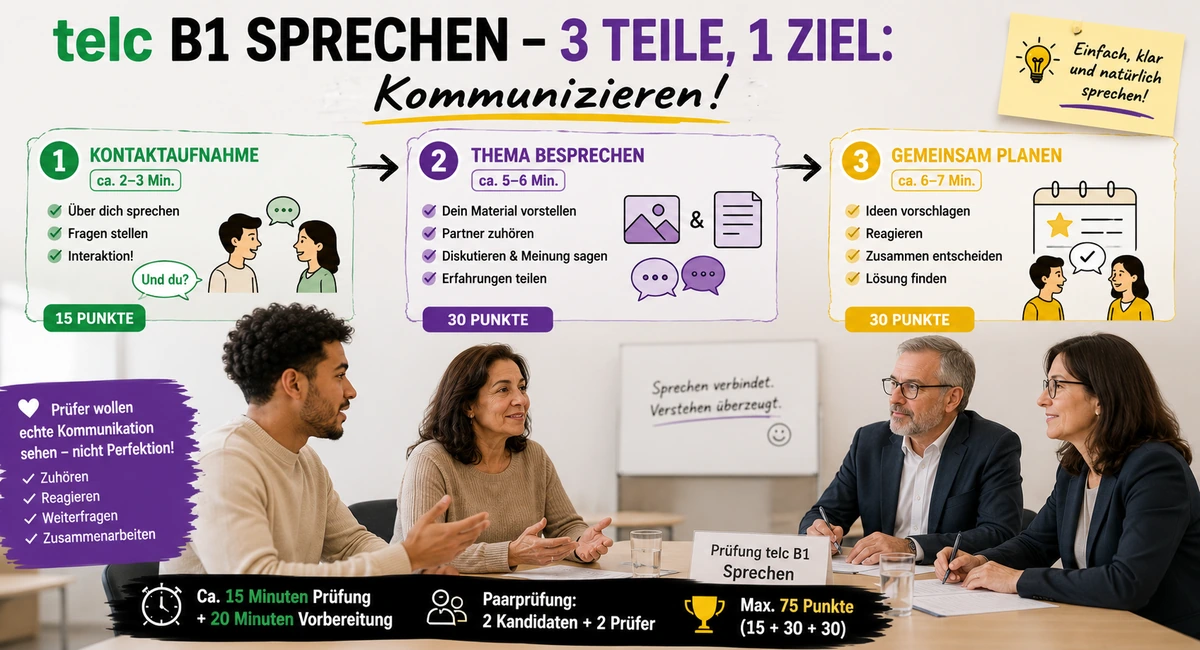
The telc B1 oral exam lasts only 15 minutes. Here you will find the exact structure, the three parts of the exam, typical questions, important set phrases and the best tips for a good mark.
What is the telc B1 oral exam?
The oral exam is the last part of the telc B1 exam. Many candidates are nervous about this part. But don’t worry: if you know what to expect, the oral exam is not that difficult.
The oral exam lasts only 15 minutes. Before that you receive 20 minutes of preparation time. This means you have enough time to prepare calmly.
The oral exam is a pair exam. This means you do not speak alone — you speak together with another candidate. Two examiners listen and assess your German. Don’t worry: the examiners are friendly. They want you to pass.
The oral exam has three parts. Each part has a different goal. Important: the exam is a conversation, not an interrogation. You should speak as you would in real life — naturally and in a friendly way.
The oral exam has 75 points in total. To pass you need at least 45 points (60 %). If you do not pass the oral exam, you can retake only this part — not the whole exam.
The three parts of the oral exam at a glance
The oral exam has three parts. Each part has its own goal and its own points. Here you can see everything at a glance:
| Part | What do you do? | Duration | Points |
|---|---|---|---|
| Teil 1 | Kontaktaufnahme: you introduce yourself and get to know your partner | 3–4 minutes | 15 points |
| Teil 2 | Conversation about a topic: you talk with your partner about an everyday topic | 5–6 minutes | 30 points |
| Teil 3 | Solving a task together: you plan something together (e.g. a party) | 5–6 minutes | 30 points |
Important to know: Teil 2 and Teil 3 give more points than Teil 1. This means: concentrate especially well on Teil 2 and Teil 3!
Preparation time (20 minutes)
Before the exam begins you receive 20 minutes of preparation time. During this time:
- You receive the task sheets for Teil 2 and Teil 3.
- You may make notes. Write down important words and ideas.
- You may not speak with your partner.
- A dictionary is not permitted.
Make good use of the 20 minutes! Read the tasks twice. Note down important words, your opinion on the topic and questions for your partner. If you are well prepared, you will speak more calmly during the exam.
Teil 1: Kontaktaufnahme — getting to know each other
In the first part you get to know each other. This is the easiest part of the exam. You introduce yourself and ask your partner questions. Duration: 3–4 minutes.
The most important thing in Teil 1: this is a conversation, not a monologue! You do not speak alone for 3 minutes. You speak with your partner. You take turns.
Typical topics in Teil 1
The topics in Teil 1 are always similar. There is no need to worry — you can prepare well:
- Name
- Country of origin
- Where you live (Wo wohnst du? Wie lange schon?)
- Family
- Work or studies
- Languages (Welche Sprachen sprichst du? Warum lernst du Deutsch?)
- Time abroad (Warst du schon in anderen Ländern?)
- Hobbies and free time
At the end the examiner asks one extra question that is not on your sheet. For example: “Was machst du am Wochenende?” or “Was ist dein Lieblingsessen?”
Example questions and example answers
A typical conversation might look like this:
You: Hallo, ich heiße Maria. Und wie heißt du?
Partner: Hallo Maria, ich bin Ivan. Woher kommst du, Maria?
You: Ich komme aus der Ukraine. Und du?
Partner: Ich komme aus Polen. Wie lange wohnst du schon in Deutschland?
You: Ich wohne seit zwei Jahren in Dortmund. Ich arbeite als Verkäuferin. Und was machst du?
Partner: Ich studiere hier Informatik. Hast du Familie in Deutschland?
You: Ja, ich habe eine Tochter. Sie ist sechs Jahre alt. Hast du auch Kinder?
Never answer with just one word! After every answer, ask your partner a question back. The little phrase “Und du?” is your best friend in this exam.
Useful set phrases for Teil 1
You can learn these sentences by heart. They help you when you are nervous:
- Ich heiße … / Mein Name ist …
- Ich komme aus …
- Ich wohne seit … Jahren in …
- Ich arbeite als … / Ich bin von Beruf …
- Ich habe … Kinder. / Ich bin verheiratet/ledig.
- Ich lerne Deutsch, weil …
- Und du? / Wie ist das bei dir?
- Kannst du mir mehr darüber erzählen?
Teil 2: Conversation about a topic
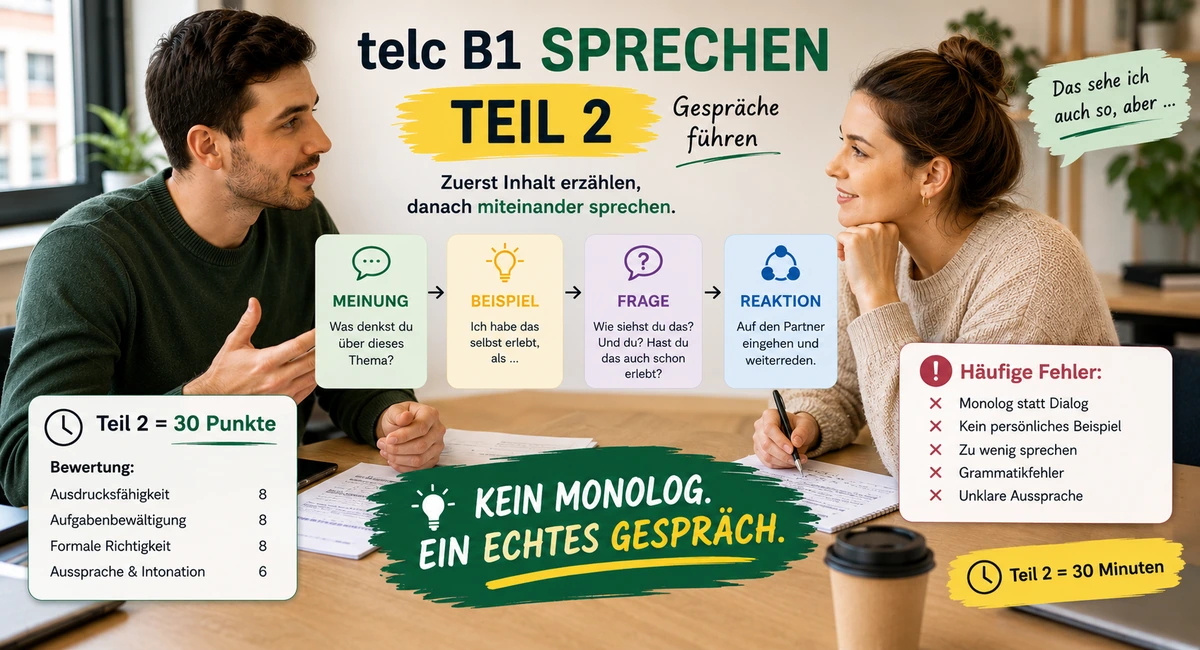
In the second part you talk with your partner about an everyday topic. Duration: 5–6 minutes. Max. 30 points.
You and your partner receive different pictures or texts on the same topic. For example: both of you receive something on the topic “Ferien und Reisen”. But the information on your picture is different from the information on your partner’s picture.
How Teil 2 works
The conversation has four steps:
- Step 1: You briefly tell your partner what is on your picture/text.
- Step 2: Your partner tells you what is on their picture/text.
- Step 3: You talk together about the topic.
- Step 4: You exchange your opinions and personal experiences.
Typical topics
The topics come from everyday life. For example:
- Ferien und Reisen
- Gesundheit und Sport
- Familie und Freunde
- Wohnen und Stadt oder Dorf
- Essen und Trinken
- Medien und Internet
- Arbeit und Beruf
Example: topic “Ferien und Reisen”
You: Auf meinem Bild sehe ich eine Statistik. Die meisten Deutschen machen Urlaub in Deutschland. Nur wenige fahren in ferne Länder.
Partner: Auf meinem Bild sehe ich, wohin die Deutschen am liebsten reisen. Italien und Spanien sind sehr beliebt.
You: Interessant! Ich mache gerne Urlaub am Meer. Und wo machst du am liebsten Urlaub?
Partner: Ich fahre gerne in die Berge. Ich wandere sehr gerne. Magst du auch Berge?
You: Hmm, nicht so. Ich mag warmes Wetter. Im letzten Jahr war ich in der Türkei. Das war super!
Important set phrases for Teil 2
Talking about the picture/text:
- Auf meinem Bild sehe ich …
- In meinem Text steht, dass …
- Die Statistik zeigt, dass …
Expressing your opinion:
- Ich finde, dass …
- Meiner Meinung nach …
- Ich denke/glaube, dass …
- Für mich ist es wichtig, dass …
Asking for an opinion:
- Und du? Was denkst du?
- Wie findest du das?
- Was ist deine Meinung dazu?
- Siehst du das auch so?
Reacting to an opinion:
- Das sehe ich auch so. / Da stimme ich dir zu.
- Das finde ich auch.
- Hmm, ich sehe das anders.
- Das ist ein interessanter Punkt, aber …
Don’t just describe the picture! Far more important is: say your opinion and ask your partner. Also talk about your own experiences. This gives you the most points.
Teil 3: Solving a task together
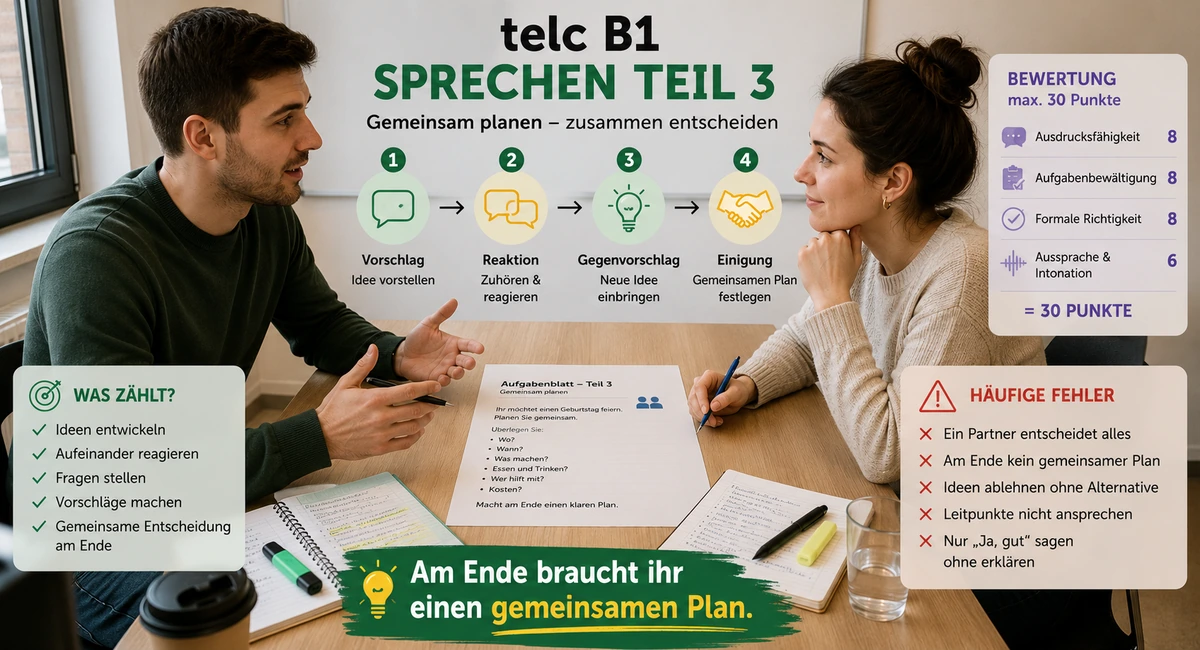
Teil 3 is the most important part of the oral exam. You and your partner must plan something together. Duration: 5–6 minutes. Max. 30 points.
The key word is “gemeinsam” (together). You are not planning alone. You make suggestions. Your partner reacts. They make suggestions. You react. Step by step you arrive at a shared solution.
Typical tasks
In Teil 3 you often have to organise something together:
- Plan a party (birthday, farewell party)
- Organise a day trip
- Choose a gift
- Choose a course or a trip together
- Prepare a celebration
Example task: planning a farewell party
A colleague is moving to another city. You plan a farewell party together. The sheet contains points to plan:
- Wann?
- Wo?
- Essen und Getränke
- Wer bezahlt was?
- Wen einladen?
How the conversation might look
You: Lass uns über die Party sprechen. Wann wollen wir sie machen?
Partner: Ich schlage Samstag vor. Am Samstag haben alle Zeit.
You: Samstag ist eine gute Idee. Und wo wollen wir feiern?
Partner: Bei mir zu Hause? Ich habe einen großen Garten.
You: Super! Aber was ist, wenn es regnet?
Partner: Dann feiern wir im Wohnzimmer. Was machen wir mit dem Essen?
You: Ich schlage vor, jeder bringt etwas mit. Ich mache einen Salat. Und du?
Partner: Gute Idee! Ich kaufe Getränke. Wen laden wir ein?
You: Alle Kollegen aus unserem Büro. Einverstanden?
Partner: Ja, einverstanden!
Set phrases for Teil 3
Making a suggestion:
- Ich schlage vor, wir …
- Wie wäre es, wenn wir …?
- Was hältst du von …?
- Wir könnten …
Accepting a suggestion:
- Das ist eine gute Idee!
- Einverstanden!
- Das machen wir so.
- Ja, das finde ich gut.
Rejecting a suggestion:
- Das finde ich nicht so gut, weil …
- Hmm, ich bin nicht sicher …
- Ich habe eine andere Idee …
- Vielleicht wäre es besser, wenn …
Involving your partner:
- Was meinst du?
- Und du, was denkst du?
- Hast du eine Idee?
- Welchen Vorschlag hast du?
Don’t dominate the conversation! If you speak the whole time alone, you will receive fewer points. Even if your partner is weaker: help them, ask questions, let them speak too. This is assessed positively.
How is the oral exam assessed?
Two examiners listen to you and assess your German. They assess you according to four criteria:
The four assessment criteria
| Criterion | What is assessed? |
|---|---|
| 1. Ausdrucksfähigkeit | How well can you express yourself? Do you have enough vocabulary? |
| 2. Aufgabenbewältigung | Do you complete the task? Do you speak fluently? Do you react to your partner? |
| 3. Formale Richtigkeit | Is your grammar correct? Do you use verbs, cases and sentence structure correctly? |
| 4. Aussprache und Intonation | Can you be understood easily? Do you sound natural? |
Points distribution
| Part | Maximum points |
|---|---|
| Teil 1: Kontaktaufnahme | 15 |
| Teil 2: Conversation about a topic | 30 |
| Teil 3: Solving a task together | 30 |
| Total | 75 |
To pass you need at least 45 points (60 %).
The best tips for the oral exam
Here are the most important tips so that you score well in the oral exam:
Tip 1: Speak simply but correctly
Many candidates want to speak in a complicated way to make a good impression. This is a mistake! A simple, correct sentence is much better than a complicated sentence with many errors.
Tip 2: Don’t panic if you don’t know a word
You don’t know a word? No problem! Paraphrase the word with other, simpler words. For example:
- You don’t know “Regenschirm”? Say: “Das Ding gegen Regen.”
- You don’t know “Supermarkt”? Say: “Der Laden, wo man Essen kauft.”
Or simply ask: “Wie sagt man das auf Deutsch?” This is much better than silence.
Tip 3: Listen carefully to your partner
The examiners also assess how well you react to your partner. Look at them, listen, answer their questions. You should not simply “play back” your own text.
Tip 4: Be friendly and cooperative
Smile, look at your partner, be polite. If your partner is unsure: help them! Ask them a question. This is assessed very positively.
Tip 5: Learn important standard sentences by heart
There are many sentences you need in every exam: greeting, asking questions, expressing an opinion, making suggestions. Learn these sentences well. This gives you more time to think during the exam.
Tip 6: Practise before the exam
The oral exam can be practised! Find a learning partner. Speak German together. Do role plays. The more you speak, the better you will become.
The examiners want to see that you can communicate. Small mistakes are not so bad. The most important thing is: you speak, you react, you understand. Stay calm and speak as naturally as possible!


There are no comments for this article. Leave your comment