





Sprachbausteine Teil 2 (telc B1):
All grammar, traps and tips
Which grammar do you really need to solve Sprachbausteine Teil 2 with confidence? Here you will find the format, the points, all typical traps and a clear grammar checklist with examples.
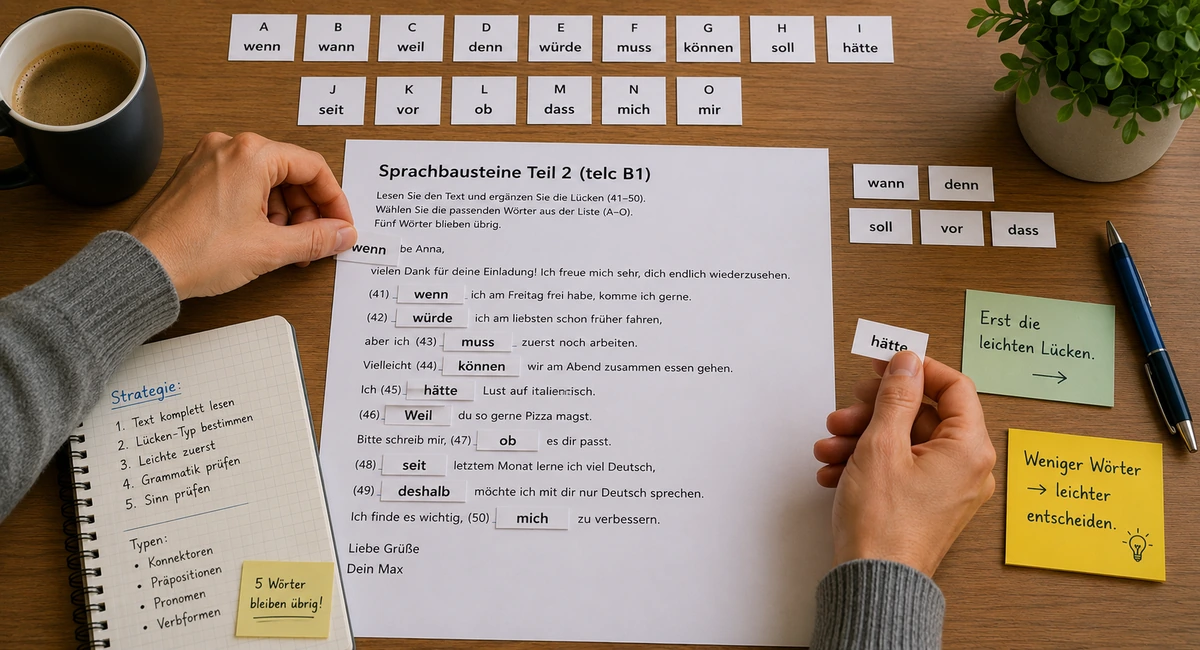
What is Sprachbausteine Teil 2? Format, task and points
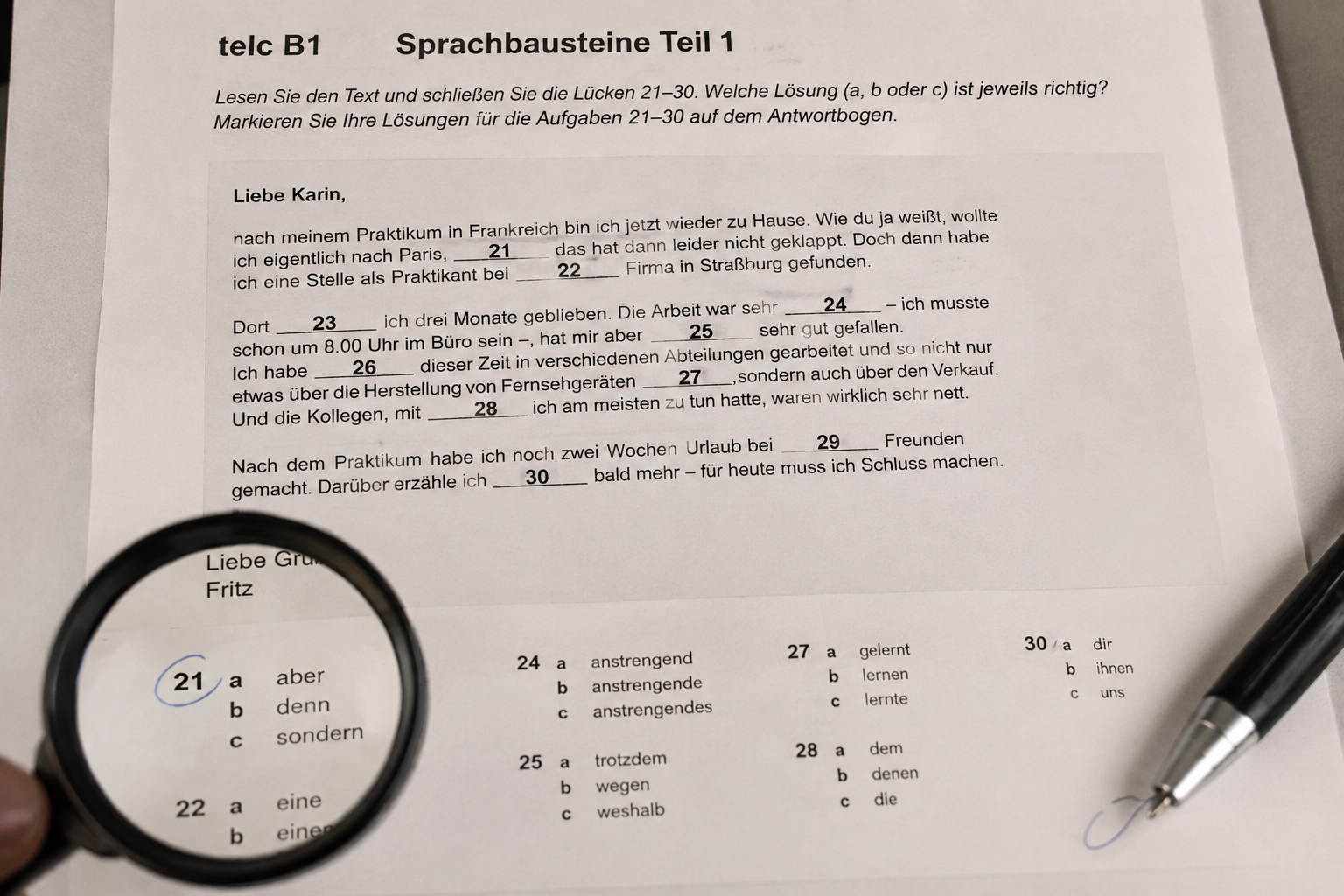
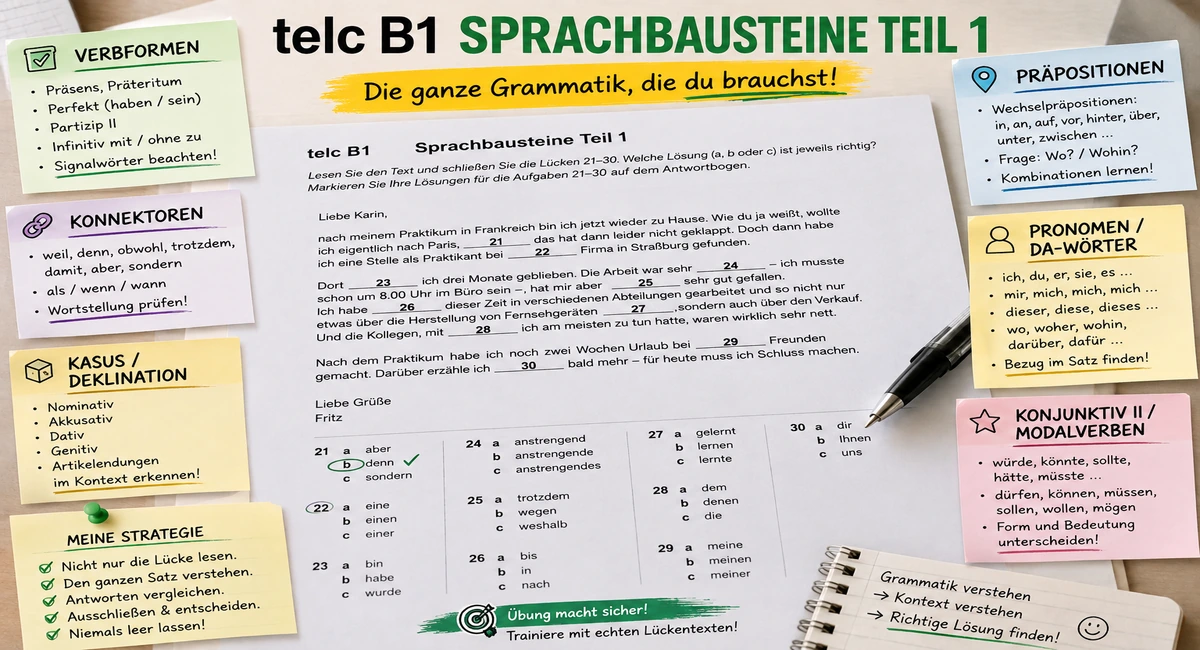
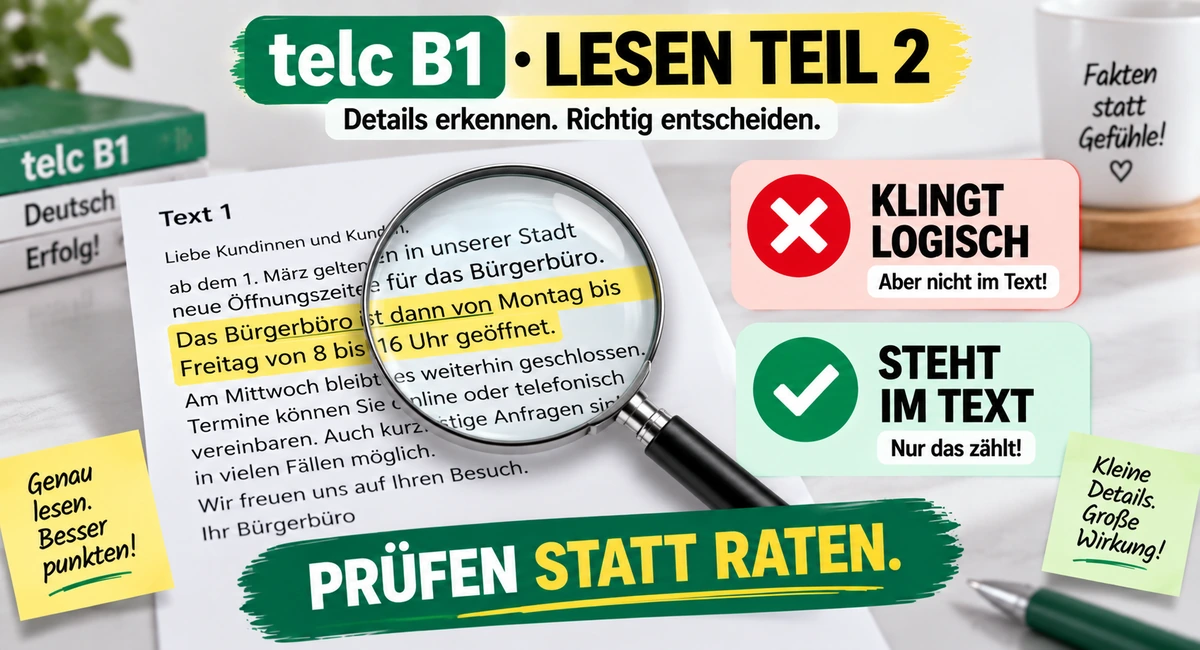
The Sprachbausteine section is part of the written portion of the telc B1 exam. It does not test reading comprehension but specifically tests grammar and vocabulary. Sprachbausteine consists of two parts: Teil 1 and Teil 2. This article is about Teil 2.
In Sprachbausteine Teil 2 you read a short text, usually a letter or an email. Ten words are missing from the text. The gaps are numbered, in the actual exam from 31 to 40. Below the text there is a list of fifteen words, labelled with the letters a to o. Your task is to choose the correct word from this list for each gap.
Important: of the fifteen words, only ten fit. The other five words are extra and do not fit into any gap. These five words are called the Distraktoren or the traps. Each word may only be used once. You do not write anything yourself — you only choose.
Sprachbausteine almost always tests small but important words: Konjunktionen, Präpositionen, Pronomen, verb forms and question words. Exactly these word groups determine the grammar in the sentence. Anyone who has a firm command of these word groups solves Teil 2 quickly and without stress.
| Feature | Sprachbausteine Teil 2 |
|---|---|
| Text type | Short letter or short email with ten gaps |
| Gaps | 10 (in the exam numbers 31 to 40) |
| Choice | 15 words (a to o), of which 10 are correct and 5 are traps |
| Rule | Each word may only be used once |
| What is tested | Grammar and vocabulary (no own sentences) |
| Points | 15 points for Teil 2, i.e. 1.5 points per gap |
Sprachbausteine gives a total of 30 points: 15 points for Teil 1 and 15 points for Teil 2. Each correct gap in Teil 2 is worth 1.5 points. It is therefore worth being confident here, because these points are easy to achieve with good grammar.
👉 Exercises in preparation for the telc B1 examStep by step: how to solve the task correctly
Many learners immediately read only the individual gap and guess. That is a mistake. Sprachbausteine Teil 2 has a clear logic. With a fixed approach you will find the correct words reliably.
Step 1: Read the whole text once
First read the whole letter without filling in the gaps. This way you understand what it is about, who is writing and to whom. This is important because some gaps depend on the meaning of the whole text.
Step 2: Look at the gap carefully
Look at what comes before and after the gap. Ask yourself three questions: is this a main clause or a subordinate clause? Where is the verb? Which type of word does the gap grammatically require — a Konjunktion, a Präposition, a Pronomen or a verb form?
Step 3: Identify the word category
Decide on the word category first, not on the individual word immediately. If you know that a Konjunktion is missing, you only need to choose between a few Konjunktionen. This quickly reduces the number of possibilities.
Step 4: Eliminate the traps
Cross out words that do not fit grammatically. In the end, five words will remain that do not fit into any gap. This is normal and actually a good sign that you have worked correctly.
Solve the easy gaps first — the ones you are sure about. This removes several words from the list. The difficult gaps then automatically become easier because fewer words remain.
The typical traps, tricks and mistakes at a glance
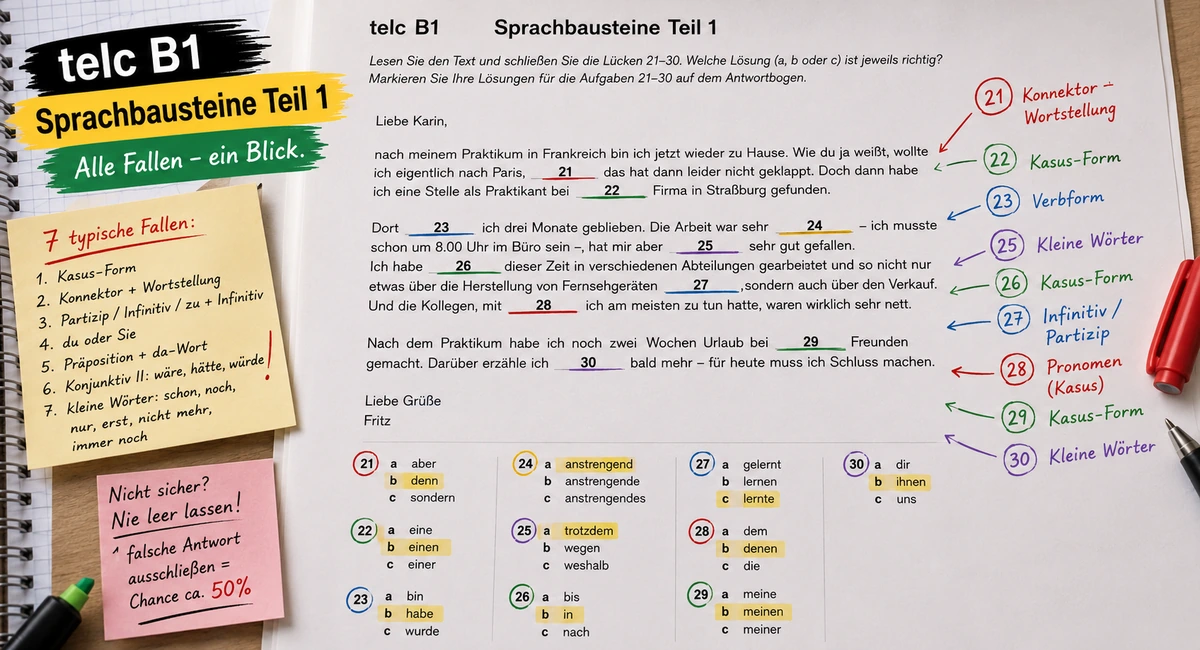
The word list is never random. The authors deliberately place similar words next to each other so that you make mistakes. Those who know the typical traps can avoid them. Here are the most common stumbling blocks from real tasks.
| Trap | What it is about | Example |
|---|---|---|
| Similar words | Two words look almost the same but have a different function | wenn (condition) versus wann (question word) |
| Verb position | Main clause or subordinate clause? The correct Konjunktion depends on this | weil with verb at the end versus denn with normal word order |
| Case trap | Dativ or Akkusativ for the Pronomen | mir (Dativ) versus mich (Akkusativ) |
| Konjunktiv bait | Polite form with Konjunktiv II instead of simple present | hätte, würde, möchte |
| Number trap | Singular or plural for the verb | würde (one person) versus würden (several) |
| Präposition pair | Two Präpositionen with different meanings | seit (ongoing) versus vor (completed) |
| Wrong da-word | Pronominaladverb does not match the verb | darüber informieren versus dafür |
| Register trap | Du-form versus Sie-form in the letter | eure versus Ihre |
| Genus trap | Wrong article or wrong Genus for the noun | das Angebot versus die Anfrage |
| Word repetition bait | A word from the text appears in the list but does not fit the gap | A word looks familiar and tempts you to the wrong place |
The biggest mistake is to look only at the meaning. In Sprachbausteine it is almost always grammar that decides. Therefore, for every gap ask not only what fits, but also why it fits grammatically.
Grammar checklist 1: Konjunktionen, word order and easily confused words
Most gaps in Teil 2 are connecting words. Anyone who understands word order immediately recognises which Konjunktion fits. There are three groups, and each group places the verb differently.
Nebensatz-Konjunktionen — verb at the end
After these words the verb goes right to the end of the sentence. This is the most important identifying feature.
| Word | Function | Example |
|---|---|---|
| weil | gives a reason | Ich schreibe Ihnen, weil ich Lust hätte. |
| dass | states a content or a fact | Mein Lehrer hat gesagt, dass Sie Kurse anbieten. |
| ob | open yes-no question | Ich weiß nicht, ob der Kurs frei ist. |
| wenn | condition or repeated time | Wenn es der Terminkalender erlaubt, fahren wir. |
| damit | states a goal | Ich übe viel, damit ich die Prüfung bestehe. |
| obwohl | contrast | Obwohl es regnet, gehen wir wandern. |
Hauptsatz-Konjunktionen — verb stays in position 2
These words connect two main clauses. They stand in position zero and do not change the word order. The verb stays in position two.
- und, aber, oder, denn, sondern: Wir fahren zwar Ski, aber der Winter ist nicht unsere Sache.
- Remember the pair zwar … aber. It almost always signals a contrast.
Konjunktionaladverbien — position 1 with inversion
These words stand at the beginning of the sentence. After them comes the verb first and then the subject. This is called inversion.
- deshalb, deswegen, daher, darum (consequence): Daher würden wir uns freuen.
- trotzdem (contrast), dann (time), außerdem (addition).
Easily confused words — the most common pairs
| Pair | How to tell them apart |
|---|---|
| wenn / wann | wenn = condition or repeated time. wann = question word asking about time. |
| weil / wenn | weil gives a reason. wenn gives a condition. |
| ob / dass | ob = yes or no is open. dass = the matter is certain. |
| als / wenn | als = once in the past. wenn = repeated or in the future. |
| der, die, das | can be an article, a relative pronoun or a demonstrative. In a relative clause the verb goes to the end. |
Grammar checklist 2: Präpositionen, Pronomen and da-Komposita
The second large group in Teil 2 consists of Präpositionen and Pronomen. Here a single letter often decides between right and wrong.
Temporal Präpositionen — do not confuse seit and vor
- seit = something starts in the past and is still continuing now: Ich lerne seit drei Jahren Deutsch.
- vor = a point in time in the past, completed: Ich war vor drei Jahren in Berlin.
- Tip: if a verb is in the present tense and the action is ongoing, seit almost always fits — not vor.
Fixed verb-Präposition combinations — learn as pairs
Many verbs have a fixed Präposition. This combination must be learnt by heart because it follows no logic.
| Verb with Präposition | Example |
|---|---|
| sich interessieren für | Ich interessiere mich sehr für Ihre Kurse. |
| sich freuen auf / über | Wir freuen uns auf gemeinsame Touren. |
| warten auf | Ich warte auf Ihre Antwort. |
| informieren über | Mein Lehrer hat mich darüber informiert. |
| Antwort auf (noun) | Für Ihre Antwort auf meine Fragen danke ich Ihnen. |
Personal Pronomen — Dativ or Akkusativ
Here you need to know which case the verb requires. This is a very common trap.
| Person | Dativ | Akkusativ |
|---|---|---|
| ich | mir | mich |
| du | dir | dich |
| wir | uns | uns |
| Sie (polite) | Ihnen | Sie |
- Verbs with Dativ: helfen, danken, gefallen, gehören, Spaß machen, antworten. Example: Das macht uns viel Spaß.
- Verbs with Akkusativ: informieren, fragen, brauchen, kennen. Example: Mein Lehrer hat mich informiert.
- Reflexive verbs: sich freuen, sich interessieren, sich entscheiden, sich Sorgen machen. Example: Ich mache mir Sorgen. (here Dativ mir)
Pronominaladverbien — the da-words
For things, not for people, you use da plus Präposition. Which da-word is correct depends on the verb.
- darüber = über das (informieren über → darüber): Er hat mich darüber informiert, dass …
- dafür = für das: Sind die Kosten dafür schon enthalten?
- Further: darauf, daran, damit, davon. Always pay attention to the Präposition of the verb.
Grammar checklist 3: Konjunktiv, Modalverben, verb forms and question words
The last group consists of verb forms and question words. Here the focus is on politeness, on singular and plural and on the correct question word.
Konjunktiv II — the polite form
In letters the Konjunktiv II is often used. It makes wishes and requests polite. These forms are very popular in the list.
- hätte (from haben): Ich hätte noch eine Frage.
- wäre (from sein): Das wäre sehr nett.
- würde (auxiliary verb): Wir würden uns freuen.
- könnte (from können): Könnten Sie mir helfen?
- möchte (from mögen): Ich möchte den Bodensee kennen lernen.
Modalverben — conjugation and end of sentence
The Modalverben are können, müssen, dürfen, sollen, wollen and möchten. The Modalverb stands in position two, the infinitive stands at the end of the sentence.
- Example: Man kann abends mit dem Computer weiterlernen.
- Pay attention to the person: ich kann, wir können; ich möchte, wir möchten.
Subject and verb — singular or plural
The verb always agrees with the subject. A very subtle but common trap.
- One subject in the singular → verb in the singular: er würde, sie möchte.
- One subject in the plural → verb in the plural: die Kollegen sprechen, wir würden.
Question words and quantity words
| Word | Function | Example |
|---|---|---|
| wie viele | asks about a number (countable) | Wie viele Teilnehmer nehmen teil? |
| wie viel | asks about a quantity (uncountable) | Wie viel kostet der Kurs? |
| wie | asks about the manner | Wie läuft der Kurs ab? |
| ein paar | means a few, a fixed expression | Noch ein paar Worte zu uns selbst. |
| zu wenig | not enough | Ich habe zu wenig Gelegenheit zu sprechen. |
| einmal / mal | makes a request friendlier | Rufen Sie uns einfach einmal an. |
Never learn these small words in isolation — always learn them in the whole sentence. This way you memorise the word order and the case at the same time. That is exactly what Sprachbausteine Teil 2 tests.



There are no comments for this article. Leave your comment